

In every ranking that matters for online gambling, California sits at the top. By Blask Index — the measure of aggregated player demand across all operators in a market — the state outpaced every other in the country through 2025. California has no regulated online gambling market. Not a single licensed domestic operator takes a wager there.
The October peak is structural, not coincidental.
The NFL opener, MLB playoffs, and the start of the NBA and NHL schedules converge in a six-week window that has become the calendar’s single most valuable stretch for U.S. iGaming operators. The 21 percent pullback from peak to January is a cooling, not a collapse.
Month-over-month
Blask Index shows the market splitting sharply — with smaller states moving fastest in both directions.
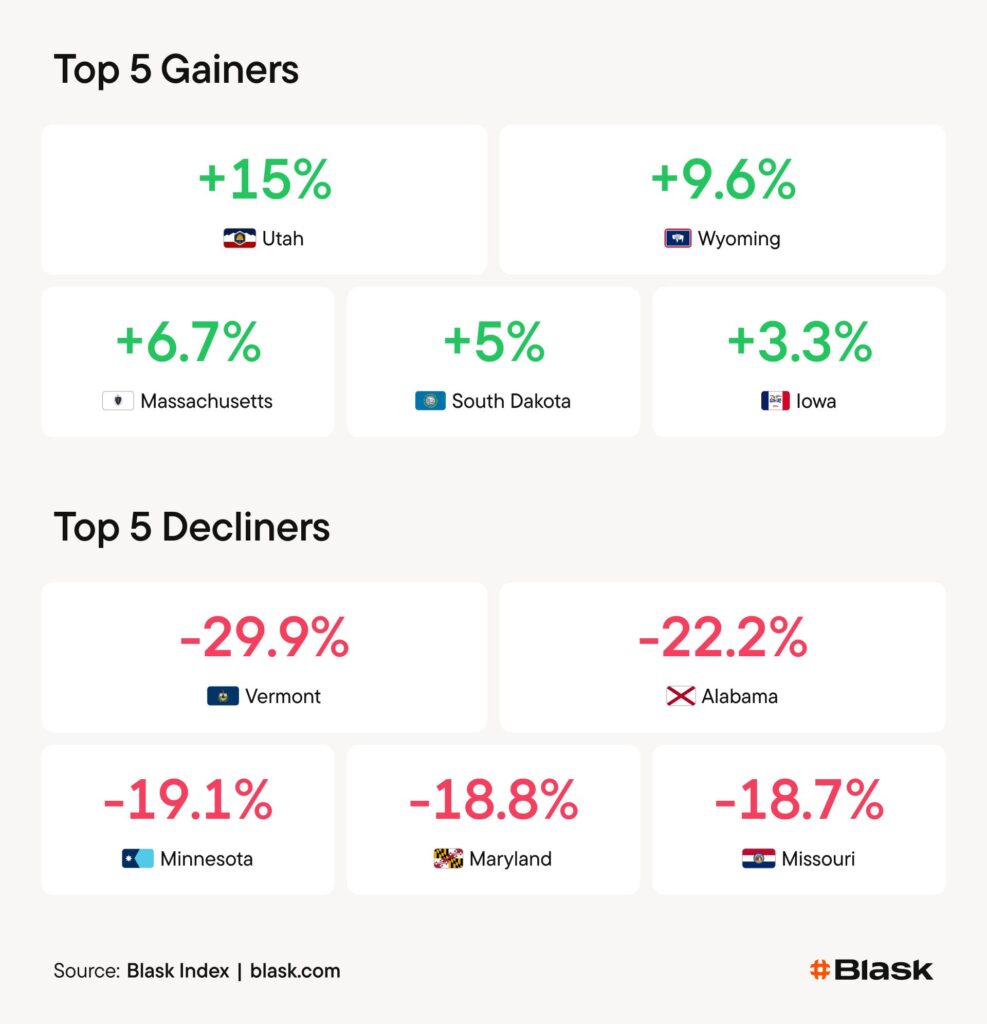
Utah led all gainers at +15 percent. Wyoming added 9.6 percent. Massachusetts, South Dakota, and Iowa rounded out the top five, each posting gains between 3 and 7 percent.
None of the five are major iGaming markets by volume — which is precisely what makes the signal interesting. Demand acceleration in low-base states tends to reflect organic growth rather than the promotional cycles that drive volume in larger, more saturated markets.
The decliners moved harder.
Vermont fell 29.9 percent, Alabama 22.2 percent. Minnesota, Maryland, and Missouri each dropped between 18 and 19 percent. Five states, five double-digit contractions — all in markets without established regulated iGaming frameworks, where demand is diffuse and more exposed to seasonal noise.
For operators allocating acquisition spend, the month-over-month picture matters as much as the annual ranking. A state accelerating from a low base can represent better marginal economics than a large market in compression.