
- Updated:
- Published:
Cash out in betting
Cash out is a sportsbook feature that settles an active bet before the outcome is known, at an amount the operator quotes and can withdraw.
A displayed figure is an offer rather than a right. Operator rules state that availability is not guaranteed, that the quote can move during the processing delay, and that a request can fail outright, so what reaches the account is the amount attached to an accepted request. The conditions deciding acceptance sit in each operator’s own terms.
What cash out is
Cash out closes a wager early in exchange for a payment based on current odds rather than the odds taken at placement. Betfair’s sportsbook rules describe the feature as closing the original bet at the customer’s request, locking in either a profit or a loss, by settling all or a portion of the bet before the event finishes.
The same feature appears as early payout, early settlement or buy out, and those labels carry no standard meaning across operators. Eligibility is set per bet: BCLC’s PlayNow conditions restrict cash out to bets where every selection comes from an eligible market and state that ongoing availability is not guaranteed.
Bonus interaction is contractual too — Betfair blocks cash out on a free-bet wager until the value exceeds that credit, and PlayNow removes bet-back bonus eligibility from any bet cashed out in full or in part.
How the offer is priced
Sportsbooks do not publish the pricing model behind the button, though its structure is visible in the arithmetic.
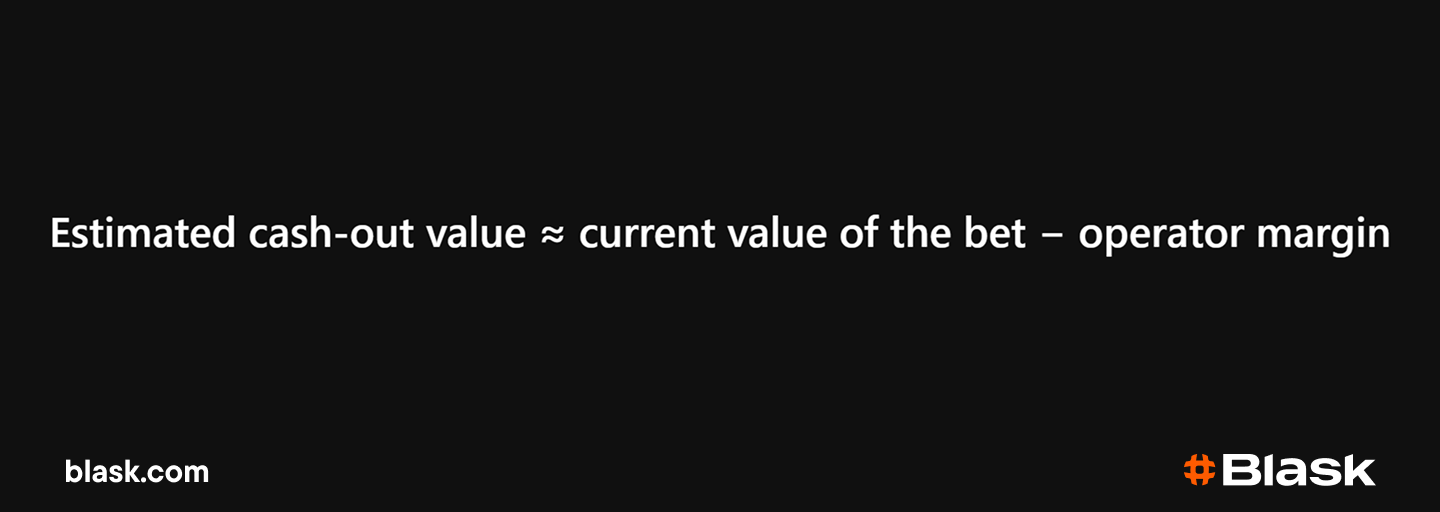
The current value before that margin approximates the potential payout divided by the current decimal odds on the same outcome.
Take a $100 stake at decimal odds of 3.00, carrying a potential payout of $300. If the same outcome later trades at 1.50, the approximate current value is $300 ÷ 1.50 = $200. The figure offered normally sits below that, because the cash-out margin is applied to it, and time remaining, market liquidity and the operator’s exposure move it further.
Full, partial and auto cash out
Three variants appear in operator rulebooks, and they differ in how much of the bet remains exposed once the request succeeds.
| Type | What settles | What stays live | Where it typically fails |
|---|---|---|---|
| Full | The whole wager, at the accepted amount | Nothing — later events do not change the settlement | The price moves or the market suspends during the processing delay |
| Partial | The chosen portion of the wager | The remainder, under the original terms | The same delay and suspension rules, plus any minimum on the amount settled |
| Auto | The whole wager, once the quote reaches a threshold set in advance | Nothing after it triggers | No quote reaches the threshold before the event ends |
Partial cash out splits one bet into a settled part and a live part. Sky Betting & Gaming states that subsequent events affect only the portion not cashed out, while the settled portion returns to the account immediately. Betfair’s rules describe the same division. A bettor who settles half of a $50 stake keeps the other half running to the final result at the original odds.
Auto cash out is a standing instruction rather than a separate transaction. PlayNow defines it as a request on a qualifying bet that settles automatically once the cash-out value reaches or exceeds the threshold the player has set, and states that where cash out is unavailable and does not become available again, the bet settles on the final result. A manual cash out on the same bet removes the auto rule. Execution is not guaranteed even where the price appears to have passed the trigger: Betfair notes that traded volumes on an exchange market can suggest an auto cash out was possible when it did not execute, because other customers matched that volume.
Products sold under adjacent names — two-goal early payout offers, bet insurance, free-bet refunds — are promotions with their own terms rather than a fourth type of cash out.
Why an offer changes or disappears
The quote follows the market, so goals, cards, injuries, settled parlay legs and repricing all move it, and a suspended market removes it. Requests made in-play also take longer to process, because the in-play bet delay applies to them.
Errors are handled separately from price movement. PlayNow voids a cash-out transaction made in error and settles the original bet on the final result at the correct odds. Sky Betting & Gaming reserves the right to suspend or disable the feature at any time, without guaranteeing availability even where it has been advertised for an event. A disappearing offer cancels nothing: the wager stands as placed.
Cash out against hedging
Cash out is a settlement with the operator holding the bet. Hedging is a second wager, usually placed elsewhere, that offsets part of the exposure while the original bet runs to the final result.
The variant chosen changes nothing about that distinction. Full, partial and auto cash out all close some or all of one bet inside one operator’s book at that operator’s price, which is why the comparison point is the quote on the screen rather than the original stake.
What market data covers here, and what it does not
No public dataset records how often bettors accept a cash-out offer; that transaction exists only in operator ledgers. Blask measures search demand for iGaming brands and markets — 5 474 brands across 139 countries in September 2026 — which describes how many separate rulebooks a bettor can encounter rather than how the feature is used inside any of them. Demand moves between those rulebooks as well: UK demand rose 5.3% year on year in H1 2026 while the market’s demand leader changed hands, with William Hill losing 3.5 percentage points of brand share. Blask does not measure cash-out availability, pricing or take-up.
FAQ
What is partial cash out?
Partial cash out settles a chosen portion of a bet and leaves the rest running under the original terms. The settled portion returns immediately and is unaffected by what happens next; the remainder is decided by the final result.
What is auto cash out?
Auto cash out is a rule set in advance on a qualifying bet: when the cash-out value reaches or exceeds the threshold chosen, the bet settles automatically. If no quote reaches that threshold before the event ends, the bet settles on the final result instead.
Is a cash-out offer guaranteed?
No. Operator rules state that availability is not guaranteed and that a request can fail if the market suspends or the price moves while it is being processed. The amount is fixed only once the request has been accepted.
Does cashing out affect a free bet or bonus?
It can, and the treatment is set per operator. Betfair withholds cash out on a free-bet wager until the cash-out value exceeds the free-bet credit, and PlayNow removes bet-back bonus eligibility from bets cashed out in full or in part.
Bottom line
Cash out converts an open position into a settled one at a price the operator controls, and the three variants differ mainly in how much of the bet stays exposed afterwards. Eligibility, processing delays, suspensions, error handling and bonus treatment are written per operator, and that rulebook — rather than the feature itself — decides what a bettor actually receives.