
- Updated:
- Published:
Chargeback (payment dispute / transaction reversal)
An iGaming chargeback reverses a card deposit when a player disputes the transaction through their bank. iGaming Payment Solutions place online casino chargeback rates at 2–4% of transactions — two to eight times above e-commerce — with friendly fraud accounting for 60–70% of disputes. Since April 2026, Visa VAMP tightened the Excessive threshold to 1.5% and fraud-coded 10.4 disputes count twice; this guide covers the lifecycle, reason codes, CE 3.0 representment, prevention layers, and affiliate clawback implications.
What is a chargeback in iGaming
| Chargeback is a consumer protection mechanism that reverses a card payment when a cardholder disputes a transaction through their issuing bank rather than directly with the merchant. |
In iGaming, where card-not-present transactions dominate and player emotions run high after losses, chargebacks represent one of the most significant operational and financial risks an operator faces.
The mechanism was established under the Fair Credit Billing Act to protect consumers from fraudulent charges and billing errors. Each chargeback carries a reason code categorizing the dispute. FinRate calculates the total cost per $100 chargeback at approximately $207 once fees, refunds, and operational time are counted.
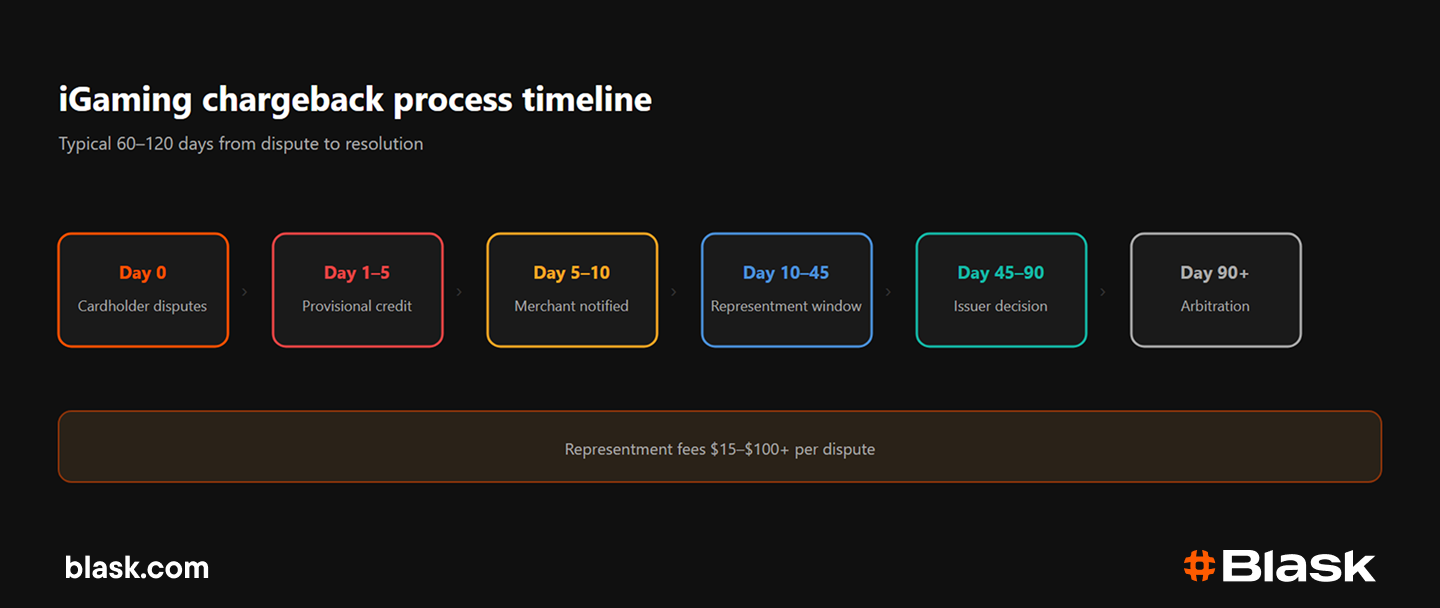
Chargeback process timeline
How the chargeback process works
The chargeback process involves multiple parties and typically spans 60–120 days:
- Dispute initiation. The cardholder contacts their issuing bank to contest a transaction.
- Provisional credit. The issuer credits the cardholder while initiating the formal chargeback.
- Merchant notification. The card network routes the chargeback to the acquirer. Disputed funds are debited immediately.
- Response window. The merchant has 20–45 days to accept the chargeback or submit a representment package with compelling evidence.
- Issuer decision. The issuing bank reviews evidence and decides whether to reverse or uphold the chargeback.
- Arbitration (if contested). Escalation to card network arbitration incurs fees of $250+ for the losing party.
Unlike a standard refund initiated voluntarily by the merchant, a chargeback is cardholder-initiated via the bank. It incurs fees of $15–$100+ per dispute, counts toward monitoring thresholds, and takes 60–120 days to resolve.
Chargeback filing windows. Visa and Mastercard generally allow 120 days from the transaction date. Some fraud claims extend to 540 days, depending on reason code and issuer policy. Operators should retain session and payment evidence for at least 540 days to support representment within these windows.
Common chargeback types in online gambling
| Type | Description | Typical trigger |
| Third-party fraud | Stolen card credentials used without authorization | Fraudster deposits, bets, withdraws before cardholder notices |
| Friendly fraud | Legitimate player disputes a valid deposit after losses | Bet regret; claims “unauthorized” to recover losses |
| Family fraud | Household member gambles without cardholder knowledge | Shared card access |
| Billing descriptor confusion | Player does not recognize charge on statement | Corporate billing name vs brand name |
| Service not rendered | Player claims value was not delivered | Withdrawal delays, account suspension |
iGaming Payment Solutions estimate friendly fraud at 60–70% of iGaming chargebacks. Friendly fraud in iGaming occurs when a legitimate player disputes a valid deposit with their bank after losses, claiming the charge was unauthorized. It clusters around losing sessions, large single deposits, and exhausted accounts, and arrives most often as Visa reason code 10.4. GetBanked places friendly fraud at 40–55% by volume on fraud-coded reason codes.
Chargebacks911 found 83% of enterprise merchants reporting friendly-fraud growth over three years.
Chargeback reason codes operators should know
GetBanked documents the following reason code frequency and representment win rates for iGaming:
| Reason code | Description | Share in iGaming | Representment win rate |
| Visa 10.4 / MC 4853 | Card-not-present fraud | 40–55% | 25–40% |
| Visa 13.1 | Service not rendered | 15–25% | 50–70% |
| Visa 13.6 | Credit not processed | 10–20% | 60–75% |
| Visa 10.5 | Fraud monitoring programme | 5–10% | 20–35% |
| Visa 12.1 | Late presentment | 3–8% | 80–90% |
Visa reason code 10.4 (card-not-present fraud) is the highest-volume category in gambling. Bet-regret disputes arrive fraud-coded because the plausible cardholder story is always unauthorized use, which triggers both a TC40 fraud report and a TC15 dispute. iGaming Payment Solutions explain this double-counting in Visa’s VAMP ratio.
GetBanked shows operators with systematic evidence capture (login records, IP logs, device fingerprints, gameplay history) winning 30–60% of friendly fraud disputes through representment. Without it, win rates drop below 15%.
Chargeback vs refund
| Refund | Chargeback | |
| Initiated by | Merchant | Cardholder via bank |
| Fees | Standard processing only | $15–$100+ per dispute |
| Impact on CB ratio | None | Counts toward VAMP thresholds |
| Resolution time | Days | 60–120 days |
| Reversible by merchant | Final once processed | Representment possible |
Why chargebacks matter for iGaming operators
Financial impact. Operators lose the transaction amount, forfeit associated bonuses, and incur per-dispute fees. FinRate estimates total merchant cost at $3.75–$4.61 for every $1 lost to chargebacks.
Revenue recognition. Disputed transactions create uncertainty in NGR and GGR calculations, complicating affiliate commission true-ups.
Payment processing risk. JustPricing describes Visa’s VAMP (Visa Acquirer Monitoring Program), which consolidated legacy VFMP and VDMP from April 2025, measuring a count-based ratio: fraud reports (TC40) plus disputes (TC15) divided by settled card-not-present transactions (TC05).
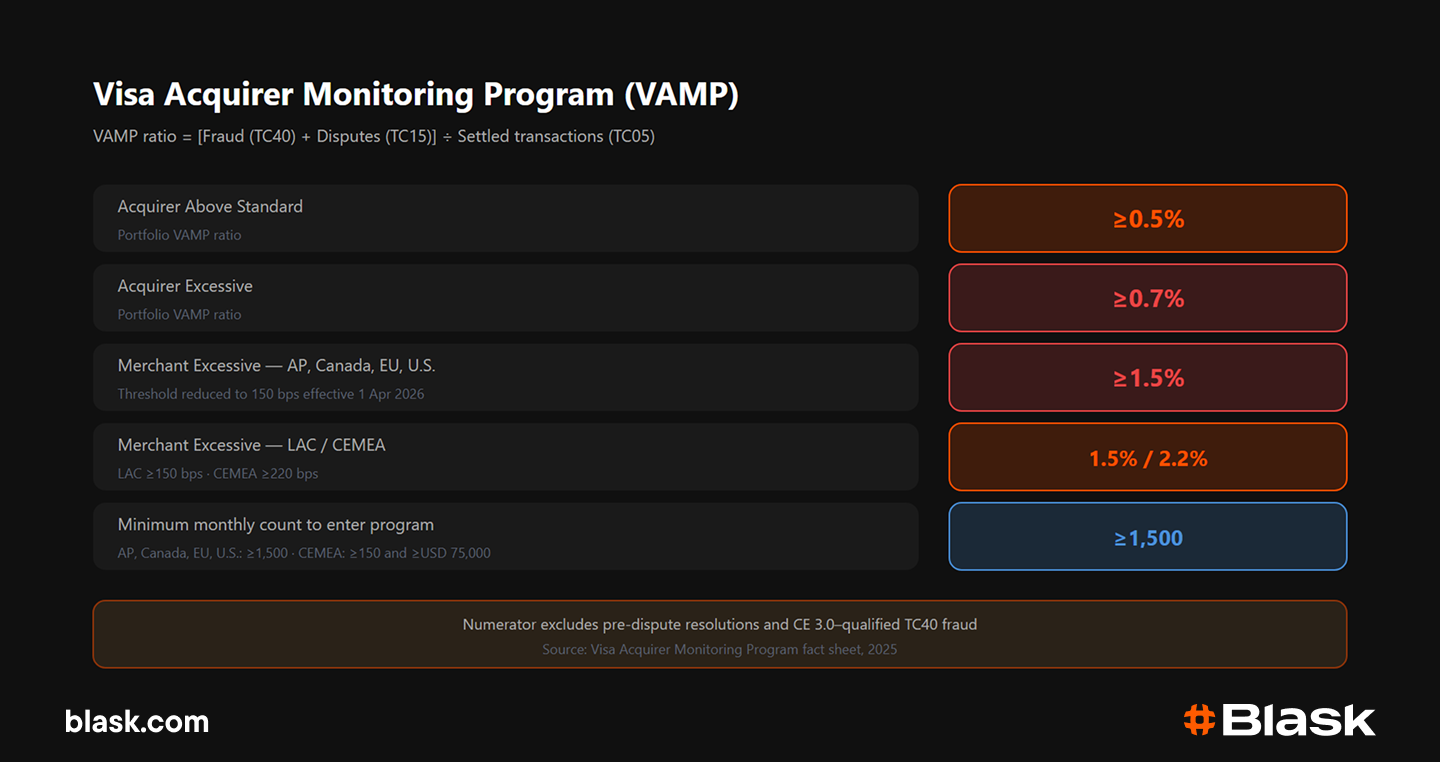
VAMP 2026 thresholds
iGaming Payment Solutions sets the Excessive merchant threshold at 1.5% from April 2026 and note fraud-coded disputes counting twice (~0.75% effective tolerance for 10.4-heavy books). iGaming Payment Solutions place the acquirer Above Standard line at 0.5–0.7%. JustPricing cites $8 per violation at the upper fine tier.
GetBanked reports most specialist acquirers beginning informal review at 0.5% and taking formal action at 0.65%, well below Visa’s published 1.5% merchant line. Safe chargeback ratios for iGaming operators sit below 0.5% for acquirer comfort. Visa’s Excessive merchant threshold is 1.5% under VAMP (April 2026). Operators whose disputes arrive fraud-coded should target an effective tolerance near 0.75%, because each 10.4 dispute contributes two countable items to the ratio.
iGaming Payment Solutions warn that exceeding thresholds can result in fines, rolling reserve increases, and processing termination, with placement on the MATCH list restricting card processing for up to five years.
| ❗️ Affiliate implications and commission clawback. High chargeback rates on specific cohorts indicate traffic quality issues, prompting operators to adjust revenue share or terminate partnerships. Most affiliate agreements include provisions for chargebacks to reduce NGR calculations retroactively. Affiliates driving traffic with elevated chargeback rates may face clawbacks or contract termination. |
Chargeback representment and Visa CE 3.0
Representment is the merchant’s formal response to a chargeback: re-presenting the transaction to the issuing bank with documented evidence that the charge was valid, authorized, and fulfilled per terms.
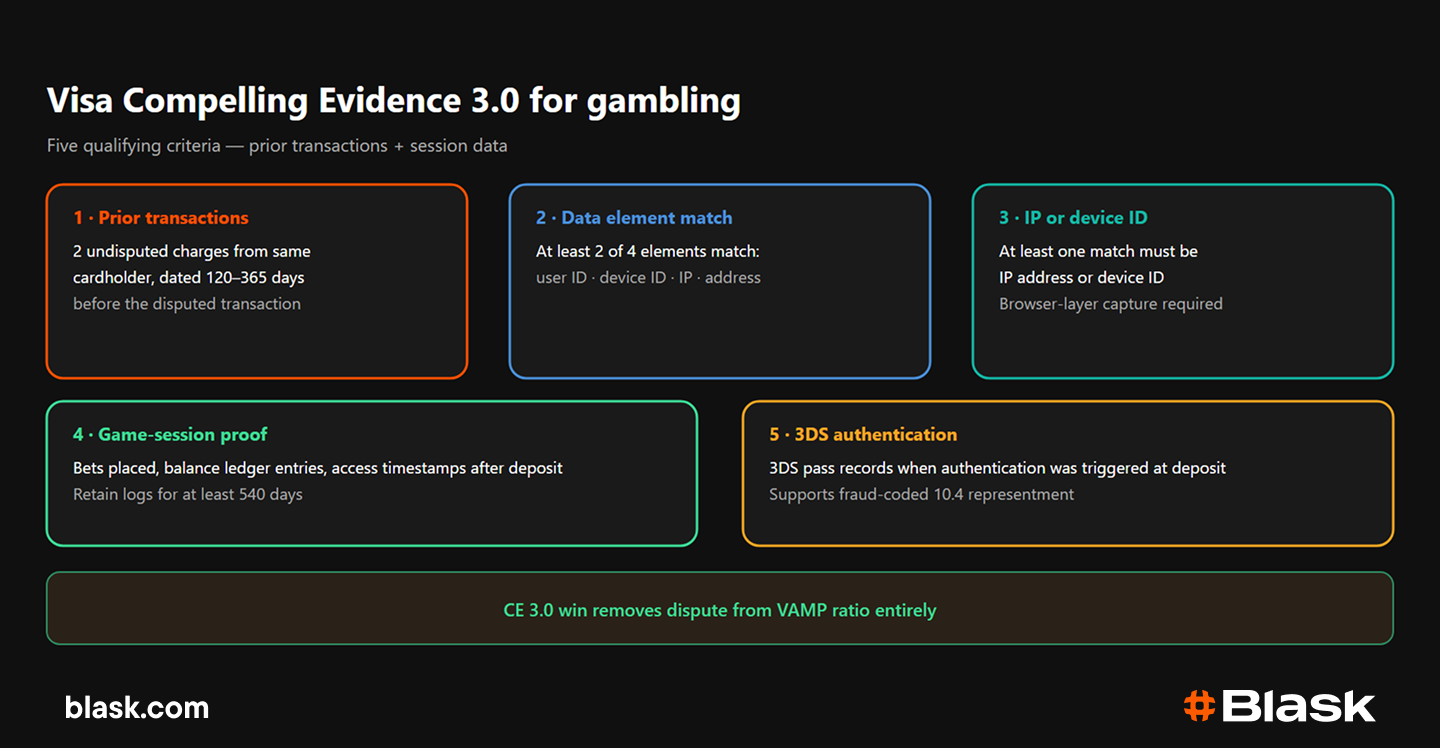
CE 3.0 evidence requirements
Visa Compelling Evidence 3.0 (CE 3.0) changes the economics for gambling operators. To qualify:
- Two prior undisputed transactions from the same cardholder, dated 120–365 days before the disputed charge
- At least two matching data elements from: user/account ID, device ID, IP address, shipping address
- At least one match must be IP address or device ID
- Supporting evidence: game-session logs, wallet ledger entries, 3DS authentication records
JustPricing confirms that when CE 3.0 criteria are met, Visa automatically reverses qualifying chargebacks and excludes CE 3.0 wins from VAMP ratio calculations entirely — Beast Insights reports the same outcome for digital goods and gaming verticals.
Cside stresses that for iGaming, the critical implementation detail is browser-layer capture: device ID and real client IP on every deposit, login, and withdrawal session. KYC data supports the case but does not alone satisfy CE 3.0 mechanics, which require session-level identity continuity.
Cside notes that under VAMP’s count-based math, a single low-value 10.4 dispute still counts as one unit in the numerator, making every eligible CE 3.0 case high-ROI for operators near the 1.5% line.
iGaming Payment Solutions report April 2026 updates extending CE 3.0 to undisputed TC40 fraud reports through Order Insight, allowing operators to remove silent fraud alerts from the VAMP numerator before they escalate to formal disputes.
Evidence strength by dispute narrative
Spinlab Studios maps evidence strength by dispute narrative:
| Dispute narrative | What the player claims | Evidence that tends to win |
| Unauthorized / fraud | “Not my deposit” | 3DS pass records, device continuity, KYC match, post-deposit gameplay |
| Service not delivered | “Paid but got nothing” | Game-session logs, balance ledger, access timestamps |
| Credit not processed | “Refund never arrived” | Refund initiation records, processing timestamps |
Beast Insights shows digital goods and gaming verticals averaging a 41.43% representment win rate when contested, versus ~30% for travel and ~17% for consumer electronics.
Five-layer chargeback defense
Effective chargeback defense runs as a pipeline: block bad deposits, watch the ratio before the acquirer does, intercept disputes pre-dispute, recover where economics justify it, then trace patterns back to traffic quality. Each layer addresses a different failure mode; skipping one leaves the rest compensating for gaps it cannot fix.
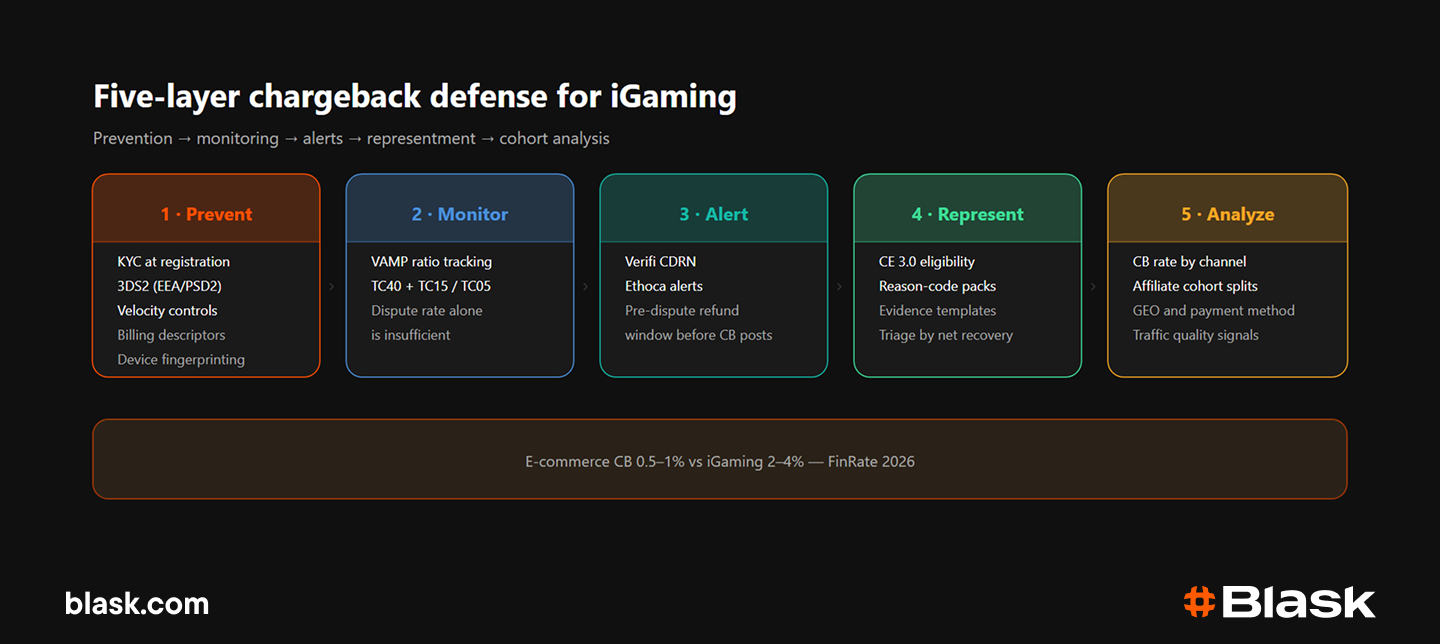
Chargeback defense layers
Layer 1. Prevention
Most chargebacks cost less to block than to dispute. KYC and device fingerprinting at registration and first deposit establish identity before money moves. For EEA cardholders, 3D Secure 2 (3DS2) is mandatory under PSD2; GetBanked reports that properly implemented 3DS2 cuts friendly-fraud chargebacks by 40–60%. Billing descriptor alignment — brand-recognizable statement lines with customer service contact where permitted — removes disputes filed because the player does not recognize the charge. Velocity controls cap single-session deposits and trigger step-up authentication above threshold amounts (e.g., £500 equivalent), slowing bet-regret patterns before they reach the bank.
Layer 2. Monitoring
A low dispute rate alone can mask VAMP exposure. JustPricing warns that merchants tracking only formal chargebacks may appear compliant while sitting in Visa’s Excessive tier, because TC40 fraud alerts count in the ratio even when no TC15 dispute follows. Operators need visibility on both traditional dispute rate and the VAMP ratio — (TC40 + TC15) divided by settled card-not-present transactions — so silent fraud reports surface before the acquirer flags the account.
Layer 3. Pre-dispute alerts
Once a player contacts their bank, the cost clock starts. Alert networks such as Verifi CDRN and Ethoca notify the merchant while the case is still pre-dispute, offering a refund window before the chargeback posts. Resolving the case in that window removes the dispute from the count entirely — a lower-cost exit than representment when the transaction value does not justify a fight.
Layer 4. Representment
When a chargeback lands, recovery depends on triage, not volume. CE 3.0-eligible Visa 10.4 cases should move to the front of the queue; reason-code-specific evidence packs cut assembly time per dispute. The economic filter is net recovery: if evidence-gathering cost exceeds recovery probability multiplied by transaction value, accepting the loss is the rational call.
Layer 5. Cohort analysis
Chargebacks cluster by source, not at random. Segment rates by acquisition channel, affiliate partner, GEO, and payment method — high-chargeback cohorts usually signal traffic quality problems that front-end prevention cannot fix. GetBanked reports withdrawal communication among the highest-ROI operational interventions: automated notifications at each withdrawal stage (requested, under review, processing, dispatched, completed) can cut Visa 13.1 “service not rendered” chargebacks by up to 70% when withdrawals exceed three business days without communication.
Examples of chargebacks in iGaming
Example 1: third-party fraud. A fraudster deposits $500 using stolen card details, places bets, and withdraws $300 before the legitimate cardholder notices. The cardholder files a chargeback. The operator loses the deposit plus fees with minimal recovery chance.
Example 2: friendly fraud after losses. A player deposits $1,000, loses on NFL bets, then files a chargeback claiming unauthorized transactions. Banks often initially side with cardholders, but operators with strong evidence can represent these cases under CE 3.0. The operator submits IP logs, device fingerprints, KYC records, and gameplay history and wins the dispute. Players who file chargebacks on legitimate losses may face account closure and blacklisting.
Example 3: billing descriptor confusion. A casino operating as “XYZ Holdings Ltd” on statements rather than “Lucky Spin Casino”. Players dispute charges they do not recognize. Descriptor alignment prevents a class of disputes that no representment strategy can fully eliminate.
Common pitfalls and challenges
Friendly fraud prevalence. EMS reports first-party fraud accounting for approximately 36% of all reported fraud globally in LexisNexis data, more than doubling from 15% in 2023.
Evidence collection gaps. Many operators lack systematic retention of device fingerprints and gameplay records needed for representment.
Ignoring low-value 10.4 disputes under VAMP. Count-based ratio math means every qualifying case removed via CE 3.0 matters, regardless of dollar value.
Descriptor misalignment. Corporate billing structures produce statement lines players do not recognize.
RDR vs CE 3.0 confusion. iGaming Payment Solutions clarifies that Rapid Dispute Resolution auto-refunds remove the dispute but leave the TC40 fraud record standing, while CE 3.0 removes TC40s from the VAMP numerator.
Tips and best practices
- Strengthen identity verification with document checks and device fingerprinting at first deposit
- Align billing descriptors to brand names; include support contact where permitted
- Deploy fraud detection: AVS, CVV matching, velocity checks, risk-based 3DS
- Implement bonus abuse detection — multi-accounting often precedes chargebacks
- Maintain comprehensive records for at least 540 days: login timestamps, device IDs, IP addresses, gameplay logs
- Enroll in pre-dispute alert services (Verifi, Ethoca)
- Build systematic representment with reason-code-specific evidence templates
- Prioritize every CE 3.0-eligible case when VAMP ratio approaches threshold
Bottom line
Effective chargeback management requires prevention, detection, and response capabilities operating as a single system. With VAMP thresholds tightening to 1.5% in April 2026 and fraud-coded gambling disputes counting twice in the ratio, operators must treat CE 3.0 representment as a compliance tool alongside a revenue recovery mechanism.
Payment processing relationships, regulatory standing, and affiliate partnerships all depend on maintaining ratios below network and acquirer thresholds. For operators and affiliates analyzing market performance, Blask’s Customer Profile feature provides competitive intelligence to contextualize player acquisition quality and identify markets with elevated fraud risk.