
- Updated:
- Published:
Maturity Index measures the split between brand and category search demand
Blask’s new metric shows how iGaming search demand in a market divides between generic exploration and brand-directed queries.
Blask has added Maturity Index to its market intelligence suite. It measures the ratio between two demand layers that Blask tracks: brand-level search demand, measured by Blask Index, and generic category-level demand, measured by Categories Blask Index.
How Maturity Index works
iGaming search demand in any market divides into two types. Generic searches — “online casino,” “sports betting sites,” “casino bonus” — come from users with no operator in mind, still comparing options and discovering operators. Brand-directed searches come from users searching for a specific name.
The ratio between these two types varies between markets. Maturity Index compares total category-level demand against total brand-level demand within a GEO and maps the result to a scale of 0 to 100 (0 — all brand search, 100 — all category search, 50 — equal split).
A higher score means category search makes up a larger share of demand relative to brand search: users are searching for a product type, not a specific operator. A lower score means brand-directed searches dominate: users are searching for operator names rather than product categories.
“Blask Index and its Categories each represent different levels of consumer awareness. Maturity Index is the ratio between them—a single number that shows how brand-directed and category-driven search demands balance out within a given market”.
Ilya Batcherikov Chief Product Officer at Blask
Comparing markets between each other and over time
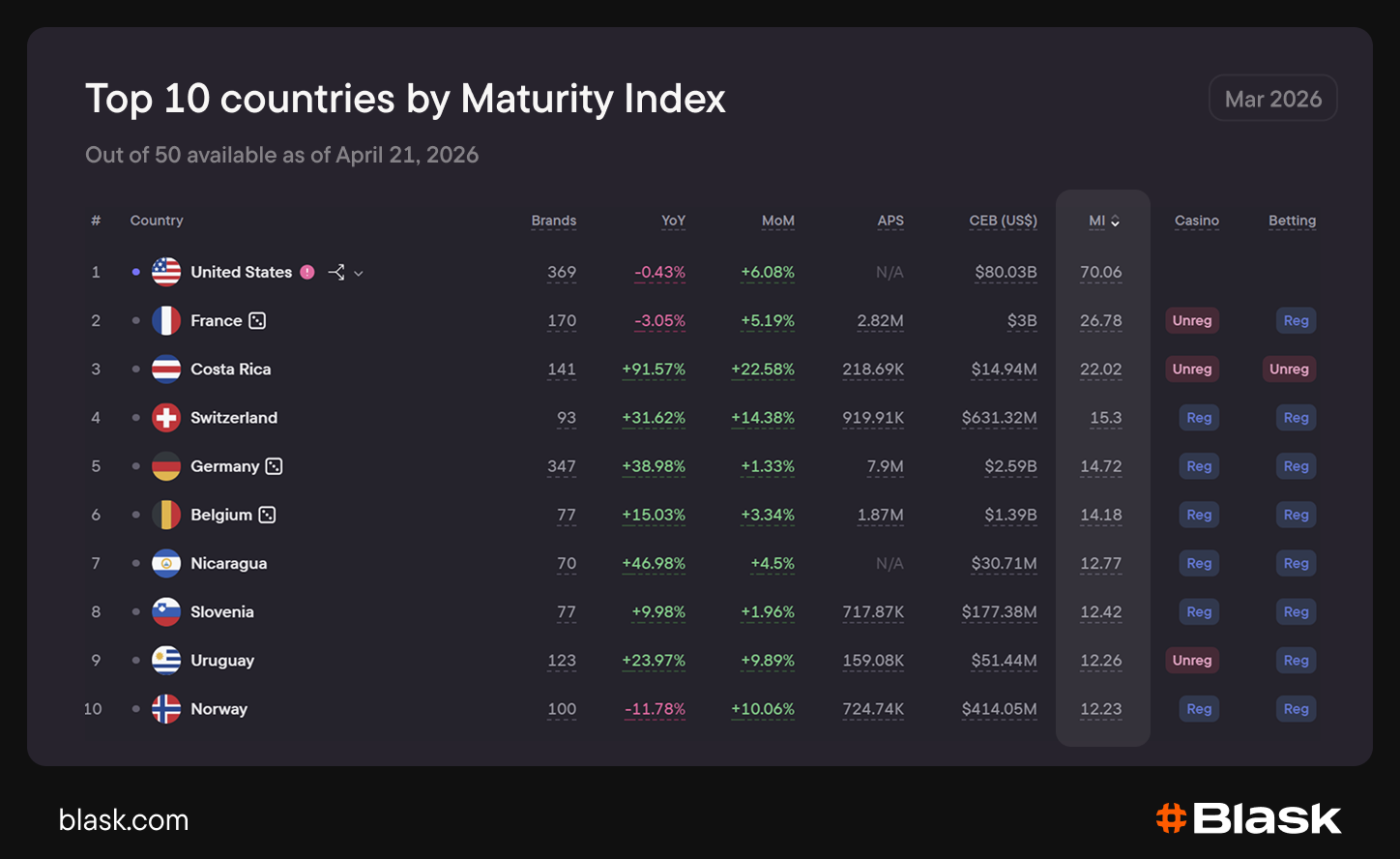
Maturity Index scores are directly comparable between markets and within regions. For example, in Latin America, Costa Rica currently scores 22.02, while Brazil – 1.99 and Peru – 0.60. It means that in Costa Rica, a larger share of iGaming search is still generic and category-driven, compared to Brazil and Peru, where brand-directed searches dominate.
The spread is just as wide in Europe. France’s Maturity Index is 26.78 — a large share of iGaming search there is generic and category-driven. The UK scores 7.62, Germany 14.72, Spain 5.67 — in all three, brand-directed searches make up the vast majority of demand.
“The metric is most useful for teams making market-entry and budget decisions: which countries to prioritise based on how demand is structured, whether to lead with brand spend or category and SEO investment, how large a budget category competition actually requires, and how fast the balance between brand and category search is shifting over time”.
Ilya Batcherikov Chief Product Officer at Blask
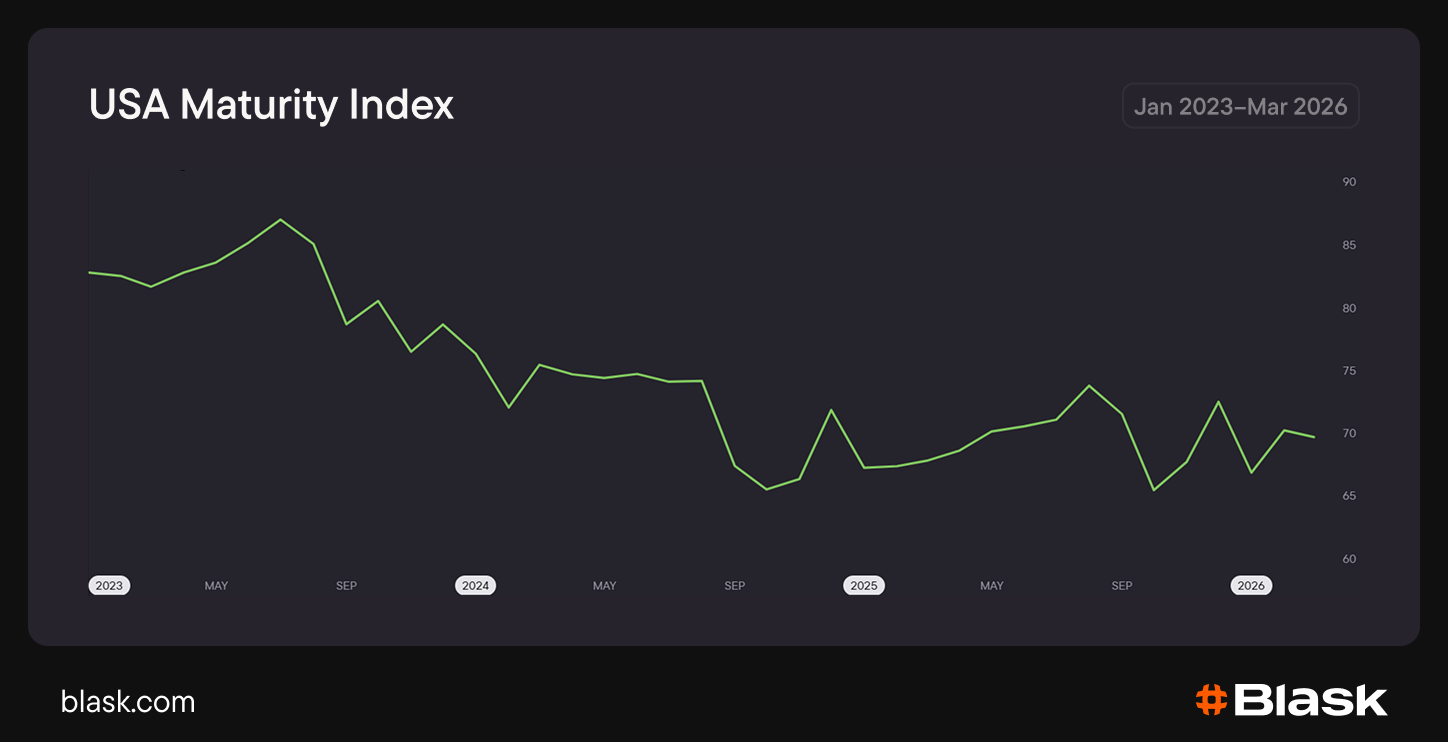
The Maturity Index shifts over time. For example, in the US it peaked at 87.36 in July 2023 and has been declining since. In March 2026 it was 70.06. The falling score reflects brand-directed searches growing as a share of total iGaming demand — a pattern visible in the data as the market expanded.
Bottom line
Two markets can show similar total demand and completely different Maturity Index scores. The metric shows not just how big a market is, but how its users search — and that determines which acquisition channels actually find volume there.