- Updated:
- Published:
Inside Colorado’s $2.1B betting market: crypto casinos are closing on the licensed leaders

Colorado ranks 14th among US states by CEB. Sports-only regulation shapes a competitive market where offshore casino brands fill a gap the law doesn’t close.
Colorado’s online gambling market runs on a single product category: sports betting. The state legalized it in November 2019 and the market launched in May 2020. According to Blask data for the period April 2024 – March 2025, Colorado generated a CEB (Competitive Earning Baseline, estimated revenue) of approximately $2.1B. That places it 14th among all US markets.
Betting happens almost entirely online. In October 2025, Colorado players wagered $680.5M, with retail sportsbooks accounting for less than $4.2M of that — under 1% of total handle. The regulatory architecture drives this: the state issues licenses to operators that partner with local casinos, each casino allowed one online skin.
What Colorado doesn’t have is online casino gaming. That absence shapes everything downstream — from which brands lead the market to what offshore operators are actually selling.
Licensing: sports betting only
Online casino gaming is explicitly illegal in Colorado. The first legal sportsbooks went live on May 1, 2020 — DraftKings, FanDuel, and BetMGM among them.
Licensing is accessible in principle: operators apply through the Colorado Division of Gaming and attach to a local casino’s license. In practice, the roster has stabilized. The same 13 platforms have held licenses for an extended period with minimal new entrants.
The state legislature is currently working through Senate Bill 131, a broader sports betting reform measure. In April 2026, legislators voted down a proposed ban on proposition bets, citing an estimated $2.4M in lost tax revenue and the risk of pushing bettors offshore.
No legislation to authorize iGaming is moving through the Colorado General Assembly at this point.
Blask Index: flat baseline, seasonal spike
Colorado’s Blask Index over the last 12 months shows a market with a defined seasonal pattern and limited structural growth outside of it.
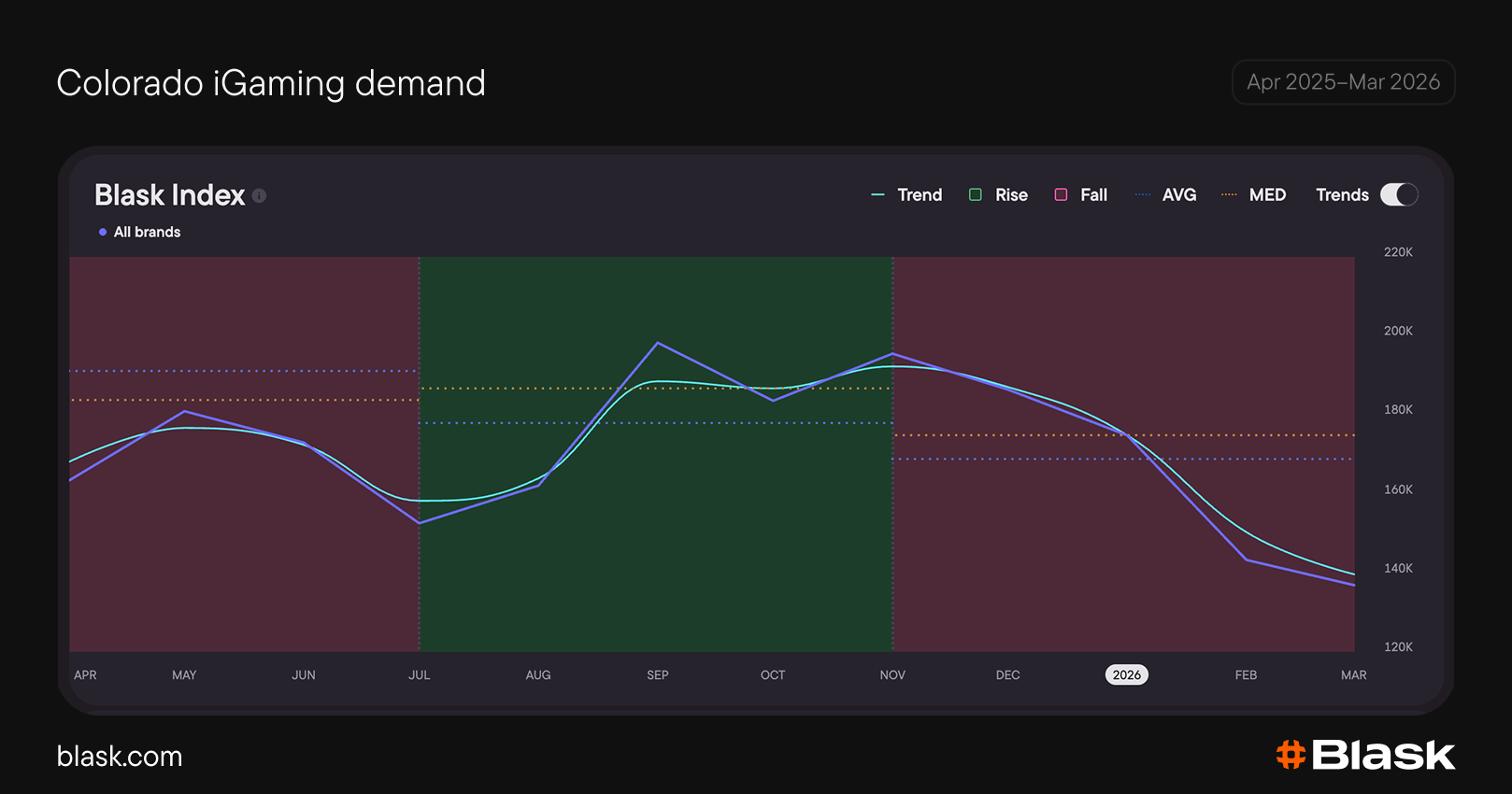
From April through August 2024, demand held steady in a relatively narrow band — in line with what you’d expect from a market without major sporting events driving volume. The September 2024 jump was sharp and immediate: the NFL season opened, and search demand for sports betting brands in Colorado climbed roughly 45% above the summer baseline in a single month. October and November held near the same elevated level.
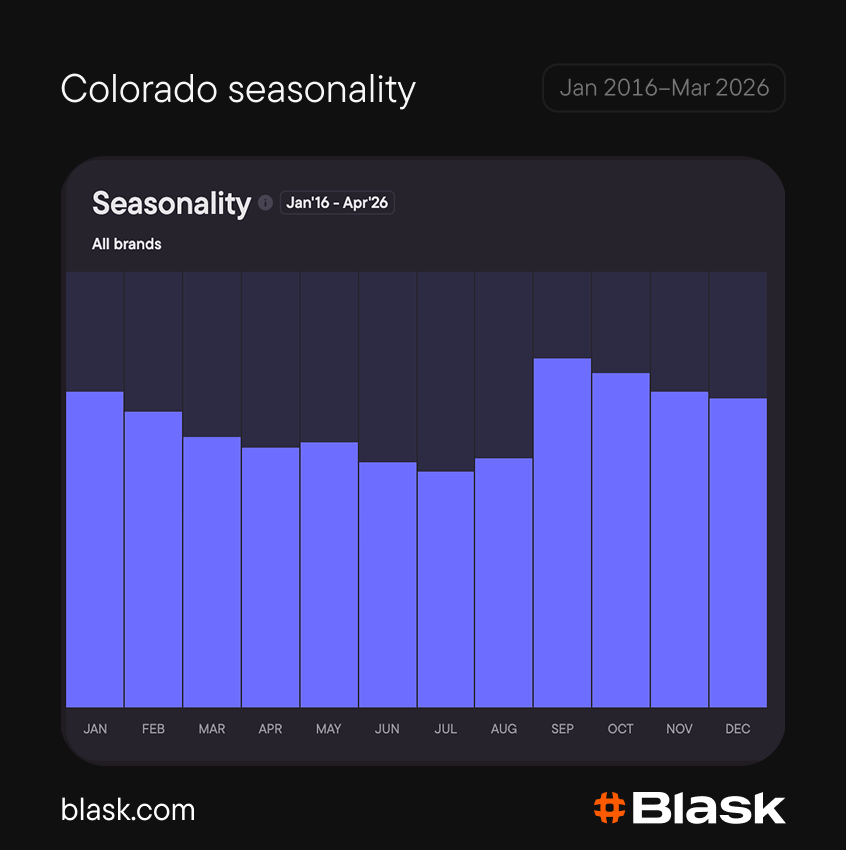
That pattern isn’t new. Blask’s seasonality data covering 2016–2026 shows the same dynamic repeating annually: a demand floor in summer, a hard spike in September as football returns, and a gradual taper through winter. Colorado’s market follows the NFL calendar more closely than almost any other seasonal variable.
Top 10 brands: licensed sportsbooks and offshore casinos
The competitive structure of Colorado’s market reflects the licensing gap directly. Over the last 12 months (April 2025 – March 2026), the top three — DraftKings, Bet365, FanDuel — hold Colorado licenses and operate exclusively in sports betting. BetMGM at tenth is the same: licensed, sports-only. Between them sit six offshore operators. Every one of them offers casino products that are unavailable from licensed platforms in Colorado.
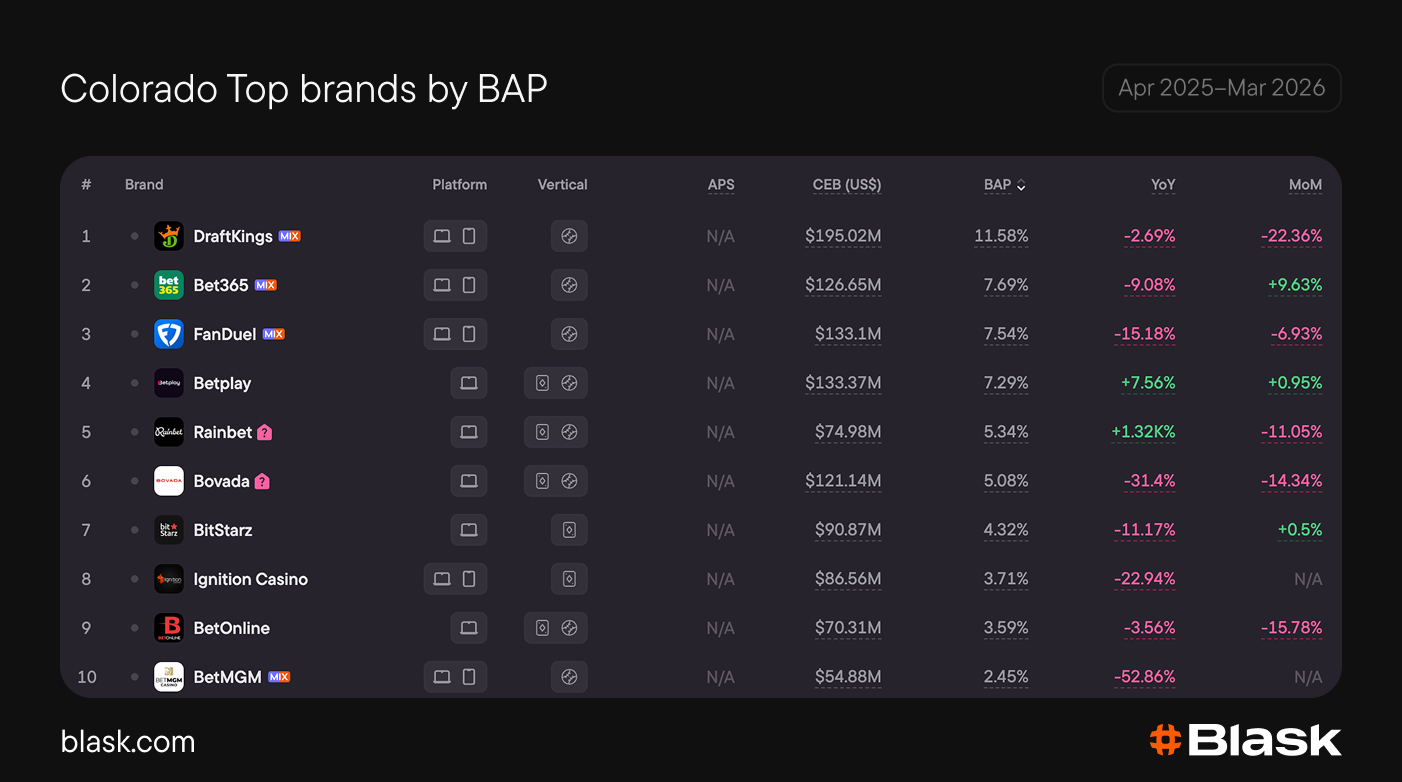
This isn’t coincidental. Players who want slots, live dealer games, or table games have no licensed option. Offshore brands — Betplay, Rainbet, Bovada, BitStarz, Ignition Casino, BetOnline — exist in Colorado’s top 10 precisely because they fill that product gap. Their combined BAP share of roughly 29% represents demand that licensed operators can’t capture under current law.
BAP dynamics: BitStarz and Rainbet rise
The competitive picture shifted notably between April 2025 and March 2026.
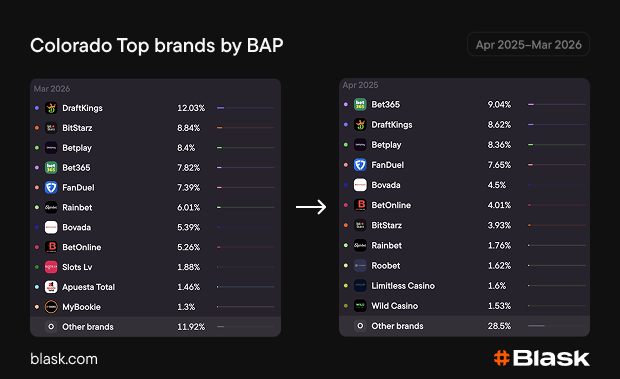
The leaderboard flipped. DraftKings took the top spot from Bet365, which slid to fourth. The licensed tier overall softened its grip on demand.
Crypto casinos made the biggest move. BitStarz jumped from seventh to second, and Rainbet climbed into the top six — both operate without a Colorado license and focus entirely on casino and slots, categories with no licensed competition in the state.
The market is fragmented, with no dominant player. The leader holds just over 12% of demand, and the next four brands sit within a few points of each other. Demand is spread across licensed sportsbooks and offshore casinos roughly in equal measure — a direct reflection of a regulation that covers only half of what players are looking for.
Bottom line
Colorado is a mid-sized, mature sports betting market with a structural constraint built into its regulation. The law created a competitive licensed sports betting tier — DraftKings, Bet365, FanDuel, BetMGM hold stable positions — but left online casino demand unaddressed. Offshore crypto casinos have moved into that gap fastest: BitStarz and Rainbet both climbed into the top six in under a year, and together with Betplay, Bovada, and BetOnline they now account for a significant share of demand.
There’s no current legislation moving toward online casino licensing in Colorado — which means offshore operators will continue to serve a portion of the market that licensed platforms can’t legally touch.