
- Updated:
- Published:
What is a casino product analyst
Casino product analyst turns behavioral and transactional platform data into product decisions — lobby design, onboarding, payment UX, and experiment-backed roadmap choices that move retention, conversion, and GGR. Operators at FanDuel hire analysts specifically for casino verticals, alongside Hard Rock Digital and bet365.
This guide covers role definition, workflow, KPIs, tools, salary bands, and how the job differs from business analysts, data analysts, and CRM.
What is a casino product analyst
| A casino product analyst is a data specialist embedded in an online casino operation who translates behavioral and transactional platform data into product decisions. The role sits at the intersection of data science and product management: analysts work alongside product managers, engineers, CRM teams, and BI developers to measure how features, game content, and player journeys perform, and what should change in the roadmap. |
As online casinos have grown in complexity, operators increasingly separate product analytics from generic business intelligence. A casino product analyst focuses on the product layer specifically: how design and content choices drive player retention, session length, conversion, and revenue per user.
Mid-size operators now carry 3,000–10,000 game titles from dozens of providers. Without a dedicated product analytics function, event data accumulates in warehouses without informing lobby design, onboarding flows, or payment UX. The casino product analyst closes that loop.
Role comparison
Why casino product analysts matter in iGaming
Player acquisition costs in competitive markets regularly exceed $500 per first-time depositor (FTD). Product decisions made after registration — lobby layout, game discovery, bonus presentation, payment friction — determine whether that spend converts into lifetime value or churn within the first week.
iGamingJobs reports that analysts tied to revenue levers (LTV modeling, churn prediction, bonus profitability) out-earn reporting-focused roles by a wide margin. Operators pay for domain knowledge: understanding bonus wagering mechanics, game volatility, and responsible gambling signals makes an analyst productive from week one.
The role also supports regulatory compliance. In licensed markets, operators are expected to demonstrate data-driven responsible gambling monitoring. Behavioral anomaly detection — session frequency spikes, rapid deposit escalation — increasingly falls within the product analyst’s scope alongside commercial KPIs.
Key responsibilities and daily workflow
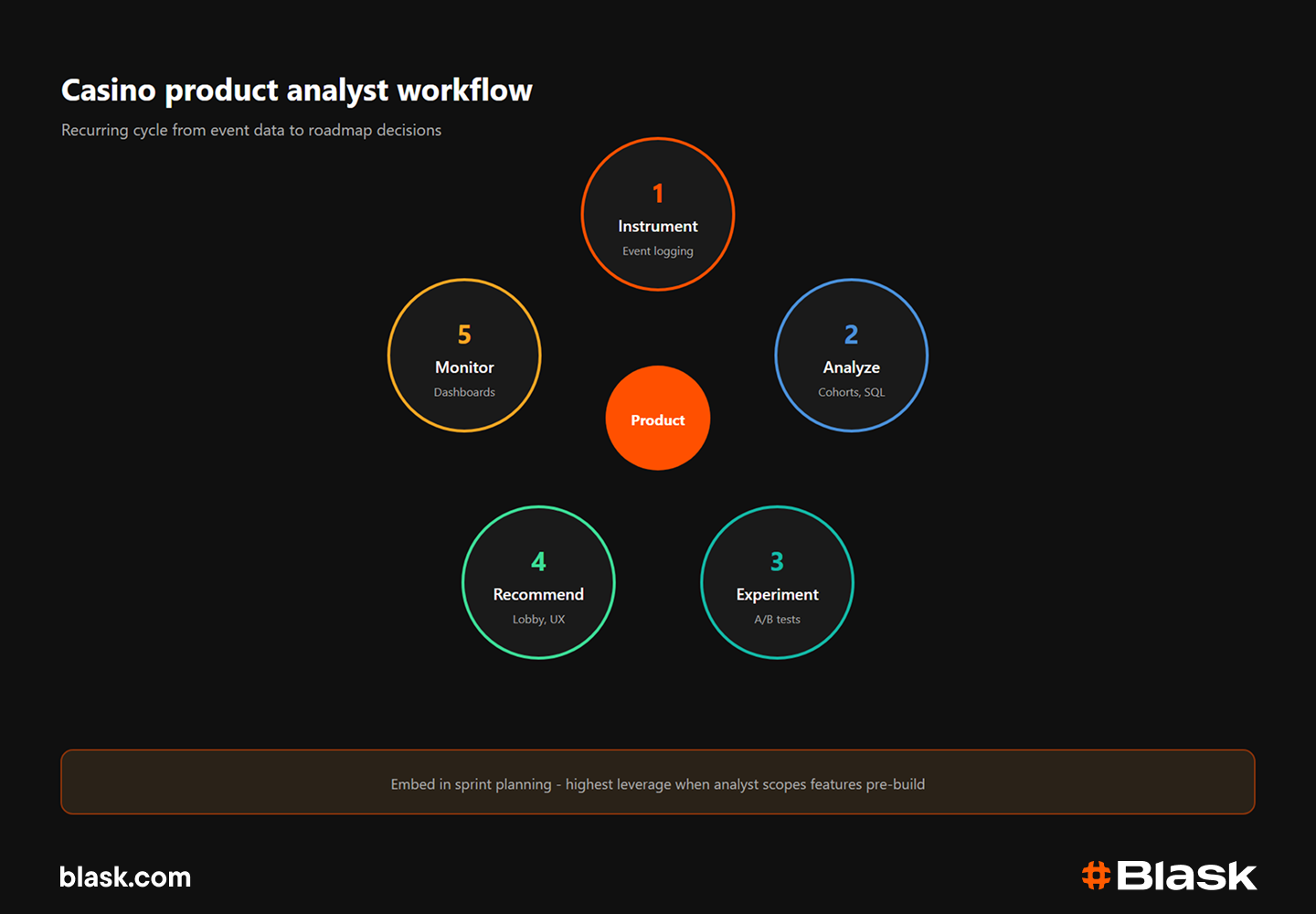
The analyst’s workflow follows a recurring cycle across four core activities, with monitoring closing the loop back to instrumentation.
Analyst workflow cycle
Behavioral analysis and cohort tracking
Using SQL against internal data warehouses (Snowflake, BigQuery, Databricks), the analyst extracts event-level data and patterns player behavior. Cohort analysis is the primary method: players grouped by registration date, acquisition channel, geography, or device, then tracked at defined intervals on ARPU, ARPPU, deposit frequency, and churn rate.
Hard Rock Digital requires product analysts to connect Amplitude behavioral data with Snowflake revenue outcomes so lobby decisions are grounded in proven GGR and retention impact, not click counts alone.
Experimentation
The analyst designs, runs, and interprets A/B tests on lobby rearrangements, bonus formats, onboarding steps, and payment flow simplifications. Statistical significance and incremental GGR impact frame every recommendation. Direcstaff notes that online casino product analysts typically work in Python or R alongside SQL and design controlled experiments at a rigor level land-based analytics teams rarely match, because traffic volume supports statistically meaningful tests.
KPI monitoring
Dashboards in Tableau, Power BI, or Metabase expose product KPIs in near real time and surface anomalies before they compound. Core metrics include GGR, NGR, FTD, funnel conversion rate, session length, Day-7 and Day-30 retention, and player lifetime value (LTV).
Stakeholder communication
Findings are delivered as concrete product actions — lobby changes, segmentation rules, UX adjustments — supported by data and projected impact. The analyst participates in sprint planning and design reviews to embed evidence-based decision-making into the product development process.
Core KPIs for casino product analysts
The iGaming Dictionary defines product KPIs through acquisition–activation–retention–revenue frameworks (AARRR), adapted for real-money wagering. The table below maps the metrics product analysts own versus those owned by CRM or finance.
KPI framework
| KPI | Definition | Product decision it informs |
| FTD conversion | Registration → first deposit | Onboarding and payment UX |
| D7 / D30 retention | Cohort return rate at day 7 and 30 | Lobby fit, game mix, bonus design |
| ARPU / ARPPU | Revenue per user / per paying user | Monetisation depth vs conversion gap |
| Session length | Average play time per visit | Engagement quality (watch RG profiles) |
| Lobby CTR | Game discovery click-through | Content placement and provider mix |
| GGR / NGR | Gross and net gaming revenue | Commercial outcome of product changes |
| LTV | Cumulative cohort revenue | Payback period vs CPA |
| ❗️ Survivorship bias warning: measuring revenue only on active players overstates average performance. Casino product analysts must report on full cohorts, including churned players. Reporting ARPU and ARPPU side by side surfaces conversion efficiency: a wide gap indicates a small paying minority subsidizing the average, which changes the optimization priority. |
Tools and tech stack
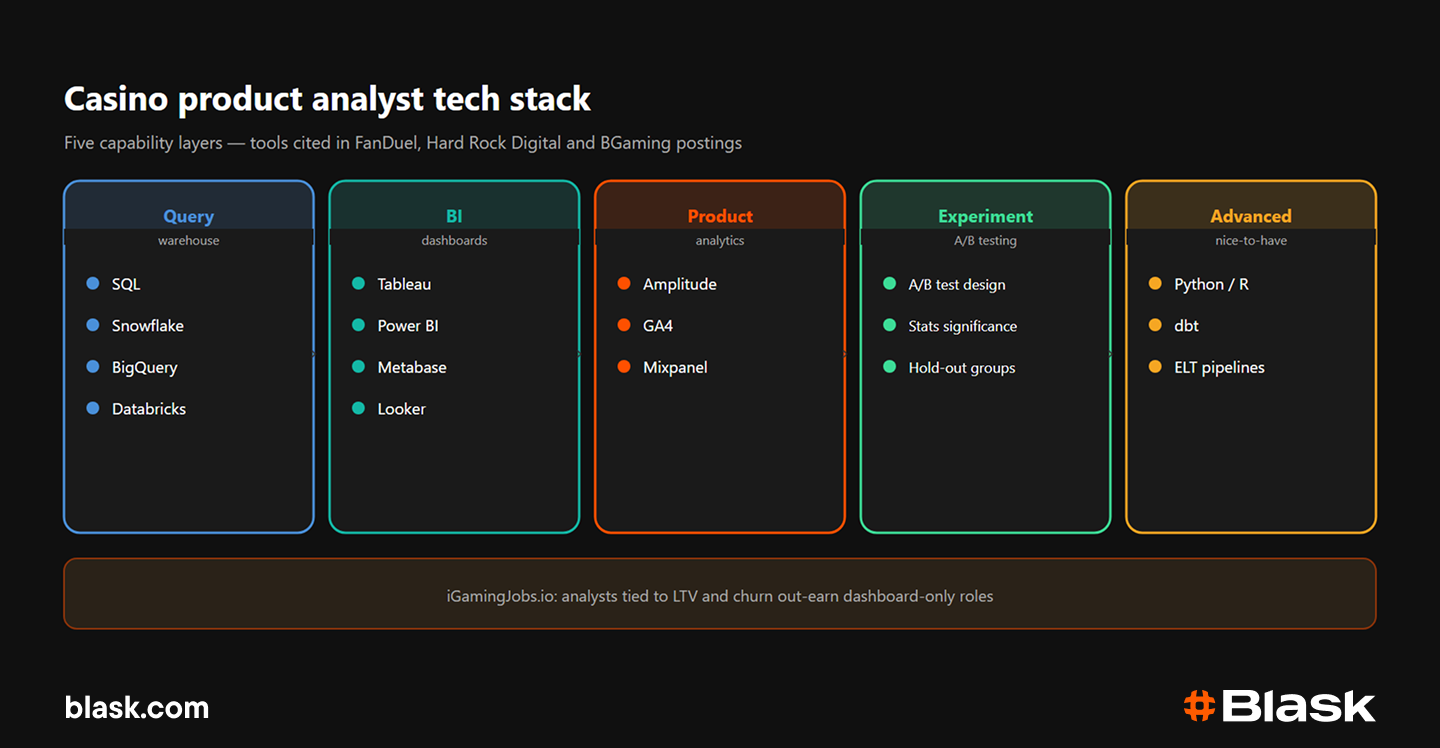
Core casino product analyst skills across major operators include advanced SQL, proficiency in at least one BI tool (Tableau, Power BI, Metabase), statistical methods for A/B testing, and increasingly Python. Domain knowledge in iGaming mechanics, bonus structures, and game volatility differentiates candidates; most roles require 2–5 years of product or analytics experience, with iGaming-specific background often preferred at regulated operators.
- Query layer. advanced SQL against Snowflake, BigQuery, or Databricks;
- BI. Tableau, Power BI, Metabase, or Looker for operational dashboards;
- Product analytics. Amplitude, GA4, or Mixpanel for event funnels and retention;
- Experimentation. A/B test design, hold-out groups, minimum sample size governance;
- Advanced. Python/R, dbt, and ELT pipelines (increasingly expected at senior level).
FanDuel lists familiarity with Amplitude, Databricks, and dbt as highly desirable. BGaming expects 3+ years of product analyst experience with hands-on A/B testing and statistical literacy.
Tech stack of casino product analysts
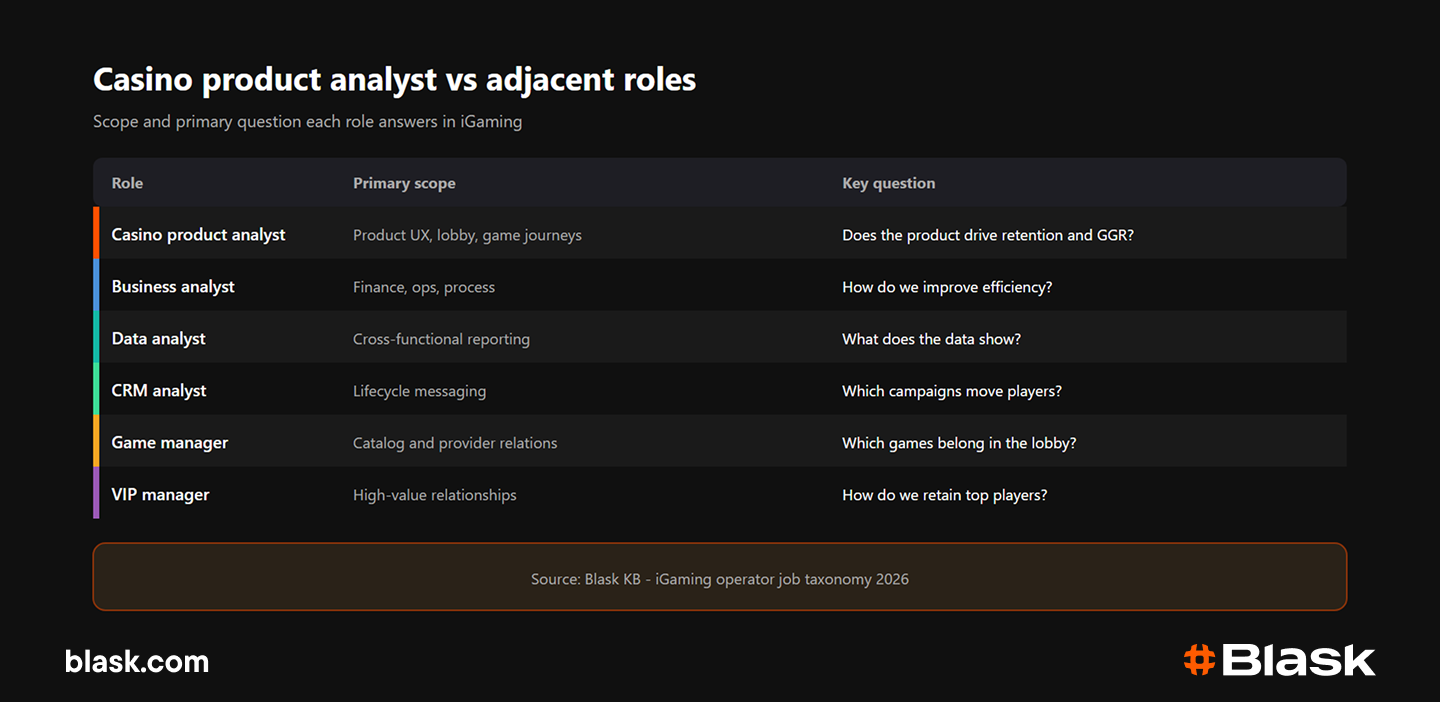
Casino product analyst vs adjacent roles
| Role | Primary scope | Core focus |
| Casino product analyst | Product UX, lobby, journeys | Retention and GGR impact |
| Business analyst | Finance, ops, process | Process and efficiency improvement |
| Data analyst | Cross-functional reporting | Cross-functional data reporting |
| CRM analyst | Lifecycle messaging | Campaign and lifecycle performance |
| Game manager | Catalog and provider relations | Game catalog and lobby curation |
| VIP manager | High-value relationships | High-value player retention |
A business analyst typically spans finance, operations, and marketing and focuses on process improvement and requirements definition. A casino product analyst vs business analyst comparison comes down to scope: the product analyst owns the digital product layer, using behavioral data and experimentation to evaluate how features perform and what should change in the roadmap. A data analyst may serve multiple departments with cross-functional reporting; the casino product analyst goes deeper on player journeys, funnels, and product KPIs within one vertical.
Examples of casino product analyst work
Lobby volatility experiment. An analyst observes that the game volatility profile of the top lobby row correlates with early churn among new registrations. After running an A/B test surfacing low-volatility titles to first-week users, Day-7 retention improves. The finding is incorporated into the default lobby configuration for the new-user segment.
RTP and engagement audit. Working with the game content team, an analyst segments the catalog by RTP band and maps it against session frequency and player tenure. The analysis identifies that a subset of mid-RTP games drives disproportionate repeat sessions in the 30–60 day cohort, informing promotional placement and content acquisition priorities.
Payment funnel diagnosis. The analyst identifies a significant drop-off between deposit page load and completed payment on mobile. Engineering traces the issue to a payment provider timeout. Resolving it produces a measurable lift in FTD within two weeks — an outcome traceable directly to the analyst’s funnel instrumentation.
Salary and career path (2025–2026)
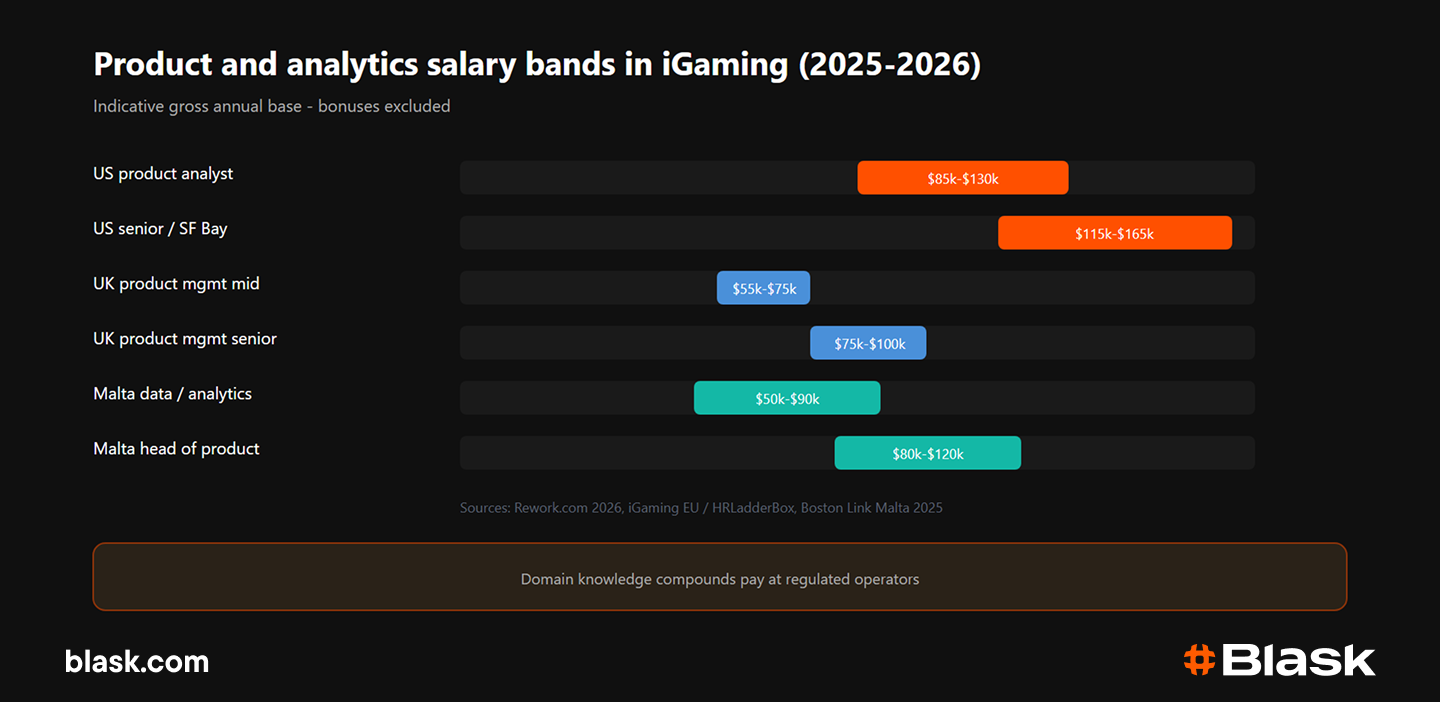
Casino product analyst salary varies by market, seniority, and whether the role sits at an operator or supplier. US base ranges cluster at $85,000–$130,000; senior roles in major hubs such as San Francisco exceed $165,000 in total compensation. European bands differ: UK product mid-level £55,000–£75,000; Malta data and analytics roles €50,000–€90,000. Figures below are indicative gross annual base; bonuses and equity excluded.
Indicative gross annual base bands:
Salary bands
Rework cites US product analyst base at $85,000–$130,000 and senior SF Bay Area at $115,000–$165,000. The iGaming EU / HRLadderBox reports UK product management mid at £55,000–£75,000 and senior at £75,000–£100,000+. Boston Link Malta places Malta data/analytics at €50,000–€90,000 and head of product (operator) at €80,000–€120,000.
| Market / level | Indicative base range |
| US product analyst | $85,000–$130,000 |
| US senior (SF Bay Area) | $115,000–$165,000 |
| UK product management (mid) | £55,000–£75,000 |
| UK product management (senior) | £75,000–£100,000+ |
| Malta data / analytics | €50,000–€90,000 |
| Malta head of product (operator) | €80,000–€120,000 |
Career paths typically run from junior analyst or BI developer into product analyst, then senior product analyst, analytics lead, and head of product analytics. iGamingJobs ranks iGaming data roles among the most remote-friendly in the industry.
In some regulated jurisdictions, a casino product analyst accessing sensitive player and financial data may need a personal gaming license issued by the relevant authority (UKGC, US state gaming commissions). Operators typically guide new hires through the application process as part of onboarding.
Common pitfalls and challenges
Lack of iGaming domain knowledge. Analysts without casino-specific context misread metrics. High session length may indicate problem gambling behavior in certain profiles — a distinction with compliance implications.
Survivorship bias in cohort reporting. Measuring revenue metrics only on active players overstates average performance. Always report on full cohorts.
Confounded experiments. Running multiple product changes simultaneously without traffic isolation produces conflicting signals. Experiment governance — a shared registry, hold-out groups, minimum sample sizes — is a prerequisite for valid A/B results.
Fragmented data infrastructure. In smaller operations, inconsistent event logging or siloed sources erode stakeholder trust and produce directionally wrong product decisions.
Tips and best practices
- Pair SQL with product intuition. Domain knowledge (bonus wagering, cohort design, RG signals) frames the right questions before querying.
- Standardize the KPI dictionary. Agree on operational definitions for GGR, NGR, active player, and retention across product, CRM, and finance.
- Build self-service reporting first. Recurring operational questions should be answerable without direct analyst involvement.
- Document experiment outcomes. A shared experiment log prevents repeated tests and preserves institutional knowledge.
- Embed in the product squad. Highest impact comes from participating in sprint planning and feature scoping before build starts.
Bottom line
The casino product analyst function grows in value as operators scale across markets and product surface area. Teams that invest in centralized data infrastructure, experiment governance, and cross-functional integration extract significantly more from this role than those that use it primarily for operational reporting.