
- Updated:
- Published:
What Is a Sweepstakes Casino
Online casino-style gaming without a real-money deposit sounds too good to be true — but the sweepstakes model has been running legally across most of the US for years, and millions of players use it every month. This guide breaks down exactly how the system works, which states allow it, which platforms are worth your time in 2026, and what the fine print looks like before you cash out your first prize.
What Is a Sweepstakes Casino
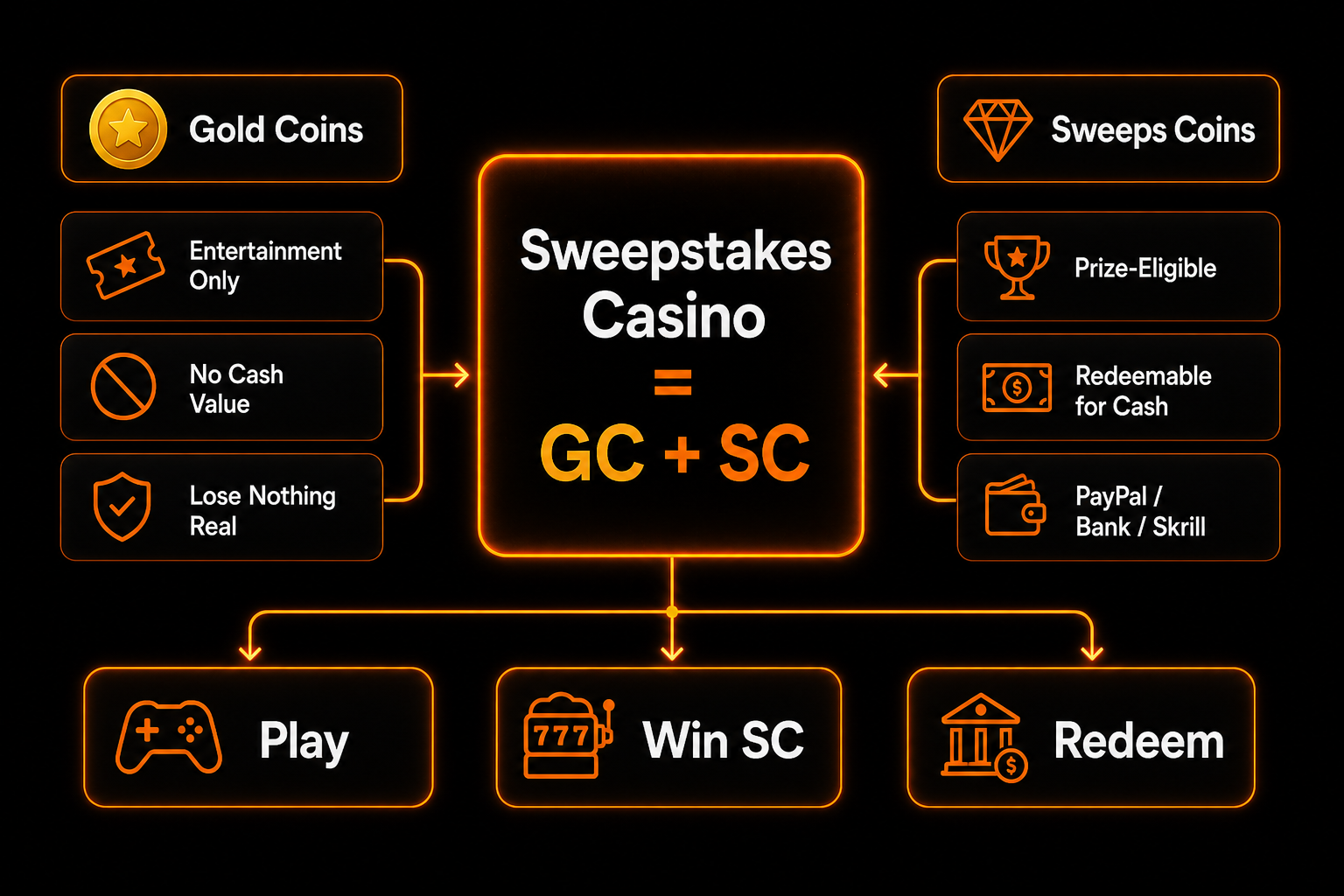
A sweepstakes casino is an online gaming platform that lets you play casino-style games without wagering real money directly. Instead of depositing cash to bet, you play with virtual currencies — Gold Coins for fun and Sweeps Coins for prize-eligible play.
The model is built around a legal workaround that has existed in US promotional law for decades. You are not technically gambling. You are participating in a sweepstakes promotion where prizes can be won — a fundamentally different legal classification than regulated gambling.
This distinction matters enormously. It means these platforms can operate in states where online casinos are fully illegal. Players in Texas, Florida, and most of the US can access them freely, while licensed real-money gambling sites remain blocked by state law.
The sweepstakes meaning here is specific: a promotion where winners are chosen by chance, entry is free, and prizes have real-world value. That definition, borrowed from decades of consumer promotion law, is the legal backbone of every platform operating in this space. Understanding what is sweepstakes gaming is the first step to using these platforms effectively — and to knowing what you are actually signing up for.
How Sweepstakes Casinos Work
Sweepstakes casinos operate in a legal gray area by offering free entry methods that mimic real gambling without requiring any purchase.
The No-Purchase-Necessary Loophole
Every legitimate platform in this category operates under one foundational rule: no purchase is necessary to participate. This is not a marketing tagline — it is a legal requirement that separates sweepstakes gaming from illegal gambling under both federal and state law.
Under US promotional sweepstakes law, if a company offers a prize promotion, it must provide a free method of entry carrying equal odds to any paid entry. Paying for Gold Coins does not improve your odds. The free mail-in entry is legally equivalent. This structure has been tested repeatedly in US courts — and operators have consistently defended it, though 2026 has brought the most aggressive legislative pressure the industry has ever faced.
Gold Coins (GC) vs Sweeps Coins (SC)
The two-currency system is the operational core of every platform. Gold Coins are play-money tokens — they carry no cash value, and losing them costs you nothing financially. Sweeps Coins are the layer that matters: you can redeem them for prizes, including cash equivalents paid via PayPal or bank transfer.
The critical legal point: you are never directly buying Sweeps Coins. You purchase Gold Coins, and SC are provided as a complimentary bonus. This packaging is how platforms maintain no-purchase-necessary compliance and avoid classification as a gambling operation.
Free Coin Acquisition Methods
Every compliant platform must offer a genuine no-cost path to Sweeps Coins. The most established method is postal mail-in requests. Beyond that, platforms award free SC through:
- Daily login bonuses — small SC amounts credited every time you open the app
- Promotional emails — limited-time SC drops sent to registered users
- Social media giveaways — contests run on Facebook, Instagram, and X
- Referral programs — SC awarded when a friend registers and makes a first purchase
- Special event promotions — seasonal campaigns with elevated SC rewards
Regulators in Michigan and New York have scrutinized whether free entry methods are genuinely accessible. Platforms that make them artificially difficult face enforcement risk.
Redemption for Cash Prizes
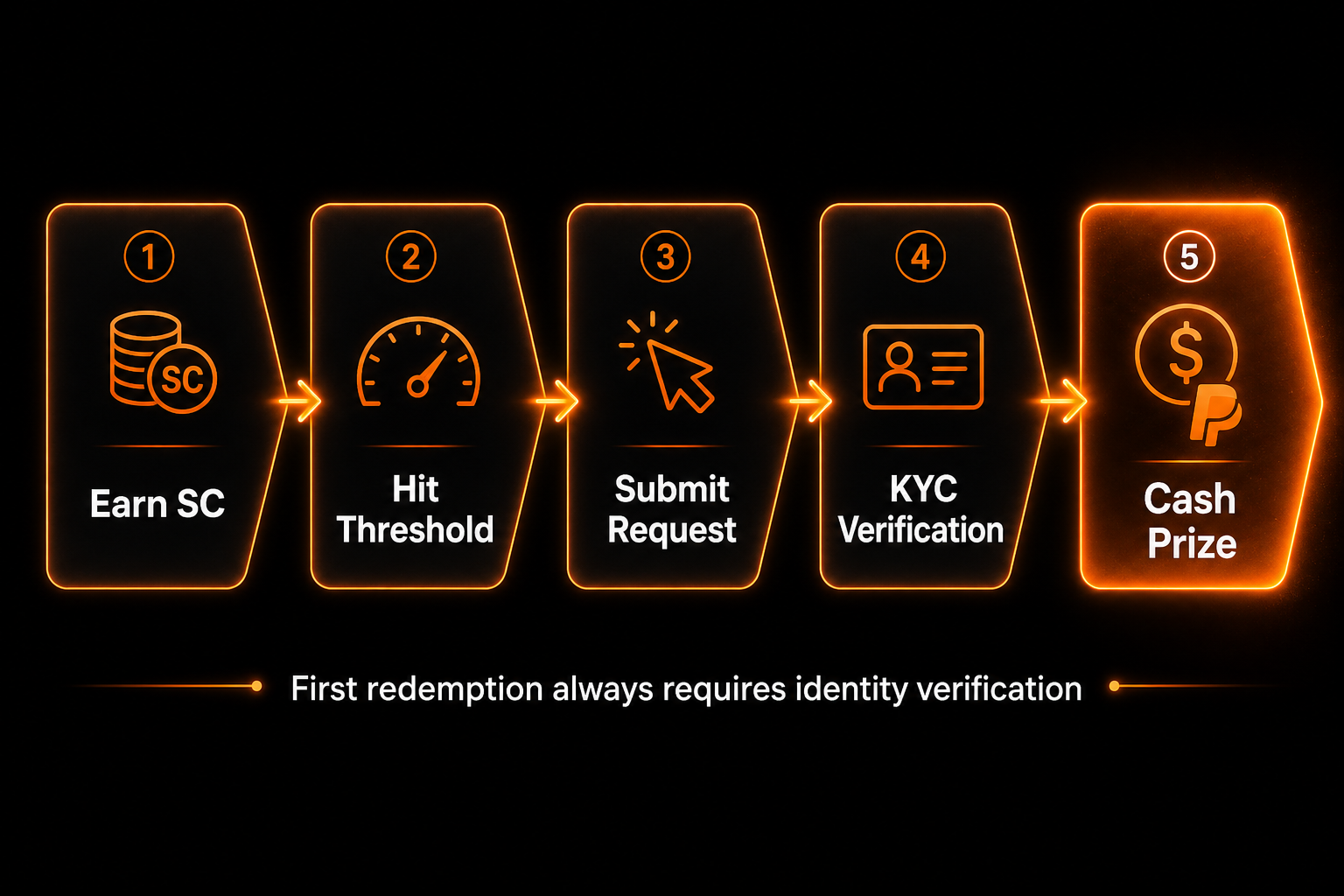
When you accumulate enough Sweeps Coins, you submit a redemption request through your account dashboard. The platform converts your SC balance into a cash equivalent after identity verification is complete. Most platforms set a minimum threshold — commonly 50 to 100 SC depending on the operator.
Payouts are classified as prize winnings, not gambling proceeds. Most US platforms issue 1099 forms for cumulative redemptions over $600 in a calendar year.
Sweepstakes Casinos vs Real-Money Casinos
| Feature | Sweepstakes Casino | Real-Money Casino |
| Deposit Required | No | Yes |
| Currency Used | GC / SC (virtual) | Real USD |
| Available Nationwide | Mostly yes | Licensed states only |
| Game Providers | Sweeps-specific studios | Major licensed studios |
| Cash Withdrawal | SC redemption only | Direct withdrawal |
| Monthly Limits | $1,000–$5,000 typical | Varies, often uncapped |
| Tax Classification | Prize income (1099) | Gambling winnings (W-2G) |
| Regulated by | Promotional sweepstakes law | State gaming commission |
Currency Differences
Real-money casinos put actual dollars at risk on every spin or hand. Sweepstakes platforms put two currencies between you and any real financial outcome. Gold Coins are pure entertainment tokens — worthless outside the platform. Sweeps Coins can eventually become cash, but only after verification and minimum redemption thresholds are cleared.
Legal Status
A licensed real-money casino needs a state-issued gambling license. As of 2026, only six states have issued those licenses for online play: New Jersey, Pennsylvania, Michigan, Connecticut, West Virginia, and Delaware. Sweepstakes platforms run under promotional prize law instead — which is why someone in Texas or Georgia can access them without issue. The tradeoff is less stable legal ground, and states like California and Michigan have been actively trying to close that gap through 2025 and into 2026.
Game Selection
Licensed real-money casinos source content from Evolution, Pragmatic Play, NetEnt. Those studios will not supply games to unlicensed operators. Sweepstakes platforms work with studios that build exclusively for this market. The games are functional and some are genuinely entertaining, but the gap in production depth and title variety is noticeable if you have played at a regulated casino.
Withdrawal Limits
At a licensed casino, a verified player can often withdraw tens of thousands in a single transaction. On sweepstakes platforms, most accounts are capped between $1,000 and $5,000 per month — which matters if you build up a significant SC balance.
Bonuses and Promotions
Licensed casinos offer deposit match bonuses tied to real wager value. Sweepstakes welcome packages advertise large GC and SC figures, but the realistic cash value is modest once you factor in house edges and redemption minimums. Neither model is straightforwardly generous — they hide complexity in different places.
Sweepstakes Casino vs Social Casino: Key Differences
The dividing line is simple: can you get anything real out of it? At a social casino — Zynga Poker, Slotomania, House of Fun — no. Chips exist only inside the app, and no one has ever received a cash payout based on a chip balance.
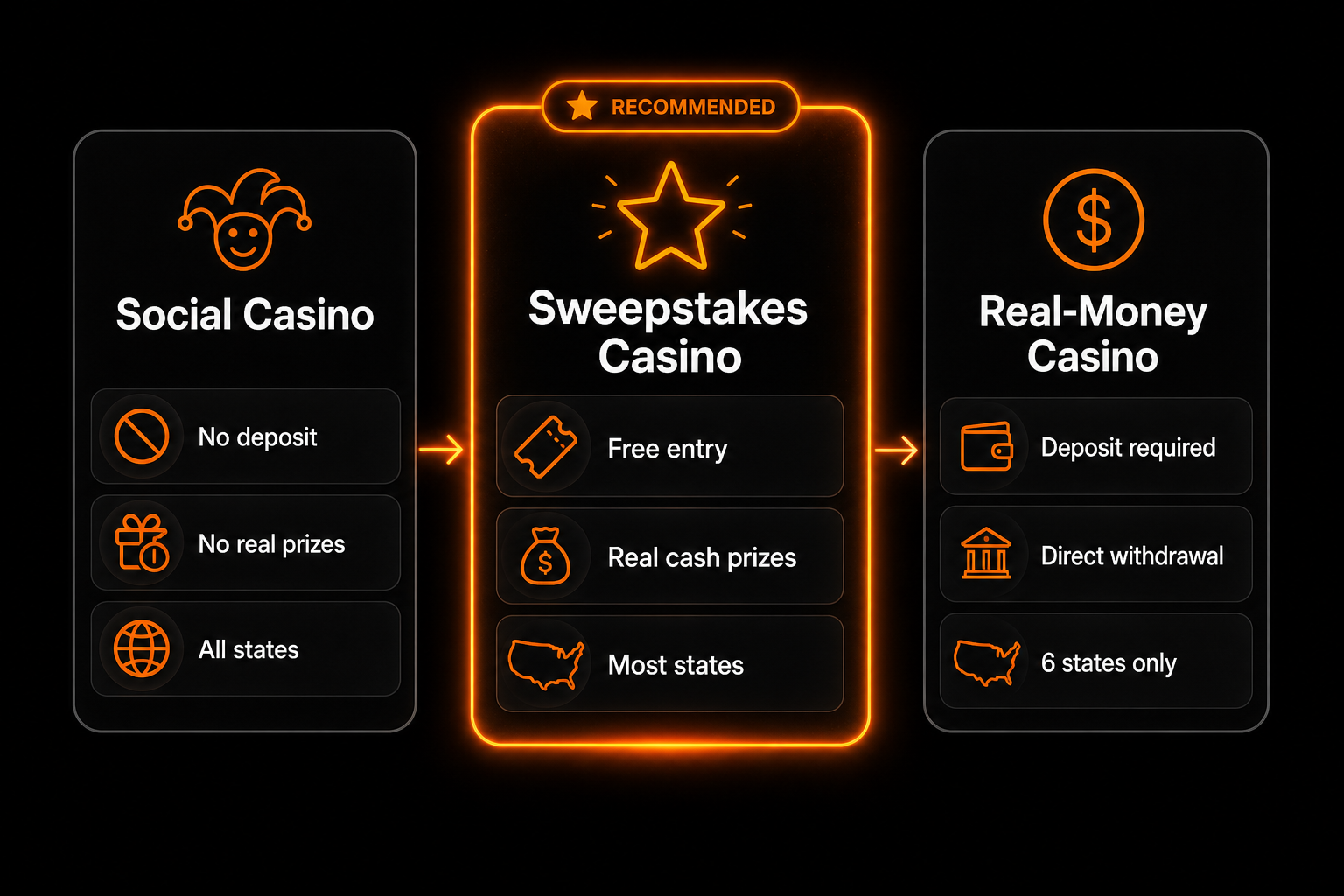
A sweeps casino is different at a foundational level. Sweeps Coins accumulated through play, daily bonuses, or mail-in requests can be converted into actual cash paid through PayPal or bank transfer. That single feature — real redemption — changes the legal classification, the regulatory scrutiny, and the entire player relationship with the platform.
Social casinos sell virtual chips and keep the money. No redemption liability, no KYC, no prize compliance. Sweepstakes operators carry a heavier load: every SC issued is a potential future redemption liability, compliance must work across dozens of jurisdictions, and the legal team has to be ready to defend the no-purchase-necessary structure whenever a state regulator looks closely — which in 2026 is happening more than ever.
The test for players is immediate: open the app, go to the cashier, look for a redemption option that leads to a real payout process with ID verification and payment method selection. If it exists, you are on a sweepstakes platform. If not, you are on a social casino.
Are Sweepstakes Casinos Legal in the US?
Yes, in most US states — but the answer comes with significant context.
Federal Legality (No-Purchase-Necessary Rule)
At the federal level, the model is legal — not under gambling law, but under promotional sweepstakes law written decades ago for cereal box contests and magazine giveaways. Three conditions keep platforms on the right side: entry must be genuinely free, winners must be determined by chance, and prizes must be real and actually delivered. The FTC watches for deceptive practices and the DOJ has acknowledged the gray-area nature of the model, but neither has moved against a sweepstakes gaming operator at the federal level as of mid-2026.
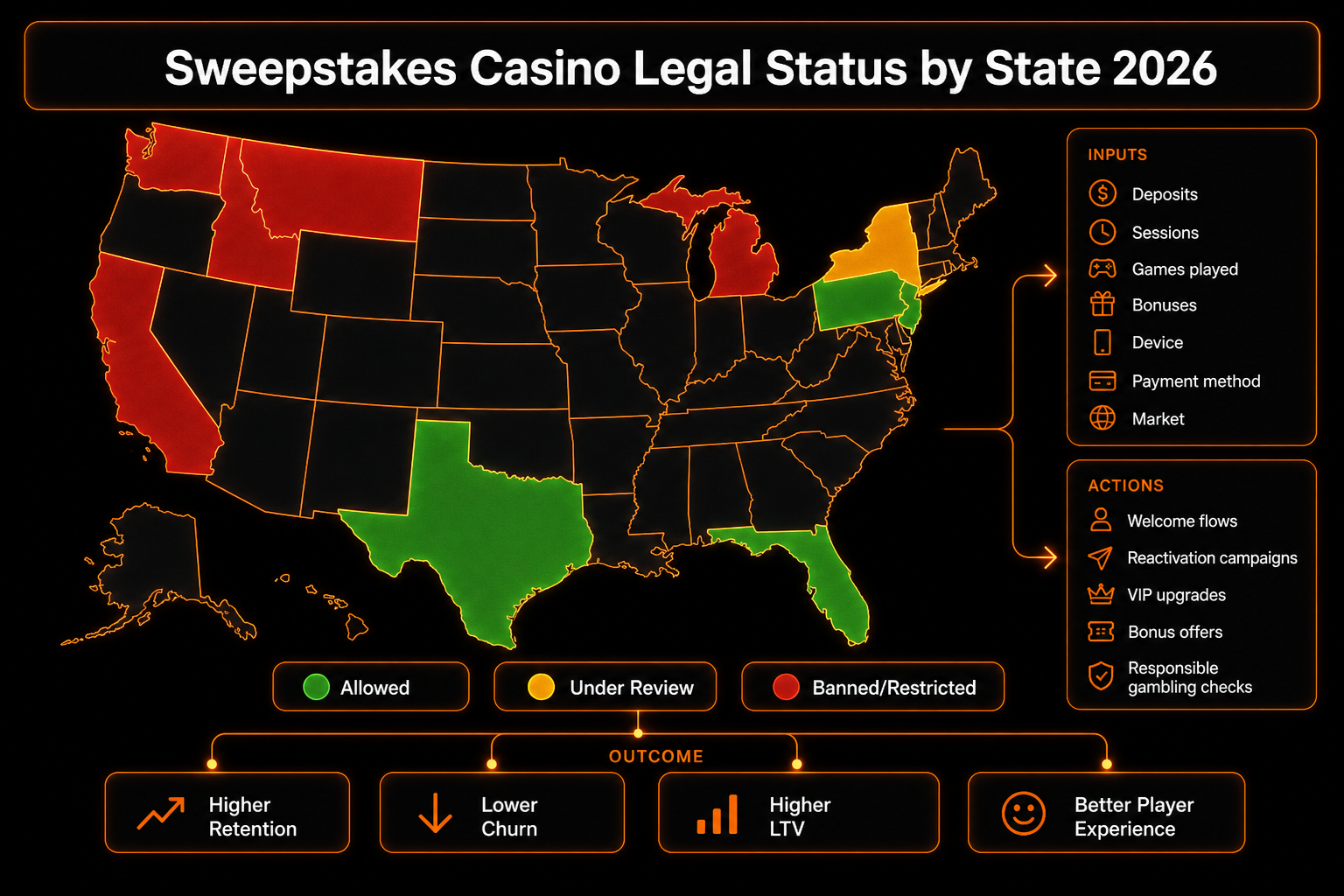
State-by-State Status (Banned, Allowed, Gray)
| State | Status | Notes |
| California | Heavily Restricted | AB 831 passed; enforcement active |
| Michigan | Restricted | Strict enforcement since 2025 |
| New York | Under Review | Legislation pending as of 2026 |
| Washington | Banned | Broad gambling statutes apply |
| Idaho | Banned | Sweeps model not permitted |
| Montana | Banned | State lottery monopoly laws |
| Texas | Allowed | No specific sweeps restrictions |
| Florida | Allowed | Broadly accessible |
| New Jersey | Allowed | Real-money casinos also legal |
| Pennsylvania | Allowed | Real-money casinos also legal |
Recent Legislation (Minnesota, Michigan, NY)
Michigan moved first with real enforcement teeth. The Michigan Gaming Control Board stated in late 2024 that running casino-style games without a state license is illegal under existing statutes, sweepstakes structure or not. Several operators quietly stopped accepting Michigan players.
Minnesota introduced dedicated legislation in early 2025 targeting the model directly — citing the absence of problem gambling protections, inadequate age verification, and revenue flowing outside the tribal gaming system. It stalled in committee but has not gone away.
New York’s 2026 framework would not ban platforms outright but would require state registration, mandatory audits, and contributions to problem gambling programs. For smaller operators, the compliance costs make the economics stop working.
Tribal Casino Pushback
Tribal casino operators are the most organized opposition to the sweepstakes model. Their argument: they negotiated exclusive gaming compacts with state governments, paying substantial fees in exchange for market protection. Sweepstakes platforms exploit a legal technicality that undercuts those compacts without contributing to the regulatory infrastructure tribal casinos are required to support.
In California, tribal operators funded lobbying behind AB 831. In Michigan, tribal nations formally petitioned the Gaming Control Board. In several other states, tribal gaming associations have retained lobbyists specifically to push for sweepstakes restrictions through 2026 legislative sessions.
Top Sweepstakes Casinos in 2026
Choosing the best sweepstakes casino depends on your priorities — payout speed, game variety, bonus frequency, or redemption reliability. These six platforms are the strongest options currently operating in the US market.
McLuck
McLuck is among the most accessible and cleanly operated platforms in the sweeps space. New players receive Gold Coins and Sweeps Coins without any purchase required, and the daily bonus system keeps regular players consistently topped up. Customer support is faster than most competitors, and redemption processing has built a reputation for reliability — a critical differentiator in a market where payout delays are common.
Chumba Casino
Chumba Casino is one of the oldest names in this space, operating under the sweeps model since before it reached mainstream awareness. That longevity translates into a tested redemption system and a library of exclusive slot titles. The mail-in free entry process is among the most straightforward in the industry, and Chumba was among the first to tighten KYC requirements ahead of the 2025 regulatory wave.
Stake.us
Stake.us is the US sweepstakes arm of the internationally recognized Stake brand. It benefits from substantial brand trust and brings a crypto-native aesthetic to the sweeps market, with frequent promotions, leaderboard competitions, and live challenges. The game variety leans into crash games and Stake originals alongside conventional slots.
WOW Vegas
WOW Vegas entered with aggressive welcome bonuses and above-average slot variety. Its loyalty program rewards consistent play with enhanced SC bonuses and priority redemption processing, and the platform has publicly committed to maintaining its US footprint through the current regulatory turbulence.
High 5 Casino
High 5 Casino has roots in the social casino market before transitioning to a full sweeps model. Its parent studio, High 5 Games, has produced hundreds of proprietary slot titles available exclusively through the platform — making it the strongest option for players who prioritize game volume over bonus frequency.
Pulsz
Pulsz has built its reputation on generous ongoing promotions rather than a headline welcome bonus. Regular players report competitive daily SC events and a responsive loyalty tier system. It is one of the few sweepstakes casinos 2026 can point to that offers live dealer content at meaningful scale, with PayPal as the primary payout channel.
Games Available at Sweepstakes Casinos
Slots
Slots dominate every major platform — straightforward mechanics, fast play cycles, easy integration of virtual currency wagering. Most platforms offer 200 to 800 titles, from classic three-reel formats to complex video slots with bonus rounds and progressive jackpots. Game quality has improved sharply over the past three years.
Table Games
Blackjack, roulette, baccarat, and video poker are standard across major platforms in multiple variant formats. Craps is available on several of the larger operators. The selection lacks the depth of a licensed casino lobby but is functionally adequate for casual play.
Live Dealer
Live dealer content remains the area of greatest disparity versus licensed casinos. Evolution Gaming — which dominates live dealer supply for licensed operators — does not supply the sweeps market. Pulsz and Stake.us lead in this category as of 2026 with alternative live dealer solutions.
Crash and Mini-Games
Crash games have grown from niche to mainstream across sweepstakes platforms, driven by overlap between sweeps players and crypto-adjacent gaming communities. Mini-games — Plinko, Mines, instant win scratchers — add variety and attract players who want faster play sessions. This category has expanded faster than any other segment over the past 18 months.
Bingo and Keno
Bingo and keno serve players looking for slower-paced play. Bingo formats often incorporate chat features and scheduled game rooms. Keno works well as a casual time-filler between slot sessions. Neither drives significant operator revenue, but both broaden demographic reach and improve session length metrics.
How to Play at a Sweepstakes Casino (Step-by-Step)
- Choose a platform — Select from McLuck, Chumba, Stake.us, or Pulsz. Verify the platform accepts players from your state before registering.
- Create an account — Provide name, email, date of birth, and home address. Age requirements are 18 or 21 depending on state.
- Claim your welcome bonus — New accounts typically receive free Gold Coins and Sweeps Coins on registration with no purchase required.
- Explore the game lobby — Start with Gold Coins to learn game mechanics before switching to Sweeps Coins.
- Acquire more Sweeps Coins — Use daily login bonuses, promotional emails, or mail-in requests for free SC.
- Accumulate SC through play — Play sweepstakes casino games using your SC balance.
- Submit a redemption request — Once you hit the minimum SC threshold, submit via your account dashboard.
- Complete identity verification — Upload a government-issued ID. First-time KYC review typically takes one to three business days.
- Receive your prize — Delivered via PayPal, bank transfer, or Skrill depending on the platform.
Sweepstakes Casino Bonuses and Promotions
Welcome Bonus (Free Coins)
Most operators offer new accounts a package combining large GC allocations with a starting SC balance. Standard welcome packages in 2026 range from 50 to 300 Sweeps Coins. Some platforms front-load the entire bonus on signup; others release it in daily installments across the first week.
Daily Login Rewards
Daily login bonuses are the primary retention mechanic across the sweeps market — small GC and SC amounts credited every day a player opens the app regardless of purchases. Several platforms also run streak bonuses that escalate rewards for consecutive daily logins.
Mail-In Requests (Free SC)
Every compliant platform offers postal mail-in for Sweeps Coins at no cost. Most allow one request per household per month. Write your name, address, and date of birth on a plain card, mail it to the operator’s published address, and SC credit arrives within two to four weeks.
VIP and Loyalty Programs
Most major platforms operate tiered VIP programs that reward cumulative play with:
- Increased daily SC bonuses beyond standard login rewards
- Priority customer support and dedicated account management
- Enhanced monthly redemption limits for cash prizes
- Exclusive promotions and early access to new game releases
- Platform-hosted tournaments with SC prize pools
McLuck and Pulsz have the most consistently rewarded VIP structures in 2026. Stake.us VIP benefits lean heavily into community features and leaderboard prestige.
How to Redeem Sweeps Coins for Cash
Minimum Redemption Thresholds
Common minimums in 2026 range from 50 SC to 100 SC. Chumba Casino sits at 100 SC minimum. McLuck and Pulsz allow redemptions from 50 SC. Stake.us thresholds vary by payout method.
Verification Requirements
First-time redemptions trigger mandatory identity verification on every compliant platform. Standard requirements:
- Government-issued photo ID — passport, driver’s license, or state ID
- Proof of address — utility bill or bank statement dated within 90 days
- Age confirmation — documentation confirming eligibility
- Account consistency check — name and address must match registration data exactly
Attempting to create multiple accounts to bypass verification results in permanent account closure and forfeiture of all balances.
Payout Methods (PayPal, Bank, Skrill)
PayPal is the most common option and typically the fastest — approved redemptions appear within 24 to 72 hours. Bank transfer (ACH) takes three to five business days. Skrill is available on Stake.us and Pulsz. Gift card redemptions are offered on some platforms, processing faster and at lower minimums than cash payouts.
How Sweepstakes Casinos Make Money (Operator Side)
Operators sell Gold Coin packages to players who want to extend play sessions. These GC purchases are the primary revenue line. Sweeps Coins bundled with those purchases represent future redemption liability — but not every player redeems, not every SC balance is cashed out, and expiration policies reduce liability on dormant accounts. The gap between SC issued and SC redeemed is a meaningful margin driver.
Marketing costs are high and rising. Player acquisition has become fiercely competitive since 2023. Operational compliance costs have grown substantially in 2026 — legal teams, state-level lobbying, enhanced KYC infrastructure — representing a fixed cost base that smaller operators struggle to absorb.
Pros and Cons of Sweepstakes Casinos
Pros:
- Accessible in most US states where real-money online casinos remain illegal
- No deposit required to start playing or earning Sweeps Coins
- Genuine cash prize redemption through established payment methods
- Low financial risk compared to real-money gambling environments
- Regular free SC through daily bonuses, mail-in, and promotions
Cons:
- Redemption limits significantly lower than licensed casino withdrawal caps
- KYC verification for first redemption can take several days
- Game quality lags behind licensed real-money platforms
- Regulatory uncertainty increasing — several states tightening rules in 2026
- Sweeps Coins have no guaranteed redemption if a platform shuts down
Common Sweepstakes Casino Misconceptions
“It’s just gambling with extra steps.” The legal distinction is real. The no-purchase-necessary rule, prize classification, and absence of a direct wager-for-money structure are all legally meaningful — even if the experience feels similar to casino play.
“You can make consistent income from sweeps platforms.” Redemption limits, house edges, and the SC conversion structure make these entertainment products, not income sources. GC purchase costs typically outpace SC redemption returns over time for players treating them as a revenue stream.
“The free SC from mail-in is not real.” It is legally required to be real and equivalent. Every compliant platform must honor mail-in requests, and the SC received carries the same redemption value as SC acquired through any other method.
“All sweepstakes casinos are the same.” The core legal structure is shared, but execution quality, redemption reliability, game selection, and platform stability vary enormously. Finding the best sweepstakes casino for your priorities requires platform-specific research.
“These platforms will be banned nationally soon.” Federal-level prohibition is unlikely near-term. What is happening in 2026 is state-by-state restriction, not a coordinated federal shutdown. The model will continue operating in the majority of states as the best-run operators adapt their compliance frameworks.
Future Trends in Sweepstakes Casinos for 2026
The industry enters the second half of 2026 under more regulatory pressure than at any point in its history, but underlying demand has not diminished. Several trends are shaping what comes next.
State-level licensing frameworks are the most discussed evolution. Some operators are actively lobbying for purpose-built regimes that would give them explicit legal standing in exchange for regulatory oversight — legitimizing the model while fundamentally altering its economics.
Consolidation is accelerating. Compliance costs, legal fees, and marketing spend required to survive 2026 are beyond smaller platforms. Several mid-tier operators have shut down or been acquired. The platforms that remain dominant — McLuck, Chumba, Stake.us, Pulsz — have sufficient capital to absorb the turbulence.
Live dealer expansion continues as a differentiation play. Building or licensing credible live dealer infrastructure is expensive but one of the most effective retention tools available.
Tribal partnership models are being explored quietly by several operators as an alternative to outright conflict — preliminary revenue-sharing or co-branding arrangements that might neutralize opposition in states currently pushing back hardest.
What is sweepstakes gaming going to look like beyond 2026 depends largely on how California and New York resolve their current legislative processes. Both states represent enormous player populations. If either creates a regulated licensing path instead of restriction, it could set a national template that stabilizes the model for years.