

- Updated:
- Published:
Ecuador introduces $315K license fee for a fully offshore betting market
Ecuador’s President Daniel Noboa has signed secondary regulation completing the country’s sports betting framework — but every active operator in the market is already offshore, and the new rules give them little reason to change that.
In June 2026, Ecuador finalised its online sports betting framework with secondary rules implementing the Organic Law on Sports approved by the National Assembly in February 2026. The new regulation, which rests on Executive Decree 487 of December 2024, sets an annual license fee of approximately $315K and introduces strict requirements for local incorporation, platform certification and KYC compliance.
The fee is set at 655 unified basic salaries — $315K at the current exchange rate. Beyond the financial obligation, operators must meet four conditions:
- Obtaining a five-year authorisation from the national sports authority
- Certifying digital platforms through an accredited independent laboratory
- Establishing local domicile and demonstrating full tax compliance
- Implementing KYC and age verification procedures
Ecuador’s licensing framework risks staying on paper
The online betting market is entirely controlled by offshore operators. Blask data for the past 12 months is unambiguous: all measurable demand in the country is distributed across 113 offshore brands.
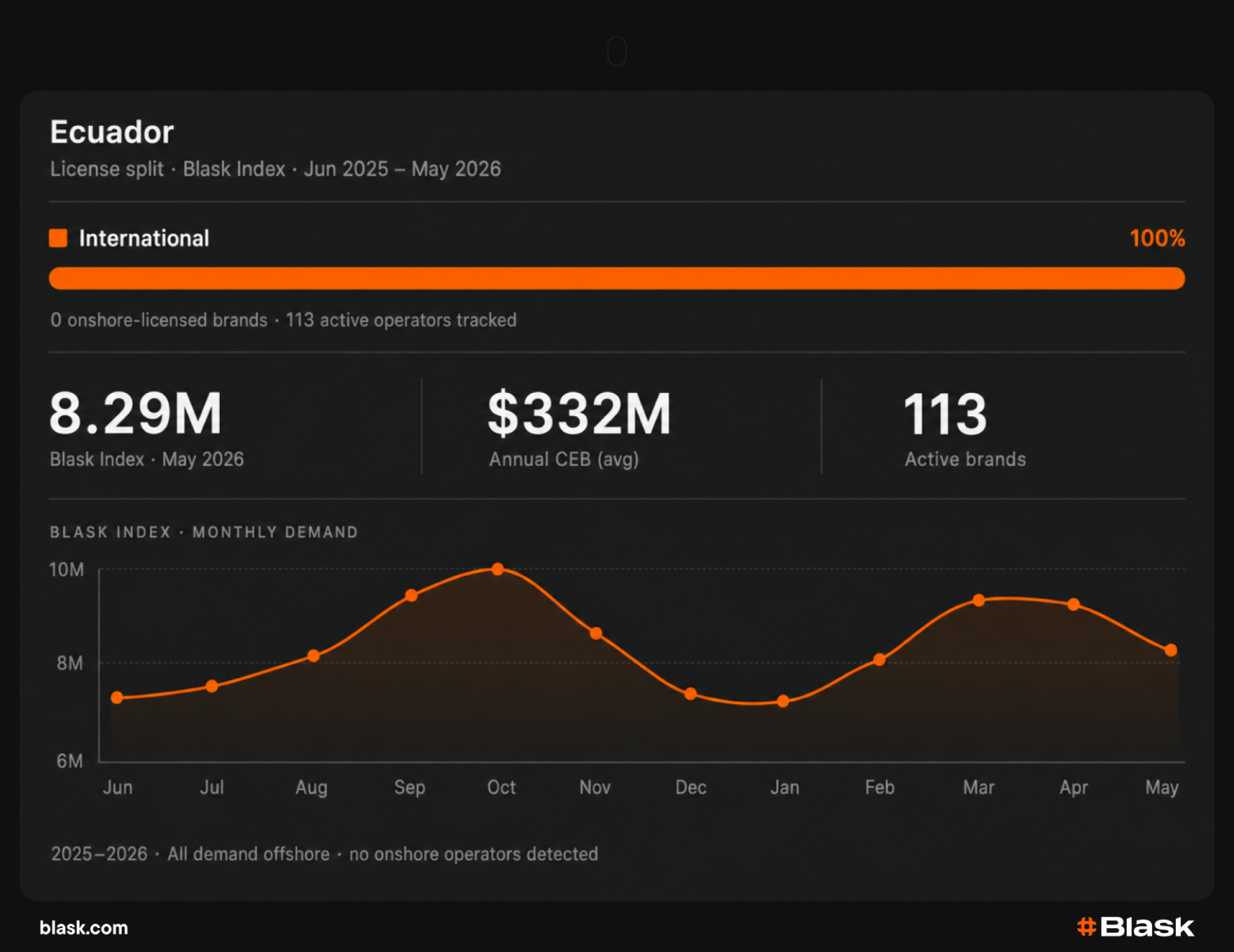
The market is booming: CEB reached $332M per year, up 23.69% YoY. Ecuabet, active since 2019, dominates with 75.78% of market demand — $234.7M in annual CEB. The remaining demand is split between DoradoBet ($21.3M, up 104% YoY), Forbet ($13.7M), Betano ($9.9M) and Bet593 ($7.79M).
Ecuador’s regulators are entering a market that is already carved up, operating comfortably in the grey zone and generating strong returns for its incumbents. The challenge now is not drafting rules — it is making local licensing more attractive than an offshore model that is already working.
Why the fee structure doesn’t create a licensing incentive
The $315K annual fee is notable, but it is not the central barrier. The new rules require foreign brands to establish a local legal entity, confirm residency and disclose audited financial statements — a structural overhaul for operators whose entire model is built offshore.
A 15% tax on gross revenue, 15% withholding on winnings and VAT on digital services push the cost of compliance above the cost of staying offshore. The regulation signals the government’s intent to formalise the market, but as currently structured it creates more costs than incentives for operators to transition.