
- Updated:
- Published:
Alberta iGaming market launch 2026: Stake, Rainbet and Roobet hold 36% of demand without a license
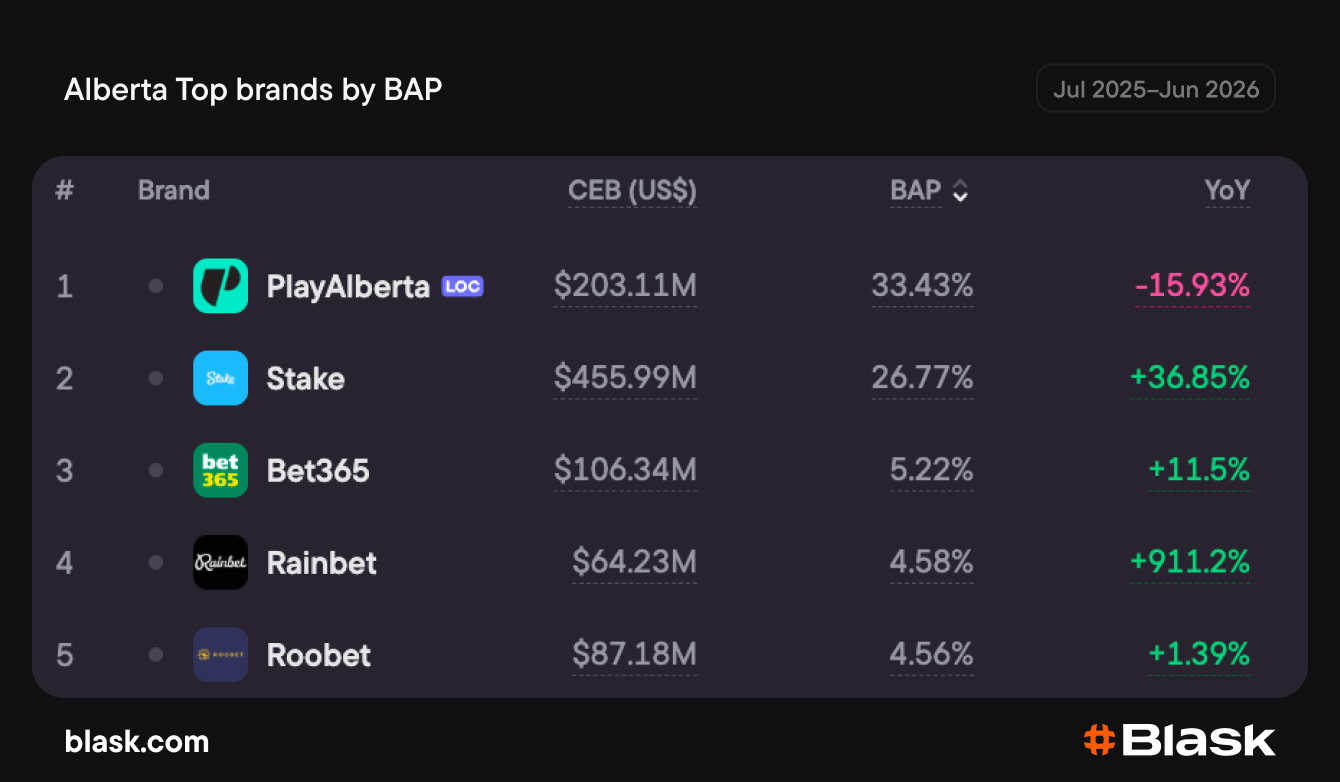
Alberta’s regulated iGaming market launched July 13, 2026, but Stake, Roobet and Rainbet, together holding 36% of provincial BAP in a $2.53B market, never applied for a license. Stake alone generated $456M in CEB over the past year, more than double what PlayAlberta earned as the sole licensed operator.
AGLC confirmed at midnight Monday that “all systems are a go”, though only around 20 of the nearly 50 registered operators were actually ready to take bets on day one — among them FanDuel, DraftKings, BetMGM, bet365 and Betty. PlayAlberta’s monopoly ended there — it had been the province’s only legal option since 2020.
Blask already covered Alberta’s brand rankings ahead of the July 13 launch, using Ontario as the benchmark for brand strength, but the list missed a fact that matters more: the brands generating the most real demand in Alberta never applied for a license at all.
Three of Alberta’s five biggest brands are not on the license applicant list
Stake, Roobet and Rainbet are missing from the AGLC registry, yet together they hold 36% of BAP in a market that generated $2.53B in CEB over the past year. Stake alone brought in $456M, more than double what Alberta’s only licensed operator earned all year — the chart below breaks down the rest.
Rainbet is growing the fastest of the three. Rainbet grew 107.6% month on month in June, lifting its monthly BAP to 6.84% and pushing the brand into third place in Alberta. The same pattern surfaced in Japan just days earlier, where Rainbet overtook Stake to become the market leader in a single month after a 50-fold jump in Blask Index. In both cases, the driver is the same — the brand launched recently and is still expanding aggressively, investing in high-profile media marketing.
PlayAlberta was losing ground even without competitors
Until July 13, PlayAlberta had been Alberta’s only regulated iGaming option since 2020. Blask data shows that the operator generated just $203.1M of the province’s $2.53B in total CEB over the past year, while international brands accounted for the overwhelming majority of market value.
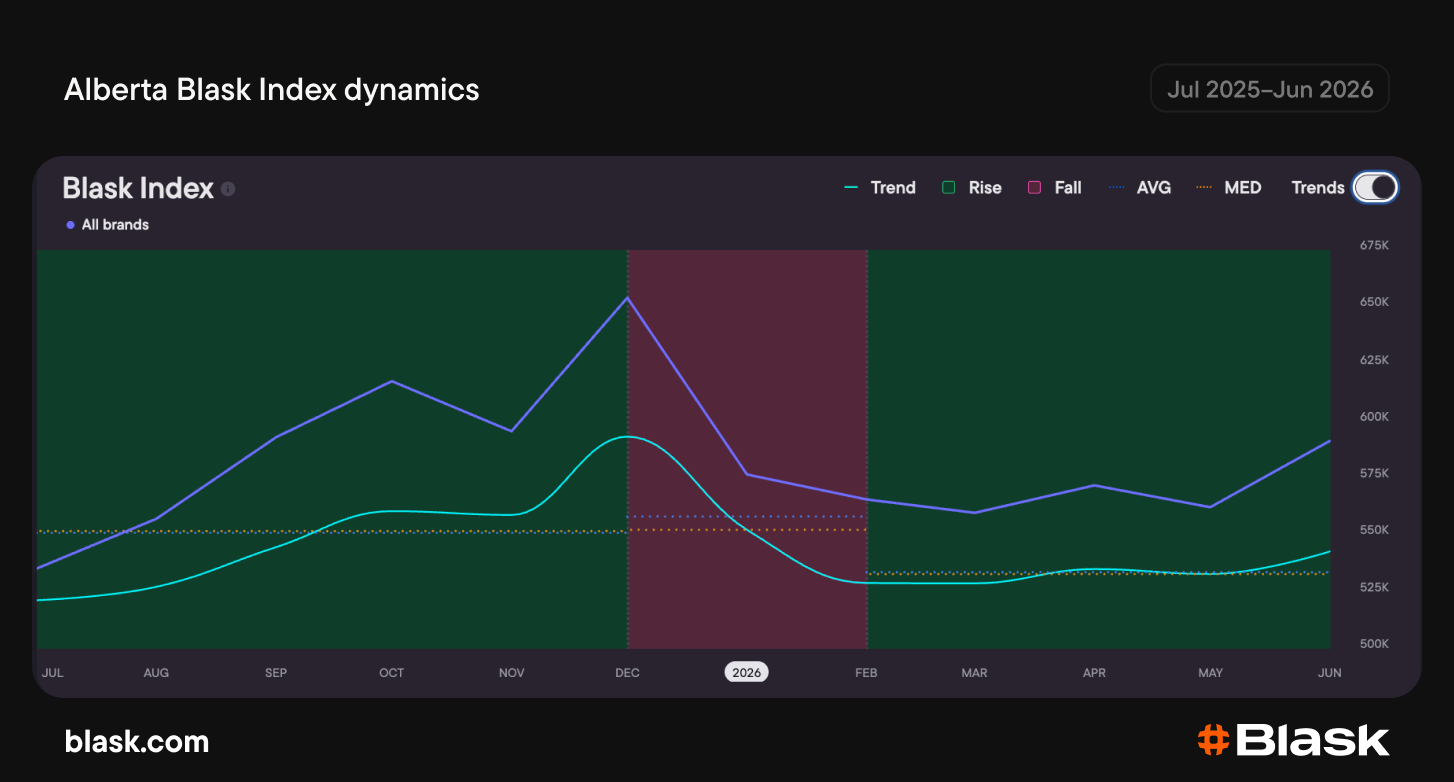
The decline was steady, not a one-off dip.PlayAlberta’s monthly CEB fell from $17.61M in July 2025 to $16.02M in May 2026, down 9%, while international CEB increased from $173.9M to $210.3M — up 20.9%. A closed market with zero licensed competition pushed players away from the regulated product, not toward it.
What the new licenses are actually up against
Alberta’s two dozen licensed entrants are competing primarily against offshore brands. Ontario took less than a year to push licensed operators’ share to 85% after its market opened. Alberta is starting today with its three biggest players sitting entirely outside the system it just built.
FAQ
Which unlicensed brands lead Alberta’s iGaming market?
Stake, Rainbet and Roobet together hold 36% of Alberta’s BAP despite none of them appearing on the AGLC license registry. Stake alone generated $456M in CEB over the past year in a market worth $2.53B total.
How much has PlayAlberta earned as Alberta’s only licensed operator?
PlayAlberta generated $203.1M of Alberta’s $2.53B total CEB over the past year, while its monthly revenue kept declining, from $17.61M in July 2025 to $16.02M in May 2026, even without any licensed competitors before July 13, 2026.
Which offshore brand is growing fastest in Alberta?
Rainbet is growing fastest, up 107.6% month over month in June 2026, which lifted its BAP to 6.84% and made it Alberta’s third-largest brand overall, a pattern also seen in Japan, where Rainbet became market leader in a single month.