
- Updated:
- Published:
US prediction markets 2026: Kalshi and Polymarket near half of iGaming interest

Kalshi and Polymarket together hold nearly half of US sports-betting interest on Blask in 2026 — a share that already rivals the traditional sportsbook stack.
By that point, Kalshi was already offering sports contracts to US users, while Polymarket had resumed operating in the US market shortly before the tournament, following its return under federal regulation. At the same time, the platforms sharply increased marketing spend, and by summer 2026 prediction markets looked and were promoted almost like classic sportsbooks.
The main difference remained legal: they operate under CFTC oversight rather than state gaming regulators. That distinction determines where such platforms can operate legally, and it is already shaping where Americans go when they want to bet on a match.
The 2026 World Cup became a stress test for the category
In June, Kalshi logged $31B in notional trading volume, up 70% from May. About 85% of activity came from sports contracts, and World Cup-related markets generated $22.42B in volume. By the end, Kalshi controlled about 83% of trading volume among CFTC-approved prediction market exchanges. Polymarket, which returned to the US market after buying the licensed exchange QCEX for $112M, posted $10.8B in volume on its international platform and another $3.5B in the US. Combined disclosed volume for the category exceeded $50B in June.
The competition extended beyond trading activity to audience share. Before the semifinals, Kalshi ran 36 ad spots and Polymarket 45, while every other US betting brand combined ran just 22. From the playoff stage, Kalshi also appeared on stadium screens and broadcasts alongside ADI Predictstreet, FIFA’s official prediction market partner; the co-branding deal was valued at roughly $20M.
The contracts themselves have long since moved past match outcomes. On Polymarket, a market on whether Cristiano Ronaldo would cry during the tournament collected more than $22M. After Portugal’s elimination, the outcome hinged on interpretation of photo and video evidence: the probability swung sharply after the platform accepted visual material as sufficient confirmation. The episode showed how large markets built on subjectively interpreted events have become.
Polymarket becomes the demand leader despite Kalshi’s trading dominance
Since March 27, 2026, Blask has also covered Kalshi and Polymarket in a separate prediction markets category, tracked apart from the main pool of iGaming brands.
Compared against all 392 brands Blask tracks in the US, Kalshi and Polymarket’s combined share of Blask Index over the World Cup window, June 1 to July 19, reached 48.85%. In other words, two prediction market brands generated almost as much Blask Index as the other brands combined.
Leadership in trading volume and demand, however, split between the two platforms. Polymarket’s US Blask Index for the period more than doubled Kalshi’s, even though Kalshi controlled 83% of regulated trading volume. That points less to one brand weakening than to two different audience-acquisition models: Kalshi leads on trading volume, Polymarket on search interest.
The largest sportsbooks moved in different directions too. In June, FanDuel’s Blask Index fell 4.2%, while DraftKings grew 22.7%. Any shift in attention toward prediction markets, then, doesn’t yet look like a uniform demand decline across the sportsbook category — its effect varies by brand.
Prediction markets account for more than 30% of demand in each of the ten largest US states
Blask data shows measurable search demand for prediction markets in 48 of 50 US states, while regulated online sports betting is available in only 31. In 17 of the 19 states without licensed sportsbooks, including California, Texas and Georgia, Kalshi and Polymarket have already established a measurable share of demand.
Across the ten largest states by combined Blask Index over the past 12 months, covering sportsbooks, online casinos and prediction markets, Kalshi and Polymarket accounted for more than 30% of total demand in every market, ranging from 31.26% in Georgia to 57.74% in New York.
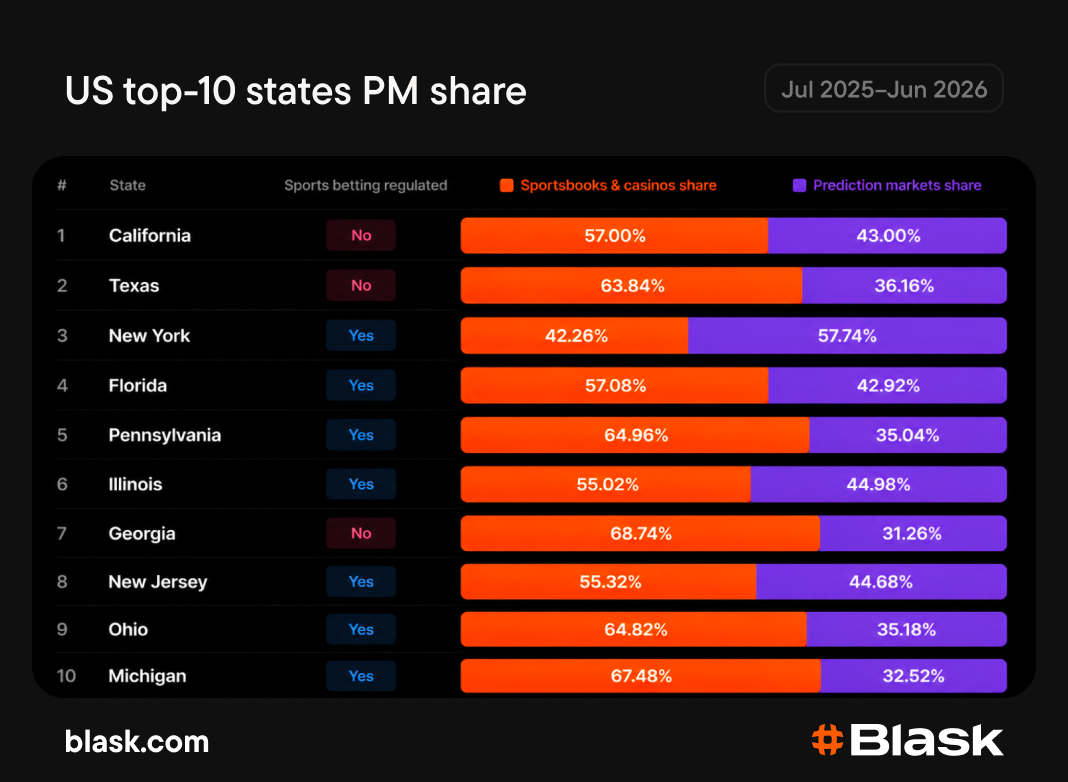
Seven of these ten states already have regulated sports betting. Yet New York, the country’s largest regulated sportsbook market by tax revenue, recorded the highest prediction market share of the entire group.
Within this top-tier group, the presence of a regulated sportsbook market did not determine how demand was distributed. Prediction markets captured a comparable share of consumer interest regardless of whether a state had licensed sportsbooks. Blask previously observed a similar pattern when comparing sweepstakes casinos with traditional iGaming operators: regulatory status alone does not necessarily translate into stronger consumer demand.
Bottom line
FanDuel and DraftKings didn’t wait to see whether the trend would hold. FanDuel Predicts, a joint venture with CME Group, already operates in all 50 states; DraftKings Predictions covers 38. Together, FanDuel and DraftKings are committing roughly $600M in marketing spend for 2026 to their own CFTC-regulated event contracts. The biggest sportsbooks aren’t fighting prediction markets — they’re becoming them.
FAQ
How much US iGaming demand do Kalshi and Polymarket control?
Kalshi and Polymarket combined captured 48.85% of Blask Index among all 392 tracked US iGaming brands during the June 1 to July 19, 2026 World Cup window, nearly matching the demand of every other betting brand combined.
Which is bigger, Kalshi or Polymarket, in the US?
It depends on the metric. Kalshi controls about 83% of CFTC-regulated trading volume and logged $31B in notional volume in June 2026, but Polymarket’s US Blask Index for the same period more than doubled Kalshi’s, showing stronger search-driven demand.
Do prediction markets operate in states without legal sports betting?
Yes. Blask measures prediction market demand in 48 of 50 US states, compared with regulated sports betting available in only 31. In 17 of the 19 states without licensed sportsbooks, including California and Texas, Kalshi and Polymarket already hold measurable demand share.
How are FanDuel and DraftKings responding to prediction markets?
Both are launching their own CFTC-regulated event contracts. FanDuel Predicts, a joint venture with CME Group, already operates in all 50 states, and DraftKings Predictions covers 38. Together the two committed roughly $600M in 2026 marketing spend to the category.