
- Updated:
- Published:
US iGaming brand rankings 2026: Rainbet enters the top five on 297% YoY growth

Bovada leads Blask’s US iGaming BAP ranking for H1 2026 with $3.9B in CEB, edging out FanDuel’s $3.7B and DraftKings’ $3.5B, both licensed market leaders. BetMGM trails at just $1.1B, behind even offshore brands MyBookie and Rainbet, showing regulated GGR growth doesn’t equal demand leadership.
New Blask data for the first half of 2026 shows that rising GGR among licensed operators doesn’t automatically mean demand is shifting into the regulated sector. On paper, FanDuel and DraftKings are the undisputed leaders, backed by heavy marketing investment and years of expansion across newly regulated states. But that picture relies on incomplete data.
Real demand vs. regulatory reports: who’s actually on top
Regulatory GGR statistics capture only licensed operators. Blask closes this gap with BAP — a metric that distributes consumer demand across all brands regardless of their licensing status.
By BAP, the leaders for the first half of 2026 are neither FanDuel nor DraftKings.
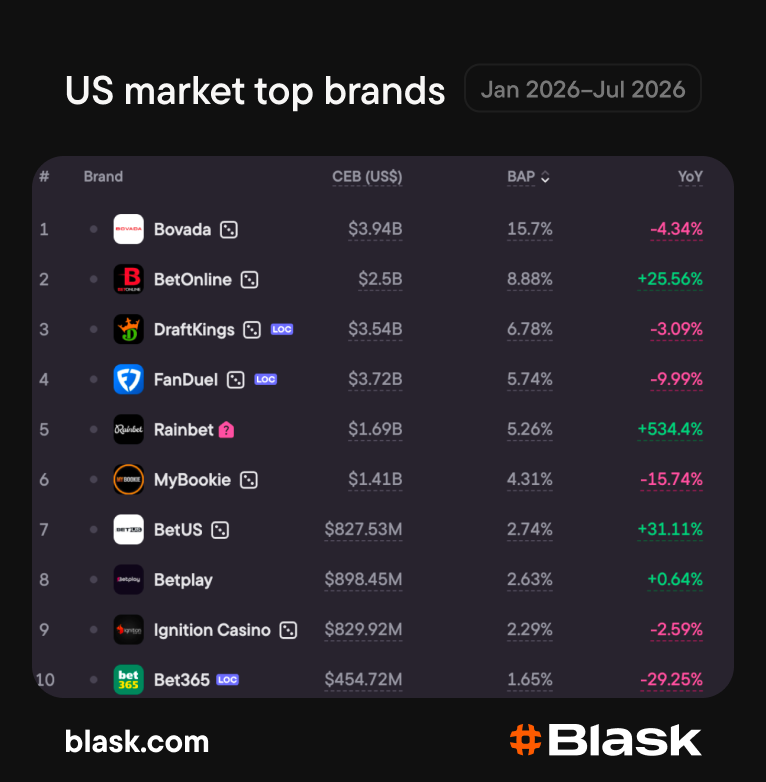
Bovada ranks first by BAP, with $3.9B in CEB — on par with FanDuel’s $3.7B and DraftKings’ $3.5B. BetMGM lags far behind at $1.1B, trailing not only the market leaders but also offshore brands MyBookie and Rainbet.
The gap widens at the market-wide level: in March 2026, Blask estimated offshore brands’ CEB at $4.6B against $2.1B for licensed operators — 69% of the tracked earnings base belonged to a segment that doesn’t appear in official statistics.
This picture aligns with the American Gaming Association’s estimates: Americans place around $84B in bets through illegal and offshore operators every year, generating roughly $5B in revenue outside state tax systems.
New entrants and a reshuffled pecking order
Outside the regulated market, Rainbet was the standout story of the first half. After entering the US in fall 2025, the brand climbed to fifth place by BAP, leapfrogging several established offshore and licensed rivals. Its annual growth reached 297.16%, though much of that trajectory reflects a low starting base.
Some licensed operators shifted strategy at the same time. In December 2025, Penn Entertainment shut down ESPN Bet and relaunched the platform under the theScore Bet brand, ending its partnership with ESPN ahead of schedule. ESPN soon signed an exclusive deal with DraftKings for odds and sportsbook service integration.
Despite FanDuel and DraftKings dominating the regulated segment, Blask’s ranking confirms the split visible above: three of the top four spots by BAP go to offshore brands, with only DraftKings breaking into the regulated side’s upper tier.
Sweepstakes casinos are another vertical pulling demand out of the regulated frame. By mid-2026, Blask data showed sweepstakes outpacing licensed and offshore operators combined in 35 of 50 states; traditional brands kept the edge only where a strong regulated offering met real enforcement, as Blask showed in its earlier analysis of the segment. Like offshore books, that demand never surfaces in regulatory GGR.
FAQ
How much of the US gambling market is offshore in 2026?
Blask estimates offshore brands controlled 67.5% of total US iGaming CEB in H1 2026, up from 65.8% a year earlier. The American Gaming Association separately estimates $673.6B, or 31.9% of total US gambling handle, flows to illegal and unregulated operators annually.
Which offshore brand leads the US gambling market?
Bovada ranks first in Blask’s BAP ranking for the US market, ahead of licensed leaders FanDuel and DraftKings. Bovada generated an estimated $3.94B in CEB during H1 2026, with BetOnline second among offshore brands at $2.5B.
Does legalizing online casinos reduce offshore gambling?
Yes, substantially. In states with legal online casinos, offshore share drops to 24% in Michigan, 30% in New Jersey and 37% in Pennsylvania. In states with sports betting only, offshore share reaches 63.9% in New York, 64.3% in Florida and 77.6% in Ohio.
How big are prediction markets compared to traditional US iGaming?
In H1 2026, Kalshi and Polymarket’s combined Blask Index reached 49.8M, nearly matching the 51.3M generated by the entire traditional iGaming segment. Prediction market demand grew 385% year over year while traditional iGaming demand fell 6%.