
- Updated:
- Published:
What is Plinko
Raise what is Plinko in an operator meeting and the room usually answers with a shrug that turns into a product argument. Someone calls it a toy, someone else calls it the quiet twin of a crash. Both are half right. A Plinko round is almost childishly simple — a ball falls through a peg pyramid and pays whatever multiplier it lands on — yet that loop now sits inside the wider instant win shelf that SOFTSWISS projects will reach €6.98B by 2032 at a 13.6% CAGR for short-session formats (scratch, mines, Plinko, dice, hi-lo). This article covers the topic of what Plinko is and how it exists online.
What is Plinko?
| Plinko is a game where a player chooses a stake, releases a chip or ball at the top of a triangular board studded with pegs, and watches it ricochet left and right until it settles in a pocket. That pocket multiplies the stake. The centre of the board — where probability piles up — often pays less than 1x. The outer edges, where paths are rare, hold the multipliers marketing likes to screenshot. |
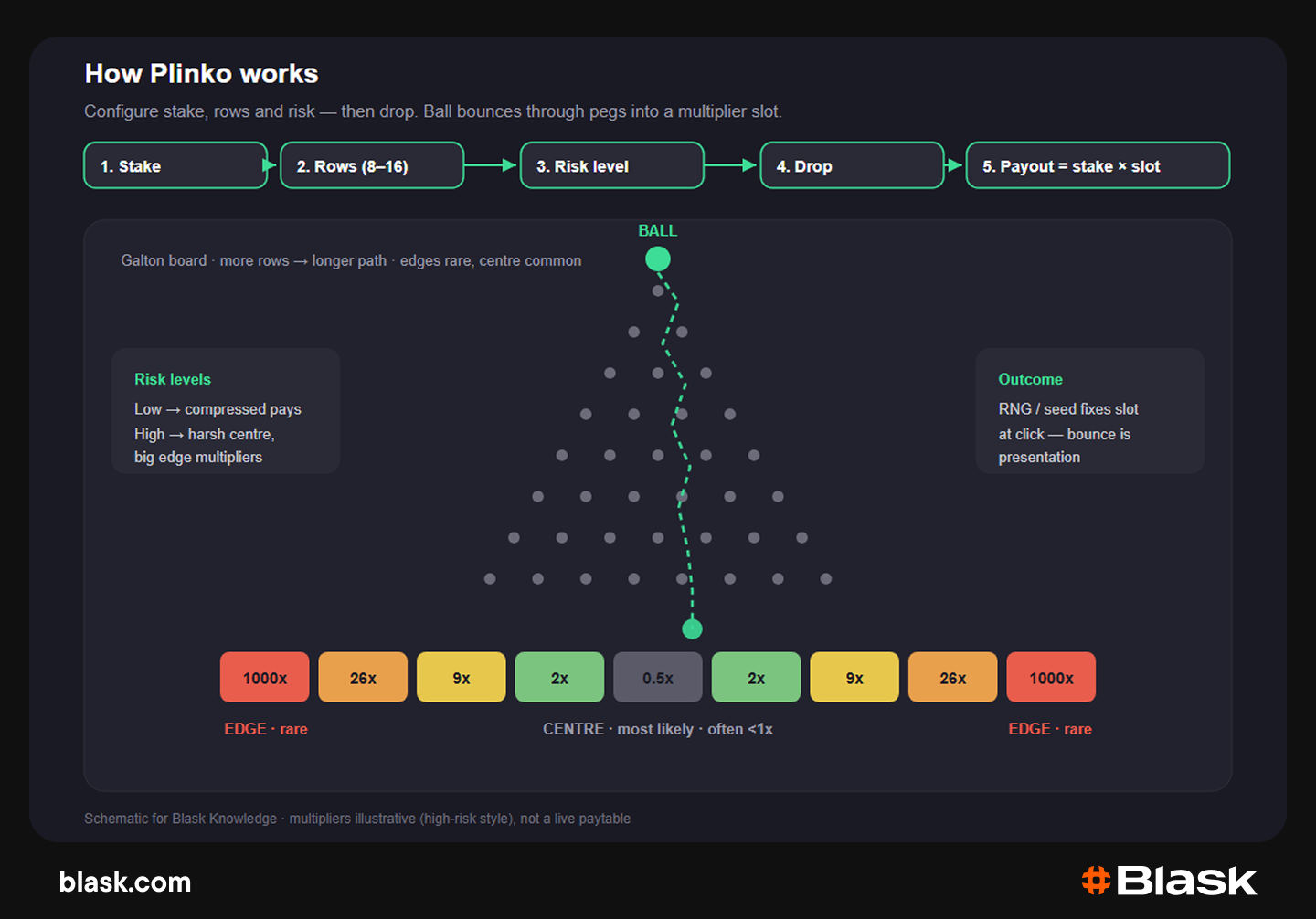
That geometry is why the format feels fair even when it is not generous. Unlike crash, there is no mid-round cash-out, no shared lobby breath-holding, no timing heroics. Once the drop starts, the story is over except for the bounce.
👉 Online Plinko casino titles therefore live closer to casual / arcade / instant win than to classic slot paylines, even when players type “Plinko slot” into search. Japanese pachinko looks related on a poster, while commercially and legally it is a different machine. Real-money Plinko adds the modern twist: players dial Plinko risk levels and row counts before the drop, shaping how wild the session feels while an RNG or seed still decides where the ball actually lands.
Brief history and origins
The board is older than daytime television. Francis Galton invented the bean machine — later called the Galton board or quincunx — to show that many tiny left-or-right choices add up to a bell curve. Drop enough balls and the centre fills first. Every online Plinko title still runs on that intuition, whether the UI looks neon or nostalgic.
Mass culture arrived later. The Price Is Right debuted its Plinko pricing game on 3 January 1983. Frank Wayne built it; Bob Barker explained the name as the sound chips make — “plink, plink, plink” — as they hit pegs. On television the economics favoured spectacle: centre prizes, physical discs, a studio audience. Casino and crypto Plinko flipped the pay logic.
The probable centre became the place players quietly lose; the improbable edges became the jackpot fantasy. Studio inflection is usually dated to BGaming’s Plinko, which the studio released on 28 January 2019 as a casual title with adjustable risk and rows — then Spribe, Hacksaw, SmartSoft and house Originals filled the category. The pegs stayed. The house edge moved into the multiplier strip.
How does Plinko work?
How does Plinko work in a casino is deliberately short. How to play Plinko is not a tutorial so much as a three-knob ritual: stake, rows, risk — then drop.
A player has to fund a ball, choose 8–16 lines, pick low / normal / high risk, then release in manual or auto mode. The ball appears to bounce; under the hood the landing slot is often already fixed at the click, and the animation is theatre. Payout is stake times the multiplier under that slot — and that multiplier can sit below 1x, which is the part affiliate copy likes to skip. Auto and multi-ball modes let the loop fire without a tap on every drop: useful for grinders, and responsible gambling surface operators cannot treat it as a free engagement cheat.
RTP, house edge, and board math
iGaming suppliers set different RTPs for their Plinko products. For example, BGaming publishes 99% RTP for Plinko (and for Plinko 2 / Plinko XY). Spribe lists 97% on its official Plinko page. Independent EV checks on Stake-style Originals tables have measured a 99.00% return that matches the brand-published figure exactly.
Provably fair and RNG models
Players who grew up on crypto Originals ask a sharper question than “is this fun?” — they ask whether the drop was already decided against them. Two trust models answer that without changing the edge.
In the provably fair model, common on crypto stacks and house Originals, the casino commits to a hashed server seed before the bet. The player’s client seed and a nonce join it; after the round the seed is revealed so anyone can rebuild the path or bucket.
Wizard of Odds notes that with 16 rows the outcome is typically fixed in advance as an integer mapped onto those 65,536 paths — the bounce is presentation. BGaming states the same commit–reveal idea for its Plinko line. In regulated fiat, certified RNG and lab seals do the social job with different vocabulary: trust the audit, read the RTP panel.
Plinko vs crash vs slots
Plinko vs Crash is the comparison that decides lobby architecture. Both are instant, both lean mobile, both sell multipliers — and they scratch different itches. Crash is a shared rising number and a timing decision; the lobby watches together. Plinko is private and post-decision: configure, release, accept. Crash players feel agency mid-round. Plinko players feel agency only in the setup.
Track360 describes crash as the flagship original and Plinko as the second pillar — visual satisfaction plus adjustable risk — and argues a serious originals catalogue needs crash, Plinko, and dice together.
| Criteria | Plinko | Crash | Slots |
| Core loop | Configure — drop — land | Climb — cash out | Spins / features |
| Mid-round agency | None after drop | Timing | Varies by feature |
| Social energy | Solo | Shared lobby | Solo |
| Volatility dial | Risk + rows | Cash-out behaviour | Fixed per title |
| Session job | Volume / grind | Adrenaline | Catalogue breadth |
Plinko vs slots is mostly a filing error. Plinko is not a payline machine with a bonus buy.
Who plays Plinko?
Blask’s Games catalogue shows the genre on shelves in 55 of 135 country markets scanned. Density is not evenly filled: Brazil leads the shelf, LatAm and Africa keep deep catalogues, Europe is wide but thinner on hero brand ceilings, and North America is present without ubiquity doing the teaching.
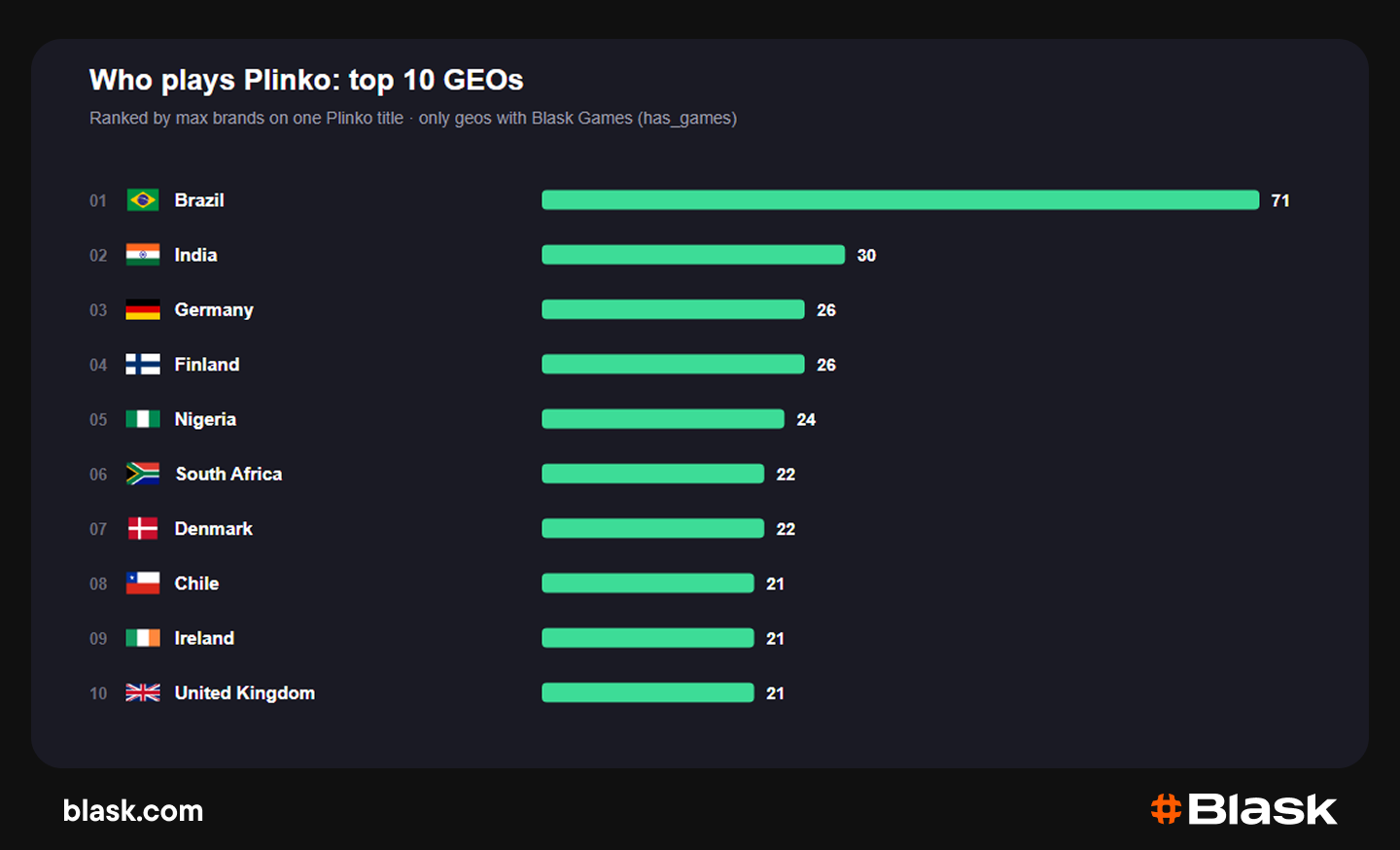
Blask Games — Plinko genre shelf depth by GEO
Most widespread Plinko titles
Across 30 Plinko-dense geos pulled from the same Blask Games snapshot (sorted by total_brands), a small set of studio titles shows up again and again. Ranked by peak brand count in any single market — then by how many of those geos carry the title:
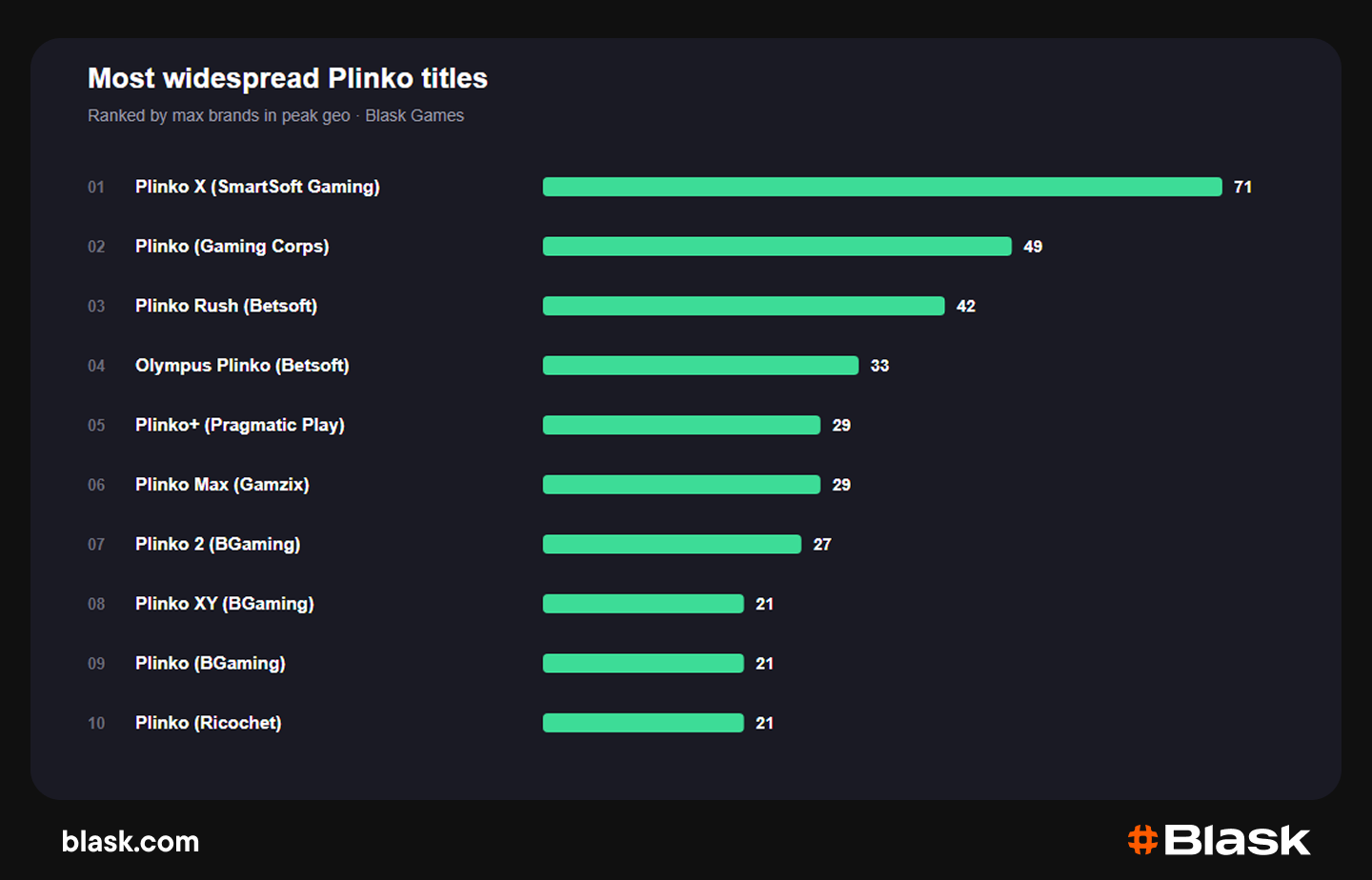
SmartSoft wins on peak density; Gaming Corps and Betsoft win on breadth — nearly every scanned geo carries them even when no market hits Brazilian ceilings. BGaming’s cluster is the crypto-era stack still common in RFPs; Pragmatic and Gamzix sit in the next distribution tier; Ricochet is the UK-shaped exception with a high local ceiling and a thinner global footprint. That mix is why “Plinko” should be managed as a genre shelf, not a single-SKU bet. Brand count is also only half the truth: avg GVR on those heroes swings, so presence shows the genre is allowed while GVR shows whether a real player can find it.
High-frequency grinders
The core session is quiet. Short rounds, clear RTP, Plinko autoplay, low or medium risk — a volume habit Crash’s shared adrenaline does not always satisfy. Thick-title geos in the shelf table above are where that habit already has somewhere to land.
Crash / originals crossover
Players who already speak Originals add Plinko when they want instant resolution without cash-out stress. Many Plinko-hit markets also run deep Crash catalogues, so both tiles in one Instant hub after a sports cool-down make the cross-sell structural — especially in LatAm and Africa, where both genres already clear real brand ceilings.
What players expect from a drop
Expectations are boring in the best way: a multiplier strip readable on a phone, risk labels that admit the centre can pay <1x, RTP that does not need hunting, autoplay that does not feel like a trap. Skill claims create complaints. In thinner shelves — North America, much of Europe outside a few denser markets — the lobby has to explain what ubiquity already teaches in Brazil.
Why Plinko matters for operators
Operators do not add Plinko because pegs are pretty. They add it because a serious originals row rarely ends at Crash. SOFTSWISS frames casual and instant formats as tools for reactivation, sportsbook cross-sell, and session-frequency uplift — and calls Mines and Plinko natively mobile. Track360 adds the harder commercial point: originals are high-frequency margin engines when the edge is set well, and favourite bonus-clearing vehicles when it is not — which is why contribution rates and bet caps during bonus play have to be tuned with the Plinko paytable, not after it.
Useful metrics are drops per session and risk-tier mix, not vanity opens of the tile. Trust is the second lever: a published high RTP or a clean provably fair verifier is an acquisition sentence — always labelled as provider-published — while regulated stacks can tell the same story with lab RNG and an honest info panel. Configuration is where margin and reputation meet: RTP tier, max-win caps, the row/risk matrix, autoplay limits, and how easily high spin rate burns bonus budgets. Mis-label high risk or hide a soft centre paytable, and the trailer may win while the inbox loses.
Future trends in Plinko
Future trends in Plinko will not invent a new board. The Galton geometry is settled. What changes is the neighbourhood the board lives in.
Configurable Plinko grew up in crypto Originals; regulated Instant and Arcade rows are absorbing the same mechanic with local RTP disclosure, stake limits, and session tools — Crash’s adoption curve, one category later. The durable catalogue idea is a mix, not a saviour title: Plinko as the passive frequency pillar beside Crash’s social timing loop, with mines or limbo for variety. Teams still hunting “one viral game” will keep under-building retention.
Players are also catching up to the math. As more of them learn that risk levels do not raise RTP, clarity becomes a competitive feature and opaque operator RTP tiers become a liability. Meanwhile autoplay and raw drops-per-minute put Plinko on the same product-intensity watchlist as fast slots and Crash — reality checks, loss prompts, caps that treat grind as a risk, not only as engagement. Skins will keep arriving (turbo, multi-ball, lightning modes, IP wrappers), but differentiation will sit in trust UX, mobile readability, and CRM fit. The pegs are not the roadmap. The shelf is.
Bottom line
What is Plinko, for operators who have to ship a lobby rather than a tweet: a chance-based instant win drop on a Galton board, where stake, rows, and Plinko risk levels set the mood and an RNG or seed sets the result. Risk reshapes volatility; it does not rewrite RTP. The commercial case is quieter than Crash’s mythology and stronger than a novelty tile — the durable move is to pair the two, surface fairness, watch frequency and tier mix, and keep the board on the Instant / Originals row where the story makes sense.