
- Updated:
- Published:
World Cup 2026 and Brazil iGaming: demand grew just 7.9% before Norway ended the run

Brazil’s iGaming demand rose only 7.9% above baseline during the national team’s World Cup run, then fell 18.8% the day after its round-of-16 loss to Norway, reaching 27% below baseline by the end of July. Betano and Sportingbet posted the strongest brand-level gains among Serie A club sponsors.
Its high existing base capped how far the tournament could push demand in the first place. Even that moderate increase faded quickly after the round-of-16 loss to Norway. Erling Haaland scored twice in the final 11 minutes, sending the five-time world champions home in their earliest World Cup exit since 1990. The defeat also marked the starting point of Brazil’s iGaming demand decline.
How did the 2026 World Cup affect Brazil’s iGaming market?
Brazil’s betting demand rose gradually throughout the tournament. Blask Index peaked ahead of the round-of-16 match against Norway, then reversed sharply after Brazil’s elimination.
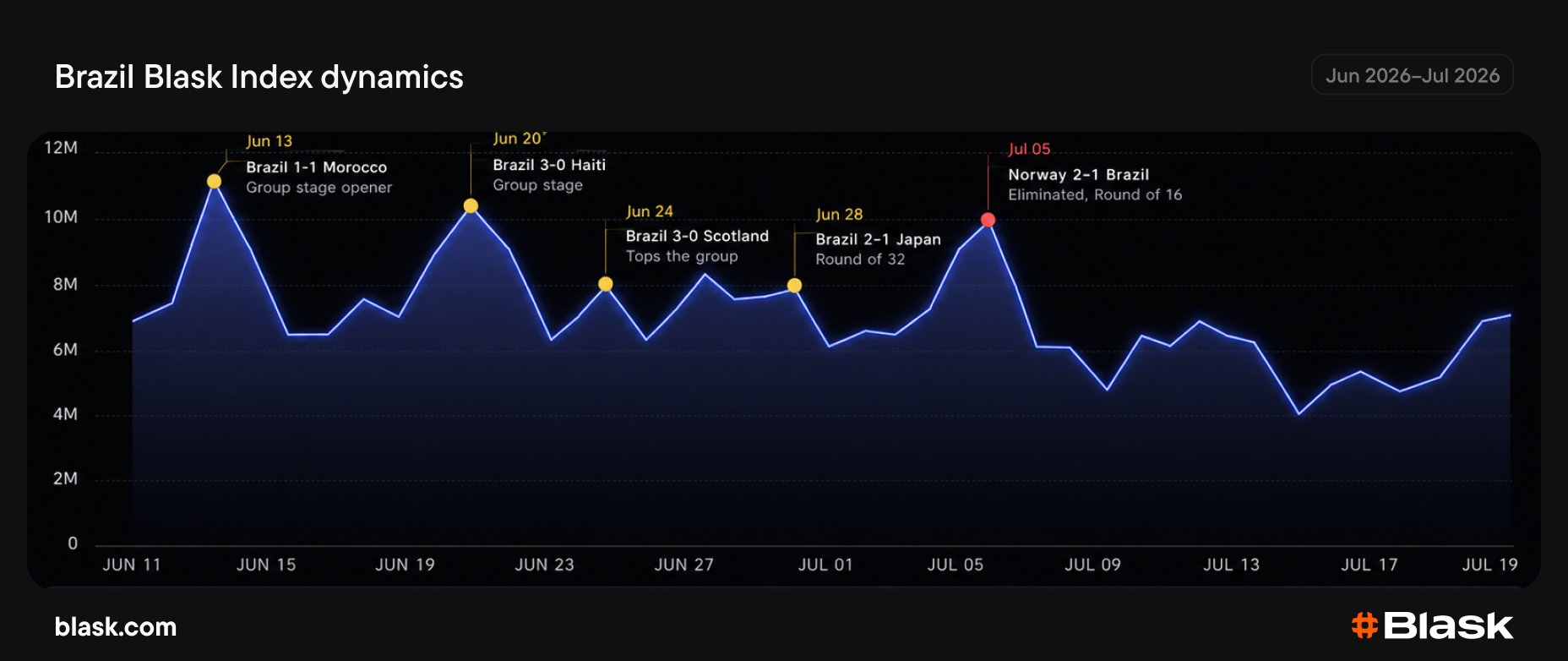
Once the tournament started, the biggest peaks coincided with the national team’s own matches, while every other game produced only a moderate uptick relative to a normal weekend.
Brazil’s own demand rhythm explains why: the market typically sees regular spikes toward the end of the week, and the tournament mostly amplified that existing pattern. Averaged across the team’s entire run in the tournament (June 11 – July 5), Blask Index was 7.9% above baseline (May 3 to June 10).
Brazil’s iGaming demand after the Norway loss, as tracked by Blask, quickly reverted to its usual trajectory: the index fell 18.8% the very next day, the decline reached 25.7% within two days, and by the end of July the figure stood 27% below baseline.
Against the backdrop of other countries in the region, the effect looks modest. Argentina grew 39% relative to its baseline period, while Peru — despite not taking part in the tournament — gained 106%. For the largest and most mature market in Latin America, the World Cup turned out to be more of a short-term amplifier of existing demand than a driver of new growth.
Sportingbet and Bet365 outgrew even Betano’s record sponsorship
Looking at which Brazil betting brands benefited from World Cup 2026 starts with club shirts. Sponsorships still help Brazil’s sports betting brands strengthen their positions during major tournaments: in the 2026 season, betting brands are shirt sponsors for 12 of Serie A’s 20 clubs, down from 18 clubs a year earlier. Some operators redirected budgets from long-term club sponsorships toward World Cup-related campaigns.
Brand-level demand across the full tournament (June 11 – July 19) varied widely even among Serie A’s own sponsors. The Betano Brazil World Cup campaign, built on Flamengo’s record shirt deal, increased demand by 9.7% and added almost three percentage points of BAP.
Sportingbet, Palmeiras’ sponsor, grew fastest of the four at 10.7% — just ahead of Betano. Superbet, tied to São Paulo and Fluminense, and Betnacional, Cruzeiro’s sponsor, barely moved: up 2.9% and 0.9% respectively.
Three other sponsors lost demand over the same window: Vaidebet fell 33.8% despite its tie to Remo, while H2Bet and Bet7k — sponsors of Atlético Mineiro and Vitória — dropped 17.2% and 17.1%. Sponsorship of nationally recognized clubs was still more often accompanied by demand growth than sponsorship of regional teams, but the gap was far tighter across the full tournament than during Brazil’s own run in it.
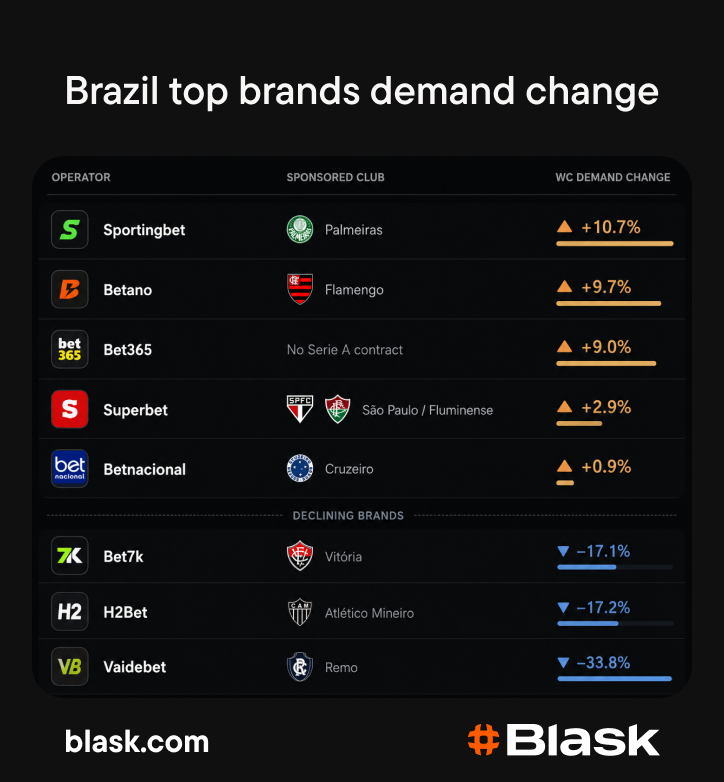
Bet365 complicates the sponsorship story rather than breaking it outright. Brazil’s second-largest brand by BAP has no Serie A club contract at all, yet its demand still grew 9.0% over the same period — ahead of Superbet and Betnacional, though behind Betano and Sportingbet’s own gains. Sponsorship correlated with which brands caught the World Cup demand spike, but it was not a requirement for doing so, and it was not the strongest predictor either.
The World Cup barely dented Brazil’s long-term demand trend
Even the biggest sporting event of the four-year cycle only briefly amplified existing demand without changing its long-term trajectory. At the same time, the tournament showed that local presence and a strong brand matter more than football fever itself: they determine who can turn a few weeks of heightened interest into a lasting gain in market share.
Track Brazil’s market in real time on Blask’s Brazil page.
FAQ
How much did Brazil’s iGaming demand grow during the 2026 World Cup?
Brazil’s Blask Index averaged just 7.9% above baseline during the national team’s tournament run, from June 11 to July 5, 2026. That is a modest gain compared with Argentina’s 39% and Peru’s 106% increases over the same window.
What happened to Brazil’s betting demand after the team’s elimination?
Demand reversed sharply after Brazil lost to Norway in the round of 16. Blask Index fell 18.8% the next day, 25.7% within two days, and stood 27% below baseline by the end of July 2026.
Which Brazilian betting brands grew the most during the World Cup?
Sportingbet, Palmeiras’ shirt sponsor, grew demand 10.7% over the full tournament window, narrowly ahead of Betano’s 9.7%. Bet365 grew 9.0% despite having no Serie A club sponsorship at all, outperforming several sponsored rivals.
Did World Cup club sponsorships guarantee a demand boost for betting brands?
No. While Sportingbet and Betano gained from strong club ties, Vaidebet fell 33.8% despite sponsoring Remo, and H2Bet and Bet7k dropped 17% each despite regional club deals, showing sponsorship helped but wasn’t the strongest predictor of growth.