I underestimated something about our market until I ran into Paul Graham’s essay on Swiss watches, The Brand Age.
The history in it is harsh. In the early 1970s the Swiss watch industry got hit from three sides at once. The Japanese caught up on accuracy. The franc rose 2.7 times after Bretton Woods collapsed. Then quartz finished the job. Mechanical precision stopped being an advantage overnight: a three-dollar quartz movement kept better time than any hand-assembled Swiss calibre.
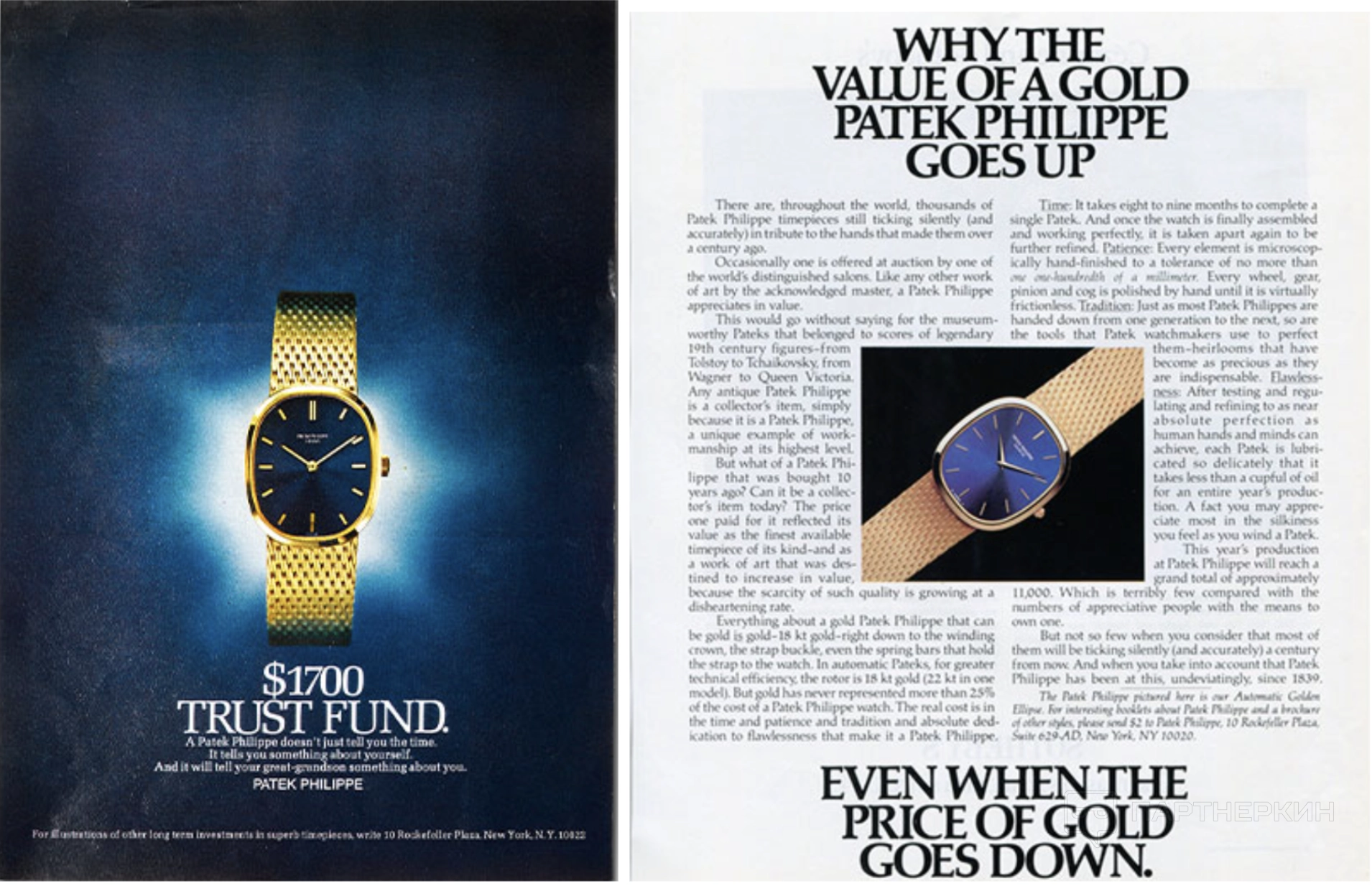
In ten years, unit sales of Swiss watches fell nearly threefold. Only a handful survived, and only because they stopped selling accuracy and started selling status. You could no longer make a watch more precise; you could rebuild status from scratch.
Patek Philippe, Audemars Piguet and Rolex bet on brand: a large recognisable case, artificial scarcity, advertising that said how much the thing cost rather than how it worked.
Graham puts it this way: brand is what remains when technology erases the substantive differences between products.
I read that and realised it is a one-to-one description of our market right now. We just call it competition, not a crisis.
The same product in two different countries
We looked at casino lobbies in Peru and the Netherlands over at Blask. These markets have almost nothing in common: different regulation, different players, different media landscape. And in both, slots take 80–83% of the catalogue, while the same provider dominates the top of distribution.
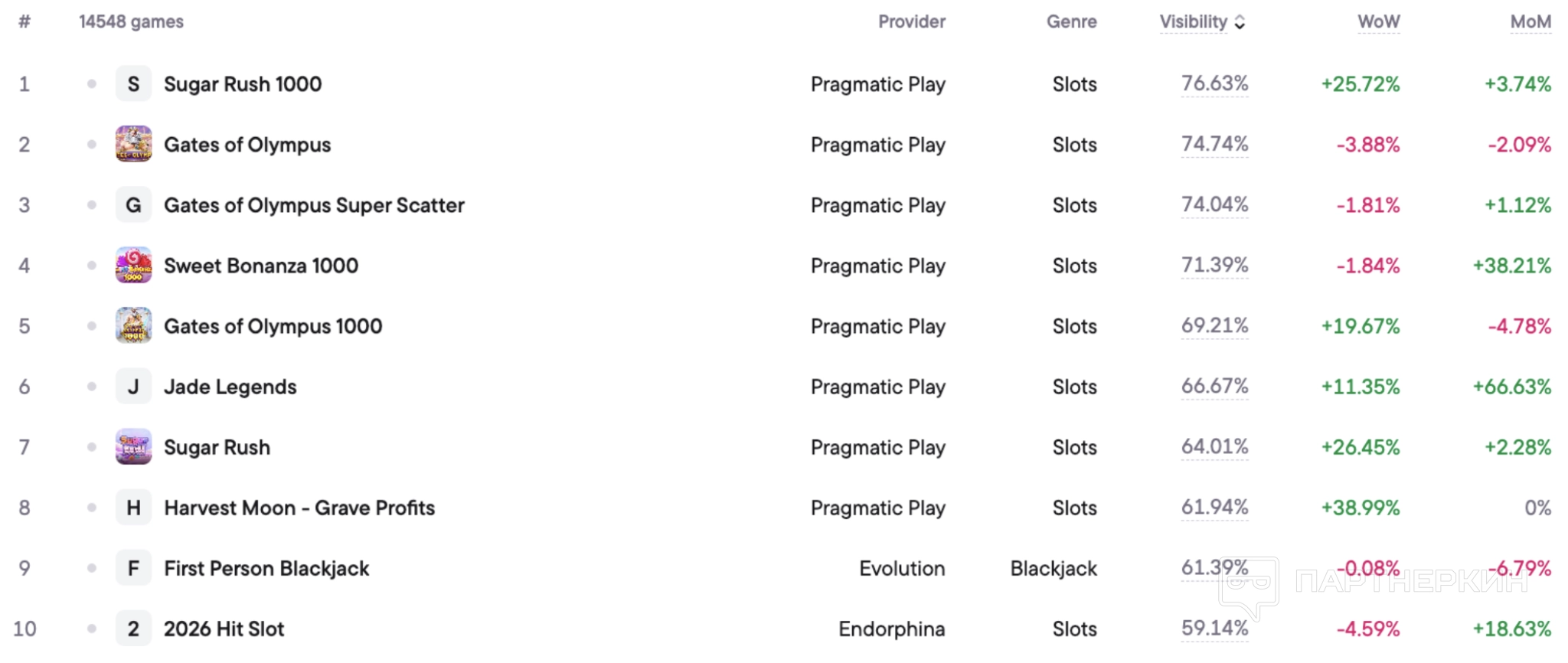
In Peru, Gates of Olympus by Pragmatic Play sits in the lobby of every one of the 50 active brands, and eight of the top ten titles by distribution are Pragmatic Play as well.
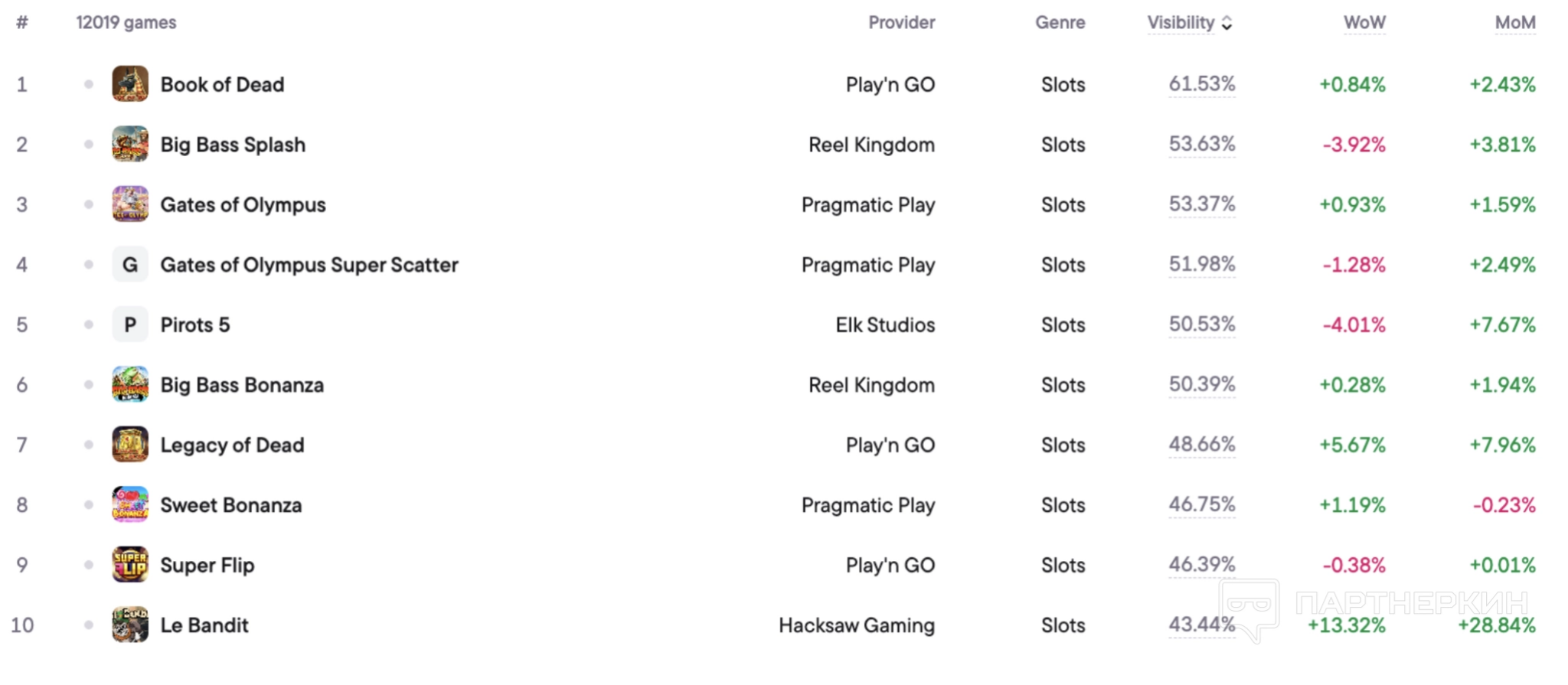
In the Netherlands, Pragmatic Play holds three spots in the top ten: Gates of Olympus, Gates of Olympus Super Scatter and Sweet Bonanza.
This is exactly what happened to watch calibres in the 1970s. One provider, one engine, the same top titles inside the vertical, whether you open a casino from Lima or from Amsterdam. Operators get harder to tell apart by product every year. The content is commoditised, and the distribution figures show it.
For brands, the picture flips
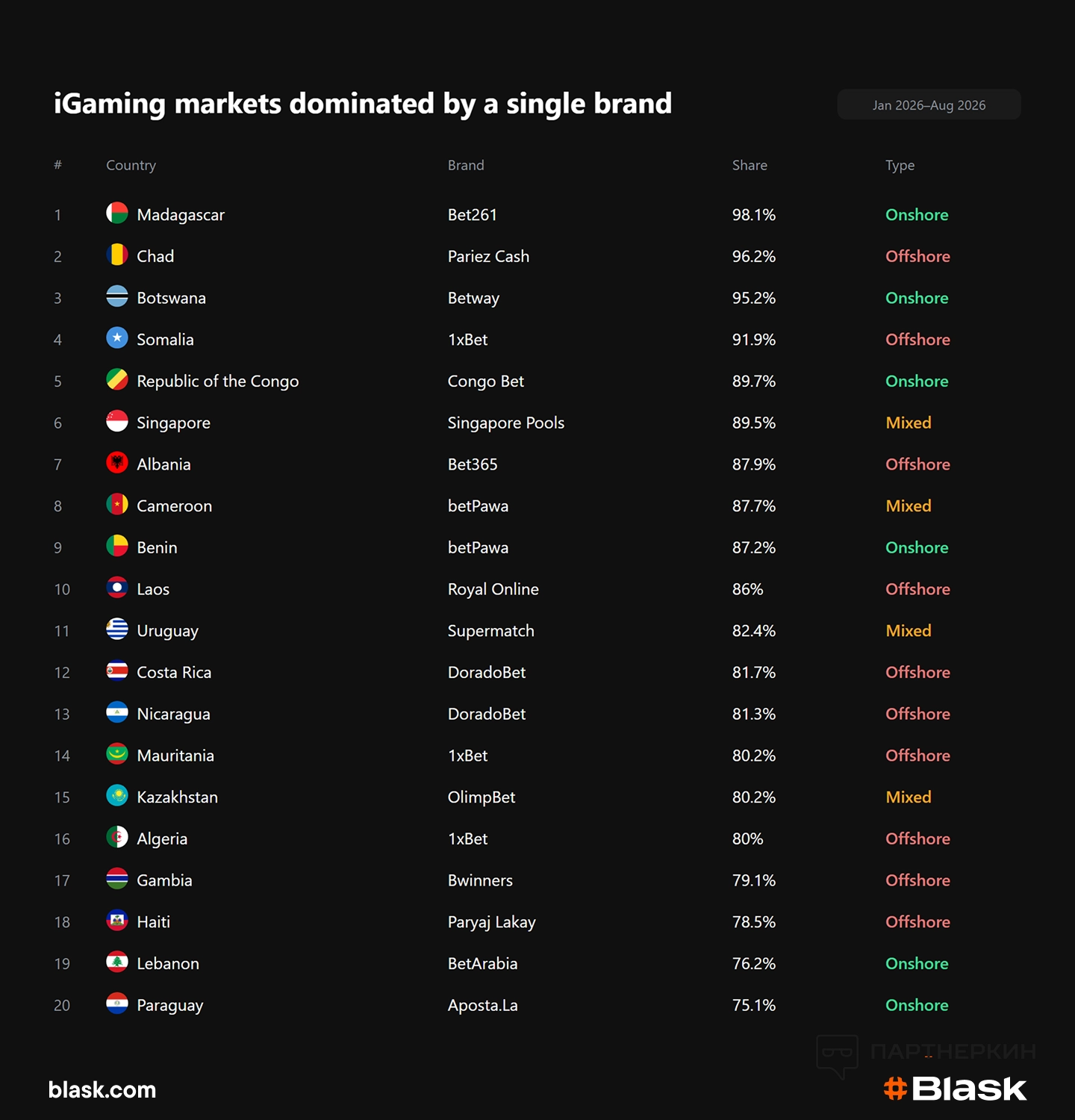
Look at demand across brands instead of games, and the picture mirrors the other way. In 19 countries one operator holds more than 75% of all market demand — not always because it has the better product.
1xBet leads demand in nine countries, betPawa in six, and both run more or less the same Pragmatic Play lobby as the local competitors who never collected those 75%.
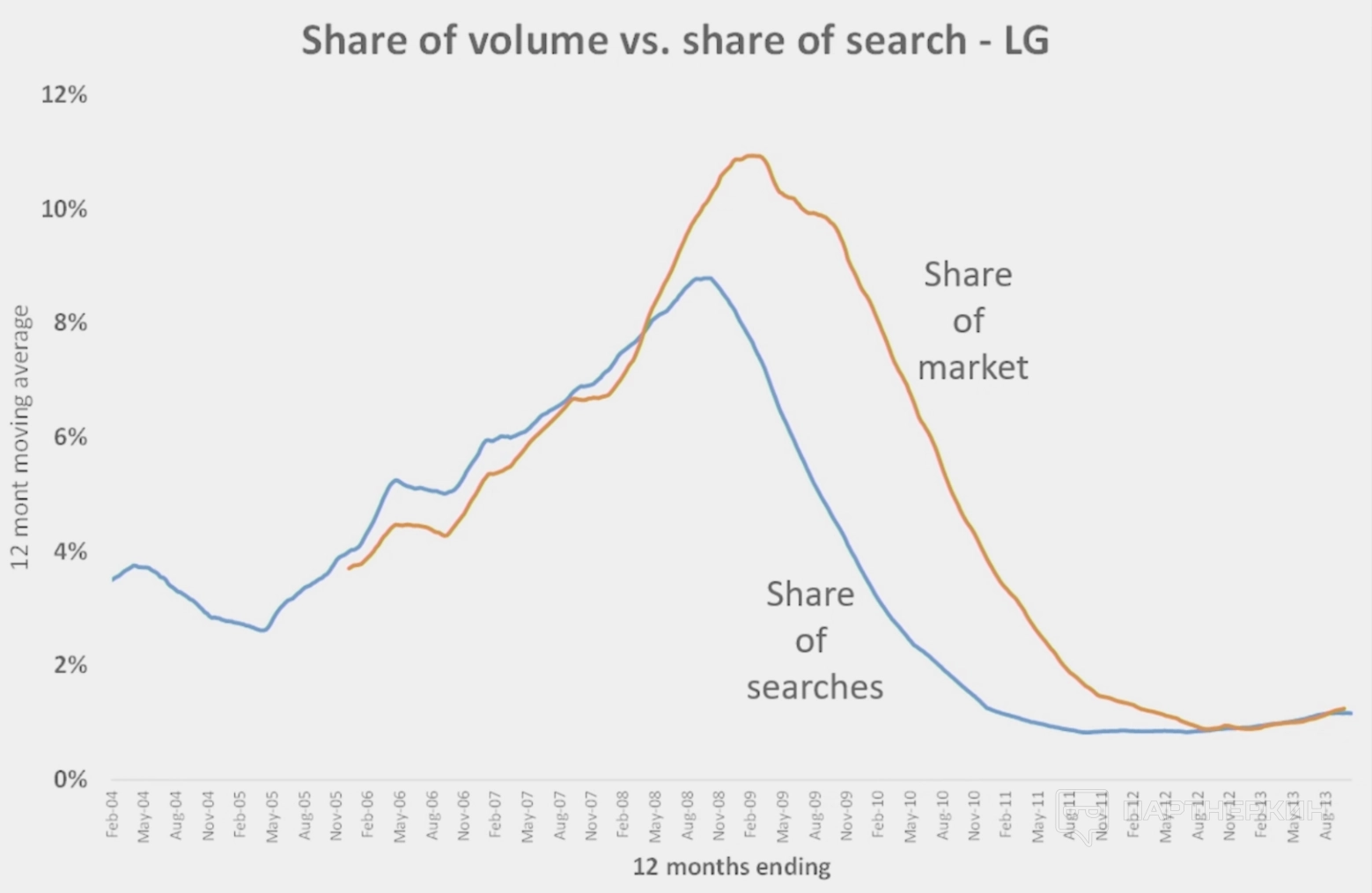
The product is roughly the same. The concentration of demand is not. The difference sits in what we call brand search — the share of branded search demand. That is not our invention: Les Binet and James Hankins drew the hypothesis in the early 2010s, across roughly a dozen and a half non-gambling niches, from cars to utilities.
We simply took it and checked it on gambling, against open regulator data from the UK, the Netherlands, the US and South Africa. I will not pretend there were no doubts that on an industry this murky and fragmented the correlation would fall apart somewhere. It did not. Later it became a product; originally it was just a check of somebody else’s hypothesis on our market.
The nuance this logic usually drops
In the same essay Graham adds a caveat that usually gets lost.
When a product moves into the brand age, quality does not stop mattering.
It simply stops being what sells the product and becomes the floor you cannot fall below. Patek can sell status, but it cannot sell a watch that loses a minute a day.
In iGaming the floor is the same: withdrawals on time, honest RTP, live support. None of them wins you a market. Any one of them, broken, takes the market away immediately. Brand just changes which job the product has to do.
What this means if you are not an operator
If you are choosing where to send traffic, which brand to partner with, which asset to price, and you compare operators on features — game counts, bonuses, account UX — you are comparing the things that barely differ anymore.
That is the three-dollar quartz movement. Everyone’s is equally good, and that does not help you choose.
What actually differs, and what actually predicts whether a brand will still have traffic a year from now, is only one thing: its share of brand demand right now, and whether that share is rising or falling faster than the competition.
You cannot see that in a casino interface. You can only see it in data on who people search for.
Brazil’s ban closed the same market for every licensed brand, but for most of them that market was the whole company. President Lula’s Provisional Measure 1,394 stopped new deposits and bets on 25 September, took licensed sites offline on 6 October and ends every federal licence on 25 October. Blask has estimated that the first […]
Malta asked its licensees which AI systems they actually run, and the answer looks little like a vendor pitch deck. On 18 September 2026 the Malta Gaming Authority published the AI Gaming Charter, written with the Malta Digital Innovation Authority (MDIA). Before setting out any principle, the 48-page document reports a study: a survey sent […]
Licensed sites were still paying withdrawals when offshore search set a new high. On 25 September President Lula banned fixed-odds betting and online casino in Brazil. Licensed sites go offline on 6 October. In the 90 days before the decree, 57% of Brazilian bettors had already visited an unlicensed site, and Blask’s calculation from India’s […]