
- Updated:
- Published:
Brazil’s betting ban: a lost market for some, a lost business for most
Brazil’s ban closed the same market for every licensed brand, but for most of them that market was the whole company.
President Lula’s Provisional Measure 1,394 stopped new deposits and bets on 25 September, took licensed sites offline on 6 October and ends every federal licence on 25 October. Blask has estimated that the first ten days cost licensed operators about R$1.2B in GGR. Congress has 120 days, plus recess, to keep or drop the measure.
The Brazil betting ban hits the whole market at once, yet each brand pays out of a different share of its business. Blask data on how much of each licensed brand’s revenue baseline sat in Brazil splits them into three groups: brands that lose the business, brands caught in the middle and brands that lose a market.
Who held Brazil’s licensed market
Before the decree Brazil’s money sat almost entirely with licensed brands. They held 96.8% of the country’s CEB (Competitive Earning Baseline, Blask’s projected revenue baseline) in January–September 2026, $7.5B, against 3.2% for offshore brands. After 25 September onshore Blask Index fell 82% while offshore brands drew the same demand as before, within 1%, so their share of search rose from 3.8% to 17.8% on a much smaller total.
Four brands, Betano, Bet365, Sportingbet and Superbet, held 50.9% of licensed CEB. Below them the market was local. Of the 158 licensed brands Blask tracks in Brazil, 125 had no other market, and together they held $3.14B, or 41.8% of the onshore total. Six of the top ten belong to that group, from Esportes da Sorte and 7Games to Betnacional and Vaidebet.
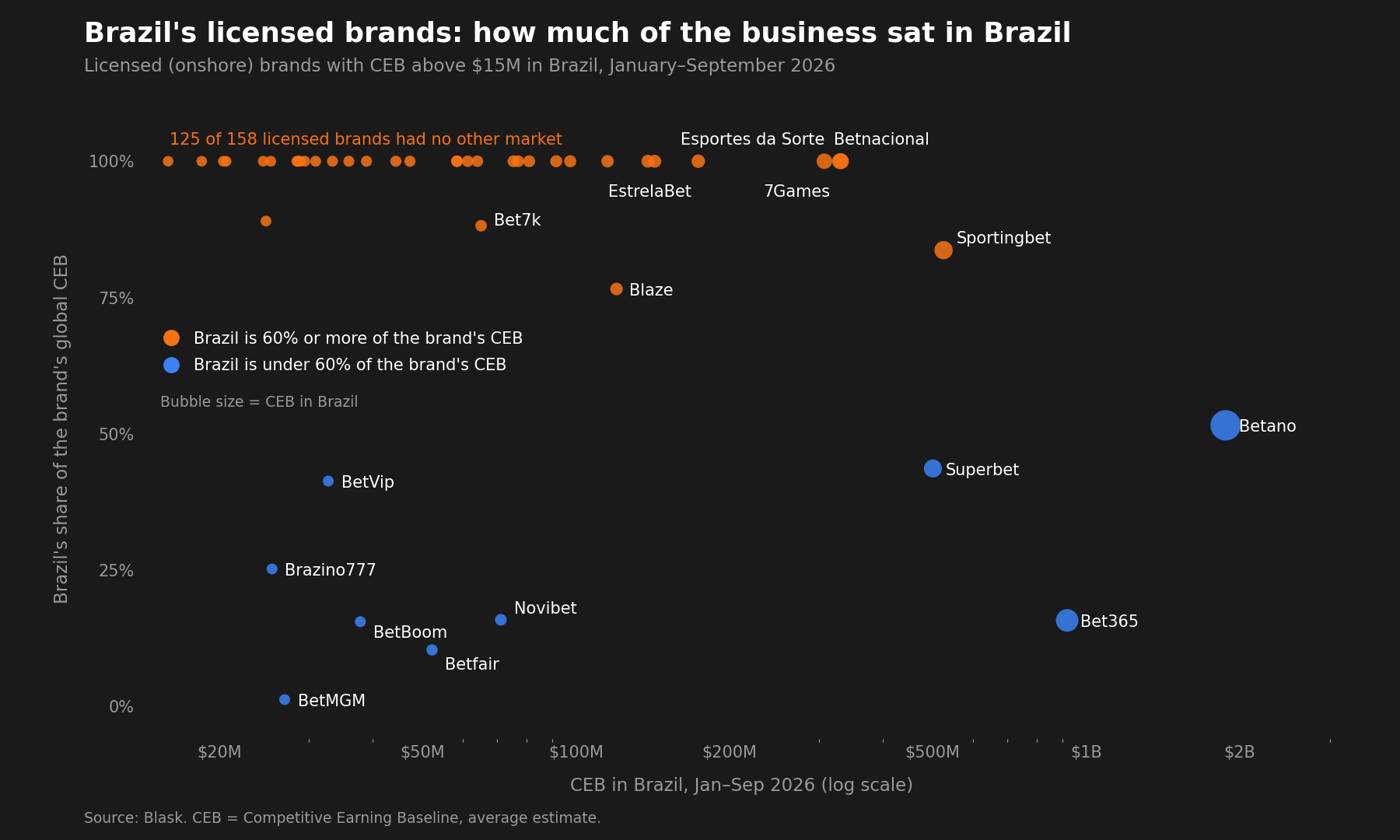
The orange dots are brands for which Brazil was most of the business. Besides the 125 Brazil-only brands, five more, including Sportingbet, Blaze and Bet7k, earned over 60% of their CEB there. Together these 130 brands held 51.7% of licensed CEB, so more than half of the licensed market belonged to companies the ban leaves with little else to earn from. At the other end sit 21 global operators for which Brazil was under 30% of CEB, and they held just 16% of the market.
Brands that lose the business
For the 125 single-market brands the ban removes all revenue at once. Most belong to Brazilian groups: OIG Gaming runs 7Games, Betão and R7, Esportes Gaming Brasil runs Esportes da Sorte and Onabet, and Ana Gaming runs 7K, VeraBet and Cassino.
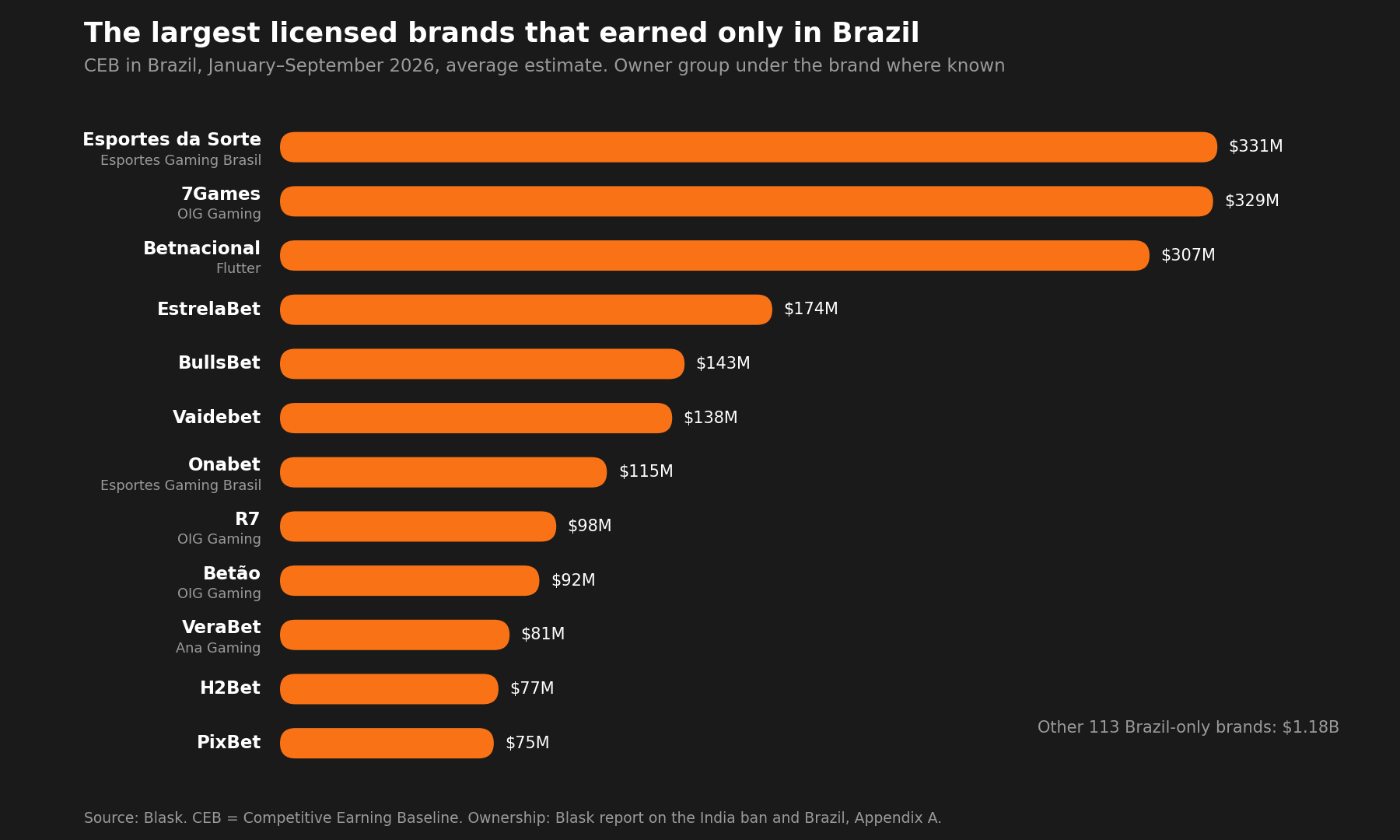
The ban falls hardest on a handful of local owners. OIG Gaming and Esportes Gaming Brasil alone held $965M of CEB through five brands, almost a third of what all Brazil-only brands earned and 12.9% of the licensed market. With every brand in one country, neither group can move revenue to another market while it waits for Congress.
Brazil-only brands were the first to cut jobs. By 5 October at least 36 of the 188 licensed brands had made staff redundant, according to a survey by Amig, Brazil’s association of women in the gaming industry, reported by Folha. Ana Gaming confirmed layoffs without numbers: “Ending operations by legal order undermines the conditions that sustain jobs and contracts. Even a possible reversal of the measure does not undo the damage already done.”
Rivalo let go almost all of its team of about 100, according to former employees, and kept a few people for a possible restart. Betano and Superbet, which have multinational structures and cash, kept their teams.
Sportingbet is the international brand closest to this group: Brazil made up 83.7% of its CEB, and its next-largest market, Greece, was less than a tenth the size. Antonio Forjaz, who heads Sportingbet in Latin America, said on 2 October that the brand will close its Brazilian operation if the ban stays.
Brands caught in the middle
Betano carries the largest absolute loss. Its Brazilian CEB was $1.88B in January–September, 51.6% of its global total. Allwyn, which owns 36.75% of Betano operator Kaizen Gaming, described Brazil as Betano’s largest market while other countries contribute the majority of revenue and grow faster. Blask’s estimate and Allwyn’s wording meet near the same 50% line. The brand is preparing legal action under its five-year licence and keeps its plan to enter four more countries in early 2027. Allwyn’s guidance of an adjusted EBITDA margin of about 37% for 2026 no longer applies if the ban lasts the year.
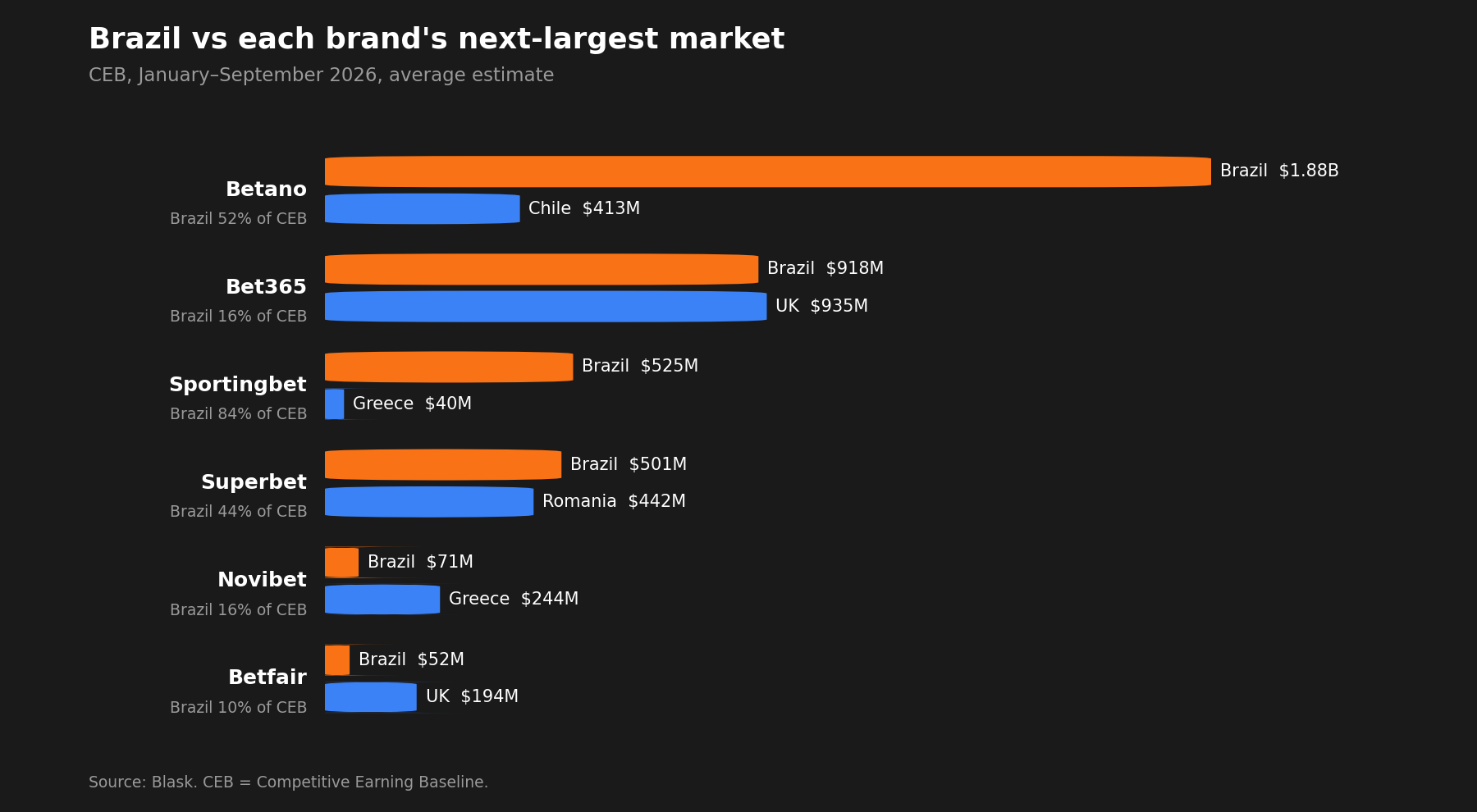
The size of the second market decides how long a brand can wait. Betano’s next-largest market, Chile, generates a fifth of what Brazil did, so no single country replaces the gap. Superbet earned 43.7% of its CEB in Brazil, but Romania nearly matches it, which leaves the group with a second home of the same scale. The group has not published a statement on Brazil; it switched off its site on 5 October and kept its staff.
Seven brands sit between 30% and 60% exposure, and two of them account for almost all of the group’s 32.3% of licensed CEB. Betano and Superbet have the cash and the markets to wait for Congress, and the most money to lose while they do.
Brands that lose a market
For listed groups Brazil shows up as a line in the guidance. Entain expected Brazil to make up about 5% of its online net gaming revenue in 2026, with a modest EBITDA contribution, and kept its EBITDA guidance while now expecting the lower end of the range. The same ban takes 83.7% of Sportingbet’s CEB and about 5% of its parent’s online revenue.
Flutter shows the same split. Betnacional earned all of its CEB in Brazil, while Flutter expects the ban to cut about $70M from its 2026 revenue and $20M from adjusted EBITDA if it lasts until year-end, against $16.4B of revenue in 2025. It plans to restart if Congress rejects the measure.
Bet365 lost its second-largest market by CEB. Brazil made up 15.8% of its global baseline across 79 countries, and the UK alone matched it. The company is private and has disclosed no figures; in a statement to trade press it called the decree unconstitutional and backed the trade bodies’ legal challenges.
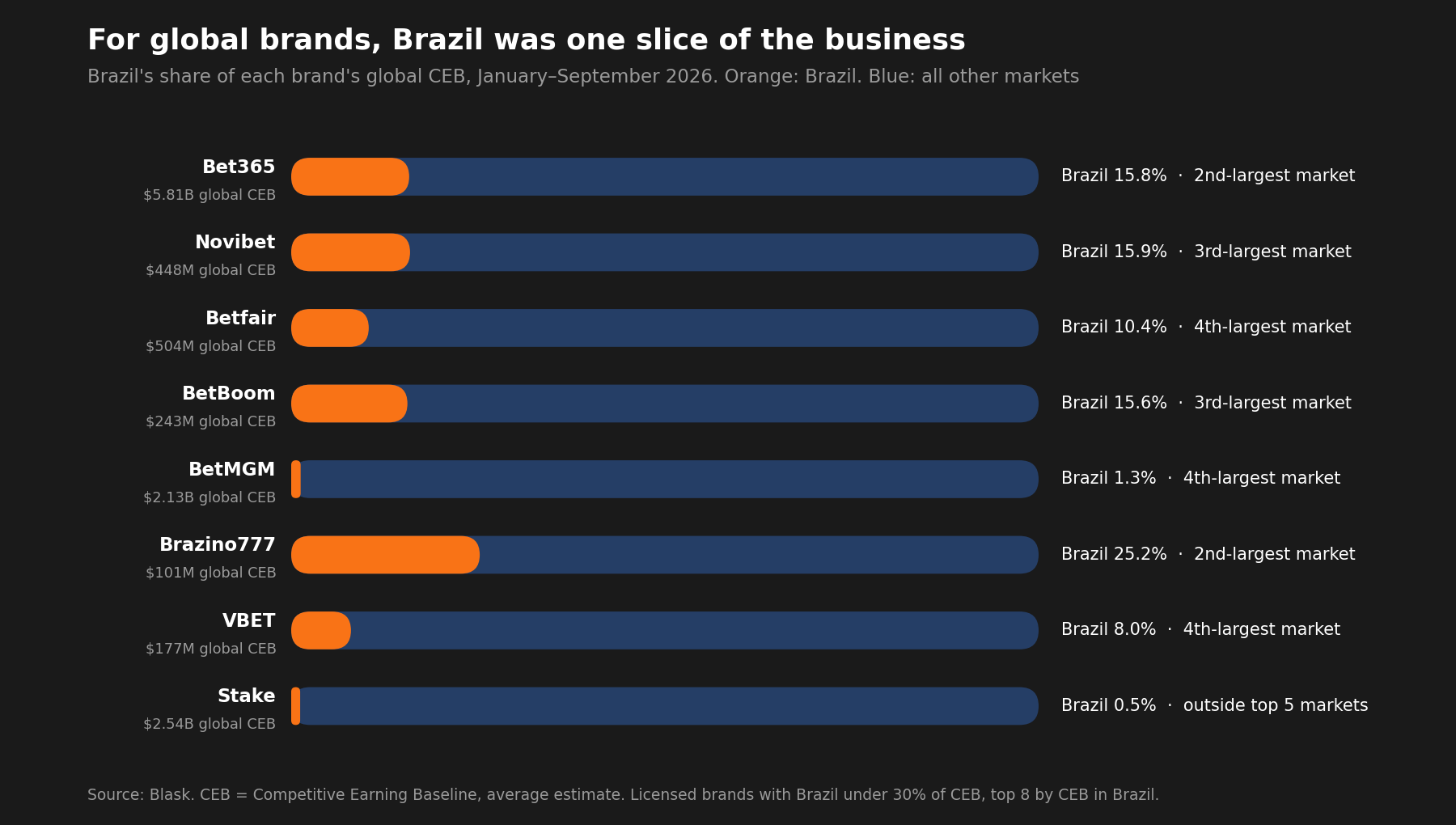
None of these brands loses more than a quarter of its business. Even where Brazil ranked second, as for Bet365 and Brazino777, the rest of the book was three to five times larger, so the ban dents a year’s results and leaves the company standing. The 21 brands in this group held 16% of Brazil’s licensed CEB, and for each of them Brazil was under 30% of the business.
Bottom line
Brazil’s ban removes one market, but half of the licensed revenue baseline belonged to brands with nowhere else to go. Global groups are guiding to a weaker year, Betano and Superbet can wait on reserves and other markets, and 125 local brands have to survive until Congress votes.
In 2004 a provisional measure closed Brazil’s bingo halls, the Senate rejected it by 32 votes to 31 that May, and the industry never returned as a regulated sector. The question this time is how many of the 125 will still exist when Congress decides.