- Updated:
- Published:
How Blask measures, calculates, and presents iGaming market intelligence

iGaming market data is fragmented, delayed, and often unavailable for unlicensed markets — Blask exists to fill that gap.
Blask provides independent market intelligence on global iGaming markets, including:
- ✅ Brand demand
- ✅ Market size estimates
- ✅ Competitive positioning and momentum
- ✅ Historical acquisition benchmarks
- ✅ Revenue baseline projections
- ✅ Game performance tracking
Our goal is to make fragmented markets comparable and help you act on market shifts earlier than traditional reporting allows.
Blask data
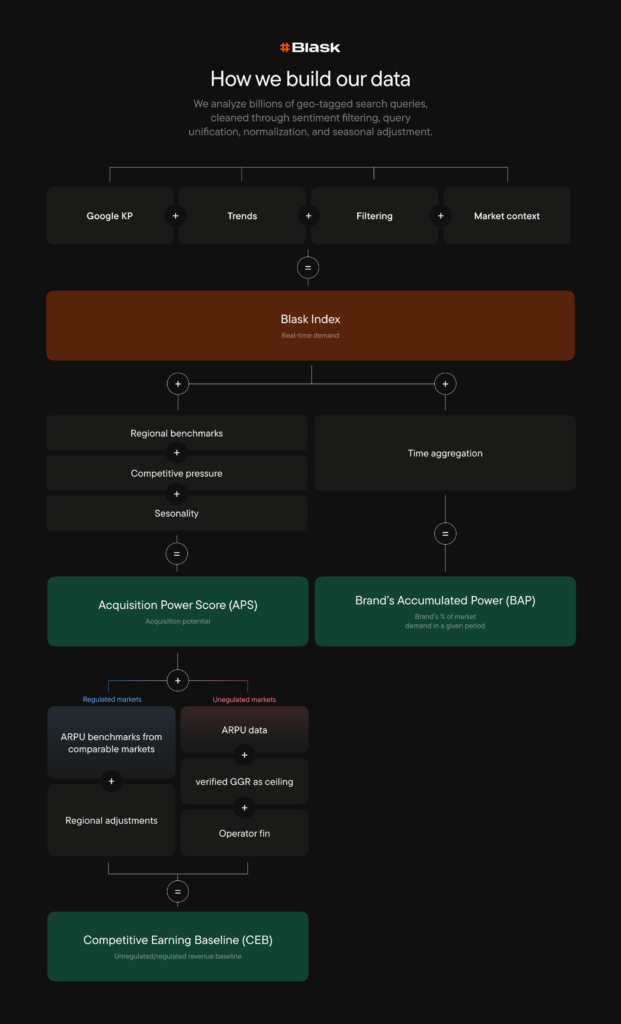
How we build our data
Blask is built on the Share of Search methodology (Les Binet & James Hankins). We process billions of geo-tagged search queries, then clean and normalize:
- Sentiment filtering — include “brand_name betting”, exclude “brand_name scam” or “brand_name payout problems”
- Variation unification — “merrybet” and “merry bet” become one brand (Google Trends shows them separately)
- Multi-pass normalization — Google can retroactively adjust its data, so we re-collect the same periods to detect and account for these revisions
- Seasonal adjustment — we account for seasonal trends that affect search demand patterns
How we calculate metrics for different markets
Blask classifies brands in regulated markets as either local (holding a domestic license) or international (operating without one). In unregulated markets, all brands are treated as international by default. This distinction matters because each type requires a different calculation path for CEB.
For regulated markets with local licensing:
- Blask processes regulatory documents (reports, tables, scans) and normalizes the data
- CEB for local brands is anchored to verified GGR figures from regulators — this gives the market a confirmed “ceiling”
- Where individual operators publish financial data, Blask uses it as an additional calibration point
For international brands (operating without local licenses):
- No public financials are typically available, so Blask relies on behavioral signals such as conversion rates and ARPU benchmarks
- CEB is derived from the brand’s Blask Index engagement and APS, translated via regional ARPU benchmarks
- The methodology ensures international brands are comparable to local ones — same framework, different data inputs
For unregulated markets:
- Market size is estimated through Blask Index (demand volume) combined with ARPU benchmarks from comparable economies
- CEB is calculated individually for each brand based on its BAP and APS
For brands with non-domestic usage:
- Some brands appear in a country’s rankings despite not actively operating in or accepting users from that market. Blask flags these with a “Non-domestic usage” indicator.
- When a brand receives significant search interest in a country where it has no active presence, the data reflects the value the brand could capture if it were to enter and operate in that market.
Data Sources
We aggregate and process data from:
- Google Keyword Planner & Google Trends
- Public regulatory disclosures
- Gambling commission reports
- Operator public filings
- Third-party research partners (cohorts, ARPU, retention)
- Proprietary modelling and weighting
Brand Metrics
Blask brand metrics work as a pipeline. Each metric builds on the previous one — but also adds new data layers at every step.
Blask Index
What it is: Real-time indicator of brand and market demand. Like a stock ticker for iGaming — shows how player attention shifts across brands, markets, and countries. Available in hourly, daily (for established brands) and monthly granularity.
What it is not:
- ❌ GGR or revenue
- ❌ Website traffic or visits
- ❌ Raw Google Trends data
Think of it as a Dow Jones for iGaming — a single number that reflects market pulse.
BAP (Brand’s Accumulated Power)
What it is: A brand’s share of total market attention in a given country and period, expressed as a percentage. Formula: BAP = Brand’s Blask Index / Market’s Blask Index × 100%. Shows how much of the market’s search-based demand each brand captures relative to competitors.
What it is not:
- ❌ Market share by GGR or NGR
APS (Acquisition Power Score)
What it is: AI-driven benchmark showing how many new customers a brand should have attracted given its market presence in a given period. Measured in potential customers, expressed as a range: min / avg / max.
APS starts with the brand’s Blask Index and BAP (its share of market attention), then applies a set of market-specific factors to translate “attention” into “expected acquisition”.
The same level of search interest converts into very different acquisition numbers depending on the market, and APS accounts for this.
What it is NOT:
- ❌ Actual FTD count
If your real acquisition is below APS — you’re underperforming your brand potential. Above — you’re outperforming.
CEB (Competitive Earning Baseline)
What it is: Projected revenue baseline a brand should realistically capture given its BAP, APS, and competitive context. Measured in USD, expressed as a range: min / avg / max.
What it is NOT:
- ❌ Revenue from PnL
- ❌ GGR from operator reports
CEB is a benchmark for what’s achievable, not a report of what happened.
Both APS and CEB are shown with a deviation range around the baseline to reflect market volatility. Min assumes underperformance, avg is the baseline forecast, max reflects stronger-than-expected growth.
Game Metrics
GVR (Game Visibility Rank)
What it is:
Daily ranking of game placement across operator lobbies. Blask scans lobbies daily, recognizes tens of thousands of games, and shows: how many brands carry each game, how often it appears in lobbies (and other pages) and at what average position, how often it appears across all pages and at what average position.
How to use it:
- Operators: See which games dominate lobbies in each GEO, build your own lobby lineup based on proven performers. Spot games that dominate competitor lobbies but are missing from yours.
- Providers: Track which competitors get best placement, see which mechanics and themes get top lobby positions in each GEO. Verify whether operators place your games in agreed positions, monitor placement changes over time
SoI (Share of Interest)
What it is: Metric based on search engine query volume, showing how much player attention each game captures in a market. Track shifts monthly — spot what’s trending up or cooling down.
How to use it:
- Operators: Identify rising games before they hit peak demand, optimize lobby for what players actually search for. Measure whether ad campaigns drove increased search interest for promoted games.
- Providers: See which mechanics and themes perform in which GEOs, shape product strategy around real demand
Provider Content Share
What it is: Share of a specific provider’s games on a given page of a given brand, expressed as a percentage. Shows how much lobby space each provider occupies — by brand, by page type (e.g. casino, slots, live), and by date.
How to use it:
- Operators: See how your lobby is distributed across providers, identify over-reliance on a single supplier.
- Providers: Track your shelf space across brands and pages, benchmark against competitors in each market. Monitor changes in your share over time — detect early if competitors are gaining ground.
Game country analytics
What it is: Overview of a game’s distribution across a specific market: how many brands carry the game and on how many pages (lobby, casino, slots, live, etc.) it appears. Available per country.
How to use it:
- Operators: Check how widely a game is already distributed in your market before adding it to your lineup
- Providers: Track your game’s reach across brands and page types in each country, spot gaps in distribution
Why numbers may differ from expectations
Blask metrics are built on demand signals. This means our numbers may not match regulatory reports or internal analytics — and that’s by design. Here’s how to interpret common differences:
- “Offshore brand is ranked higher than licensed operator”
Blask measures demand — what players search for. Demand exists independently of licensing status. When an offshore brand shows strong search interest, it reflects real audience behavior. This can be a useful signal for licensed operators to understand where attention is going. - “Our revenue is different from CEB”
CEB is a baseline projection, not a prediction of your actual revenue. Think of it as a benchmark: it shows what’s typical for a brand with your level of market presence. The gap between CEB and your real numbers can highlight opportunities or strengths in your conversion. - “I never heard of this brand, but it’s in your top 10”
Some brands are highly visible in digital channels but less present at industry events or in trade media. Blask captures audience search behavior, which may surface brands that aren’t yet on your radar. - “Regulator published different numbers”
Regulatory data and Blask data measure different things. Regulators report completed transactions, often with a delay. Blask tracks real-time demand signals. Both are valid — they answer different questions.
What Blask data is not
Blask is a market intelligence tool, not a financial reporting system. Our metrics are designed to show demand, potential, and competitive positioning — not to replace internal analytics or regulatory filings. Blask data is not:
- ❌ Official regulatory reporting — however, Blask does use publicly available regulatory data as calibration inputs for CEB in regulated markets.
- ❌ Operator-reported financials
- ❌ A substitute for licensed disclosures
- ❌ Brands’ internal PnL