
- Updated:
- Published:
How payment service providers use Blask in iGaming
Payment service providers use Blask to standardize two core screening workflows: evaluating new markets and assessing potential operator clients.
PSPs (Payment Service Providers) that want to scale in iGaming often face the same bottleneck: deciding which countries to prioritise and which operators justify integration effort, with limited time and imperfect information. Both workflows can be handled through internal reporting and manual research, but the work is hard to keep consistent across GEOs and to repeat at pace.
Blask packages these recurring questions into a structured format with country pages (market context, regulation, demographics, Customer Profile) and brand pages (cross-GEO presence and comparable metrics such as BAP and CEB).
💡 Blask Index
Real-time measure of market demand volume for iGaming brands in a given country, based on normalized search data. Read more
💡 BAP
A brand’s percentage share of total market demand in a specific country and period. Read more
💡 CEB
Projected revenue a brand should realistically capture given its market presence, expressed in USD. Read more
Country screening
This workflow triggers when a company wishes to enter a new country or when a PSP evaluates whether to build infrastructure for a new jurisdiction. The goal is not to predict payment volumes, but to produce a disciplined market brief: regulatory posture, demand direction, and operator landscape.
What PSPs can pull from Blask for a country brief:
- Regulation status by iGaming verticals (casino and betting)
- Licensing context: which operators have licensees for both verticals, which only for one, and which are not licenced at all
- Customer Profile, that shows the typical iGaming player in that country: age, income, employment status, problem gambler status, etc
- Demand signal, measured by Blask Index
- Timing: trends are shown on Blask Index chart and accompanied with Market explanation feature
- Revenue benchmarks, projected with CEB
Use case: researching Tanzanian market for potential expansion
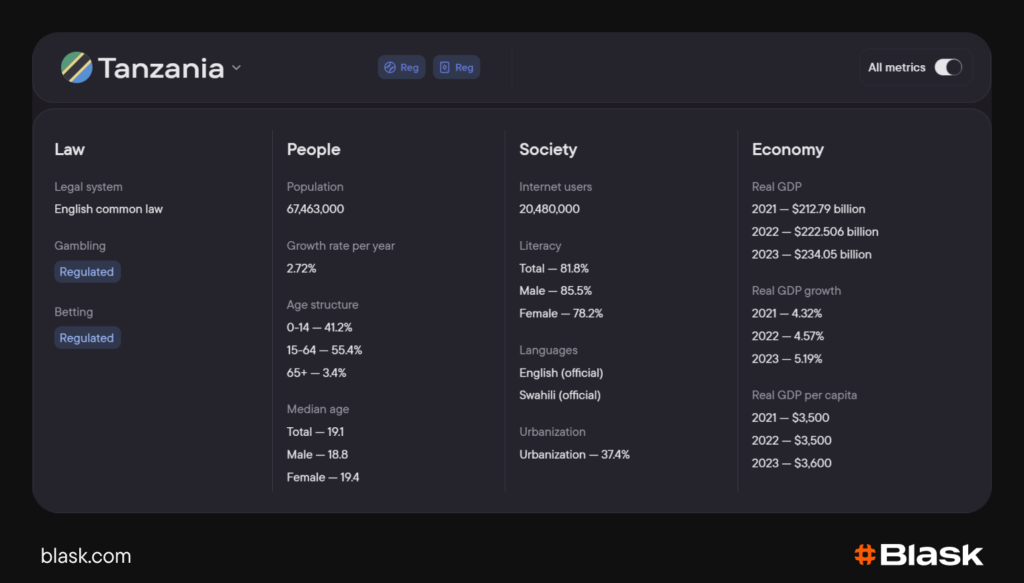
The Country Profile shows that both online casino and online betting are regulated in Tanzania. The page surfaces key economic and demographic indicators — population size, internet penetration, GDP per capita — giving the baseline context for market maturity.
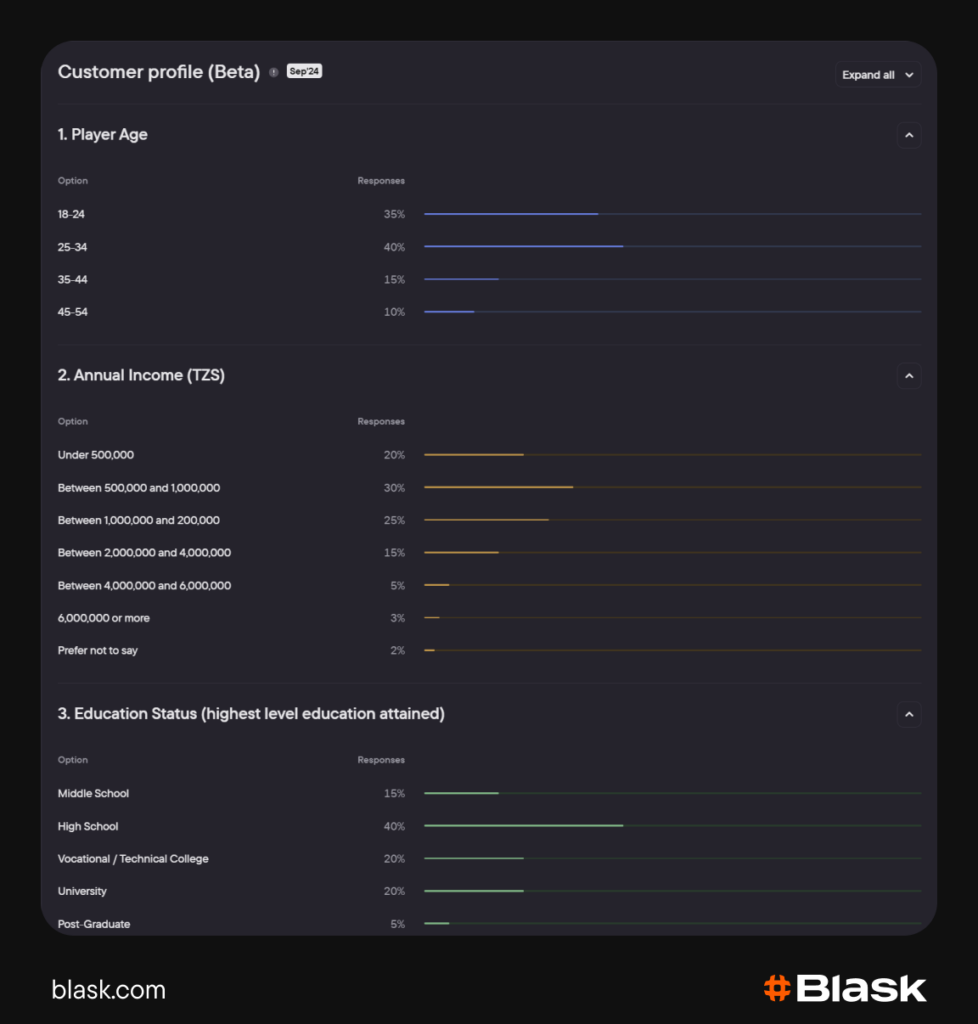
The Customer Profile page breaks down the typical Tanzanian iGaming user: age distribution, employment status, income level, motivations for playing and much more. This helps the PSP understand whether the player base aligns with their existing client portfolio and payment method capabilities.
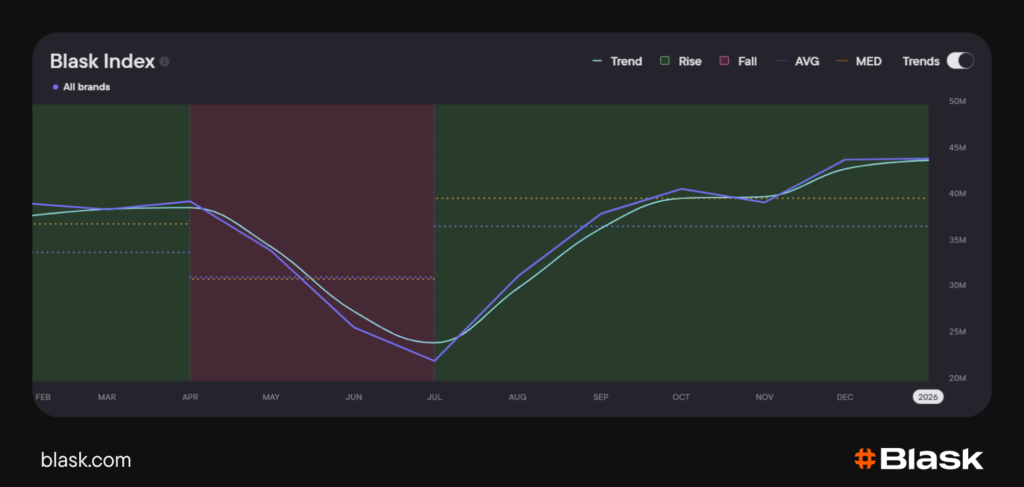
The Blask Index chart shows that user attention in Tanzania is rising. The click through to the Market Explanation feature helps understand why — whether growth is driven by regulatory changes, marketing spend, sports events, or shifting consumer behavior.
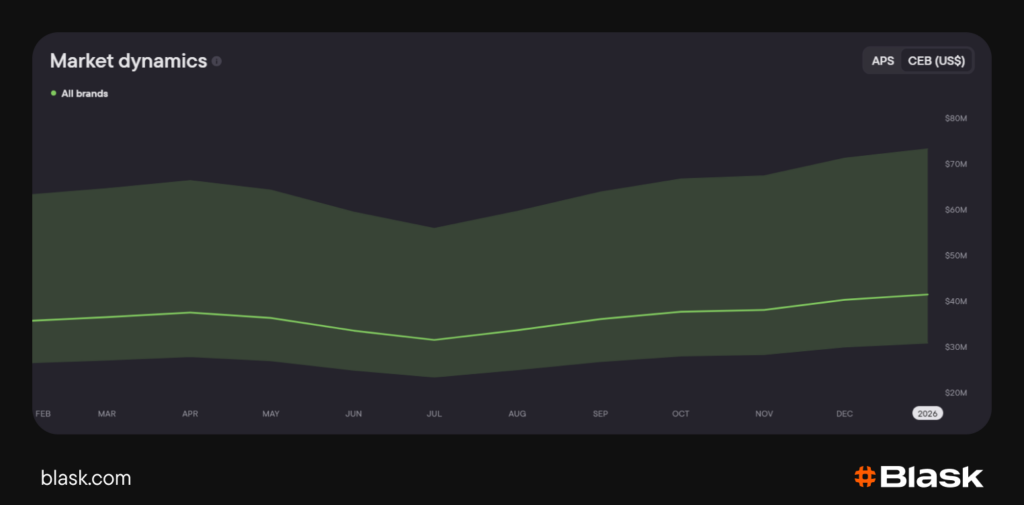
Market Dynamics by CEB shows consistent growth, confirming the sustainable trend.
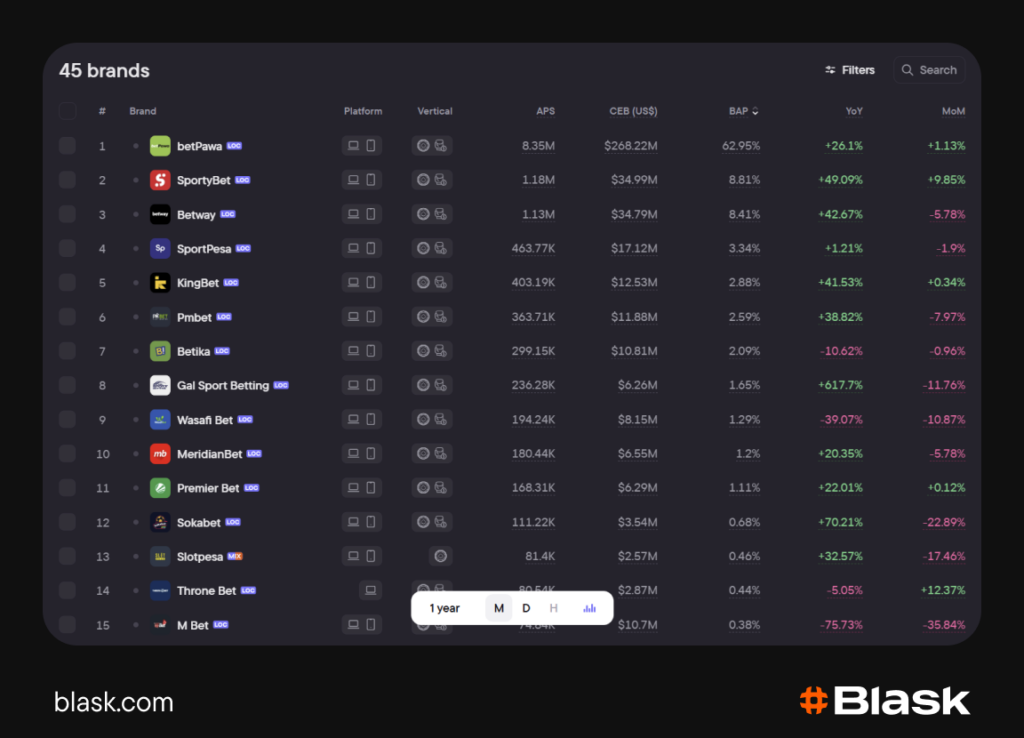
The Country’s Brands page lists active operators in Tanzania, information on their licence status, platforms they operate, their CEB and BAP, as well as their YoY and MoM performance.
Brand Screening
This workflow applies to both inbound inquiries (operators approach you) and outbound prospecting (you build target lists). The questions are straightforward but time-intensive to answer manually: Where does this brand operate? Which markets drive its business? Is revenue concentrated or diversified?
What PSPs can pull from Blask for a brand profile:
- Geographic footprint — the brand page lists all countries where the operator is active and ranks its top markets
- Brand strength by market and its position on each country’s market based on BAP
- Revenue estimates per country shown as CEB
- Licensing posture for regulated markets
- Close competitors for the brand on country page
Use case: evaluating EU9 brand as potential client in Southeast Asia
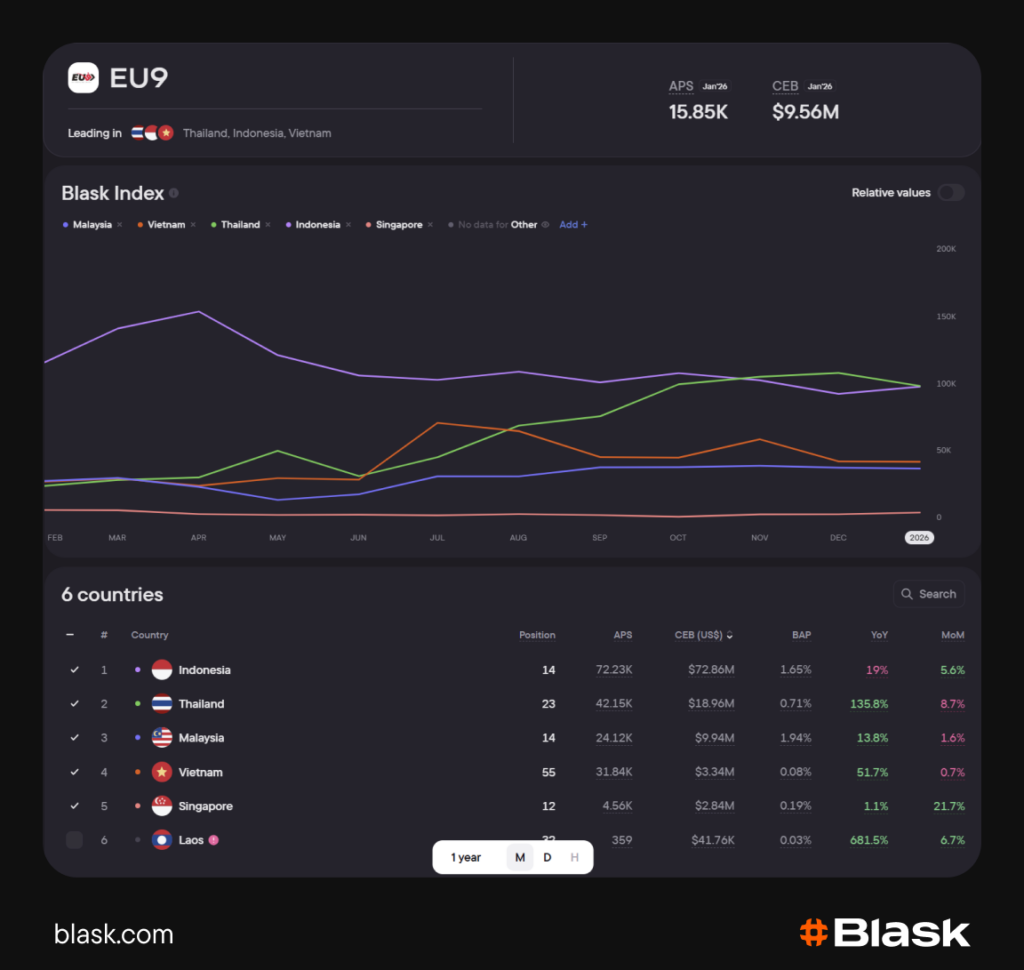
Brand’s page shows that EU9’s operations are concentrated in SEA. It is present in 6 countries and holds strong positions in Indonesia, Malaysia and Singapore. Performance in Thailand for the last year looks promising, though momentum is slowing down. Most CEB comes from operations in Indonesia.
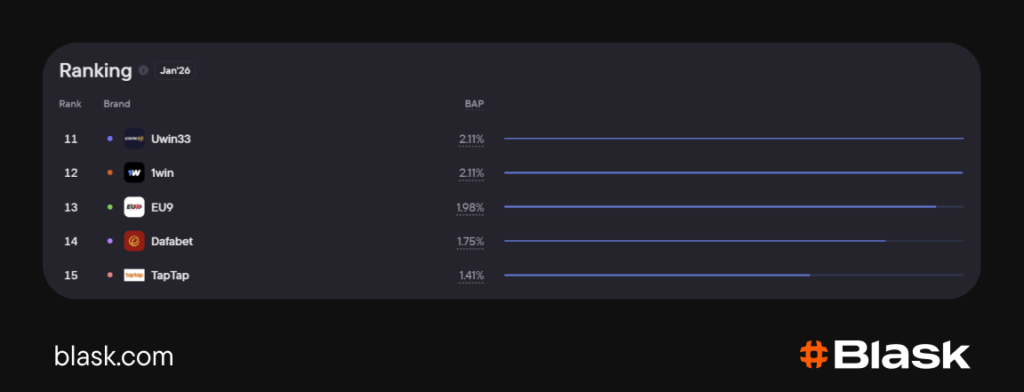
EU9`s close competitors in each country can be seen on its page. For example, as of January 2026 EU9 ranks in Malaysia between such globally known brands as 1win and Dafabet.
A reliable source for intelligence and insights
Blask helps PSPs to structure market and merchant research into repeatable frameworks. It is a reliable front-end research layer before formal due diligence begins.