

- Updated:
- Published:
College basketball disrupts the US sports betting calendar

US online betting demand follows major leagues calendars — with one exception.
One of the biggest sporting events in the United States takes place every March. The college basketball tournament known as March Madness is the only student sports event that visibly moves US iGaming demand, measured by Blask Index. Everything else in the US online sports betting calendar is driven rather by professional North American leagues schedules or by big international events — including this summer’s FIFA World Cup, co-hosted by the USA.
This article accompanies Blask’s wider report covering the US and Canadian iGaming markets — state-by-state and province-by-province breakdowns, offshore vs. domestic dynamics, brand rankings, and expert commentary.
Basketball: a college tournament that stops the spring decline
The NCAA (National Collegiate Athletic Association) Division I men’s basketball tournament, more often called March Madness or The Big Dance, is a single-elimination event in which 68 university teams are reduced to one champion over three weeks. The pressure is high — lose once and you are out. The 2026 edition begins on 17 March, with the final on 6 April in Indianapolis, Indiana.
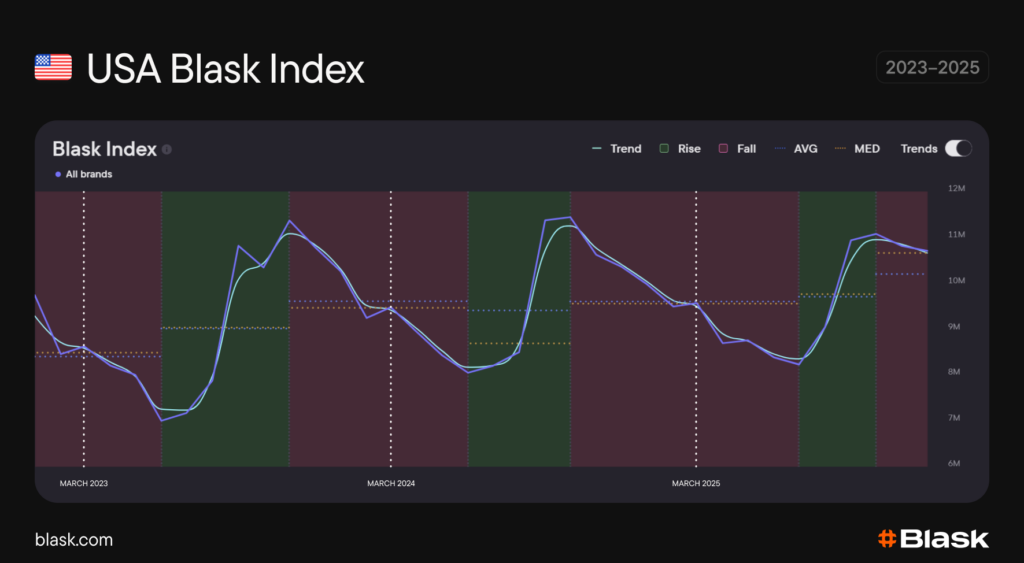
The tournament, with 87 years of history, is large enough to shift iGaming demand across the whole US market. Blask Index tends to fall in spring after the winter high, but in March that decline slows and often briefly reverses before continuing the downtrend.
Blask’s Categories feature breaks it down further. March Madness generates the highest demand for online basketball betting of any point in the year. Blask Index of the basketball subcategory peaks exactly in March, which means the NCAA event draws more attention than the opening or high-stakes stages of the National Basketball Association (NBA) season.
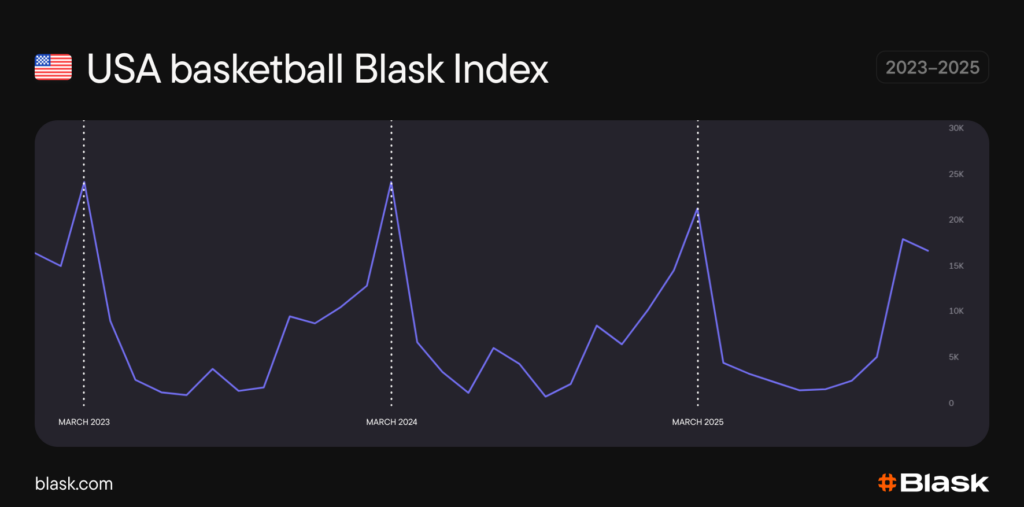
In every other major US sport, no college competition comes close to this effect. While basketball is the exception, the rule is set by professional leagues — starting with the biggest one.
American football: the season opener rules
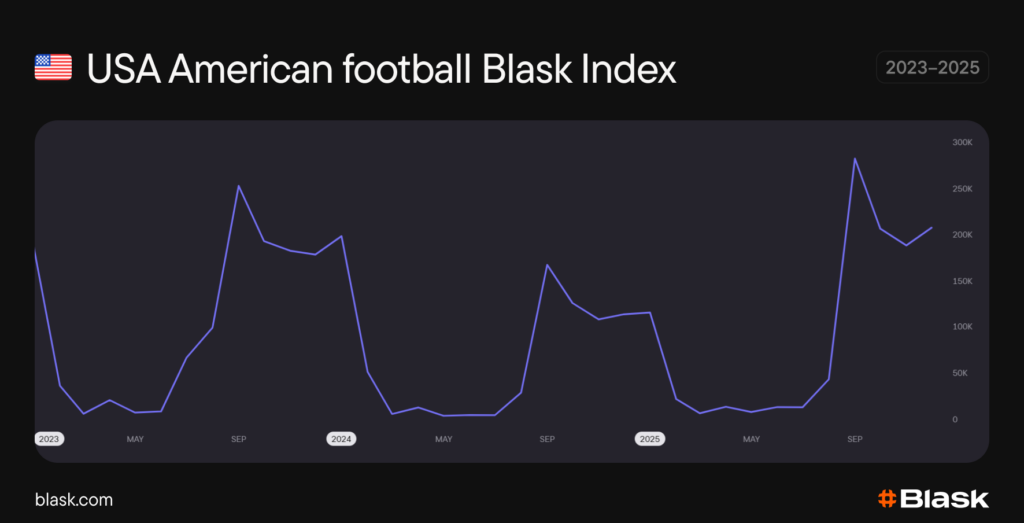
American football — simply called football in the United States — is the country’s number one sport. According to Blask data, it accounted for over 56% of the US online betting demand across 2023–2025 (excluding general interest).
Demand jumps in September when the National Football League (NFL) regular season kicks off. It holds high through autumn, then lifts again in December as the playoff race reaches its climax, before the postseason takes over in January.
The NFL is the only one of North America’s “Big four” major professional leagues composed entirely of US-based teams. The National Hockey League (NHL), Major League Baseball (MLB), and the NBA all include franchises from Canada.
With only 285 games across its entire regular season and playoffs, the NFL runs the leanest schedule. It has almost 9x fewer games than MLB and 5x fewer than the NHL, making demand for American football betting uniquely concentrated.
And yet, online betting demand for baseball and hockey follows a similar pattern to American football. Interest peaks at the beginning of the professional league season then fades and rebounds closer to the playoffs.
The fifth major sport differs from “Big four” completely.
Soccer: the league that does not command the demand
In recent years the term “Big four” has been transitioning to “Big five”, as internationally recognised football, which is called soccer in the US, grows in popularity. Major League soccer (MLS) runs from February through early December, but online betting demand does not follow its schedule in the way it follows the NFL, MLB and the NHL.
Soccer demand has historically been driven by big international tournaments — spiking sharply then falling back. June 2024 produced the biggest spike, driven by UEFA Euro 2024 and Copa América. Summer 2025 brought another, although far more modest, spike from the FIFA Club World Cup and UEFA Women’s European Championship.
But after that, interest did not fall back to the previous lows, as the country is preparing to co-host the FIFA World Cup this summer, for the first time since 1994.
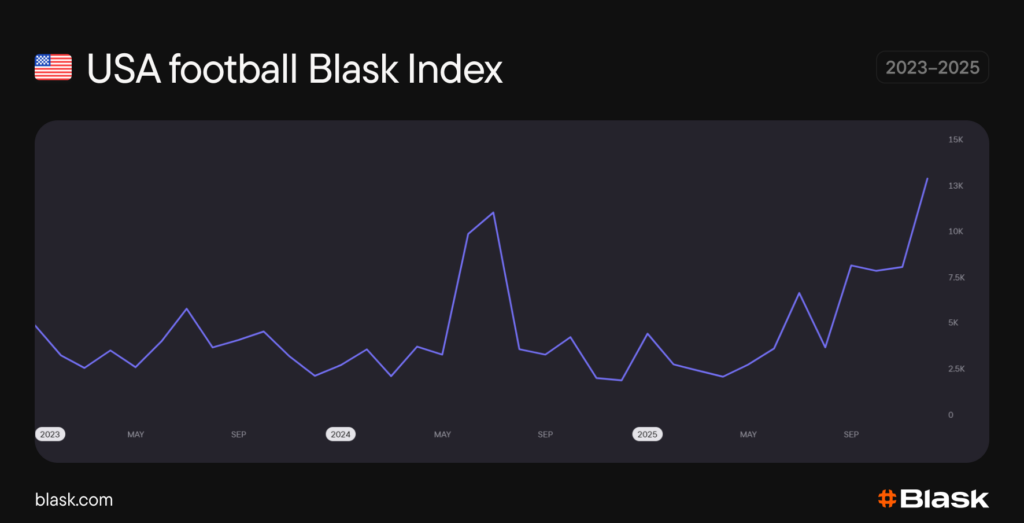
The rise in soccer betting interest in the last months of 2025 is likely connected to the prop betting scandal involving two MLS players and a World Cup group stage draw ceremony that took place in Washington D.C. on 5 December.
During the event, US president Donald Trump made headlines by suggesting that the United States should stop using the word “soccer” and call the sport “football” instead. The remark sparked a wide debate, but nothing changed, and even FIFA’s US-related messaging continues to use “soccer” alongside “football”.
The NFL and MLS are unlikely to rename themselves, but the World Cup on North American soil could spike online betting interest for the sport beyond the tournament and to the domestic league.
Bottom line: what drives US sports betting
According to Blask data, three patterns define online betting demand for major sports in the US. Football, baseball and hockey follow their professional leagues calendars. Basketball peaks with the March Madness college tournament. Soccer experiences the most impact from international tournaments. This year, the biggest of those tournaments — FIFA World Cup — comes to North America.