
- Updated:
- Published:
What is a betting limit
A customer sees “$5,000 max” on an NFL spread and assumes that number belongs to them. Often it does not. The same screen might cap a sharp account at $100 without changing the posted maximum, or refuse a $200 correct-score ticket while accepting $40,000 on the moneyline in the same game. Betting limits are how sportsbooks and casinos draw those lines: not one rule for everyone, but a stack of ceilings tuned to market depth, event risk, and the person holding the account.
What is a betting limit?
| A betting limit is the maximum or minimum amount permitted on a single wager, payout, or account-defined stake band. Operators set these boundaries to control financial exposure, keep markets tradable, and in many jurisdictions meet responsible gambling expectations. |
The term sounds simple. Implementation is not. A limit can bind the stake (what the customer risks), the payout (what the book pays if the bet wins), or both. The difference between a wager limit and a payout limit is direction: wager limits cap what the customer can risk; payout limits cap total winnings on a ticket, especially on large parlays. It can apply to one market, one sport, one session, or one customer profile. It is not the same as a deposit cap or a loss limit the player chooses in a responsible gambling menu, though product copy often blurs the three. The difference between a betting limit and a deposit limit is ownership: operators set stake and payout caps; players (or regulators) often set how much funding enters the account.
Betting limits vs other account limits
Customers encounter several caps with similar names and different owners.
| Limit type | Who sets it | Primary purpose | Typical example |
| Betting / wager limit | Operator | Book liability and risk | Max $2,500 on a player prop |
| Payout limit | Operator | Cap winnings on a ticket | Max $250,000 parlay payout |
| Deposit limit | Player (often) or regulator | Control funding | $500 per week self-cap |
| Loss limit | Player or regulator | Cap net losses | $200 lost per session |
| Time limit | Player or regulator | Session duration | Two hours per day |
Bodog’s limits guide separates operator-set wager and payout caps from player-set deposit and loss controls. The distinction matters in product copy: a bettor who hits a betting limit is not necessarily breaching a self-exclusion or deposit rule. Support scripts should not treat the events as interchangeable.
How betting limits work
Limits attach at different layers and multiply together at placement.
Market liability. Trading asks how much the book can afford to lose if this selection wins. Liability scales with odds: the same dollar cap allows a smaller stake at long prices than at short ones. Betting Calculators’ glossary describes market limits as liability-driven, not stake-driven.
Sport and event tier. Liquid majors carry higher ceilings than niche leagues. OddsIndex gives a representative US pattern: a book might take a $50,000 NFL spread but cap MLS at $5,000 on the same bet type because volume and price discovery differ.
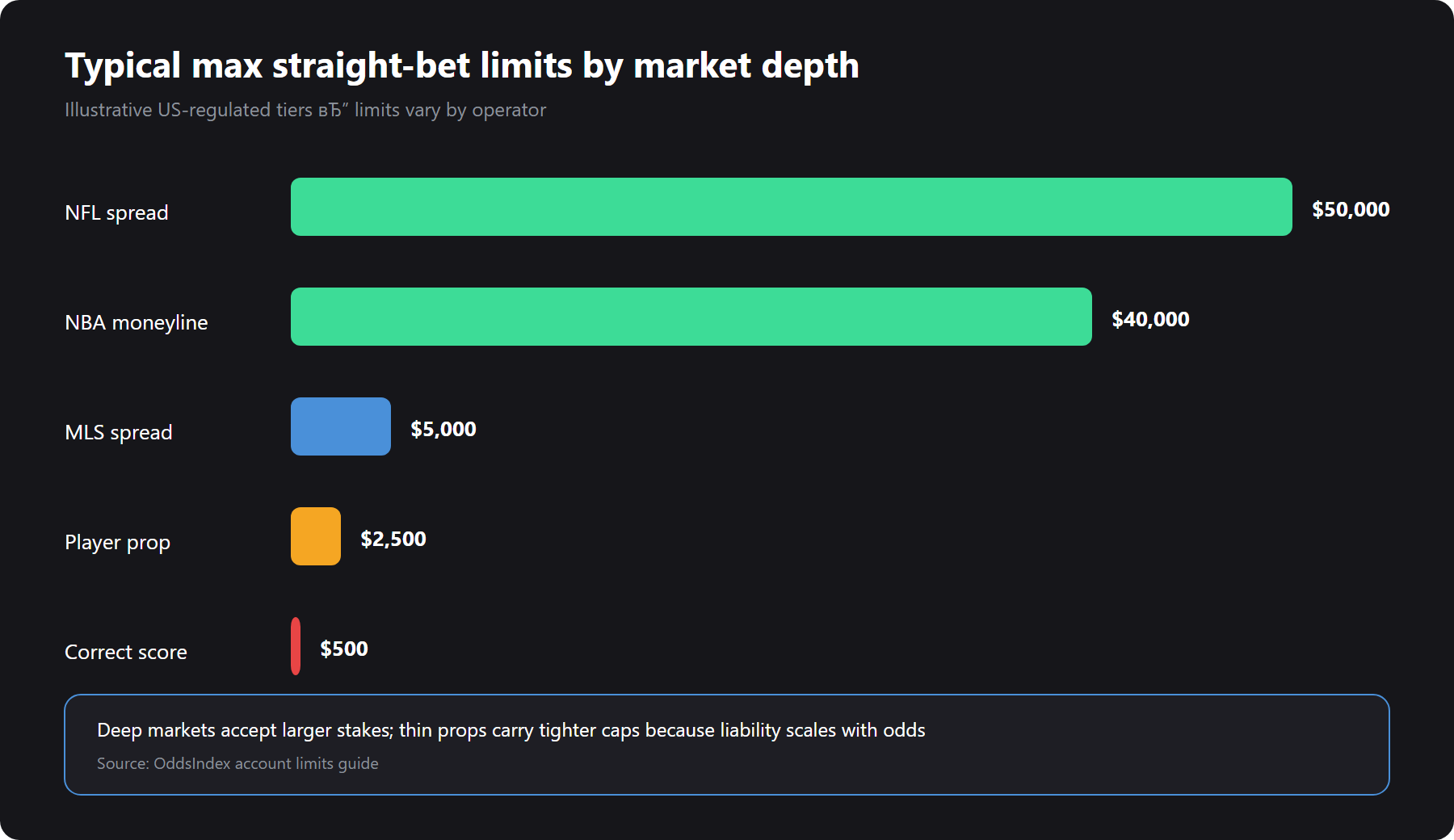
Typical max straight-bet limits by market depth
Market type within one game. Moneyline and spread usually outrank player props, alternate lines, and exotic scores. Parlays often hit payout caps ($250,000–$1,000,000 at large US books) rather than per-leg stake caps alone.
Account-level multipliers. The posted maximum is a ceiling for recreational profiles. Risk teams apply a stake factor (0–1) per customer, sport, or market. A 0.1 factor turns a $5,000 market max into a $500 personal max without updating the public number.
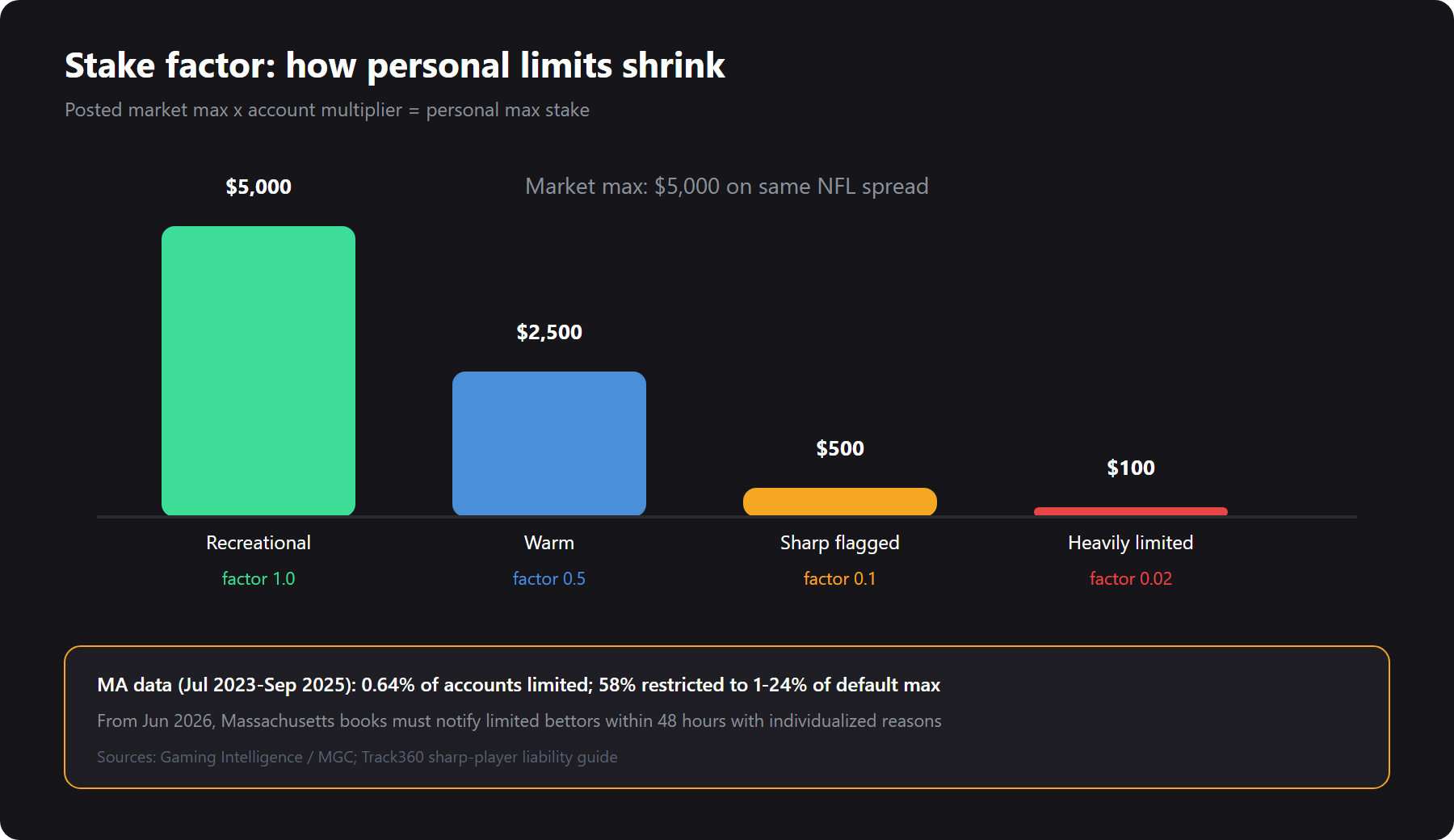
Stake factor — how personal limits shrink from market max
Minimum bets. Floor limits matter for casino tables and low-stakes acquisition funnels. Wikigamia’s bet limit entry lists typical casino ranges: blackjack tables often start at $5–$25 minimum with $500–$10,000 maximums in standard rooms, wider in VIP.
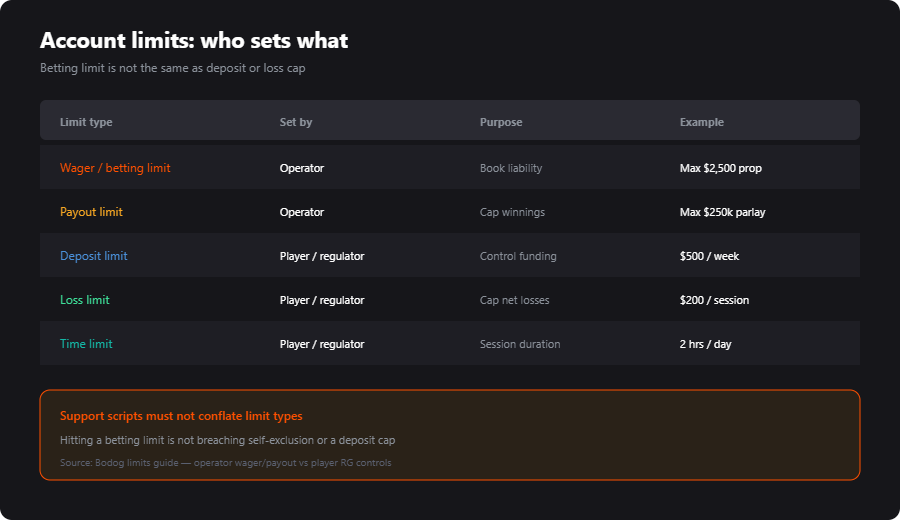
Betting limit types — minimum, maximum, payout, personalised
Types of betting limits
Minimum bet limits define the smallest accepted wager.
Maximum bet limits cap stake on a single selection or ticket.
Table / game limits preset min and max for a specific roulette, blackjack, or slot configuration.
Payout limits cap total return on high-multiple tickets, especially parlays.
Personalised limits let players set their own betting limits through responsible gambling tools; these sit alongside operator limits and whichever is stricter wins at placement. In many regulated markets, self-imposed caps are a standard player control, not a substitute for book-side liability management.
What drives limit levels
Three forces pull the sliders.
Liquidity and pricing confidence. Deep, heavily traded markets absorb size. Thin props do not; one mispriced anytime goalscorer can cost more than the market’s monthly handle if limits are loose. That is why limits vary by sport: NFL and NBA handles support higher straight-bet ceilings than lower-tier soccer or exotic props, where pricing confidence and historical volume are thinner.
Product type. In-play betting carries tighter caps in many books because prices move faster and manipulation risk is higher. Same fixture, different limit by pre-match vs live.
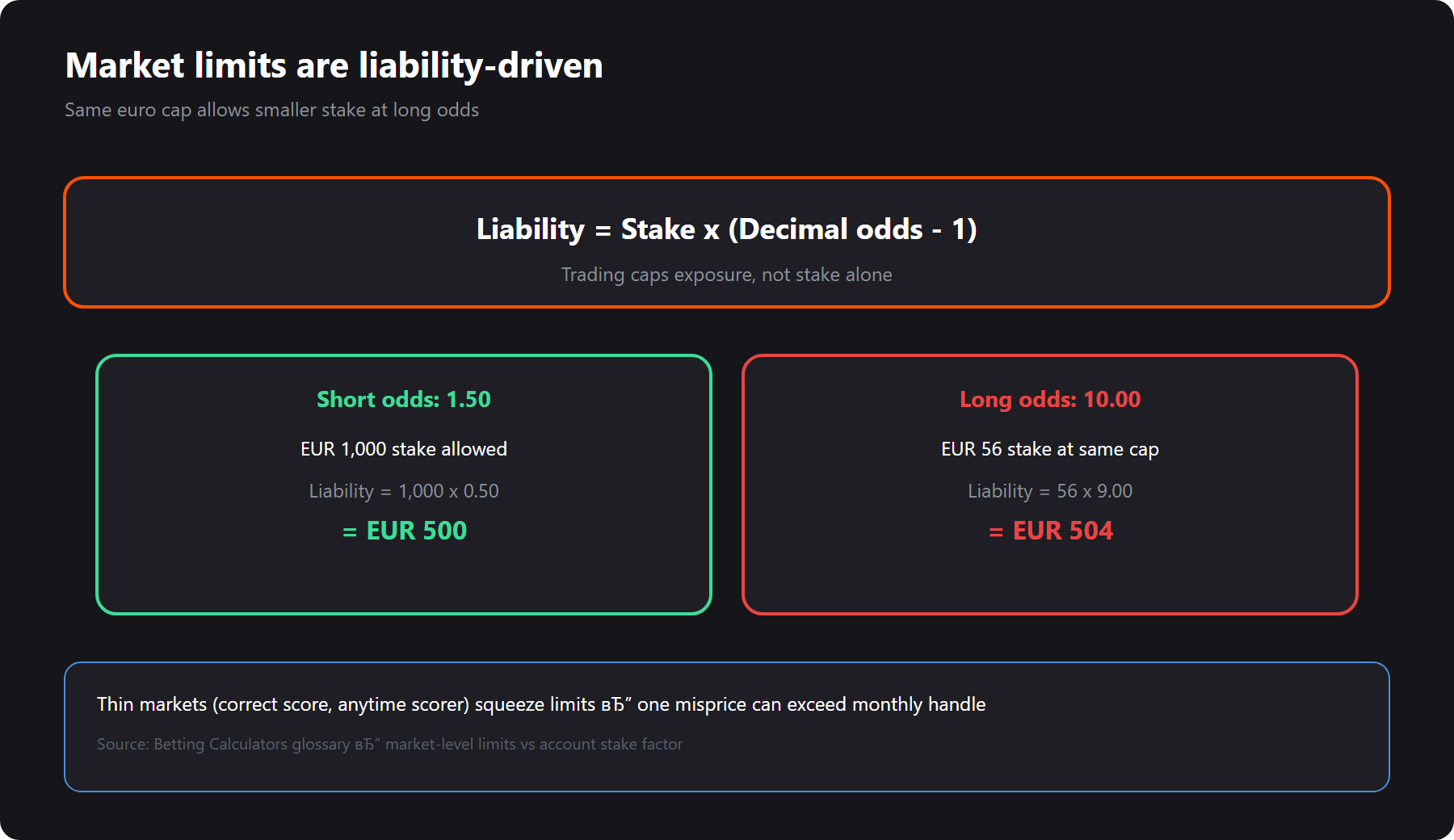
Betting limit liability maths — stake cap scales with odds
Customer archetype. Recreational accounts see full posted limits. Accounts that consistently beat the closing line see factors tighten. Do sharp bettors get lower limits? Yes, routinely. Sportsbooks reduce personal ceilings for accounts that show consistent profitability or professional patterns; that is standard liability practice, not proof of rule-breaking. Track360’s 2026 operator guide frames limiting as liability management, not punishment: the book shrinks accepted stake rather than refusing service outright.
Market-making books that use sharp action to refine lines may tolerate winners longer. Retail books optimised for mass acquisition often factor faster. Neither approach is hidden industry lore; it is visible in how quickly a profitable account’s max bet collapses.
Account-level limits and stake factors
Stake factoring is the quiet mechanic behind “I used to get $2,000 down; now I get $40.”
A stake factor is an internal multiplier between 0 and 1 applied to a customer’s allowed stake against the posted market maximum. Every account carries these multipliers by sport and market. Detection signals include positive closing line value (CLV), early line movement, and patterns associated with professional wagering. Factors can sit at 1.0 for NFL and 0.05 for Asian handicap soccer on the same login.
Regulation is catching up to the opacity. Massachusetts became the first US state to require sportsbooks to notify customers within 48 hours when an account is limited and to give a specific, non-boilerplate reason, with retroactive notices for prior restrictions. Gaming Intelligence reported the rule in June 2026. Operator data presented to the Massachusetts Gaming Commission showed limitations touched 0.64% of accounts in the December 2024–September 2025 window; among those limited, 58% were restricted to between 1% and 24% of the default bet amount.
That is a small share of accounts and a large share of trading desk attention.
Betting limits in casino vs sportsbook
Sports limits chase event liability and move by fixture and market.
Casino limits chase house edge math on a fixed game. Casino table limits differ from sportsbook caps: they are fixed per table or machine (minimum and maximum per hand or spin), not tied to sporting events. Slot maximums tie to denomination and progressive linkage; roulette separates inside and outside maximums; VIP rooms negotiate overrides. The configuration layer is table- or machine-level, not team-versus-team.
Cross-vertical operators still unify the vocabulary in CRM and VIP manager playbooks: a high roller on baccarat may receive different treatment than a sharp on tennis, but both hit “limits” enforced by different engines.
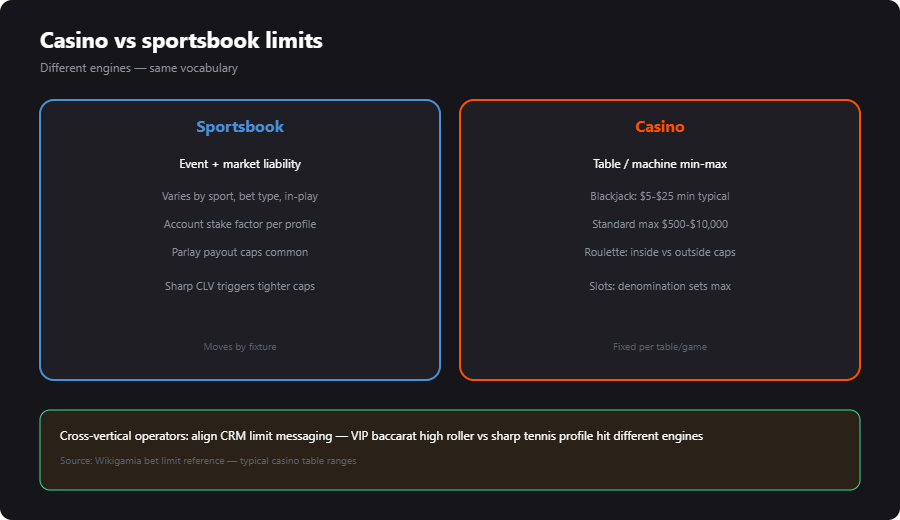
Casino vs sportsbook limits — event liability vs table configuration
Why betting limits matter for operators
Risk management. Without caps, one accepted ticket can threaten solvency on a mispriced line.
Sustainable margins. Limits let books offer deep markets on majors while ring-fencing exotic exposure.
Responsible gambling alignment. Many licences require accessible limit tools; operator caps complement player self-control.
Regulatory transparency. Jurisdictions increasingly ask books to document why an account was restricted, not only that it was.
Affiliate and CRM quality. Accounts that exist to exploit soft lines produce little durable NGR even when acquisition metrics look fine.
Tips and best practices
Publish what you can. Posted limits build trust even when personal factors remain internal.
Train support on limit types. Wager vs payout vs deposit confusion drives unnecessary escalations.
Document factor decisions. Massachusetts-style regimes will spread; audit trails beat ad hoc trader notes.
Segment VIP fairly. High-value recreational players deserve high limits; sharp profiles need different economics, not silent ghosting without process.
Monitor limit hits in analytics. Spikes on specific markets can signal bad prices, not bad customers.
Align casino and sports configs. Cross-sell journeys break when a player hits an unexpected floor on the second product.
Bottom line
Betting limits are the book’s circuit breakers: per market, per sport, per account. They protect the balance sheet, shape the product experience, and increasingly sit under regulatory scrutiny. Understanding stake factors and liability maths separates operator teams who manage limits from those who only react when a ticket gets rejected at checkout.