
- Updated:
- Published:
What is bonus abuse detection
Marketing turns the bonus dial and FTDs spike. Finance waits for GGR to follow. Sometimes it does not. The cohort that arrived on a 100% match and a wall of free spins places the minimum required bets, hits the withdrawal threshold, and vanishes before the second deposit. Bonus abuse detection is the discipline of telling that pattern apart from a legitimate newcomer who simply likes a welcome offer, and doing it before the promo budget becomes a subsidy for organised extraction.
What is bonus abuse detection?
| Bonus abuse detection is how iGaming operators identify players or rings who exploit promotional offers in ways the terms did not intend: multi-accounting, wagering circumvention, matched-bet arbitrage on free bets, chip dumping between products, and circular cash-out schemes designed to harvest reload or cashback mechanics with minimal real play. |
Detection is not the same as prevention. Detection is quiet scoring on device graphs, payment clusters, and session behaviour. Prevention is policy: contribution tables, max bet during wagering, excluded games, and plain-language terms shown before opt-in. Sift’s iGaming fraud overview separates the signal layer from the rule layer; both must exist, but conflating them produces either paranoia (block everyone) or naivety (block no one until chargeback season).
The tooling matured because the abuse industrialised. Rings no longer need twenty laptops in one room; emulators, residential proxies, and synthetic identities scale welcome harvesting across brands. Human review alone cannot score thousands of micro-signals per registration. Machine learning and graph analytics fill the gap.
What counts as bonus abuse?
The boundary is legal and contractual, not moral.
A player who reads the terms, picks low-variance games allowed under wagering rules, and clears a bonus within published constraints is playing the offer as designed, even if the operator wished the maths were tighter. Bonus hunting often falls on this side of the line: optimising game selection and bet sizing within published rules. Bonus abuse crosses it when a player opens five accounts with five identities to claim five welcome packages, violates multi-account clauses, or exploits loopholes the terms never intended. Regulators such as the MGA and UKGC will back enforcement when terms are clear and the breach is documented; they will not support punitive action when the terms accidentally permit the behaviour.
Track360’s 2026 operator playbook states the line plainly: abuse is activity that extracts bonus value in a way the operator did not intend the terms to allow. Intent helps investigations; terms win audits.
Common bonus abuse patterns
Abuse is not one shape. Product and fraud teams usually track several recurring modes.
Multi-accounting. Multiple profiles from shared devices, networks, or payment instruments, each claiming onboarding promos. EveryMatrix’s industry note lists this alongside long-running gnoming rings: coordinated groups that harvest loyalty and reload offers over months with linked identities, rather than one-off welcome grabs.
Bonus hunting / welcome exploit. Serial registration across brands when terms are under-tested, or aggressive optimisation of game selection to clear wagering with minimum variance.
Matched betting on free bets. Using external odds to lock value from risk-free credits regardless of event outcome.
Wagering circumvention. Exploiting game weighting, side bets, or partial wagers to satisfy playthrough without genuine exposure.
Chip dumping and P2P transfer. Moving value between accounts or products (poker, peer markets) to convert bonus balance into withdrawable cash.
Circular cash-outs. Rapid deposit–withdraw loops through shared e-wallets to trigger cashback or reload triggers with little net handle.
At scale these patterns leave fingerprints: abnormal session tempos, impossible win-rate streaks on contribution-weighted slots, clusters of payment tokens, and registration velocity spikes from one ASN.
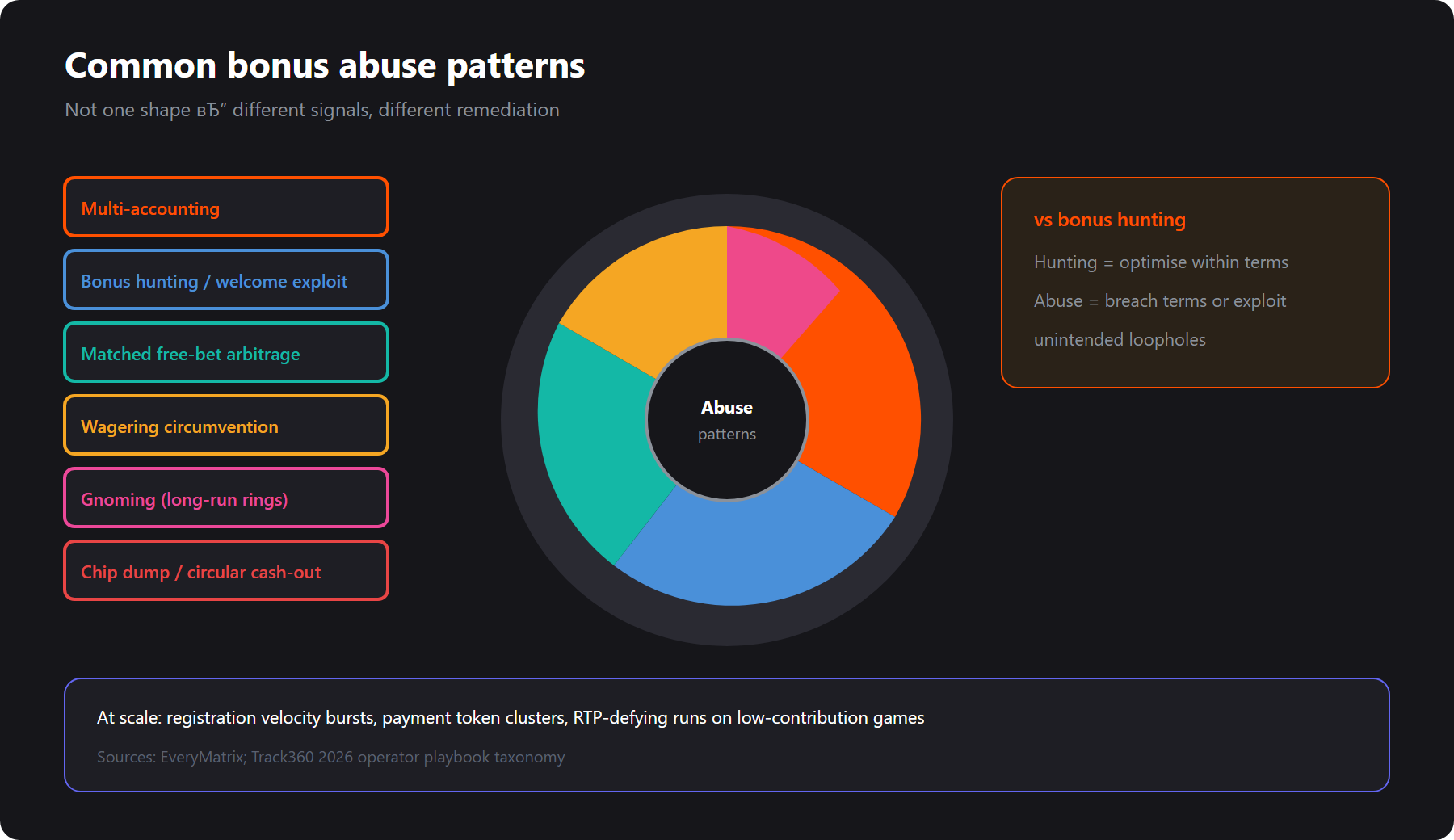
Common bonus abuse attack patterns — multi-accounting, matched betting, chip dumping
How bonus abuse detection works
Modern programmes stack layers rather than rely on one rule.
Edge signals at registration: IP and ASN reputation, VPN and proxy detection, disposable email screens, device fingerprinting that builds a stable identifier from browser and hardware attributes to link registrations even when cookies are cleared.
Wallet signals at funding: instrument reuse, chargeback history, deposit velocity, name mismatches against KYC files.
Play signals during wagering: max-bet guards, restricted titles, RTP-defying runs on low-contribution games.
Graph scoring above the transactional layer: accounts, devices, addresses, affiliates, and payments linked as nodes; high-score clusters route to review, low scores pass with friction only where regulation demands.
How is multi-accounting detected? By correlating these layers: device fingerprints, payment instruments, identity documents, IP patterns, and behavioural similarity across accounts. No single match is proof; clusters are.
iGaming Business quoted EveryMatrix’s fraud lead describing modern abuse as dozens of subtle indicators that look harmless alone but form a pattern in combination. No human team reads every signal on every player in real time; models and rules engines do, with humans adjudicating borderline cases.
Bonus abuse detection — three layers: edge, wallet, graph scoring
Detection should run across the full lifecycle, not only onboarding. Is detection only needed at signup? No. Abuse often surfaces across deposit, wagering, and withdrawal phases; mature programmes monitor the whole journey because bonus abuse is a behaviour curve, not a single registration event.
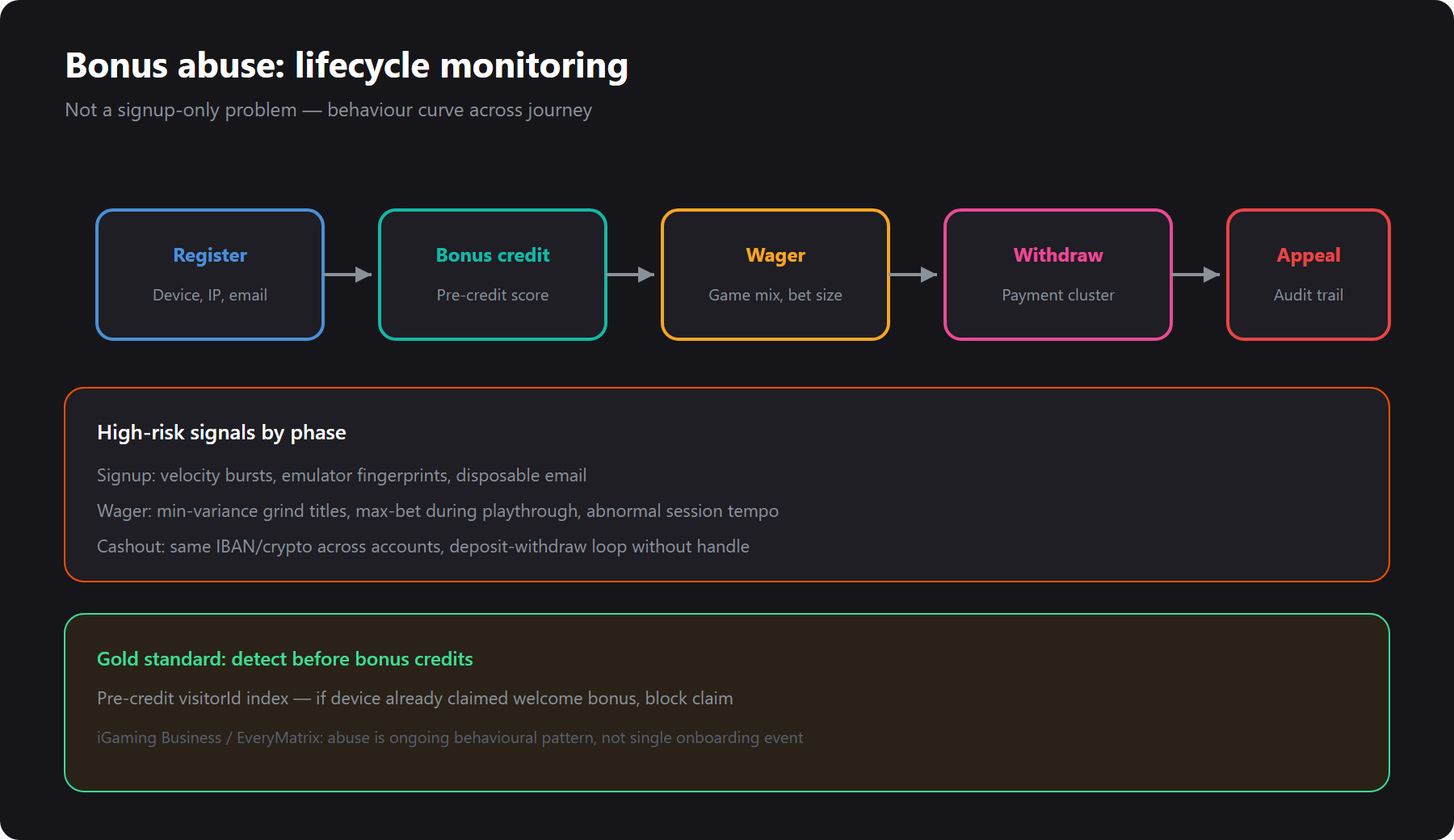
Bonus abuse lifecycle monitoring — signup through withdrawal
Detection signals operators use
Bonus abuse detection — four signal families to correlate
Effective detection correlates four families. Any one alone over-blocks or under-blocks.
| Signal family | What it captures | Strength | Weakness alone |
| Device | Fingerprint, emulator links, hardware consistency | Catches careless multi-accounters | Misses farmed devices with clean separation |
| Network | IP, VPN, geo velocity, registration bursts | Spots sloppy rings | Residential proxies look “clean” |
| Identity / payment | KYC doc similarity, BIN reuse, e-wallet clustering | High specificity at cashout | Slow; privacy-sensitive UX |
| Behaviour | Game mix, bet sizing, navigation paths, session timing | Hard to fake at scale | Needs history; slower trigger |
iGamingHub’s 2026 operator guide argues that 2026 detection must treat all four as one case file. Device-only programmes catch the lazy; organised farms invest in separation specifically to pass device gates.
Gamingtec’s detection overview adds payment intelligence as often the clearest cash-out signal: several accounts withdrawing to the same IBAN or crypto wallet is rarely a coincidence.
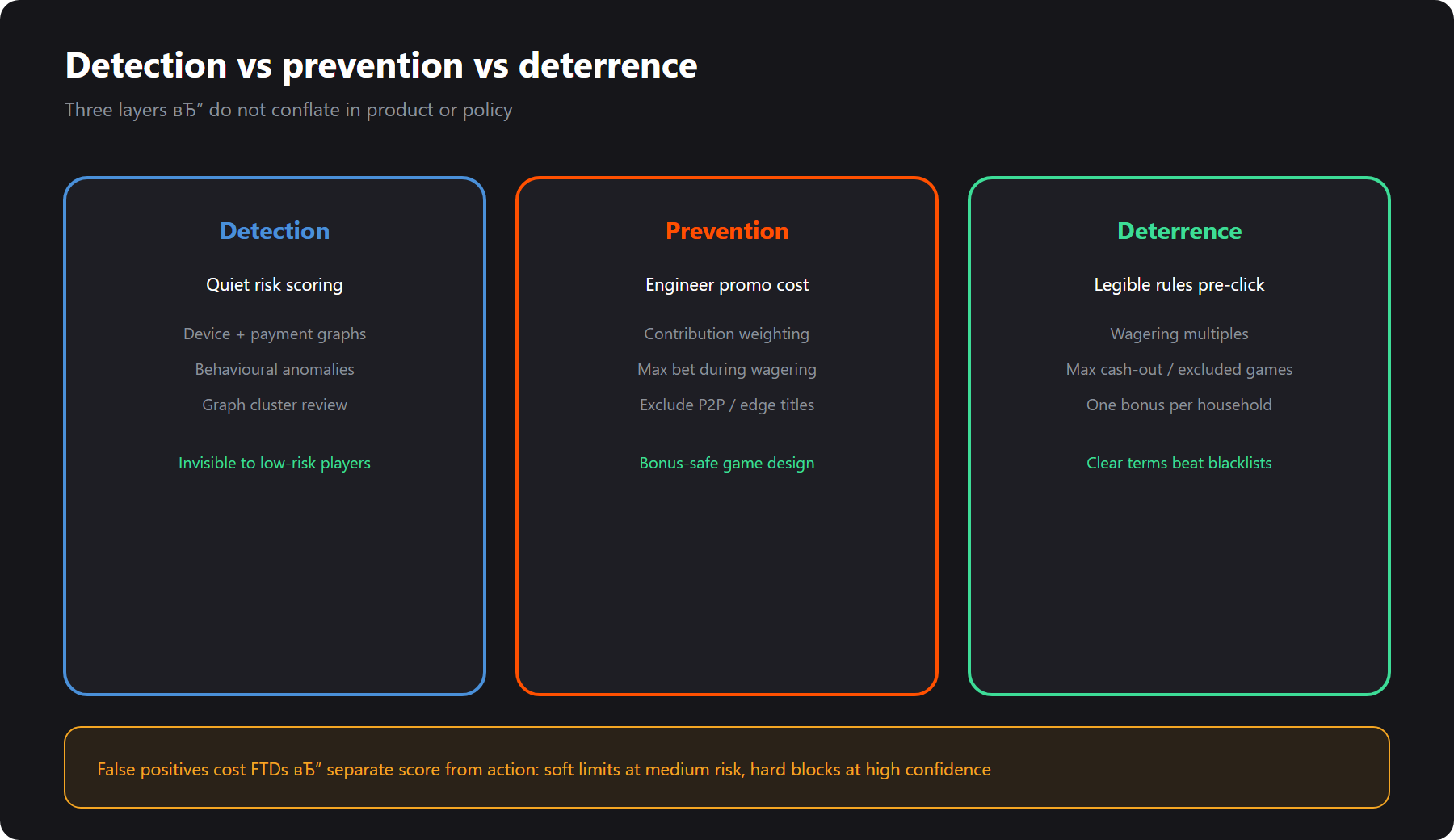
Detection vs prevention vs deterrence
Detection scores risk and routes cases. It should stay invisible to low-risk players.
Prevention engineers the promo so abuse is expensive: contribution weighting away from 99% RTP grind titles, caps on max bet during wagering, exclusion of P2P value transfer from playthrough.
Deterrence makes rules legible before click: wagering multiples, max cash-out, excluded games, one bonus per household. Sumsub’s 2026 iGaming fraud guide reports that bonus abuse dominates fraud typology in their operator sample; clear terms prevent more loss than reactive blacklists alone.
False positives carry real cost: KYC friction that kills good FTDs, support queues, brand damage. Good programmes separate score from action: soft limits and step-up verification at medium risk, hard blocks at high confidence.
Operator playbook
A practical sequence most mature teams converge on:
- Data hygiene. Stable account keys, durable device IDs, consistent affiliate tags.
- Risk score blending identity, payment, and behaviour with explainable features for compliance.
- Graduated response. Prompts and manual review before automatic confiscation where licence allows appeals.
- Bonus design guardrails. Engineering and CRM align so marketing cannot launch terms the fraud team has not stress-tested.
- Appeals monitoring. If complaint rates spike, the model is too tight or the terms too opaque.
- Affiliate contract enforcement. Cloaked landings and incentive stacking belong in clawback clauses, not shrugged off as traffic quality variance.
Licensed operators in Malta, Gibraltar, and the UK often see 4–11% of bonus-funded revenue lost to abuse-related leakage when controls are weak, per Track360’s industry benchmarking note. Teams that push leakage below 2% typically combine tighter terms, lifecycle graph detection, and documented appeals that survive regulator review. That range is a planning anchor, not a confession to paste into investor slides without your own measurement.
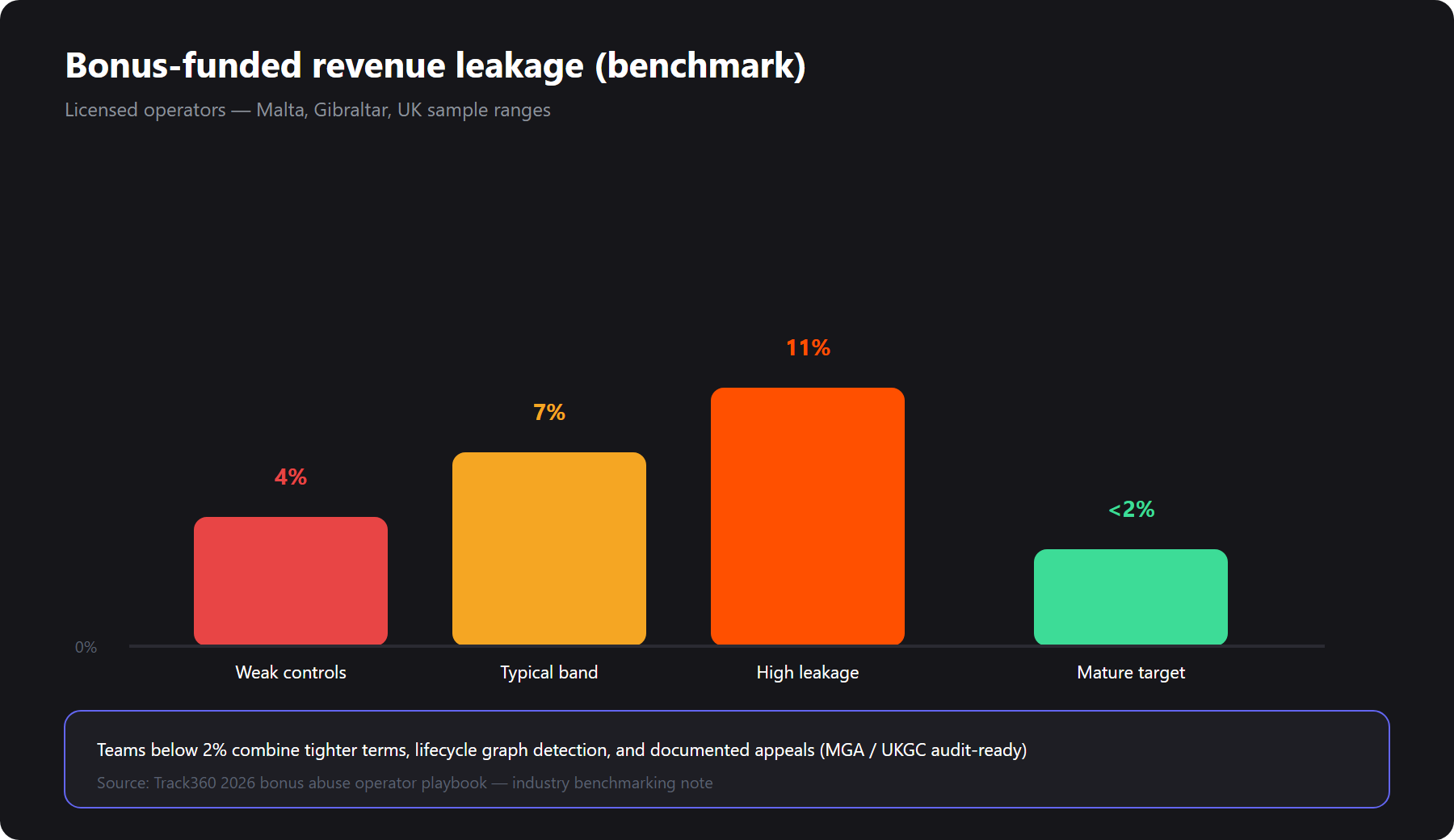
Bonus abuse leakage benchmark — weak vs mature controls
False positives, appeals, and fair UX
Detection without fairness becomes a growth tax.
Legitimate players use VPNs for privacy, share households, and deposit from family cards. Should VPN users always be blocked? No. VPN detection is one network signal among many; risk models should combine it with device consistency and payment context rather than auto-rejecting all anonymised traffic. Device match alone is sometimes contested in UK and Malta inquiries; device match plus behavioural baseline plus payment cluster carries more weight at adjudication.
Publish simple rules. Align support macros to those rules. Nothing erodes trust faster than confiscating a bonus with a generic email that cites a clause the player never saw.
Why bonus abuse detection matters
Commercial. Promo spend is among the largest variable costs in acquisition. Abuse converts CPA into a direct loss.
Affiliate quality. Bonus-first cohorts inflate FTD counts while producing no durable CEB-class revenue.
Compliance. Antifraud and AML programmes share data with bonus detection; rings often touch both. How does bonus abuse relate to antifraud? It is a major antifraud category, not the whole programme: payment fraud, chargebacks, and account takeover use overlapping data but distinct response playbooks.
Studio relations. Game suppliers care when their titles become wagering grind vectors; detection informs lobby placement and contribution policy.
Tips and best practices
Detect early, act proportionately. Pre-credit scoring beats post-withdrawal warfare.
Write terms like a human. If CRM cannot explain a clause in one sentence, rewrite it.
Weight wagering away from trivial grind paths. Product and fraud must co-sign contribution tables.
Audit affiliates when clusters share UTMs. Traffic quality is part of the detection perimeter.
Measure leakage honestly. One consolidated metric beats three teams reporting different numerators.
Bottom line
Bonus abuse detection is how operators protect promo ROI without treating every new registrant as a suspect. The patterns are familiar; the scale is new. Graphs, fingerprints, and lifecycle scoring replace gut feel, but policy and plain terms still do the heaviest deterrence work. Teams that combine all three spend less on bonuses that never become players.