
- Updated:
- Published:
What is a casino crypto token
A casino crypto token is a platform-specific blockchain asset — distinct from a crypto casino (an operator accepting cryptocurrency) and from Bitcoin (general-purpose infrastructure) — that powers deposits, loyalty, and in GambleFi models, revenue share through staking or buyback-and-burn. BitcoinPlay estimates crypto gambling at 17–27% of global online GGR, per Track360 data. This guide defines the asset class, explains tokenomics at operators like Rollbit and Shuffle, and covers regulatory risk, volatility, and operator due diligence for 2026.
What is a casino crypto token
| A casino crypto token (or gambling token) is a blockchain-based digital asset designed for use within a specific online gambling platform. Unlike mainstream cryptocurrencies such as Bitcoin or Ethereum, which serve as general-purpose stores of value, casino crypto tokens power a platform’s internal economy: deposits, wagering, fee discounts, loyalty rewards, and in some cases governance. |
The concept sits at the intersection of utility-token design and iGaming product strategy. Getting it right requires balancing payment convenience, price-volatility management, regulatory compliance, and anti-fraud controls while keeping the player experience fast and frictionless.
BitcoinPlay estimates global crypto gambling GGR at $92.6 billion in 2026 under high-end methodologies, roughly 27% of total online gambling GGR worldwide. Track360 places the conservative 2026 range at $25–35 billion. Either way, platform-native tokens have moved from marketing gimmicks to structural product layers at operators like Rollbit, Shuffle, and BetFury.
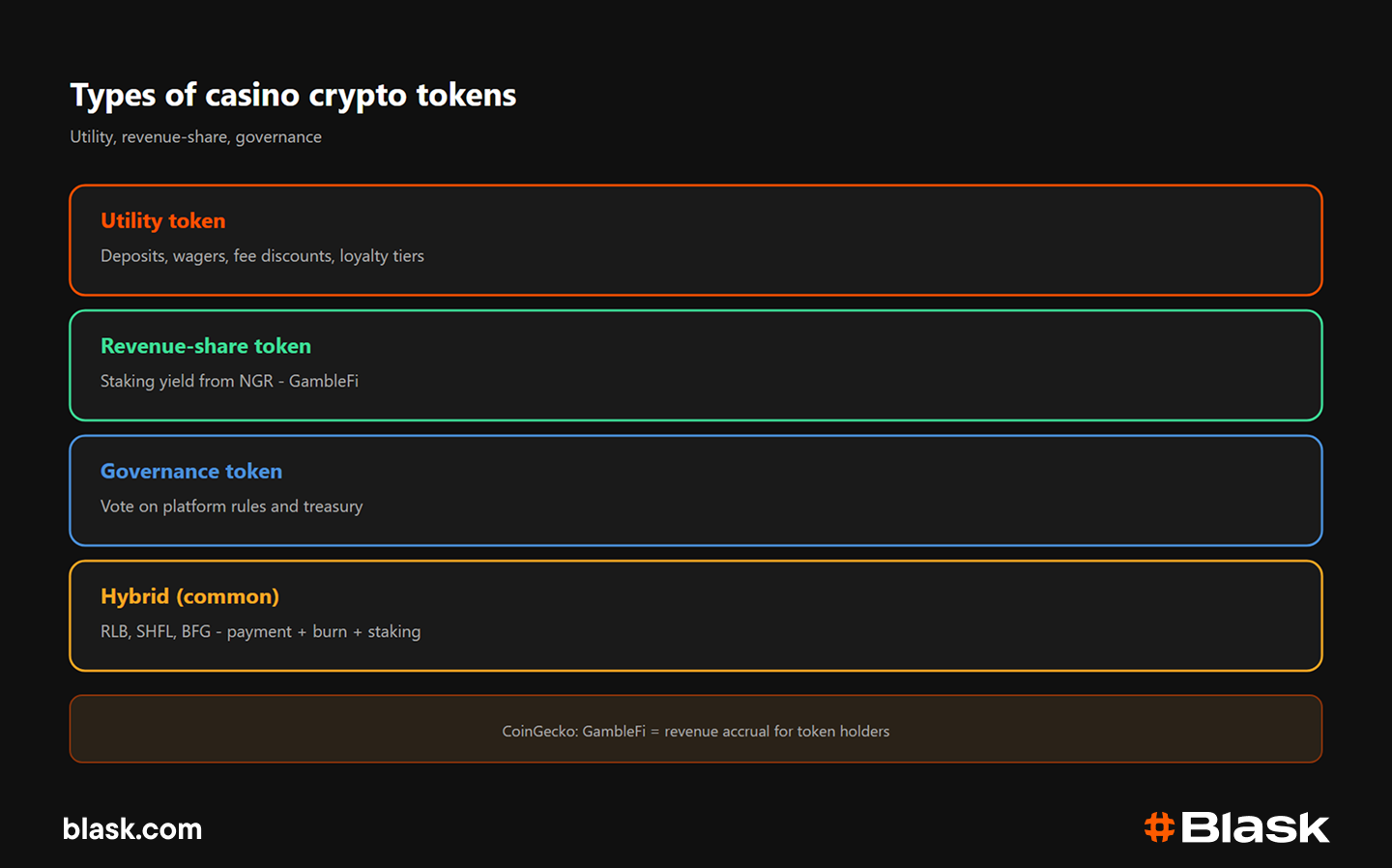
Token types
How casino crypto tokens work
A casino crypto token is a digital asset issued on an existing blockchain (most commonly Ethereum, BNB Chain, Polygon, or Tron) via smart contracts, typically following ERC-20 or BEP-20 standards.
Issuance and acquisition
The operator creates a fixed or inflationary supply through a smart contract. Initial distribution may happen through an ICO, airdrop, or direct on-platform purchase. Players acquire tokens on decentralized exchanges (Uniswap, PancakeSwap), centralized exchanges, or through the casino interface using another cryptocurrency or fiat.
Deposits, wagering, and rewards
Once in the player’s platform wallet, tokens fund bets, pay reduced fees, or unlock premium features. Internally, the operator maps token value to a fiat-equivalent for game math (RTP calculations, bet limits). Many platforms pair native tokens with stablecoin support (USDT, USDC): Track360 reports stablecoins at an estimated 35–40% of crypto casino deposits per operator and payment-gateway disclosures.
Withdrawal and conversion
Players withdraw tokens to external wallets and convert to BTC, ETH, stablecoins, or fiat via exchanges. On-chain transfers are irreversible, which eliminates card chargeback risk on crypto-only rails.
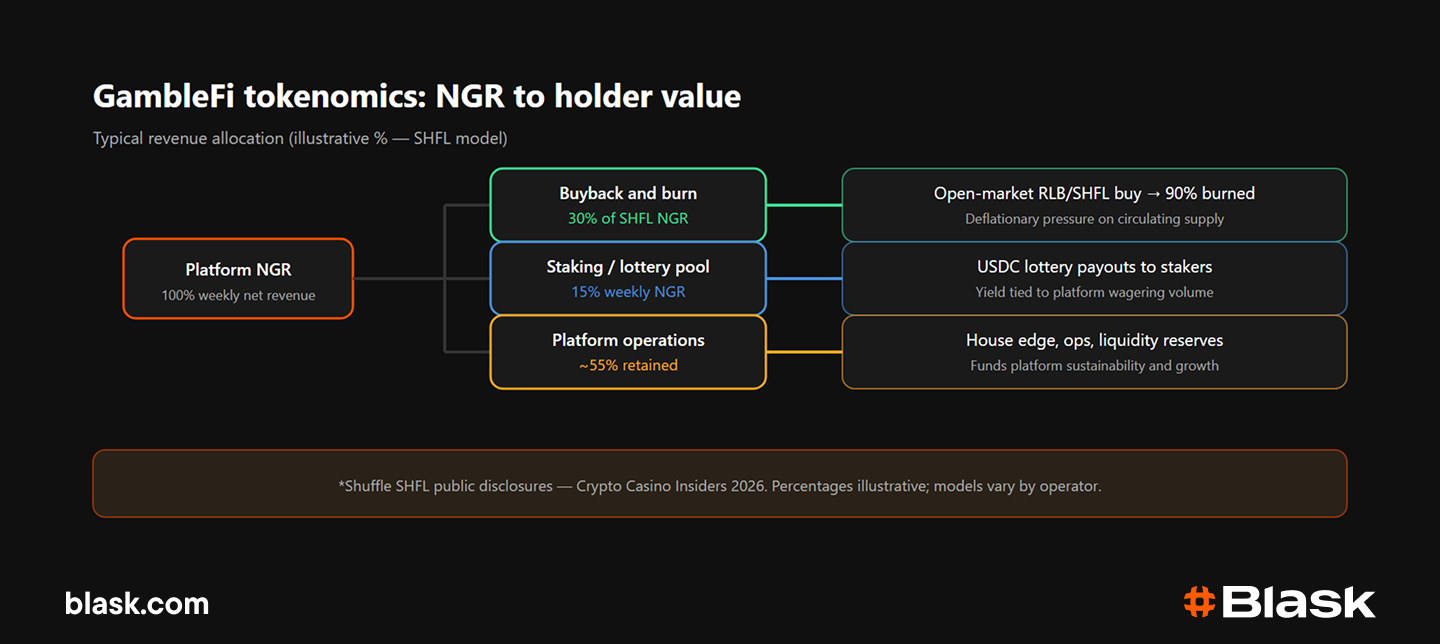
Tokenomics flow
Types of casino crypto tokens
| Type | Function | Example platforms |
| Utility token | Deposits, wagers, fee discounts, loyalty tiers | Most crypto casinos |
| Revenue-share token (GambleFi) | Staking yield from NGR / house edge | Rollbit (RLB), Shuffle (SHFL), BetFury (BFG) |
| Governance token | Vote on platform rules and treasury | Hybrid models on GambleFi platforms |
| Hybrid | Combines payment utility with burn/staking mechanics | SHFL, RLB, TGC |
CoinGecko describes GambleFi as the convergence of gambling and blockchain where token holders accrue a share of platform revenue — the ability to own part of the house.
| 👉 GambleFi s the subcategory of crypto casinos where native tokens entitle holders to revenue through staking, buyback-and-burn, or lottery mechanisms, with value accrual tied to house edge rather than pure payment utility. Crypto Casino Insiders document Shuffle’s SHFL committing 30% of weekly SHFL-denominated net gaming revenue to an on-chain buyback-and-burn, with a further 15% funding a lottery pool paid in USDC to stakers. Casino Originals report BetFury allocating a published share of house profits (typically in the ~3% band) to BFG stakers daily. |
Casino crypto token vs crypto casino vs Bitcoin
These three terms describe different layers of the crypto gambling stack:
| Casino crypto token | Crypto casino | Bitcoin | |
| What it is | Platform-specific ERC-20/BEP-20 | Operator accepting crypto payments | General-purpose cryptocurrency |
| Scope | One brand ecosystem | Full gambling platform | Any wallet or merchant |
| Revenue link | Often yes (GambleFi models) | Operator treasury only | None |
| Chargeback risk | On-chain: irreversible | Mixed payment rails | Irreversible |
| Regulatory lens | Utility vs security classification | VASP / AML / licence | Payment rail |
A crypto casino accepts cryptocurrency deposits and withdrawals. A casino crypto token is a proprietary asset within that ecosystem.
Bitcoin and Ethereum are standalone cryptocurrencies with their own blockchains and no platform-specific utility. A casino crypto token is built on top of an existing chain (ERC-20, BEP-20) and designed for use within one gambling ecosystem. Bitcoin carries no loyalty tiers, revenue share, or burn mechanics tied to a single operator.
Tokenomics: buyback, burn, and revenue share
The strongest GambleFi models tie token value to verifiable platform revenue rather than inflationary emissions.
CoinGecko details Rollbit’s buy-and-burn program directing a portion of revenue across casino, sportsbook, and futures products to open-market RLB purchases, with 90% of repurchased tokens permanently burned. Crypto Casino Insiders verify Shuffle publishing weekly on-chain burn records: by early 2026 the program had produced 80+ consecutive weekly burn transactions on Etherscan.
GameIndustry.com advises operators assessing a token-backed model to evaluate three due-diligence axes:
- What fraction of supply has actually been distributed to players vs insiders
- How much of net revenue is committed to buyback or prize-pool flows
- Whether holders can exit at fair value without internal withdrawal caps
Crypto Casino Insiders warn that short-lock APY figures extrapolated from small time windows should be treated with skepticism; sustainable yield depends on consistent wagering volume through full market cycles.
Market context: crypto gambling in 2026
| Year | High-end GGR estimate | Conservative GGR range |
| 2022 | ~$20B | $5–8B |
| 2023 | ~$45B | $9–14B |
| 2024 | $81.4B | $15–25B |
| 2025 | ~$90–100B | $20–30B |
| 2026E | ~$105–115B | $25–35B |
BitcoinPlay counts 3,800+ cryptocurrency gambling platforms globally, up from ~1,200 in 2020 — a 217% increase in six years. Track360 breaks down game mix at ~52% slots and ~25% roulette of crypto casino revenue.
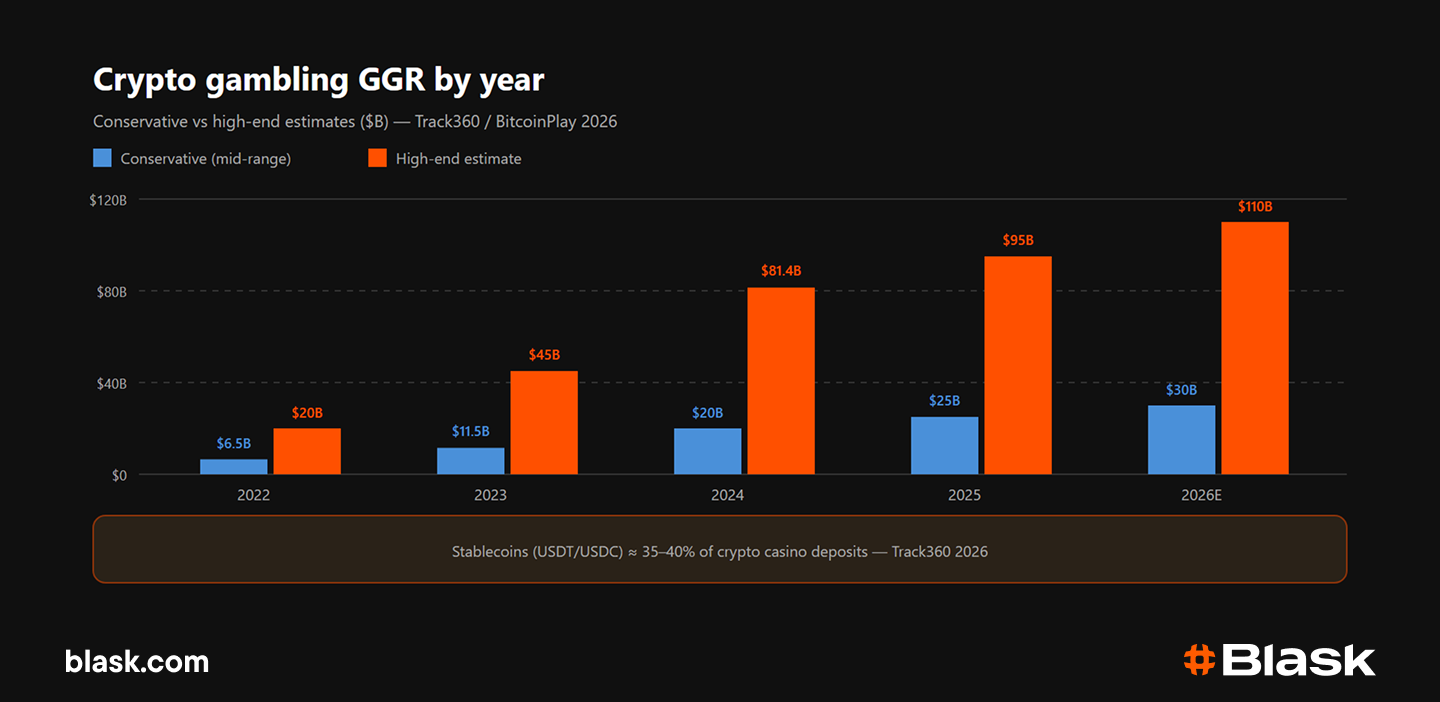
Market size trajectory
Why casino crypto tokens matter for operators
Reduced payment friction. Crypto tokens settle in minutes. Processing fees are typically a fraction of card-network charges, with no intermediary that can freeze funds or reverse transactions.
Player retention through tokenomics. Staking tiers, deflationary burn mechanics, and loyalty unlocks create switching costs: a player who has accumulated tokens and staking rewards is less likely to migrate. This directly supports LTV metrics.
Transparency and provably fair gaming. Tokens on public blockchains create auditable deposit and payout records. The token itself is a payment instrument. Provably fair refers to game-outcome verification via cryptographic seeds, deployed alongside the token on many crypto-native platforms. Players verify each round independently; the token handles value transfer, not RNG logic.
Operator treasury management. Fee structures, liquidity pools, and reward distribution can be governed programmatically through smart contracts, reducing reliance on third-party payment processors.
Chargeback elimination on crypto rails. FinRate calculates card chargebacks at an estimated $3.75–$4.61 per $1 lost once fees and operational time are counted — costs that do not apply to irreversible on-chain transfers.
Regulatory and compliance context
Regulatory treatment varies sharply by jurisdiction and token design. Curaçao and Anjouan-licensed operators may accept crypto tokens with AML and KYC compliance. The UK imposes stricter rules on crypto-based gambling and source-of-funds evidence at licence stage. Revenue-share tokens face elevated securities risk under the US SEC Howey Test and the EU MiCA framework.
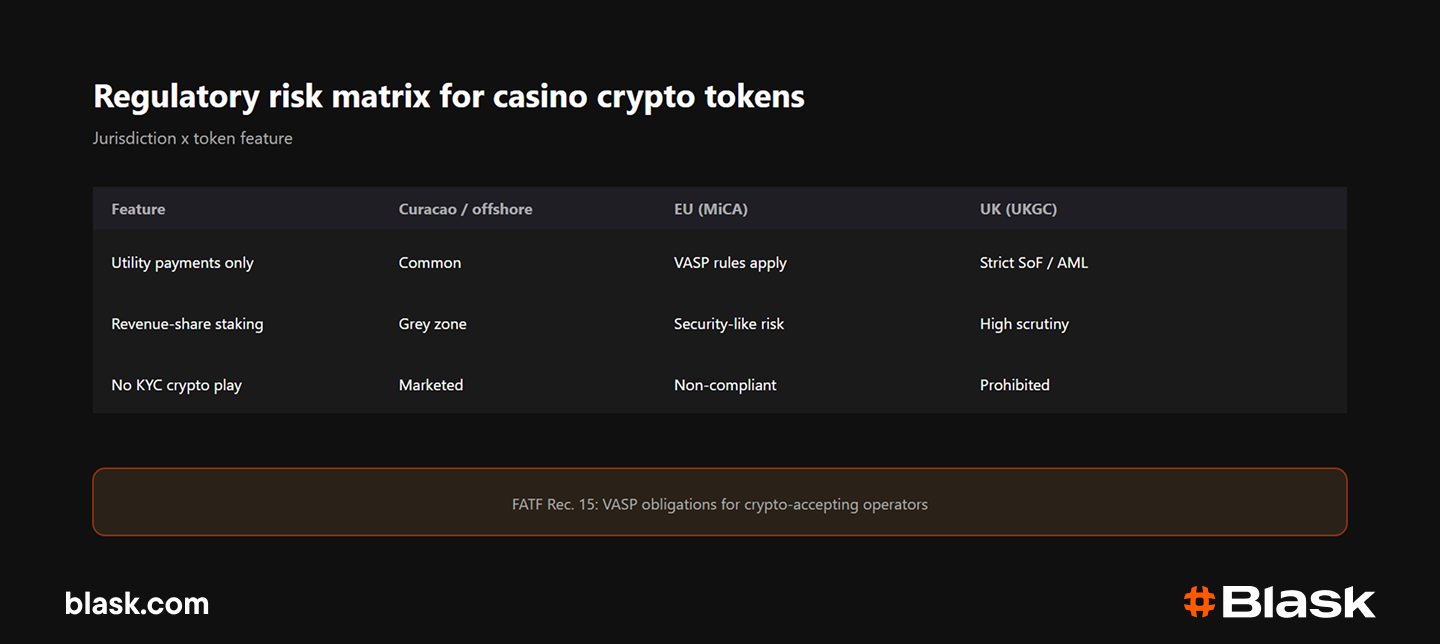
Regulatory matrix
CoinGecko notes that most gambling tokens are structured as utility instruments, but revenue-sharing or staking dividends may attract securities scrutiny under the US SEC Howey Test or the EU’s MiCA regulation.
The UK Gambling Commission requires operators using crypto to evidence source of funds at licence application stage. Applications with crypto funding elements need a full and complete source-of-funds history; incomplete evidence leads to rejection.
FATF Recommendation 15. Virtual-asset service providers (VASPs), including crypto-accepting gambling operators, face AML/CFT obligations equivalent to traditional financial institutions: customer due diligence, transaction monitoring, and Travel Rule compliance for qualifying transfers.
KYC reality. While some platforms market token transactions as anonymous, regulated operators must still implement identity verification. Blockchain analytics tools (Chainalysis, Elliptic) trace token flows, and regulators expect wallet screening and suspicious-pattern reporting.
Common pitfalls and challenges
Price volatility. A token losing 20% overnight erodes player balances and distorts GGR calculations. Stablecoin rails and real-time conversion options hedge this risk.
Regulatory ambiguity. A token with revenue-sharing features may be treated as a security in one market and a utility instrument in another.
Liquidity risk. Platform-specific tokens with thin exchange order books create slippage for players and reputational exposure if large holders dump supply.
Smart-contract risk. Bugs, exploits, or unaudited contracts can lead to loss of funds or unauthorized minting.
Unsustainable yield marketing. APY figures extrapolated from brief high-volume windows collapse when wagering normalizes. Operators and affiliates should distinguish verified on-chain revenue share from emission-based rewards.
Tips and best practices
- Pair the native token with stablecoin support. Let players wager in the platform token for loyalty benefits or in USDT/USDC for price stability. How do players protect against token price crashes? Converting winnings to stablecoins immediately after play is the most common approach; some platforms offer auto-conversion or price-alert triggers for automatic swaps.
- Publish transparent tokenomics. Supply caps, burn schedules, staking mechanics, and treasury allocations should be auditable on-chain or in public documents.
- Build compliance into the protocol. On-chain KYC checkpoints, FATF Travel Rule alignment, and real-time transaction monitoring are essential for licensed-market ambitions.
- Audit smart contracts before launch. Engage independent security auditors and publish reports.
- Design rewards for long-term engagement. Milestone unlocks and utility-driven perks outperform yield-farming schemes that attract mercenary capital.
Bottom line
Casino crypto tokens are more than a payment shortcut. They are a strategic tool for shaping player engagement, managing operational costs, and building a differentiated platform economy. The operators that extract the most value treat tokenomics as a product discipline: balancing utility, compliance, and transparency from day one.
BitcoinPlay projects crypto gambling GGR at $168 billion by 2030 under high-end estimates — a trajectory that keeps token design a core competitive variable for crypto-native operators and a due-diligence checkpoint for affiliates, investors, and B2B partners evaluating platform economics.