- Updated:
- Published:
Content Management System (CMS)
A content management system controls what players see, when they see it, and across which channels — and in 2026, the operators who publish fastest with the most precision are winning the acquisition race.
Every time a player opens a casino or sportsbook site, a content management system sits behind what loads. Game lobby order, promotional banners, bonus terms, geo-targeted offers — all of it flows through a CMS.
For operators managing multiple brands or markets, selecting the right one is not a secondary infrastructure decision. It shapes how fast a team can execute, how cleanly a market launch goes, and how much regulatory exposure accumulates over time.
The iGaming industry runs on event-driven publishing windows and regulatory precision. A CMS that routes every banner update through a developer queue cannot absorb that kind of requirement.
What is a CMS in iGaming
Understanding what is a CMS in iGaming starts with a definitional problem: the term covers two different types of software that solve different problems.
- The first is a digital content management system — software built to create, organize, and publish website content without coding. Operators use it to manage landing pages, promotional banners, game listings, pop-ups, and localized offer pages.
- The second is a casino management system — back-office software that manages player accounts, bonuses, payments, and compliance reporting. This is what regulators and operations teams mean when they discuss back-office infrastructure.
Both types are called CMS in iGaming conversations. Knowing the distinction matters when evaluating vendors, because a platform marketed as a “CMS” could mean either one or a hybrid of both. A procurement process that treats them as equivalent ends up comparing incompatible products.
Content management system vs casino management system
The overlap between these two terms creates real procurement confusion.
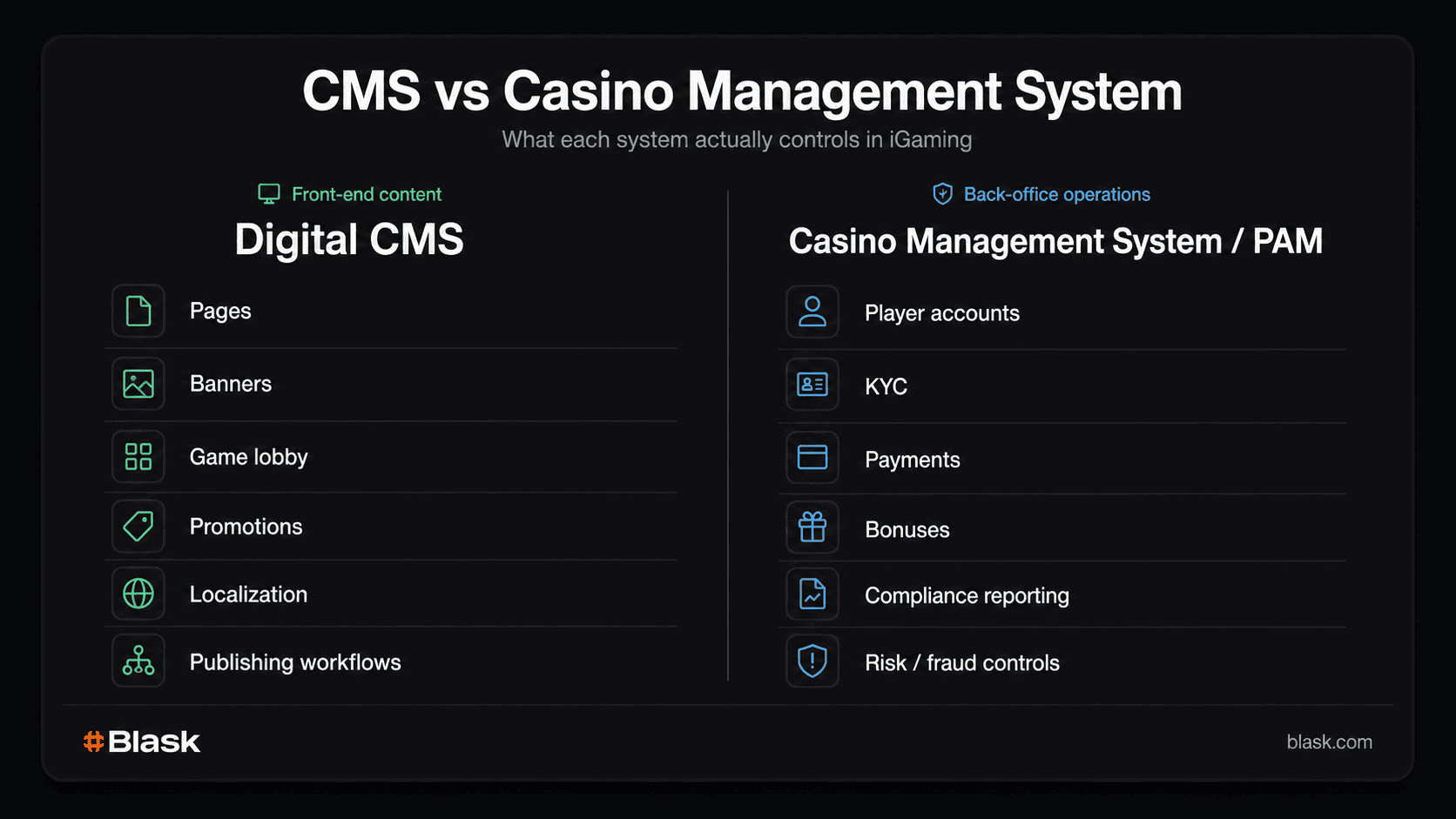
Operators evaluating a content management system sometimes end up comparing back-office platforms, and the reverse is equally common.
CMS for digital content
A digital CMS handles the operator’s front-end. Its core function is enabling non-technical staff to publish and update website content without developer support.
Typical functions include:
- Creating and editing landing pages and promotional content
- Managing game listings, provider filters, and lobby layouts
- Scheduling content publication by date, time, or player segment
- Localizing content across languages and markets
- Managing banners, pop-ups, and display rules for bonus offers
The goal is publishing speed. An operator needs to push a match-day page live at kick-off without filing a developer ticket.
Casino management system (back-office)
A casino management system operates behind the player-facing layer. It manages accounts, transactions, compliance reporting, and risk controls.
Core back-office functions include:
- Player account management, KYC, and identity verification
- Bonus and promotion configuration
- Payment processing and reconciliation
- Compliance reporting and audit logging
- Fraud detection and risk management
This back-office platform is often called a PAM (Player Account Management) system. The PAM handles identity, money, and regulatory compliance. The digital CMS handles content and presentation.
How they overlap and when to use each
Modern integrated iGaming platforms blur this line. Operators running on suites like GR8.tech or BetConstruct use a single platform that handles both editorial content and back-office configuration.
BetConstruct calls this its “3 Cs” model: Content, Config, and Casino — all managed from one interface.
The separation still matters for larger operators building custom stacks. A brand running a headless front end typically uses a standalone editorial CMS paired with a separate PAM for player data. The choice depends on which operational problem you’re solving first: content speed or player data control.
Why iGaming operators need a specialized CMS
A general-purpose CMS (WordPress, Drupal, or Contentful) can publish content. It cannot configure a game lobby, route bonuses by jurisdiction, or produce a compliant audit trail. That gap is why an iGaming content management system exists as its own product category.
The iGaming sector operates under constraints that general-purpose platforms were not designed for:
- Regulatory variability. Operators running in the UK, Malta, and Curaçao face different content rules. The UKGC’s January 2026 rule changes require that promotional offers covering more than one gambling product type be restructured or removed. A CMS that can’t apply jurisdiction-level content rules at the publishing layer puts that compliance burden on editorial teams — where human error is expensive.
- Event-driven publishing. A major sporting event creates a publishing deadline measured in hours, not days. Content teams need to execute without a developer queue.
- Multi-product complexity. Casino and sportsbook content follow different logic. Game listings, odds feeds, and bonus mechanics each have distinct configuration requirements that a generic CMS was not built to handle.
- Audit requirements. UKGC regulations require documented records of every content change, including who published what, when, and what version was live during a given period. A general-purpose CMS does not produce the compliance-grade audit trail that licensed operators need.
Blask tracks 349 active brands in the UK and 370 in the US. Each runs a content stack. The operators who update offers faster, adjust lobbies to market conditions, and react to regulatory changes without a development sprint have a structural advantage over those still routing every content change through a ticket.
Key features of an iGaming CMS
Not every feature in a vendor pitch carries equal operational weight.
The features that matter most are those that reduce developer dependency and give content teams control over time-sensitive publishing decisions.
No-code content publishing
The baseline requirement for any casino CMS is letting content editors work without filing tickets. Page creation, banner updates, and lobby configuration should be executable by a marketing or product manager with no technical background.
Platforms that still require developer involvement for routine content changes carry a hidden operational cost: slower responses to competitor moves, missed event windows, and reduced publishing velocity across the full content calendar.
GR8.tech’s CMS, for example, lets operators create, preview, and publish changes in real time, updates appear on websites and apps without server restarts.
Multi-channel distribution (web, mobile, apps)
Players access iGaming products across devices. BetConstruct’s CMS Pro manages web, mobile, iOS, and Android content from a single interface, publishing instantly to all channels or targeting specific devices with tailored content. An operator running a web casino, mobile site, and native app needs content consistent across all three without duplicating effort.
A headless CMS architecture solves this at scale by separating content from presentation. Content is stored centrally and served to any channel via API. One update reaches web, mobile, and app simultaneously, with no manual synchronization required.
Localization for multi-market operations
Running across five markets means five sets of content rules, languages, and regulatory requirements. A CMS built for iGaming handles localization at the content model level, not through manual page duplication.
Vardan Hakobyan Head of regional sales 
If you can get a ready-made solution with everything in one place at reasonable cost and tailored to specific GEOs, most choose that option. This enables faster launches, resource savings, reduced risks, and easier maintenance.
Examples:
- SOFTSWISS rolled out enhanced locale management for its sportsbook CMS specifically to reduce manual work when localizing content for different markets. The upgrade allows operators to manage complex configurations with greater precision, cutting the time required to expand into new regions.
- Sportal365, used by bet365 across 30+ markets in 10+ languages, solved this by building multi-language support directly into its Content API — allowing editors to create articles in a main language and a secondary one from the same interface, with article searches filterable by language.
Scheduled publishing and workflows
Promotional windows in iGaming are precise. A match-day offer goes live at kick-off and expires at full time. Scheduled publishing with approval workflows lets teams prepare content in advance and deploy it automatically — removing the human error risk of manual publishing during high-traffic windows, when a compliance mistake is most costly.
Game listings and promotional banner management
The game lobby is a direct revenue lever. A sportsbook CMS gives operators visual lobby management tools — drag-and-drop game ordering, featured slots, and banner placement without code.
As Dmitry Belyanin, Co-founder of Blask, explained: “If a game is at the top of the lobby, it will generate player interest, retention, and return.” Game content is also an acquisition strategy.
Dmitry Belyanin Co-founder of Blask 
“Games are the content through which I attract an audience. I need to know which new games are launching and when — these are release calendars.”

A CMS that integrates with game aggregators pulls new title data automatically, reducing manual catalog maintenance.
Blask tracks 14+ game titles in the UK market as of May 2026, across providers including Pragmatic Play, Play’n GO, and Reel Kingdom. Which of those titles sits at the top of the lobby and which gets buried is a revenue decision, not an editorial one.
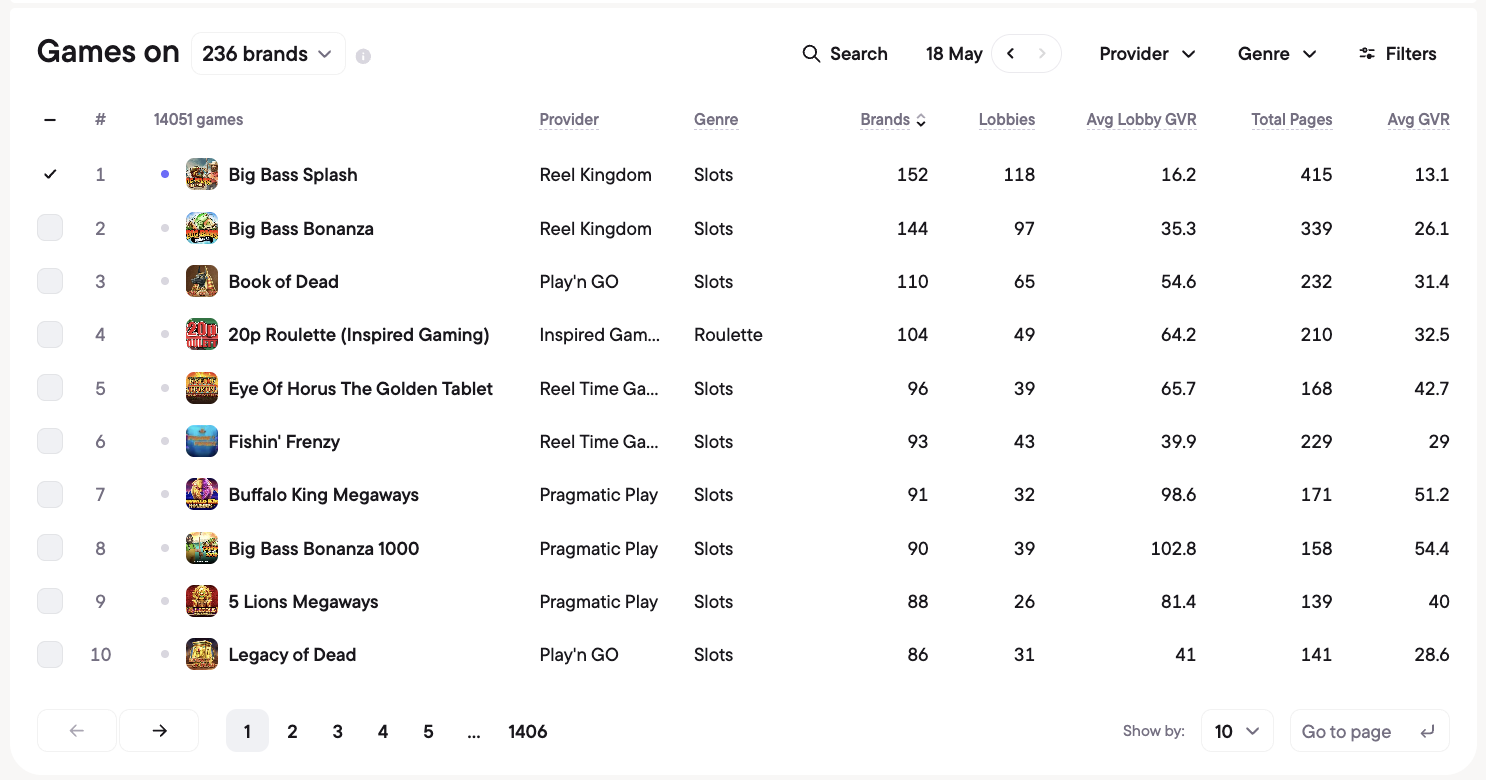
A game placed in a visible slot generates more sessions, more retention, and more return visits. The same title three rows down generates a fraction of that.
That decision requires data on what players in a given market are actually engaging with. Blask shows operators which titles are gaining demand, which providers dominate in their target market, and how competitors are structuring their lobbies, so the CMS becomes an execution layer for a data-driven placement strategy, not a manual sorting exercise across thousands of titles.
Headless architecture
A headless CMS stores content independently of any front-end. The presentation layer retrieves content via API. This gives operators full design control without being constrained by CMS templates.
William Hill made this choice explicitly in 2021, replacing several coupled legacy CMSes with Contentstack’s headless platform. The decision was driven by the need for faster iteration, A/B testing capability, and the ability to extend across sports betting terminals in physical shops as well as digital channels.
Bartek Gerlich, Senior Engineering Lead at William Hill at the time, noted that Contentstack’s headless architecture “significantly reduced the time and effort used to perfect the player experience”.
For large operators building custom front-ends or running multiple brands from a shared content repository, headless is the architecture that scales without rebuilding content for every new channel.
API integrations with PAM, sportsbook, aggregators
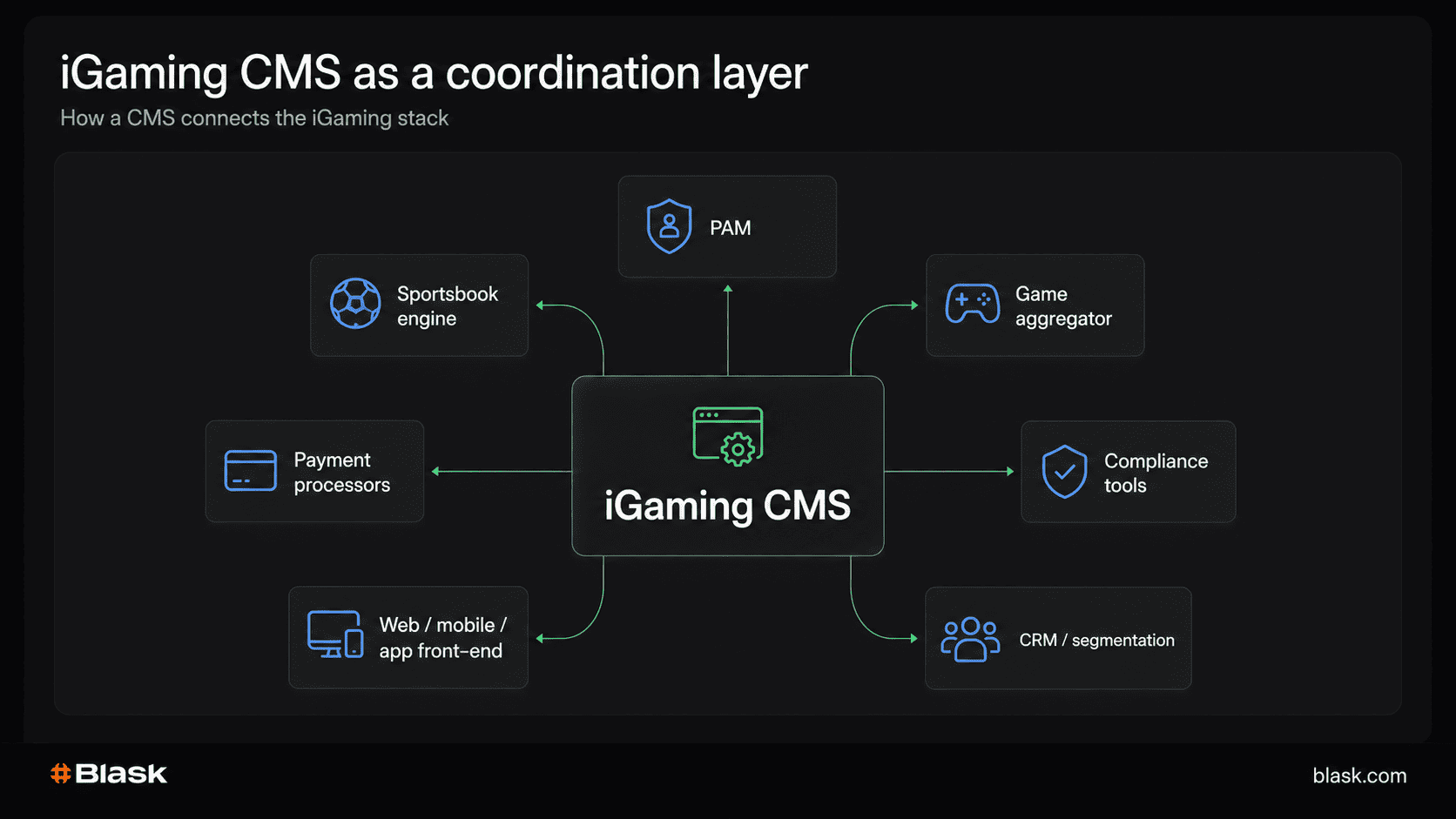
An iGaming CMS does not work in isolation. It connects to the broader platform stack:
- PAM platforms for player-specific content personalization
- Sportsbook engines for live odds and fixture data
- Game aggregators for catalog feeds and availability status
- Payment processors for payment method display rules by market
A sportsbook integration means the CMS surfaces live markets, upcoming fixtures, and bet-relevant content dynamically — without editorial input for every event.
Compliance and audit trails
Licensed operators need a documented record of every content change: who published what, when, and which version was live during a given period. This is a licensing requirement in regulated markets, not an optional feature.
Following the January 2026 UKGC changes, operators must also be able to demonstrate that mixed-product promotional content was removed or restructured by the implementation date. A CMS without version history and audit logs creates regulatory exposure for operators holding UKGC, MGA, or Curaçao licenses.
How an iGaming CMS works
Understanding the architecture behind a CMS platform clarifies which type of system fits a given operator stack.
Content repository
All content — text, images, configuration rules, and localization variants — lives in a central database. Editors access it through an admin interface. The repository stores versioned drafts, published content, and archived versions.
Version control is critical in regulated markets. When a regulator asks what was displayed on a player’s account page on a specific date, the CMS should reproduce the exact state without manual reconstruction.
API layer and front-end delivery
In a headless or API-first setup, the front-end does not render content from the same system that stores it. A web app, mobile app, or kiosk makes API calls to the CMS, which returns structured content in JSON format.
Directus, a headless CMS used by gaming operators including FEG and IslandLuck, claims operators deploy content up to 70% faster compared to legacy CMS workflows. FEG’s R&D Lead for Online Gaming Products described Directus as “a swift way to prove out the concept, scalability, out-of-the-shelf resolution for 95% of what anybody needs from a CMS.”
User roles and permissions
In an operator where marketing, compliance, and product teams all touch the CMS, role-based access controls prevent accidental errors and enforce approval workflows.
A compliance officer reviews and approves content before publication without having edit access across every page. A regional manager updates localized content for their market without accessing content for other jurisdictions. This is where a CMS becomes an operational governance tool, not just a publishing interface.
Common pain points an iGaming CMS solves
Slow content updates
Without a dedicated CMS, iGaming content updates typically require developer involvement. A new bonus banner means a ticket, a sprint, and a deployment. By the time the change goes live, the event window has closed.
A CMS built for iGaming eliminates this dependency. Marketing teams publish independently. Content velocity increases across the entire operation and when a regulator issues an enforcement notice requiring immediate content changes, operators can respond in hours rather than days.
Multi-channel chaos
KPAX Marketing, which operates 48 brands across 10 markets including the UK, Sweden, Spain, and Ontario, faced this problem directly.
Managing personalized content for players in each region required manual updates and in-house solutions that “couldn’t provide the granular personalization that today’s players expect,” according to Pernilla Strand, Head of CRM at KPAX.
After deploying Optimove’s Opti-X platform, KPAX moved from broad location-based targeting to individual-level personalization, managed entirely within the CRM team, without additional tech support.
Limited sportsbook content control
A sportsbook operator needs to surface the right markets at the right time: pre-match, in-play, featured leagues, boosted odds. Without CMS tooling built for sportsbook operations, every campaign requires custom development.
A sportsbook CMS with live data integration handles this through configuration, not code. SOFTSWISS’s sportsbook CMS, for instance, allows operators to update betting options and promotional content without touching the front-end.
The February 2025 upgrade added a preview function, so operators can see how page updates will display before they go live, preventing misconfigurations during high-stakes event windows.
Scaling nightmares
An operator adding a second market faces a choice: duplicate the entire content stack and maintain two separate systems, or invest in a CMS that handles multi-market content natively.
Operators who choose duplication typically face a replatforming project by market three or four. Directus positions its architecture specifically around operators “adding 500+ new games per quarter” — a volume that breaks systems built for single-market, single-brand operations.
Benefits of using an iGaming CMS
Faster time-to-market
Content that previously required a development cycle gets published in hours or minutes. That speed compounds across hundreds of campaigns per year. An operator running 50 campaigns annually, each faster by two days, recaptures 100 days of go-to-market time.
Higher conversion rates
Personalized, geo-targeted, event-timed content converts better than generic content. A CMS that segments banners by player profile, market, and device produces measurable conversion improvements.
Brand consistency across channels
Players see the same promotions on web and mobile, in the correct language, with jurisdiction-accurate bonus terms. Consistency builds trust. Inconsistency — a bonus offer appearing on one channel but missing from another — erodes it at a moment when a competitor’s offer is one click away.
Reduced operational costs
Every developer hour spent on routine content changes is a cost that could fund product development. A CMS that removes developer dependency from routine publishing redirects that resource to features that differentiate the product. For operators with lean technical teams, this difference is material.
Top iGaming CMS providers
The iGaming CMS market divides into two segments: integrated platform vendors who bundle CMS with sportsbook, PAM, and aggregator tooling; and standalone CMS tools built for or adapted to iGaming requirements.
GR8.tech CMS
GR8.tech’s CMS is part of an integrated iGaming platform that also includes sportsbook, PAM, and payments. The admin interface gives operators no-code control over site navigation, game lobby layout, and content styling — with 30+ pre-built widgets available out of the box.
The architecture is modular. Operators can run the full GR8.tech stack or use the sportsbook engine headlessly via API. GR8.tech reports campaign launch times cut by up to 5x and technical team dependency reduced by around 60% for operators using its CMS.
Centralized, reusable content blocks let operators update compliance text or responsible gaming notices once and push that update everywhere — reducing the error surface for regulatory content changes.
BetConstruct CMS Pro
BetConstruct’s CMS Pro is designed for multi-channel iGaming operations. Its “3 Cs” framework unifies Content (banners, stories, pop-ups, menus), Config (website settings and technical configurations), and Casino (game categories and provider management) in a single interface.
The system manages web, mobile, iOS, and Android channels simultaneously. Updates appear instantly on all platforms without server restarts or downtime.
BetConstruct positions it as a tool for “total operational independence”, marketing and operations teams manage the platform entirely without technical resources for daily updates.
Delasport Orbit
Delasport’s Orbit is a one-stop-shop platform covering PAM, CMS, CRM, sportsbook, and payment gateway from a unified back office. The CMS component handles content segmentation, targeting, and SEO optimization alongside player account management.
Orbit’s gamification layer — missions, tournaments, Wheel of Luck, level progression — is integrated at the same level as content management. Delasport reports that operators using these engagement tools see ARPU increase by 32%, player conversion by 46%, and deposits per player by 80%.
Sportal365
Sportal365 is the world’s first headless sports CMS, built for media publishers, betting companies, and sports rights holders. It integrates editorial content, sports data, and live odds from providers including Betradar into a single interface — so editors can create articles with embedded match data and betting markets without switching tools.
The platform is API-first and front-end agnostic, making it compatible with any existing tech stack. Bet365 — which serves more than 60 million visitors per month across 25+ countries — uses Sportal365 to manage its news platform across 30+ markets and 10+ languages.
The CMS’s Content API was extended specifically for bet365 to support multi-language articles, language-based filtering, and article duplication for translation workflows. Sportal365 has also partnered with GiG (Gaming Innovation Group) to offer the sports CMS across GiG’s network of sportsbook clients.
SOFTSWISS sportsbook CMS
SOFTSWISS’s CMS module sits inside its sportsbook platform, handling content pages, promotional banners, and multi-market localization. Launched in May 2022, it was significantly upgraded in February 2025 with enhanced locale management, an improved interface, and a preview function that lets operators review page updates before they go live.
A mobile optimization update is also planned: in-play events will shift from vertical scrolling to a side-scrolling format for a more app-like mobile experience.
SOFTSWISS won Best Online Sportsbook Provider and Best Sports Book Supplier of the Year at industry awards in 2025. Operators already on the SOFTSWISS stack use the CMS as an integrated component rather than a standalone procurement decision.
Directus (headless CMS for gaming)
Directus is an open-source headless CMS used by a growing number of iGaming operators including FEG and IslandLuck. It is not built exclusively for iGaming, but its API-first architecture — supporting REST, GraphQL, and SDK — integrates cleanly with complex multi-channel stacks.
Directus claims operators deploy content up to 70% faster compared to traditional CMS workflows. Its workflow engine moves content through test, staging, and production with one click — a practical fit for compliance-conscious operations where multiple teams need to sign off before content goes live.
For operators building custom front-ends who want editorial flexibility without vendor lock-in, Directus is a practical option when paired with a dedicated PAM and sportsbook platform.
Contentstack (headless, MACH)
Contentstack is a headless CMS and founding member of the MACH Alliance — a consortium advocating for Microservices-based, API-first, Cloud-native SaaS, and Headless architecture in enterprise technology. It targets operators building composable stacks who need content management decoupled from every other system.
William Hill chose Contentstack in 2021 to replace several legacy coupled CMSes, migrating its UK market offering and extending across physical terminal content in betting shops.
The platform’s A/B testing capability and speed of building new feature iterations were the deciding factors. For operators building across digital and physical channels, Contentstack’s architecture handles that scope without rebuilding content for each channel.
How to choose the right iGaming CMS
Knowing what a CMS vendor is offering — integrated suite or standalone tool, headless or traditional, back-office or editorial — is the first filter.The second is whether the platform fits the operation’s current constraints and near-term growth.
Selection criteria
Five criteria consistently determine long-term fit:
- Scalability. Can the CMS handle 50 markets on the same infrastructure it runs for five? Multi-market operations expose limits in localization architecture, permission models, and content repository design. Operators who skipped this question at three markets typically face a replatforming project at five.
- Integration depth. Does the CMS connect cleanly to the PAM, sportsbook, and aggregator stack? A CMS that cannot receive player segmentation data cannot personalize. One that cannot pull live sports fixtures is a static page manager for a sportsbook operation.
- Compliance tooling. Does it produce audit trails in a format regulators accept? Does it enforce approval workflows before publication? Following the UKGC’s January 2026 changes, these need to be structural features, not optional add-ons. Operators need to demonstrate that content changes were reviewed and approved before going live.
- Support responsiveness. iGaming operations run 24/7. CMS downtime during a major event is not recoverable. Vendor SLAs and support availability matter more here than in most other digital sectors.
- Total cost of ownership. Enterprise iGaming CMS platforms charge per license, per market, or as a GGR percentage. Total cost includes implementation, training, and ongoing maintenance — not just the license fee.
Build vs buy
Building a proprietary CMS gives full control and deep integration with existing systems. It also means ongoing maintenance costs, a development team committed to CMS infrastructure, and a rebuilding cycle every few years as technology changes.
Buying a purpose-built iGaming CMS transfers maintenance to a specialist vendor. Most operators at scale choose to buy the CMS and build differentiation elsewhere — in the front-end experience, bonus strategy, or game selection logic.
Headless vs traditional CMS
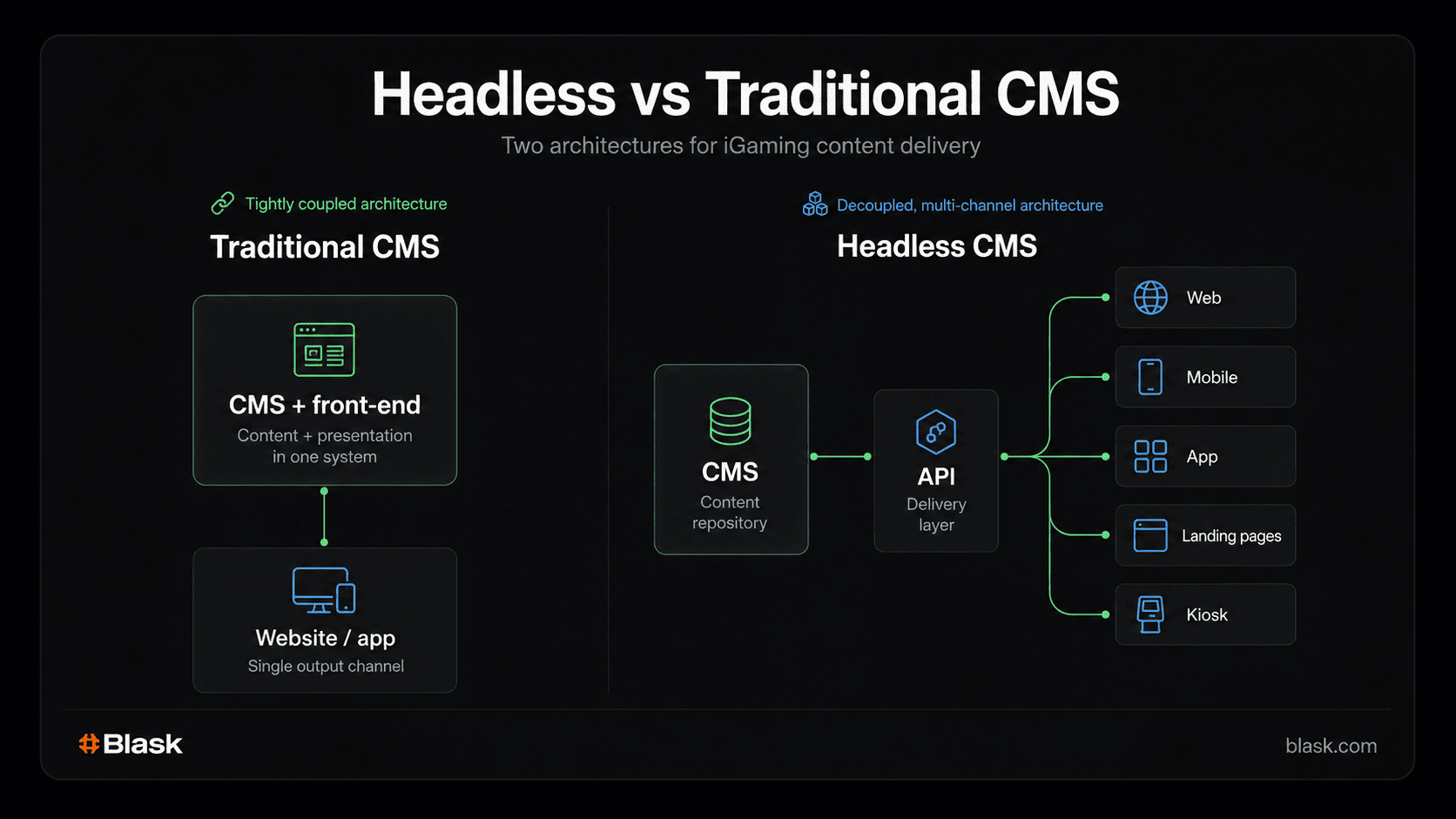
A traditional CMS bundles content management with a presentation layer. It deploys faster and requires less technical overhead. For smaller operators or those on integrated white-label platforms, this is typically the right starting point.
A headless CMS separates content from presentation, supports multi-channel delivery without content duplication, and allows complete front-end customization. For operators with custom-built front-ends or multiple brands running off a shared content layer, headless is the correct architecture.
The tradeoff is implementation complexity. Headless requires front-end development capability that traditional CMS deployments do not. An operator with a small technical team cannot maintain a custom front-end and an API-first CMS stack simultaneously.
Integration with PAM, sportsbook, and game aggregators
A content management system in iGaming is a coordination layer. Its value is proportional to the depth of its integrations.
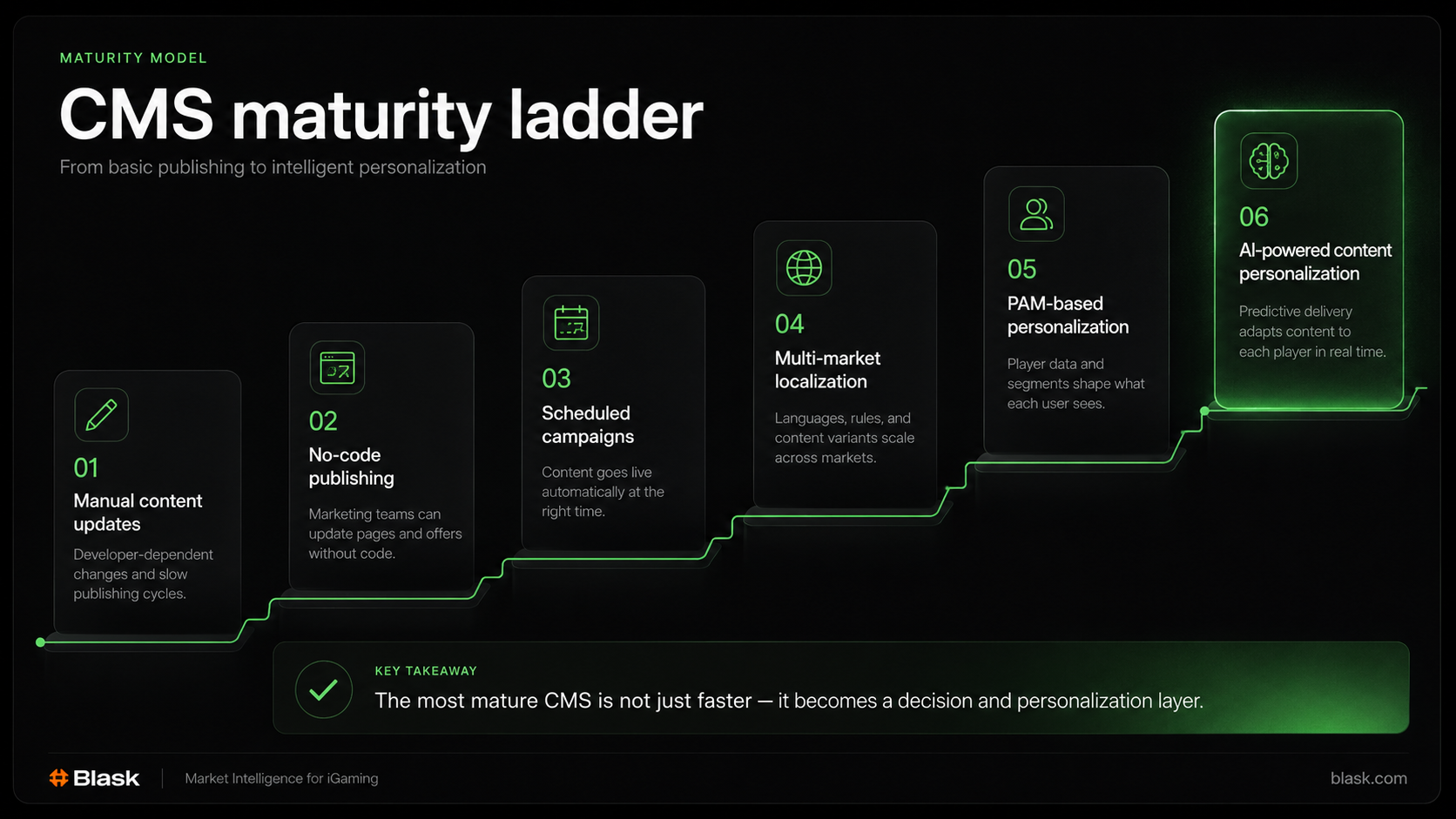
PAM integration enables personalized content delivery. When the PAM identifies a player as a high-value live casino user, the CMS serves a personalized lobby without manual editorial work. The PAM segment triggers the content variant automatically. Blask’s knowledge base covers Player Account Management in depth.
Sportsbook integration means live data flows into content pages automatically. Upcoming fixtures, boosted markets, and in-play odds surface dynamically. Without this connection, every odds update is a manual content task. A sportsbook platform connected to the CMS transforms the editorial workflow from reactive to automated. SOFTSWISS’s sportsbook CMS handles this through direct integration with trading services from Betradar and Oddin.gg.
Game aggregator integration is where content strategy meets catalog management. As Dmitry Belyanin, Co-founder of Blask, put it:
“I want to see provider content share — which providers dominate in the lobby of a specific market.”
Dmitry Belyanin
A CMS connected to a game aggregator pulls provider feeds and new release data automatically, reducing manual work across thousands of titles. Understanding the iGaming market structure — which providers lead in which geographies — informs lobby strategy directly.
Compliance and regulatory requirements
UKGC, MGA, Curaçao
Content rules vary significantly by regulator. UKGC-licensed operators now face additional requirements that took effect January 19, 2026: the ban on mixed-product promotions means offers that combine betting and casino products in a single incentive are no longer permitted. Wagering requirements are capped at 10x. Full terms must be one click away from the headline promotional offer on all relevant landing pages and sign-up pages.
These are not just advertising standards requirements. They require operators to audit and update existing promotional content across every channel — and demonstrate that the changes were made before the implementation date. A CMS with version history and geo-level content control can produce that evidence; one without it cannot.
MGA regulations cover multi-jurisdictional operators with comparable content requirements for licensed brands. Curaçao is less prescriptive but requires audit capability for all licensed operations.
A CMS deployed in regulated markets needs:
- Geo-level content rule enforcement before publication
- Approval workflows with documented sign-off records
- Audit logs recording timestamp and editor identity
- Automated compliance checks before a page goes live
GDPR and data privacy
iGaming operators serving EU players operate under GDPR. Content involving player data — personalized banners, targeted offers, behavioral retargeting — must meet data processing requirements.
Operators need to document which player data their CMS uses to serve personalized content, and ensure that content processing stops when a player withdraws consent.
AI personalization systems that pull live behavioral signals must be architected to exclude players who have opted out of data processing. This is a structural requirement, not a manual process.
Future trends in iGaming CMS for 2026
AI-powered content personalization
AI personalization moves beyond segment-based targeting. Casumo went live with Future Anthem’s Amplifier AI in October 2024, deploying real-time game recommendations tailored to individual players. The system runs continuously — not as a scheduled campaign, but as a live decisioning layer that updates as player behavior changes within a session.
For operators, the result is fewer manual segmentation rules and higher-converting content without additional editorial workload.
Pragmatic Play integrated Optimove’s Opti-X in March 2026 to enable personalized game recommendations and bonus execution across its operator portfolio. At the content level, this means the CMS serves different lobby layouts, banner sets, and promotional copy to different player segments — automatically, based on live signals from the PAM and game engine.
Composable and headless architectures
The composable architecture trend means operators increasingly build stacks from best-of-breed components: a headless CMS for content, a separate PAM, a sportsbook engine, a payment layer — all connected via API.
The MACH Alliance, whose founding members include Contentstack, advocates for this architecture explicitly. William Hill’s 2021 migration is the clearest operator-side precedent: replacing multiple coupled systems with a headless CMS that can serve web, mobile, and retail terminals from one content repository.
The practical implication for CMS selection: more operators will choose standalone headless tools rather than CMS modules bundled with platform suites. The integration overhead is real, but the long-term flexibility justifies it at scale.
Crypto and blockchain content
Crypto-native casino operators have content requirements that traditional CMS platforms were not built for: token balance displays, NFT-based reward tracking, blockchain transaction status. These are dynamic content types requiring real-time data feeds and compliance in a regulatory framework that is still forming.
CMS vendors targeting the crypto iGaming segment are building connectors for blockchain data sources and adapting their compliance tooling for this environment. SOFTSWISS has offered a dedicated Crypto Casino Solution since 2020, with content management integrated into the same platform operators use for fiat operations.
Common mistakes when implementing an iGaming CMS
Underestimating integration complexity. A CMS that does not connect cleanly to the PAM and sportsbook creates manual workarounds that multiply over time. Integration scoping needs to happen before vendor selection, not after. The William Hill experience — replacing several disconnected legacy CMSes with one headless platform — is a direct result of letting integration debt accumulate across product lines.
Choosing the wrong architecture for the operation’s stage. A headless CMS is powerful but requires front-end development capability. An operator with a small technical team cannot maintain a custom front-end and an API-first CMS stack simultaneously. Start with what the team can operate sustainably.
Treating compliance as a phase-two task. The UKGC’s January 2026 rule changes were announced in March 2025 — operators had ten months to update their content workflows. Operators without approval workflows and version history in their CMS faced that window without the tools to execute it cleanly. Audit trails and approval workflows are easier to build in than to retrofit.
Ignoring localization architecture. Content structured without localization in mind becomes a maintenance burden at market three. Multi-market operators should confirm their CMS handles content variants at the data model level — as Sportal365 does via its Content API — not through page duplication.
Underinvesting in team training. The business case for a CMS is that non-technical staff manage content independently. If the editorial team still needs developer help after deployment, the operational ROI does not materialize. BetConstruct explicitly lists “operational autonomy” as a core design goal of CMS Pro — the benchmark is zero developer dependency for daily content tasks.
FAQ
What is a CMS in iGaming?
In iGaming, a CMS refers to either a digital content management system — software for managing website content without coding — or a casino management system, which is a back-office platform. They are different products. Understanding which type a vendor is offering is the first question to ask in any procurement process.
Do smaller operators need a specialized iGaming CMS?
Smaller operators on white-label platforms typically use the CMS bundled with their platform provider. As operations scale — adding markets, brands, or custom front-ends — the limitations of bundled CMS tools become operational constraints. Most operators outgrow the bundled CMS before they outgrow their platform.
Can I use WordPress or a general CMS for an iGaming site?
Technically, yes. In practice, a general CMS lacks the compliance tooling, game lobby management features, and regulatory audit capabilities that licensed operators need. General-purpose CMS platforms are used in iGaming for the content marketing layer (blogs, SEO pages), while a separate system handles operational content.
How long does a CMS implementation take?
For integrated platform CMS modules, implementation is part of the broader platform rollout — typically 8–16 weeks for a full deployment. For standalone headless CMS tools, timelines depend on front-end complexity. A basic API integration takes 4–8 weeks; a full custom front-end rebuild may take six months or more. FEG described the Directus rollout as “one of the best rollouts in Fortuna history” — with rapid time-to-value from an out-of-the-shelf architecture that covered 95% of requirements without custom development.
Final thoughts
The right iGaming CMS is not the one with the most features. It is the one that matches the operator’s current stage, existing stack, and market footprint — and that can absorb regulatory changes without a development sprint.
Scale of competition varies by market, but the pattern is consistent: every major jurisdiction runs hundreds of active brands, all managing content stacks, all competing for the same player demand.
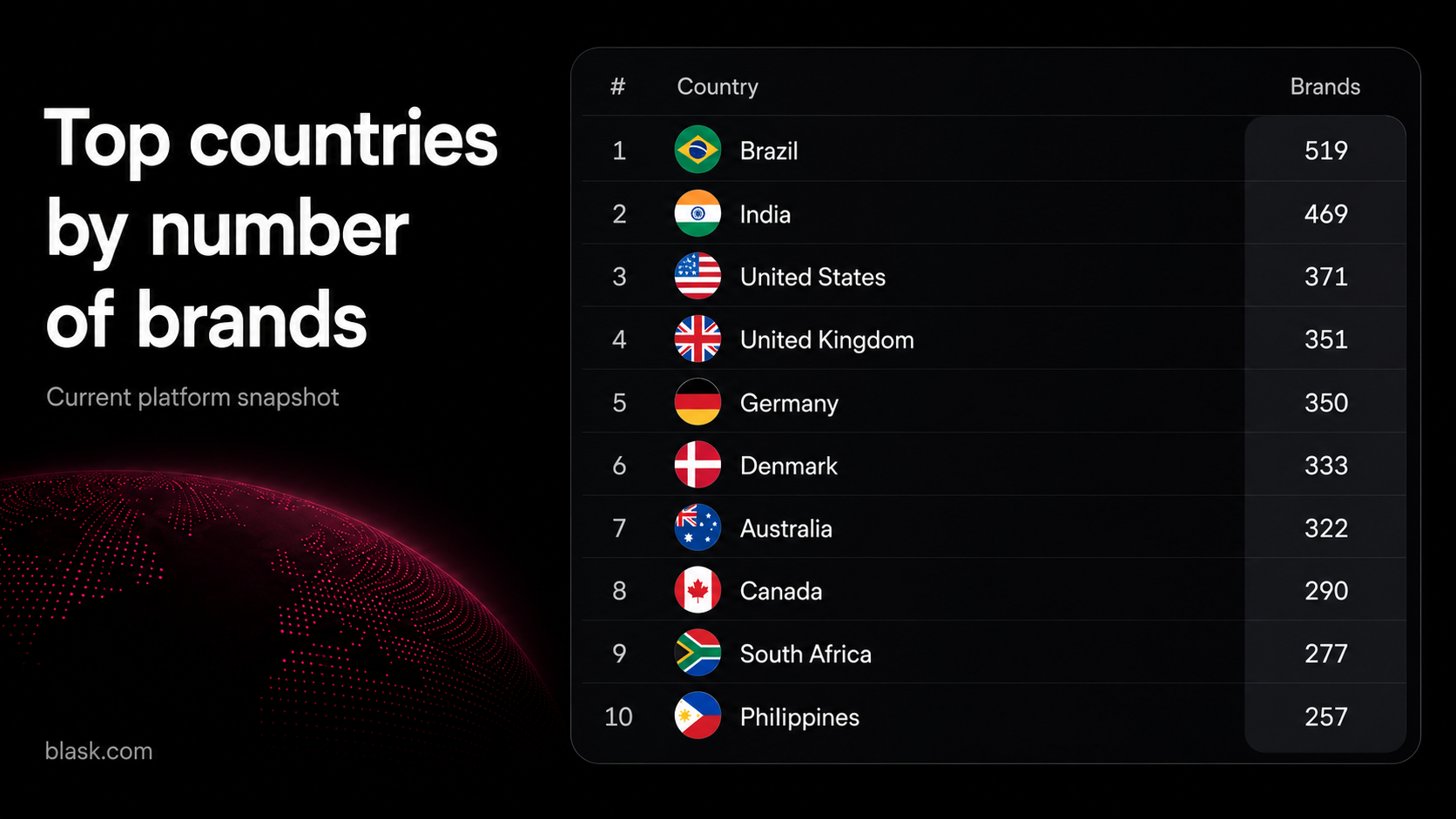
Brazil has the highest brand count of any market Blask tracks — 519 active brands competing in a $6.35B market. The US runs fewer brands (371) but against a market nearly 12 times larger.
At that level of competition, content speed and precision are not operational details — they are competitive factors that compound across every campaign and every market entry.
Operators evaluating a CMS or planning a platform migration should benchmark operational capabilities alongside market data.
Blask covers casino software providers and online casino market benchmarks to show what the competitive field already has in place.
The question is not which CMS is best in the abstract. The question is: which CMS lets this team, with this stack, move at the speed this market requires.