
- Updated:
- Published:
What are paylines
Paylines are the predefined paths on a slot grid where matching symbols must land to count as a win. Classic machines used one horizontal centre line; modern titles apply the same rule across diagonals, zigzags, hundreds of numbered routes, and later alternatives such as ways, Megaways, and clusters. After the RNG stops the reels, the game engine scores only those active paths against the paytable — symbols that sit off-path do not pay, even when they look close on screen.
The sections below cover what are paylines, how line maps evolved, and how operators and players should read line count versus RTP and volatility.
What are slot paylines?
| Paylines are the predefined paths across a reel grid where matching symbols must land to form a win. In a classic layout, that path is a straight horizontal line through the centre of three reels. In modern video slots, the same idea scales into dozens or hundreds of zigzags, diagonals, and multi-row routes — still called lines and still evaluated by the same rule: symbols on an active path, in the required order and count, pay according to the paytable. |
The plain payline meaning is geometric. The Random Number Generator (RNG) decides which symbols stop on each reel. The game engine then checks only the active lines (or equivalent “ways”) against the paytable. Extra symbols sitting off those paths do not count toward that line win, even when they look close on screen.
A brief history: from Liberty Bell to Megaways
Charles Fey’s Liberty Bell, built in San Francisco in 1895, is the reference point for the modern three-reel machine. California landmark documentation records Fey’s coin-operated three-reel design and workshop on Market Street. The machine used a single centre horizontal line: three matching symbols paid automatically from a hopper — the first mass-market line-pay model.
| Era | Typical grid | Win model |
| 1895–1970s | 3 reels × 1 row | 1 horizontal line |
| 1976–1990s | 3–5 reels, multi-line | Fixed multi-line video |
| 2000s–2010s | 5×3 ways / lines | 243 ways, adjustable lines |
| 2015+ | Variable reel height | Megaways (up to 117,649) |
Multi-line video slots arrived with electronic displays in the late 1970s and accelerated through the 1980s–90s as cabinets moved from mechanical strips to screens. The 2000s popularised “ways to win” maths that dropped strict line geometry. In 2015, Big Time Gaming shipped Bonanza and the Megaways engine. By Evolution’s acquisition announcement in 2021 the mechanic already sat inside 200+ licensed titles. The deal closed for up to €450 million consideration.
How slot paylines work
How do paylines work in practice: stake — spin — reel stop — line evaluation — paytable lookup — credit. The visible animation is theatre; the line check is deterministic once the RNG outcome is fixed.
Reels, rows, and symbols
A standard video slot shows five vertical reels and three visible rows (a 5×3 window). Each reel carries a longer strip of symbols offline; only three positions are shown. Wilds substitute for regular pays. Scatters and bonus icons usually follow separate rules and may pay off-line. The help-screen line map — the usual place for a slot machine paylines diagram — plots every numbered path onto that 5×3 (or larger) window so the geometry is unambiguous.
Triggering a winning combination
A line wins when the required number of identical symbols (or wild-assisted substitutes) land on consecutive positions along an active path, usually starting from the leftmost reel. Two-of-a-kind may pay for premium symbols only. Three-of-a-kind is the common floor. The engine awards the highest win per line, then sums wins across all active lines for that spin.
Left-to-right vs any-direction pays
| Evaluation rule | Typical requirement | Common use |
| Left-to-right | Match from reel 1 outward | Classic lines and most ways |
| Both ways | Left-to-right and right-to-left | Selected multi-line titles |
| Any-ways / adjacent | Adjacent reels, any row | 243 / 1024 / Megaways |
Left-to-right remains the default for traditional paylines in slots. Both-ways double the directional checks without changing the underlying symbol weights. Ways-to-win systems drop the fixed path entirely and pay for matching symbols on adjacent reels regardless of vertical position.
Reading the paytable
The paytable lists symbol values, usually as multiples of the line stake or total stake — the help file states which. It also states minimum match length, wild behaviour, scatter pays, and feature triggers. Line count and coin value sit beside that table because total bet = coins x coin value x active lines (or a flat total bet on ways titles).
Independent labs and regulators treat theoretical RTP as a long-run design figure, not a session promise. UKGC guidance shows how actual RTP is measured from turnover and wins, with tolerance bands that widen when spin samples are small. A paytable that looks generous on high symbols can still sit inside a high-volatility model where those hits are rare.
Types of slot paylines
There are different types of slot paylines: horizontal, vertical, diagonal, zigzag and V-shaped. The sections below explore them.
Horizontal paylines
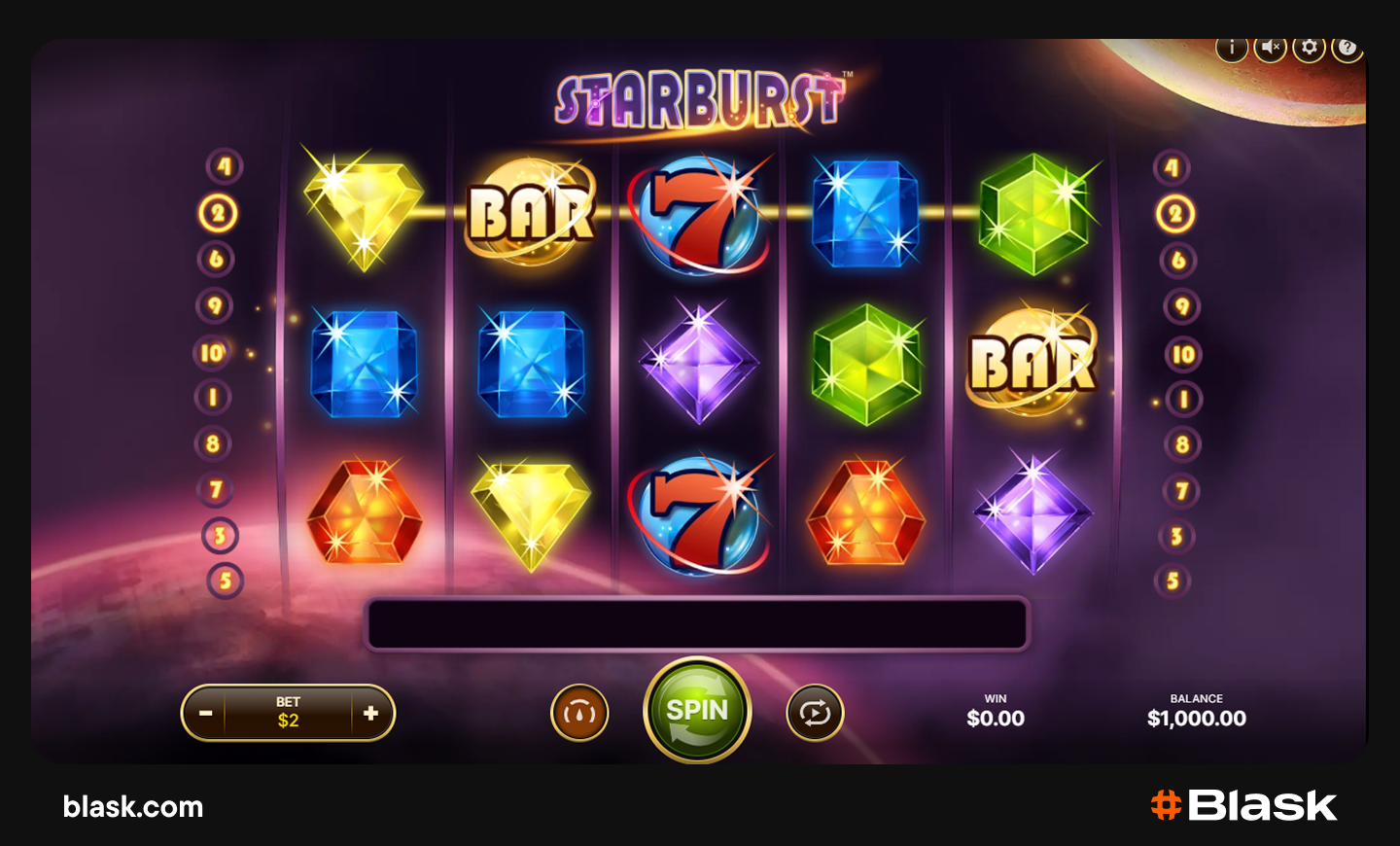
Horizontal slot paylines example (Starburst, NetEnt)
Straight rows across the window — centre, top, or bottom. The Liberty Bell pattern is the ancestor; modern 5×3 games often keep three horizontals inside a larger line set.
Vertical paylines
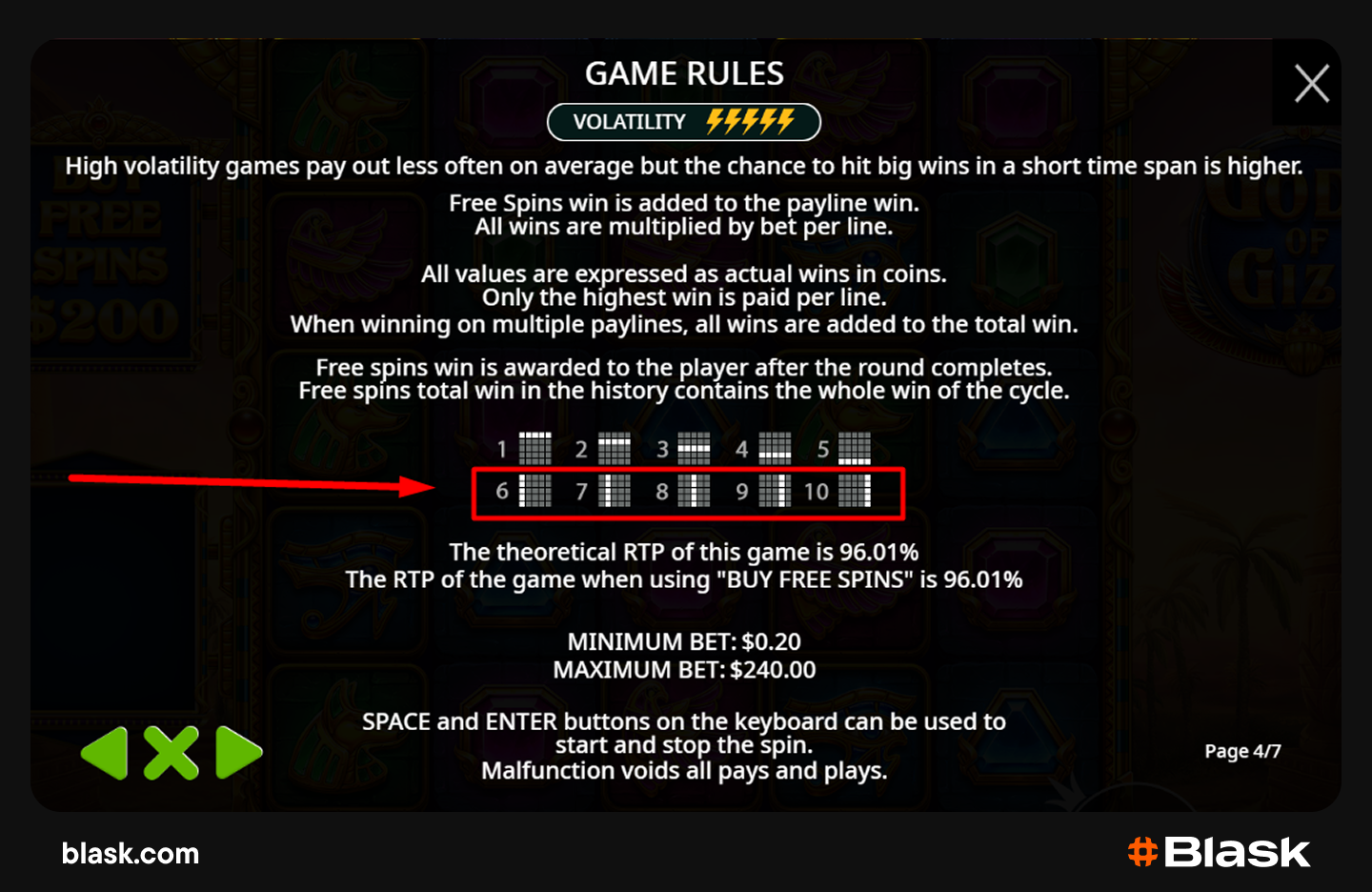
Vertical paylines example (Gods of Giza, Pragmatic Play)
Rare as primary wins on classic fruit machines, more common as specialty pays or in some grid games. Vertical evaluation treats a single reel’s stacked matches as a paying path.
Diagonal paylines
Corner-to-corner routes across five reels. They raise pattern variety without changing reel strips and appear in almost every multi-line 5 reel slot machine paylines package.
Zigzag and V-Shaped paylines
V, W, and irregular zigzags fill out 20-, 25-, and 50-line maps. Marketing counts often come from these shapes: more numbered paths, same 5×3 window. A SlotsRank analysis of 3,000+ non-branded video slots tracked from February 2025 found ≤25 lines still covering 58.55% of titles, while 1,000+ lines already accounted for 16.47%.
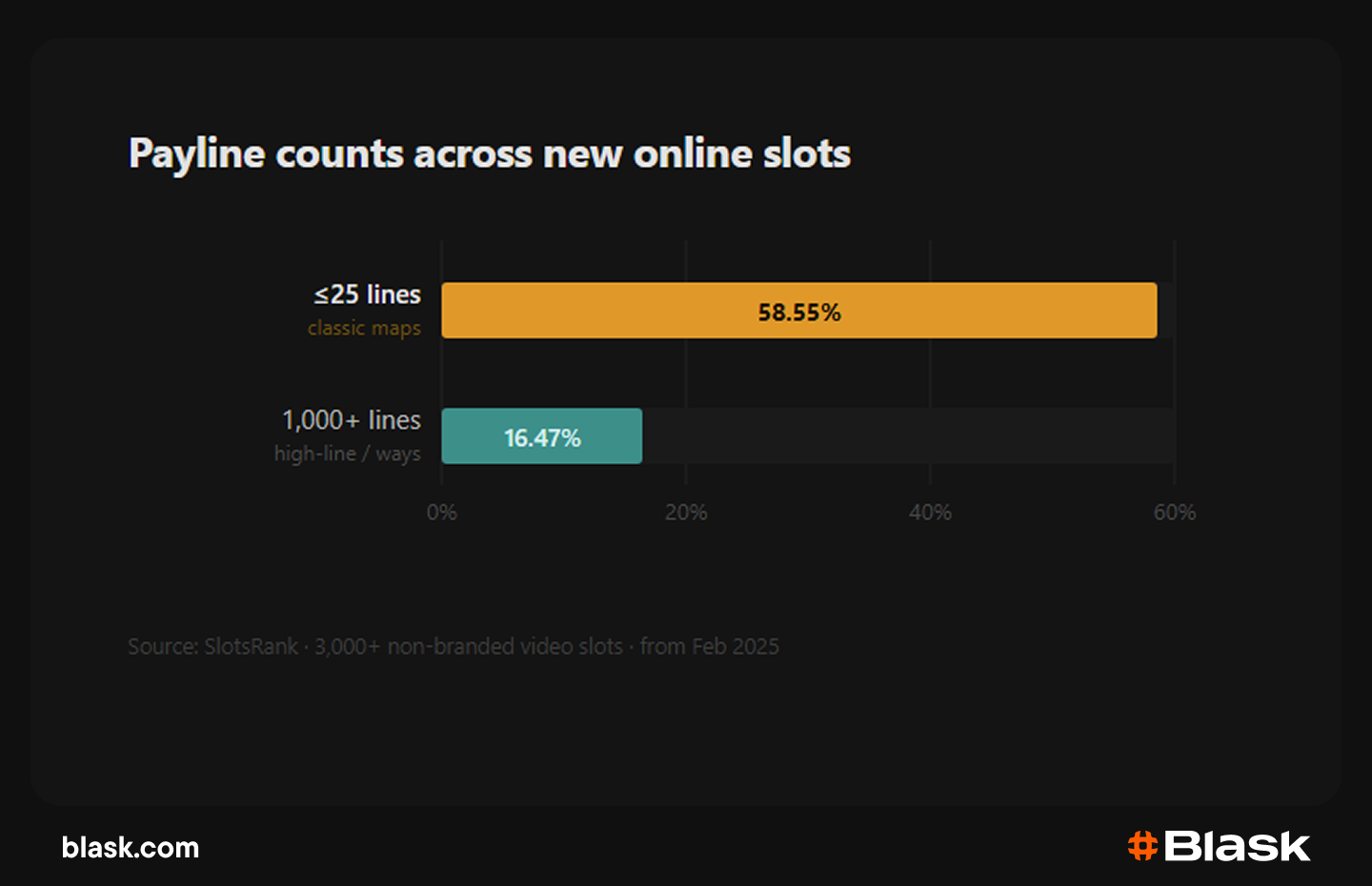
Two parallel design tracks rather than a single replacement of classic maps
Fixed paylines vs adjustable paylines
Fixed-line games lock every line on every spin. Adjustable (or “select lines”) games allow a subset of lines to be activated, historically to manage stake size on land-based coin machines and early online ports.
Pros and cons of fixed paylines
| Advantage | Trade-off | Operator note |
| Full paytable access | Higher minimum bet | Cleaner UX, fewer support tickets |
| No “missed line” disputes | Less stake granularity | Preferred in modern video slots |
| Simpler bonus math | — | Easier certification narratives |
Pros and cons of adjustable paylines
| Advantage | Trade-off | Player-facing risk |
| Finer bet control | Wins on inactive lines void | Partial-line play can feel punitive |
| Legacy cabinet familiarity | Confusing for new players | Paytable values scale with line bet |
| Lower entry stake options | Incomplete feature eligibility | Some bonuses require max lines |
Industry practice has shifted toward fixed lines or flat total-bet ways models. Partial-line selection survives mainly in older catalogues and certain regulated land-based conversions.
Ways to win beyond traditional paylines
243 ways to win
On a 5×3 grid, each reel contributes three positions: 3x3x3x3x3 = 243 ways. Matching symbols on adjacent reels pay regardless of row. NetEnt’s classic ways titles popularised the format in the late 2000s; it remains a standard alternative to numbered line maps.
1024 ways to win
A 5×4 window yields 4⁵ = 1,024 ways. The extra row increases combination surface area and usually raises visual density without requiring Megaways licensing.
Megaways mechanic
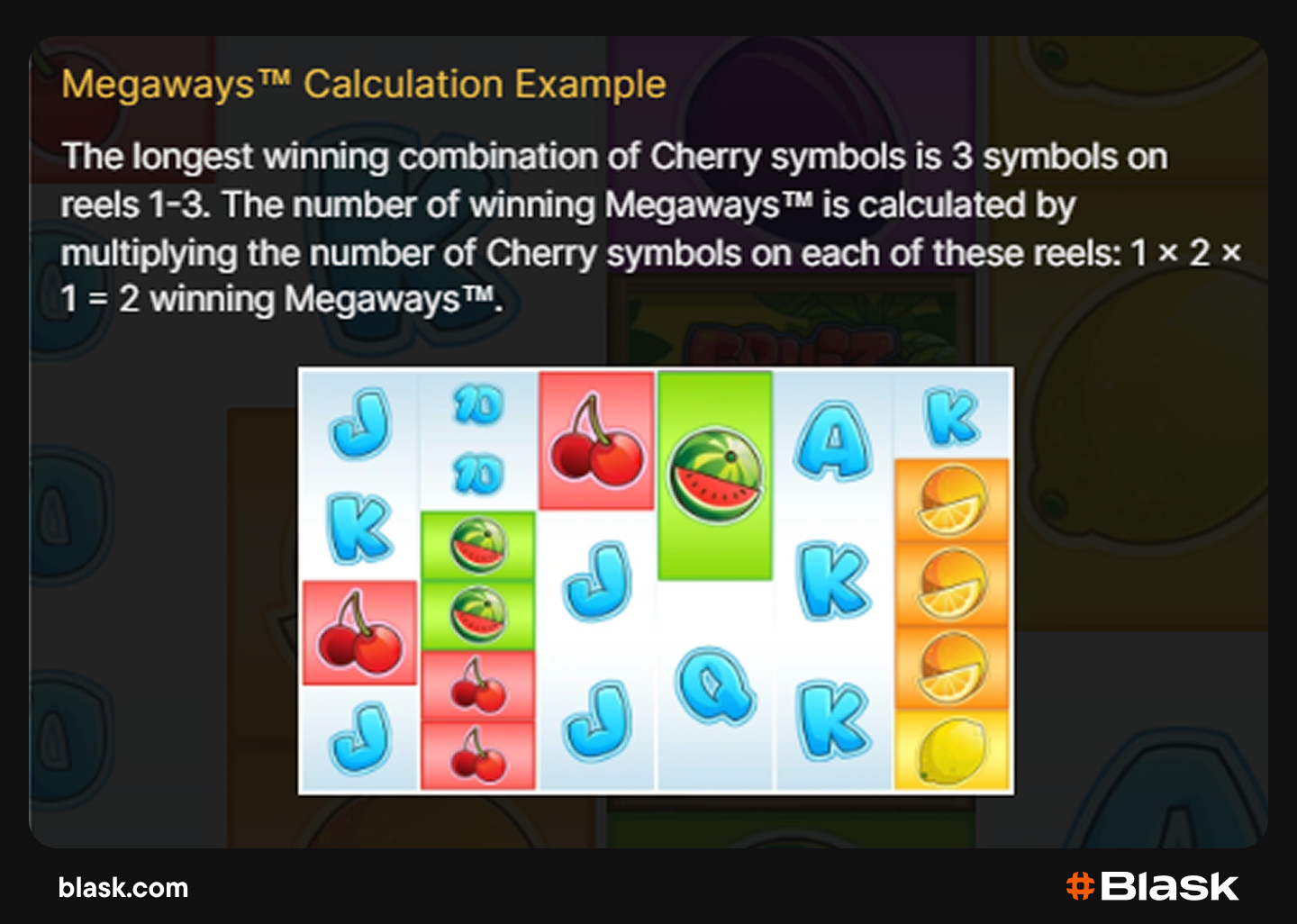
Megaways calculation example (Fruit Shop Megaways, NetEnt)
Megaways randomises reel height — typically 2 to 7 symbols per reel on six reels. Ways equal the product of visible symbol counts. Minimum 2⁶ = 64; maximum 7⁶ = 117,649. Evolution’s 2021 deal note stated the engine was already in 200+ third-party games. Licensed catalogues have since expanded across Blueprint, Red Tiger, Pragmatic Play, and others. Most spins land far below the marketing ceiling — commonly in the low thousands to low tens of thousands of ways.
Cluster pays

Cluster pays explanation from Stake about Moon Pricess Origins (Play’n’GO)
Cluster systems abandon lines and ways. Wins form when a minimum group of identical symbols (often 5+) touches horizontally or vertically. Cascades and multipliers usually sit on top. NetEnt and later Pragmatic Play titles (e.g. cluster candy / fruit grids) pushed the model into mainstream lobbies. Canada’s player base has shown a documented affinity for cluster-pay catalogues in regional market reviews.
| Model | Typical grid | Win rule |
| Fixed lines | 5×3, 10–50 lines | Exact path match |
| 243 / 1024 ways | 5×3 / 5×4 | Adjacent reels, any row |
| Megaways | 6 reels, 2–7 high | Product of reel heights |
| Cluster pays | e.g. 6×5 / 7×7 | Touching symbol groups |
How paylines affect volatility and RTP
Line count does not set RTP. RTP is the long-run percentage of stakes returned by the maths model; volatility describes how lumpy that return feels. SlotsRank’s 2025–26 exposure study found median RTP High at 96.10%, with 56.24% of new non-branded titles between 96% and under 98%, while high volatility accounted for 52.64% of the global snapshot. Separately, eGM & iGB’s Q3 2024 casino review reported average RTP around 95.45% across scanned operator pages, with high-volatility share near 29.5% of distributed content and 5-reel games still ~79% of tiles.
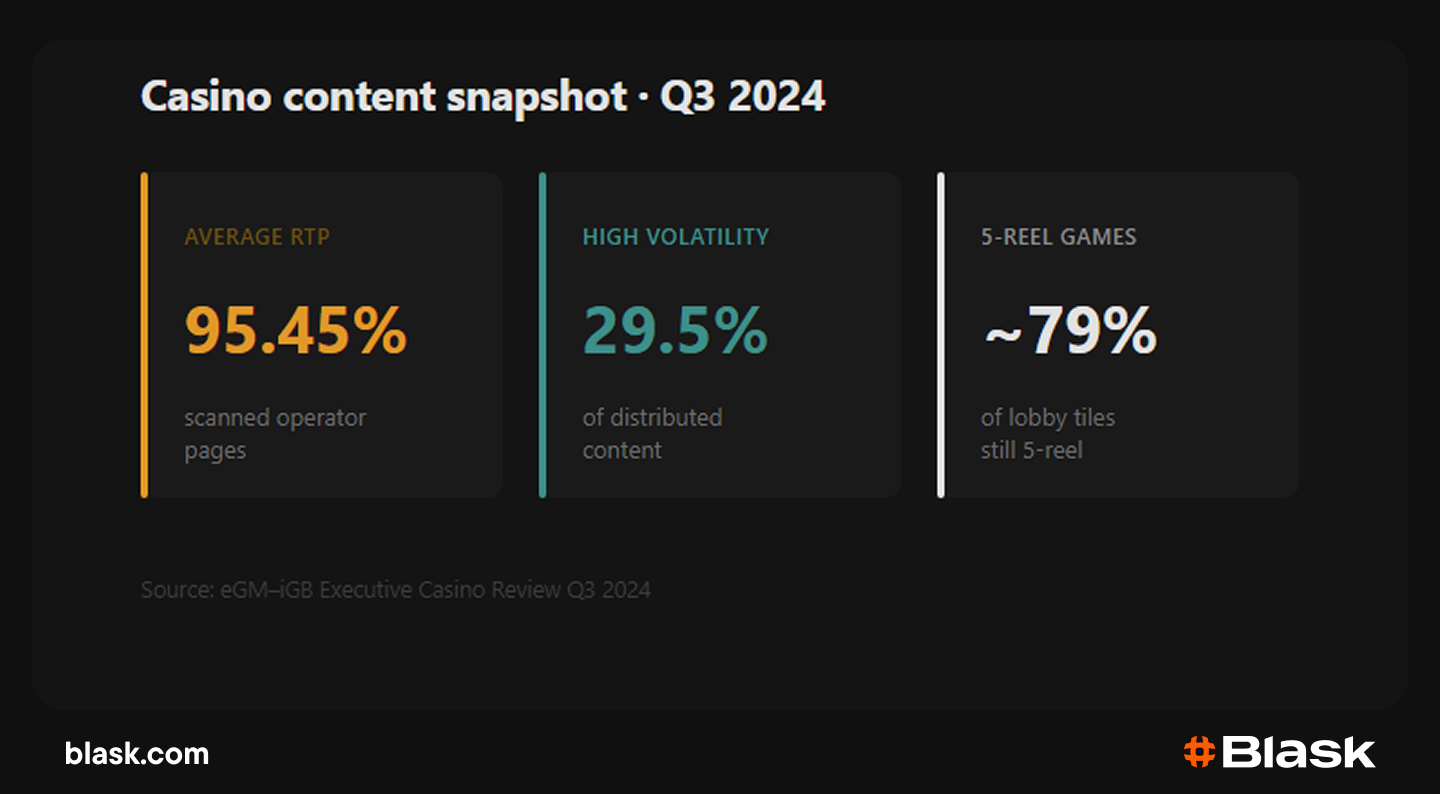
79% of lobby titles are 5-reel
More lines or ways change hit presentation — more small line wins can appear — but studios rebalance symbol weights and feature contribution so the target RTP holds. A 50-line game is not “twice as generous” as a 25-line game at the same total stake; the line bet is usually halved when lines double.
Bet size, coin value, and paylines
On classic multi-line machines:
| Total bet = coin value x coins per line x active lines |
Ways and Megaways titles usually collapse that into a single total bet control; the engine allocates stake across the active ways internally. Raising coin value scales all lines proportionally. Activating fewer adjustable lines lowers total bet but leaves wins on dark lines unpaid — a structural rule, not a glitch.
| Control | What it changes | What it does not change |
| Coin / bet value | Absolute win size | Relative paytable ratios |
| Active lines (adjustable) | Stake and eligible paths | Symbol probabilities on the strip |
| Max lines / fixed | Full paytable coverage | Guaranteed hit rate |
Jackpot contribution, where present, is typically a fixed slice of total bet defined in the game rules — another reason operators prefer fixed-line or flat-bet configurations for progressive networks.
Bonus symbols and special features on paylines
Scatters usually pay or trigger features regardless of line position; three or more scatters commonly open free spins. Bonus symbols may need to land on specific reels (often 1, 3, and 5) rather than on a numbered line. Expanding wilds, walking wilds, and stacked wilds interact with line maps by completing multiple paths in one stop.
Cascading / tumbling engines remove winning symbols and drop new ones into the same spin cycle, re-evaluating slot paylines or ways after each cascade. Megaways titles lean on this loop; cluster games use the same idea without line maps. Feature buy options, where legal, purchase direct entry into the bonus state — the payline model still governs how wins inside that state are counted.
Top provider innovations in payline mechanics
Big Time Gaming and the Megaways Engine
BTG’s patent-backed variable-reel system turned “ways” into a fluctuating product marketed up to 117,649. Evolution paid up to €450m for BTG in 2021, citing Bonanza, Extra Chilli, and the Megaways licence book already spanning 200+ games and 350+ operators. The commercial insight was licensing: studios rent the mechanic instead of reinventing variable-height maths.
NetEnt and Cluster Pays
NetEnt (also under Evolution) scaled clusters and ways alternatives alongside classic line games. High-RTP line titles such as Blood Suckers (98% RTP, 25 lines) remain reference points in “highest RTP” roundups, while cluster grids shifted engagement toward avalanche pace rather than line-count marketing.
Microgaming and Pragmatic Play
Microgaming’s catalogue historically anchored progressive networks on multi-line video slots and later variants. Pragmatic Play pushed high-volatility cluster and Megaways-licensed titles deep into aggregator feeds. Regional share snapshots have placed Pragmatic near 18.6% in Canada’s online slots mix as of late 2024 in secondary market reporting.
| ✅ Both publishers illustrate the B2B pattern: ship multiple evaluation models under one brand so operators can segment casual, medium, and high-risk demand. |
How operators choose payline configurations (B2B Angle)
Lobby composition is a portfolio problem. Slots still represent roughly 80% of game tiles on monitored casino pages even as live and crash formats gain share. Buyers weigh:
| Decision factor | Why it matters | Typical preference |
| Certification & RTP variants | Jurisdictional builds differ | Fixed lines / clear help files |
| Session length & hold | Volatility mix drives NGR shape | Ladder of low / mid / high vol |
| Licence cost | Megaways and brands add fees | Mix licensed + exclusive |
UK remote slots GGY of £3.6bn inside £4.4bn online casino GGY (FY 2023/24) keeps slot maths — including payline and ways structure — at the centre of content deals (UKGC). Operators rarely pick a single model: classic ≤25-line games still dominate release counts, while high-line and ways titles fill “ways to win” filters and campaign creatives.
Tips for choosing slots based on paylines
- Read whether the game uses lines, ways, Megaways, or clusters — the help screen states it in one line.
- Prefer fixed lines or flat total bet when the goal is full paytable access without inactive-path traps.
- Treat line count as presentation, not generosity; compare published RTP and volatility instead.
- On adjustable games, match active lines to the rules for bonus eligibility.
- Use the info-panel line map to verify diagonals and zigzags before raising stakes.
- For Megaways, expect the ways counter to move every spin; the 117,649 figure is a ceiling, not a baseline.
- Align volatility with bankroll length: high-vol ways titles can idle longer between features even when RTP sits near 96%.
Common payline misconceptions
More paylines mean better odds
False! Studios rebalance strip weights and feature frequency. Hit rate and RTP are maths outputs, not line marketing.
Inactive lines can still pay
On adjustable games, they do not. Symbols on dark lines are ignored for that spin’s line evaluation.
Megaways always plays with 117,649 ways
Only when every reel shows seven symbols. Typical spins sit far lower.
Ways to win removed the house edge
Ways change combination geometry. A 96% RTP game still holds 4% over the long run, lines or not.
Cluster pays are just 100+ paylines
Clusters use adjacency groups, not numbered paths. Comparing them to line counts mixes two different evaluation engines.