
- Updated:
- Published:
What is provably fair
Online gambling became a structural market long before most players could check a single bet. H2 Gambling Capital puts global online GGR at $293 billion in 2024 (41% of total gambling revenue). Fairness is still mostly institutional: licences, lab seals, audits. Commit–reveal replaces “trust the RNG” with proof that an outcome was fixed before the stake and not rewritten after.
The model — hashed server commitment, client seed, nonce, public hash — spread from Bitcoin dice into crypto lobbies. This article tells about what is provably fair, how it works, how bet outcome is generated, and other important things about this method.
What is provably fair gaming?
| Provably fair gaming is a method of generating and disclosing outcomes so a player can independently verify two claims after the round:The operator committed to a secret value before the bet.The published result is exactly what that secret, combined with the player’s input, produces under a known formula. |
Chainlink’s technical guide defines the approach as an algorithmic process that lets participants verify fairness through cryptographic hashing rather than a black-box server. The production pattern combines server seed, client seed, and nonce — typically via HMAC-SHA256.
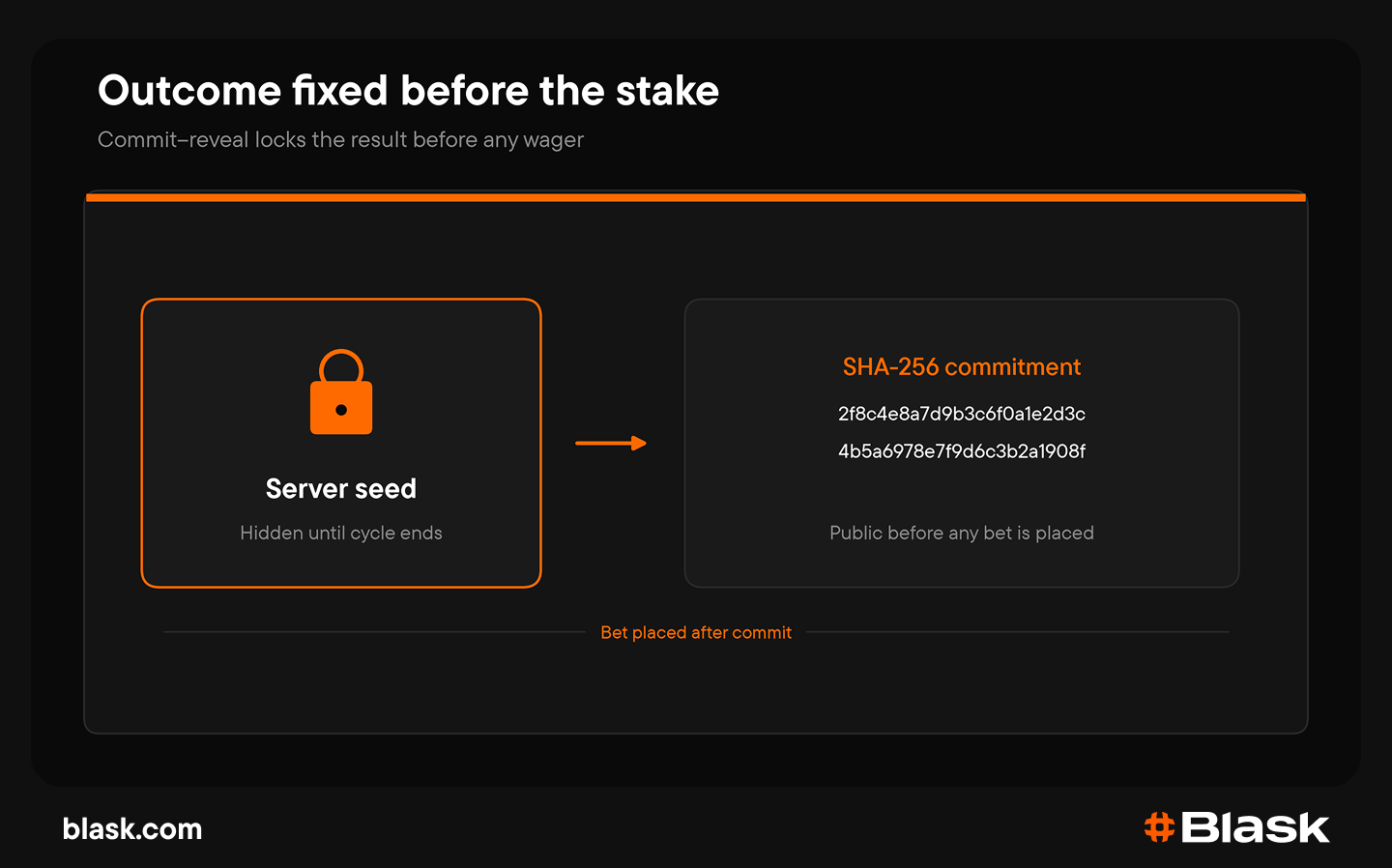
A provably fair casino does not remove the house edge. It removes silent post-bet manipulation of that round. RTP describes long-run expected return; commit–reveal describes per-round integrity. Those are related ideas, not substitutes.
In practice the label covers originals built around verification — dice, crash, mines, plinko, limbo — and, less often, card or slot products that expose seeds. A provably fair crypto casino usually means in-house or partner originals follow this model. Third-party studio slots on the same site may still run conventional certified RNG without player-side proofs.
Why provably fair exists: the trust problem in online gambling
Traditional online gambling asks players to accept an invisible RNG on a provider or operator server. Fairness is argued through licences and lab reports most players never open. Survey research shows the gap.
ENV Media’s Brazil fairness survey (617 adults) found 35% view casino games and sports betting as unfair or very unfair, against 19% who call them fair. 74% did not know how fairness is controlled. Games Magazine Brasil summarises the same study: 39% believe operators always manipulate games and 25% believe it happens sometimes; 62% had heard that playing at a specific time changes outcomes; 49% had heard of “cheat algorithms.”
The UK Gambling Commission’s qualitative work on consumer trust notes the same opacity in a regulated market. Commit–reveal emerged from Bitcoin-era rooms because institutional trust was thin and cryptographic proof was available.
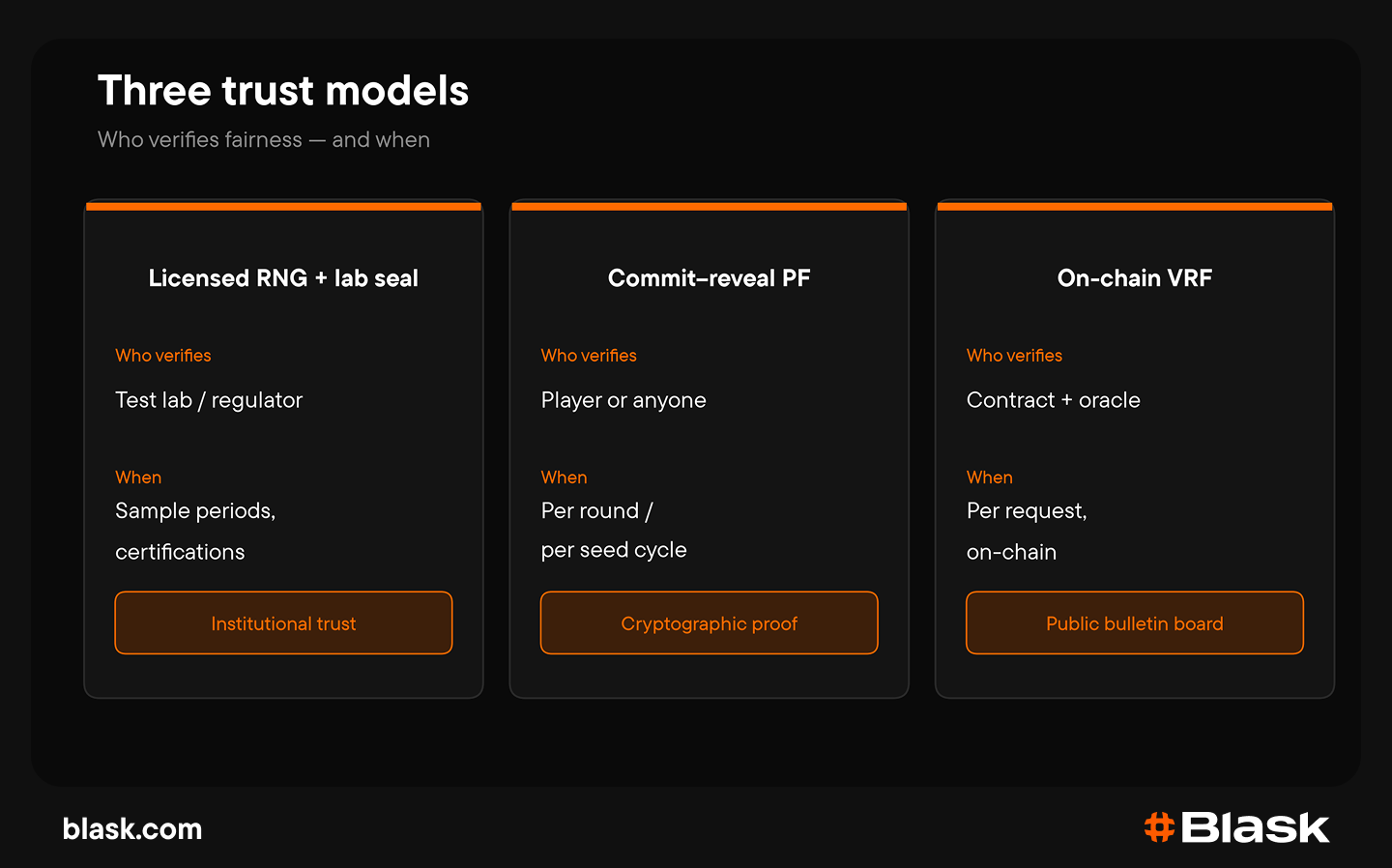
| Trust model | Who verifies | When verification happens |
| Licensed RNG + lab seal | Test lab / regulator | Sample periods, certifications |
| Commit–reveal PF | Player or any third party | Per round / per seed cycle |
| On-chain VRF | Smart contract + oracle proof | Per request, on-chain |
Provably fair VS traditional RNG and RTP
RNGs and RTP remain the backbone of regulated iGaming. Labs such as eCOGRA and iTech Labs test that RNG output is statistically random and that published RTP matches game math over large samples. Providers such as BGaming treat RNG certification (iTech Labs, BMM Testlabs) as the practical path from claims to independent proof.
That model is strong on statistical fairness and weak on individual-round transparency. A certificate confirms behaviour under test conditions. It does not hand a player a replayable proof for spin #48,291.
Commit–reveal inverts the audit surface. The math for one bet is public; the long-run distribution still depends on rules and edge. RTP answers “what share of stakes returns over time.” The seed model answers “was this outcome generated as promised.”
| Dimension | Traditional RNG / RTP | Commit–reveal PF |
| Proof type | Lab report, regulator file | Hash recompute by anyone |
| Scope | System-level, sample-based | Bet-level, deterministic |
| Player role | Trust seal and licence | Re-run the algorithm |
A game can be certified and still lack player verification. A game can expose seeds and still carry a steep house edge. Neither label guarantees profit.
How the provably fair algorithm works
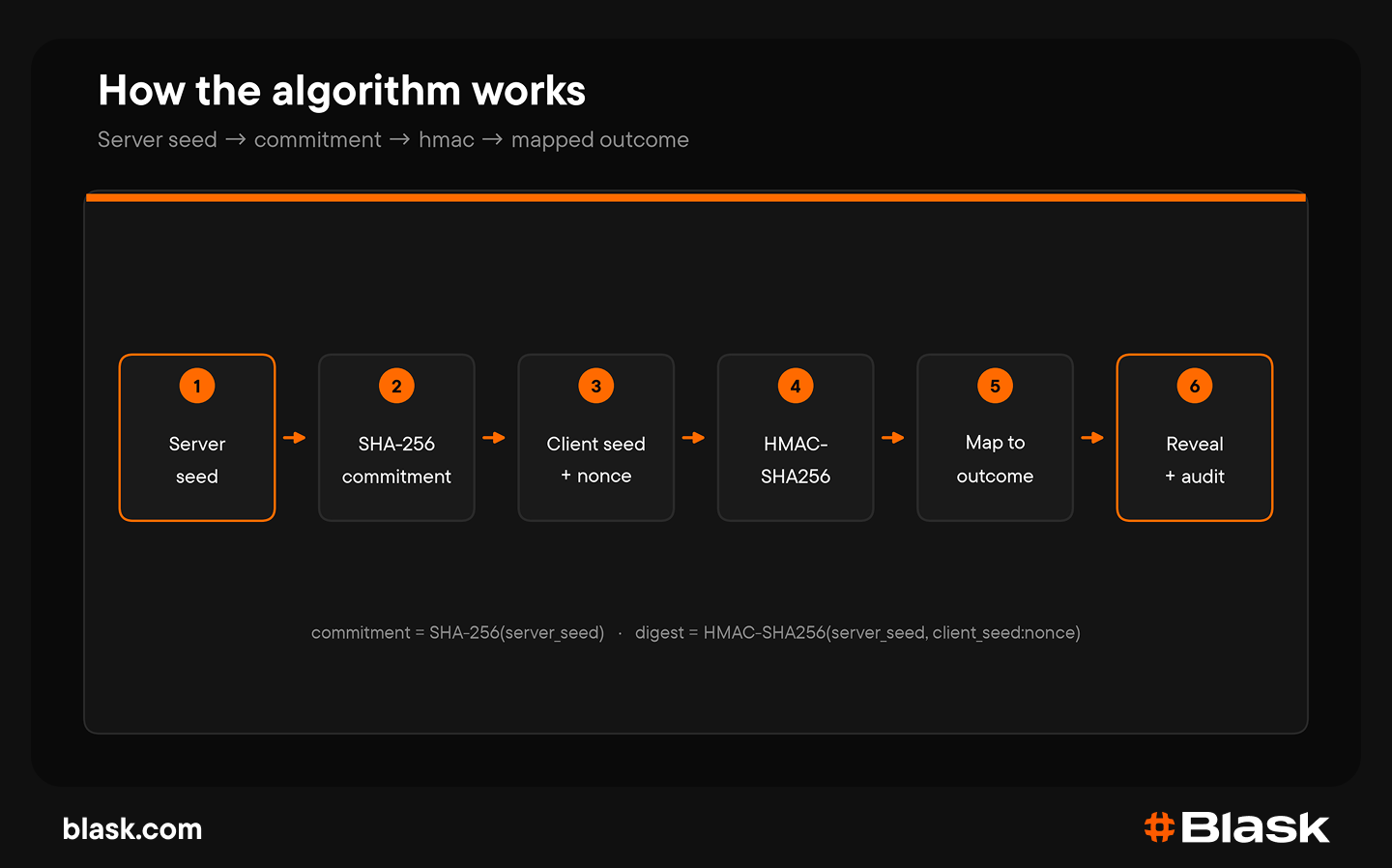
The commit–reveal algorithm used across most crypto operators works as follows. The operator publishes a commitment (usually a hash of a secret server seed) before play. Each bet derives from that secret plus player input plus a counter. After the seed cycle ends, the secret is revealed. Anyone who stored the original hash can confirm the match, then recompute every outcome in the cycle.
Chainlink summarises the three primary variables: server seed, client seed, and nonce. Common production form:
| commitment = SHA-256(server_seed)digest = HMAC-SHA256(key = server_seed, message = client_seed:nonce)outcome = map(digest → game result) |
Some titles add a cursor (byte offset) when one bet needs multiple random floats — multi-reel or multi-card draws — as in Maktub’s classic RNG notes.
Server seed and the hashed commitment
The server seed is a high-entropy secret from the operator. Players see only its hash at cycle start — typically SHA-256, standardised in NIST’s FIPS 180-4.
Publishing the hash first is the commitment. Changing the seed later changes the hash. Finding a different seed with the same hash is computationally infeasible under current SHA-256 assumptions. That is the anti-tamper lock.
While the seed stays secret, future results stay unpredictable. Once revealed, past results become checkable — and future results under that seed would become predictable, which is why cycles rotate.
Client seed
The client seed is the player’s contribution, auto-generated or set manually. It stops the house from shopping for a server seed that maps known stake patterns to a forced loss. Both sides contribute entropy to the final digest. Rotating the client seed does not improve RTP; it refreshes player-side input so seed pairs do not persist longer than needed.
Nonce
The nonce is an integer counter on a seed pair. It increments with each bet so identical seeds still produce distinct digests. Without it, every bet under the same seeds would collide. Verification needs four pieces for a classic HMAC setup: revealed server seed, client seed, nonce, and the game’s mapping rules.
Hashing functions (SHA-256, HMAC, SHAKE256)
| Function | Role in PF stacks | Standard |
| SHA-256 | Commit hash of server seed | FIPS 180-4 |
| HMAC-SHA256 | Per-bet digest from seeds + nonce | FIPS 198-1 / SP 800-224 |
| SHAKE256 | Variable-length digest / XOF | FIPS 202 |
SHA-256 fingerprints the server seed. HMAC (FIPS 198-1) uses that seed as key and client_seed:nonce as message, yielding a deterministic digest for mapping. SHAKE256 (FIPS 202) is an XOF that can emit as many bits as needed for long bitstreams. Product rule: publish the exact function and encoding — verification fails if concatenation, charset, or float extraction differs from production.
Step-by-step: how a bet outcome is generated
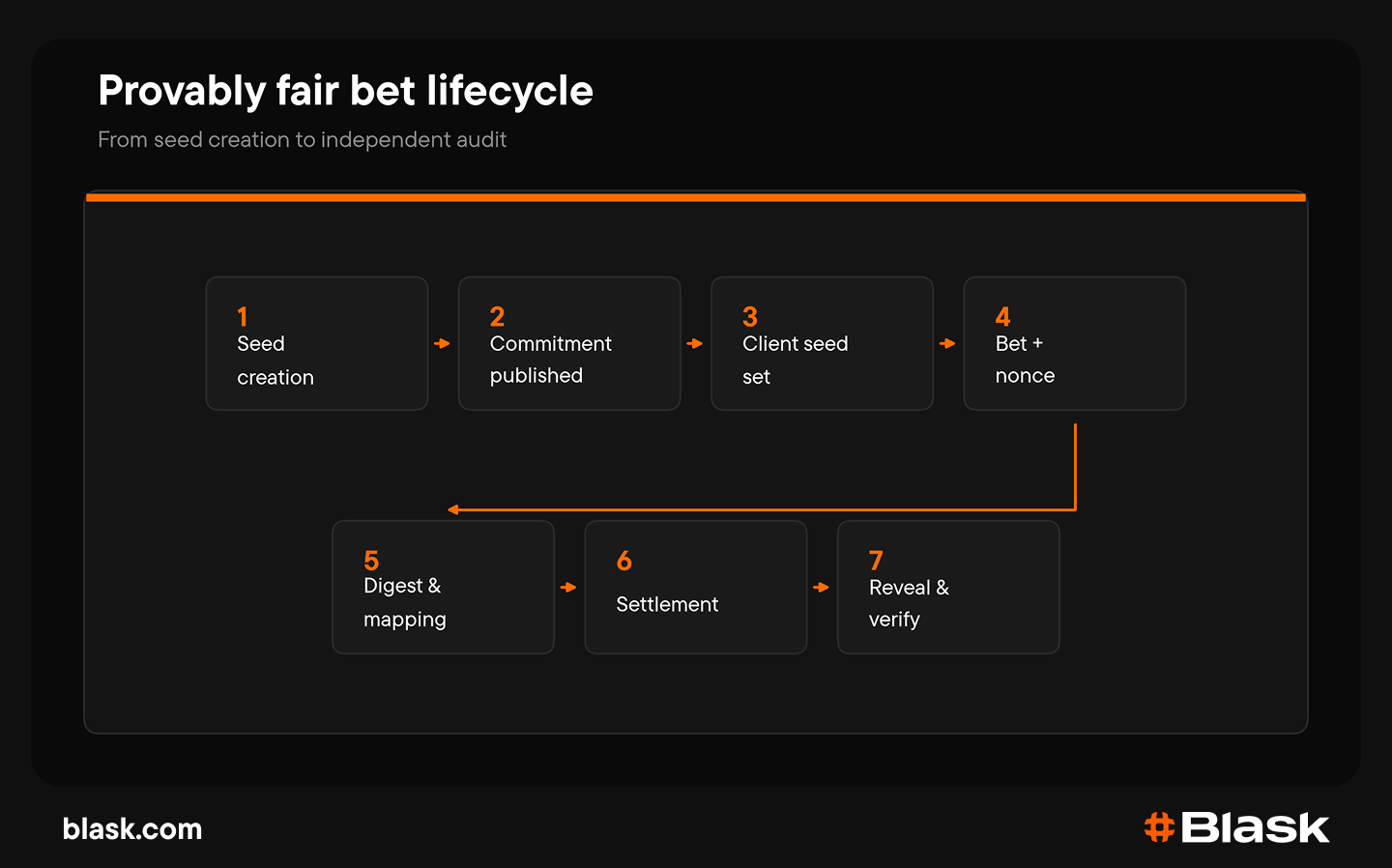
A typical original-game cycle on a provably fair bitcoin casino or broader crypto lobby:
- Seed creation. Server generates a server seed via a cryptographically secure RNG.
- Commitment. The site shows SHA-256(server_seed) before bets under that seed.
- Client seed set. Client seed accepted; nonce starts at 0 or 1.
- Bet placement. Stake and parameters chosen; nonce for this bet fixed.
- Digest. HMAC-SHA256(server_seed, client_seed:nonce[:cursor]).
- Mapping. Digest bytes become the outcome — e.g. float in [0, 1) scaled to 0–100 for dice, or a crash multiplier.
- Settlement. UI shows the result; pays by published odds and edge.
- Reveal. On seed rotation (or cycle end), raw server seed is disclosed.
- Audit. SHA-256(revealed seed) must equal the commitment; recomputed HMAC must match each recorded result.
If step 9 fails, the integrity claim fails. If it passes, the round followed the published formula. That is the entire guarantee.
How to verify a provably fair bet
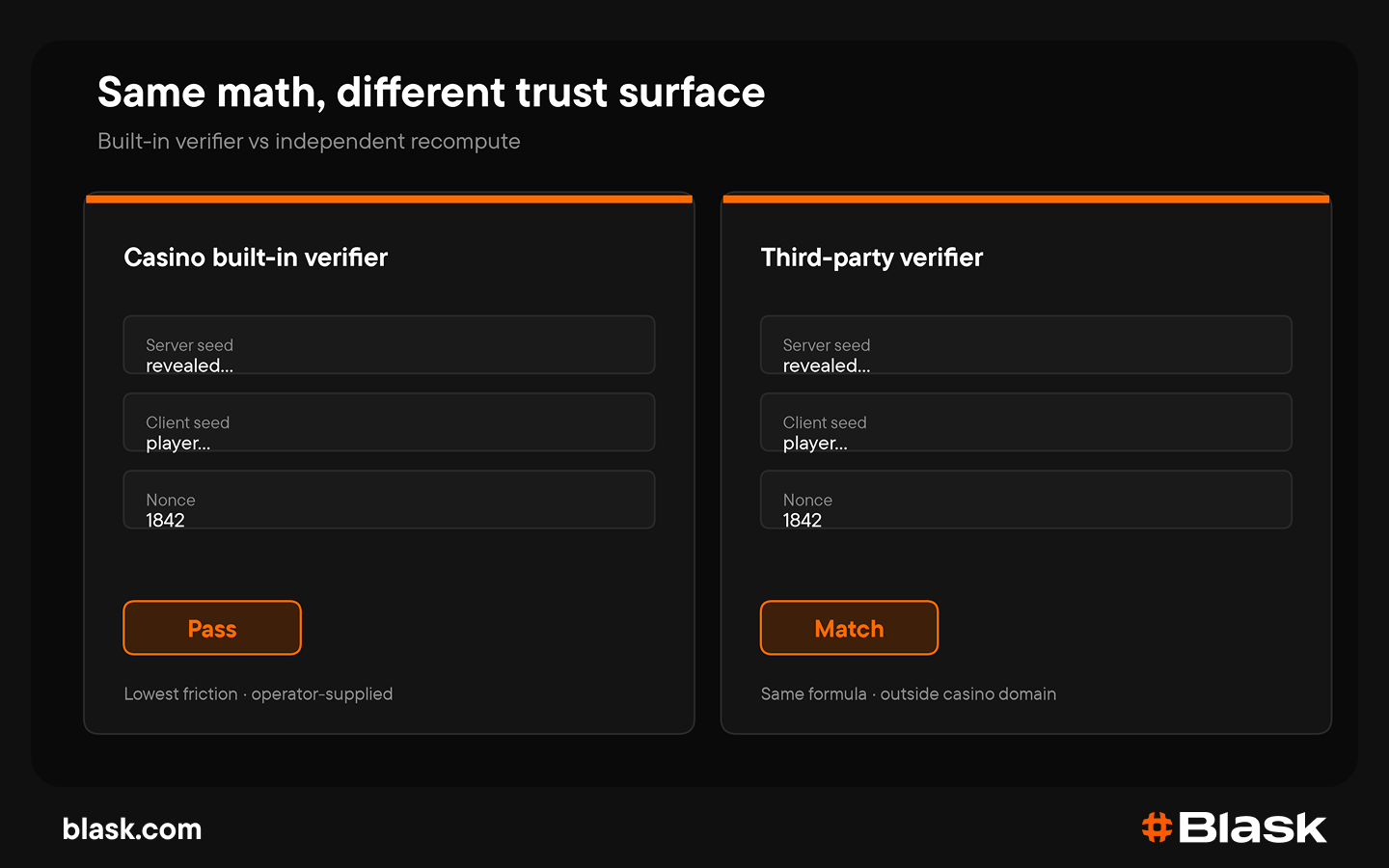
Verification needs retained data: pre-play commitment hash, client seed, nonce, and final server seed. Most platforms store these in bet history or a fairness modal.
Using a casino’s built-in verifier
Built-in tools feed revealed server seed, client seed, and nonce into the same path the game uses, then show pass/fail. Lowest friction; most players stop here. Limitation: the verifier is still operator-supplied. Fine for routine checks; disputed high-value rounds deserve an independent recompute.
Using a third-party verifier
External tools re-implement the published algorithm outside the casino domain. They need exact specs — message format, HMAC vs plain hash, endianness, outcome mapping. Chainlink frames the advantage: verification is available to anyone at any time, not only to auditors on a schedule. A correct hash for a low-RTP novelty game is still a low-RTP novelty game.
Rotating the client seed
Seed rotation reveals the previous server seed and starts a new commitment. Sensible practice: rotate after a meaningful session or when the nonce list grows long. Rotation must happen before the old server seed is treated as public for future bets. After reveal, that seed must never be reused for new wagering.
Provably fair across game types
Simple numeric outcomes verify cleanly. Complex reel strips and multi-stage bonuses need more random draws and clearer docs.
Dice and crash games
Dice and crash remain the reference. Dice maps a digest to a fixed range; the player picks roll-under or roll-over. Crash precommits to a crash point; the multiplier rises until that point or cash-out. Chainlink cites both as the most visible crypto-native use cases. Transparent edge tables next to a verifier explain why provably fair games of this type dominate original lobbies.
Roulette and card games
Digital roulette can map hash output to a pocket. Card games need a shuffle; verification is heavier (full seed and deal order). Shared-shoe multi-player designs add constraints — one private client seed cannot steer a shared deck without leaking information. Live dealer products sit outside classic PF: physical balls and shoes are audited by procedure and cameras, not HMAC digests.
Slots
A modern slot may need dozens of random values per spin. Providers can still attach proofs — BGaming combines certified RNG with verification on selected titles — but the UX is heavier than dice. Many operators push PF on originals and keep studio slots under lab certificates.
Blockchain, VRF, and on-chain randomness
Commit–reveal can run entirely off-chain. Blockchain adds a public bulletin board and, with the right tools, randomness smart contracts can consume safely.
Blockchains are deterministic; naive randomness from block hashes is vulnerable to validator influence. Chainlink VRF generates values off-chain and delivers them on-chain with a proof verified before use.
| Approach | Where it runs | Main guarantee |
| Classic PF (HMAC seeds) | Operator servers + player verify | Per-bet commit–reveal integrity |
| On-chain game logic | Smart contracts | Public state transitions |
| Chainlink VRF | Oracle + on-chain verify | Verifiable randomness for contracts |
TRM Labs notes platforms such as Stake, WINk, and Rollbit still take the other side of bets with a house edge, settling via PF RNG or live events. On-chain volume growth does not mean decentralised custody or licence-grade consumer protection. It means settlement — and sometimes randomness proofs — move onto public rails.
Benefits of provably fair for players
- Per-round auditability. A lost bet can be recomputed — stronger than a monthly seal for the dispute that matters.
- Less “rigged spin” ambiguity. When verification passes, the conversation is variance and edge, not a silent rewrite.
- Portable proof. Seeds and digests can be checked outside the casino domain.
- Fit for crypto distribution. Where licensing is uneven, cryptographic transparency is often the only proof players can operate themselves.
Symphony Solutions links crypto casino growth to payment friction and transparency demand, citing 560M+ crypto owners and Chainalysis at ~$703B average monthly USDT volume (June 2024–June 2025). None of these benefits raise RTP — only the quality of evidence around how RTP was applied.
Limitations and criticisms of provably fair
The fair is not favourable. Chainlink states the misconception clearly: a game can expose seeds and still embed a large house edge.
Verification is rare. Most players never open the fairness panel. Reputation still carries more day-to-day trust than math.
Scope is incomplete. PF proves outcome integrity for covered games. It does not prove solvency, withdrawal policy, bonus honesty, KYC handling, or that third-party slots in the same lobby are verifiable.
Seed handling risk. If a server seed leaks before the cycle ends, a sophisticated player could compute favourable client seeds. Secrets need payment-key seriousness.
Implementation variance. The label is not a single certified standard. Weak mapping, unclear docs, or verifiers that diverge from production create a theatre of transparency.
Not a licence. CoinsPaid Media notes PF is a technical verification model; licensing is a legal status. One does not imply the other.
Provably fair vs licensed RNG certification (eCOGRA, iTech Labs)
Independent labs remain the compliance language of regulated markets. eCOGRA’s RNG certification emphasises statistical analysis of RNG output across major online jurisdictions. iTech Labs focuses on technical RNG testing, RTP calculations, and security reviews under ISO/IEC 17025-style practice.
| Topic | eCOGRA / iTech Labs | Commit–reveal PF |
| Audience | Regulators, operators, compliance | Players verifying bets |
| Evidence | Certificate, report, seal | Hash + recompute |
| Coverage | Game suites, ops controls* | Games that expose seeds |
Scopes differ by product; eCOGRA’s wider Safe and Fair programme also covers operational and player-protection themes beyond raw RNG math.
Useful framing is stack, not rivalry. Regulated supply often needs lab RNG; crypto originals often need PF. Dual stacks exist: BGaming ships iTech Labs / BMM RNG evaluation plus verification tools on selected titles.
How operators and providers implement provably fair (B2B Angle)
On the supply side, PF is a product module: seed service, commitment API, bet logger, reveal workflow, verifier. Game math must consume PF floats like conventional RNG so RTP worksheets stay valid. Crypto-first operators treat originals as trust SKUs; support closes “rigged game” tickets with seed recomputes. Logs also help with internal audits where regulators still want classic RNG certificates. A provably fair gambling pitch works only when demos show the commit hash before a bet and third-party verify after reveal.
| Capability | Why it matters | Failure mode |
| Public algorithm spec | External verify possible | Marketing-only PF |
| Seed rotate + reveal | Cycle integrity | Stuck or opaque seeds |
| Bet-level logging | Dispute resolution | Missing nonce history |
How to spot a genuinely provably fair casino
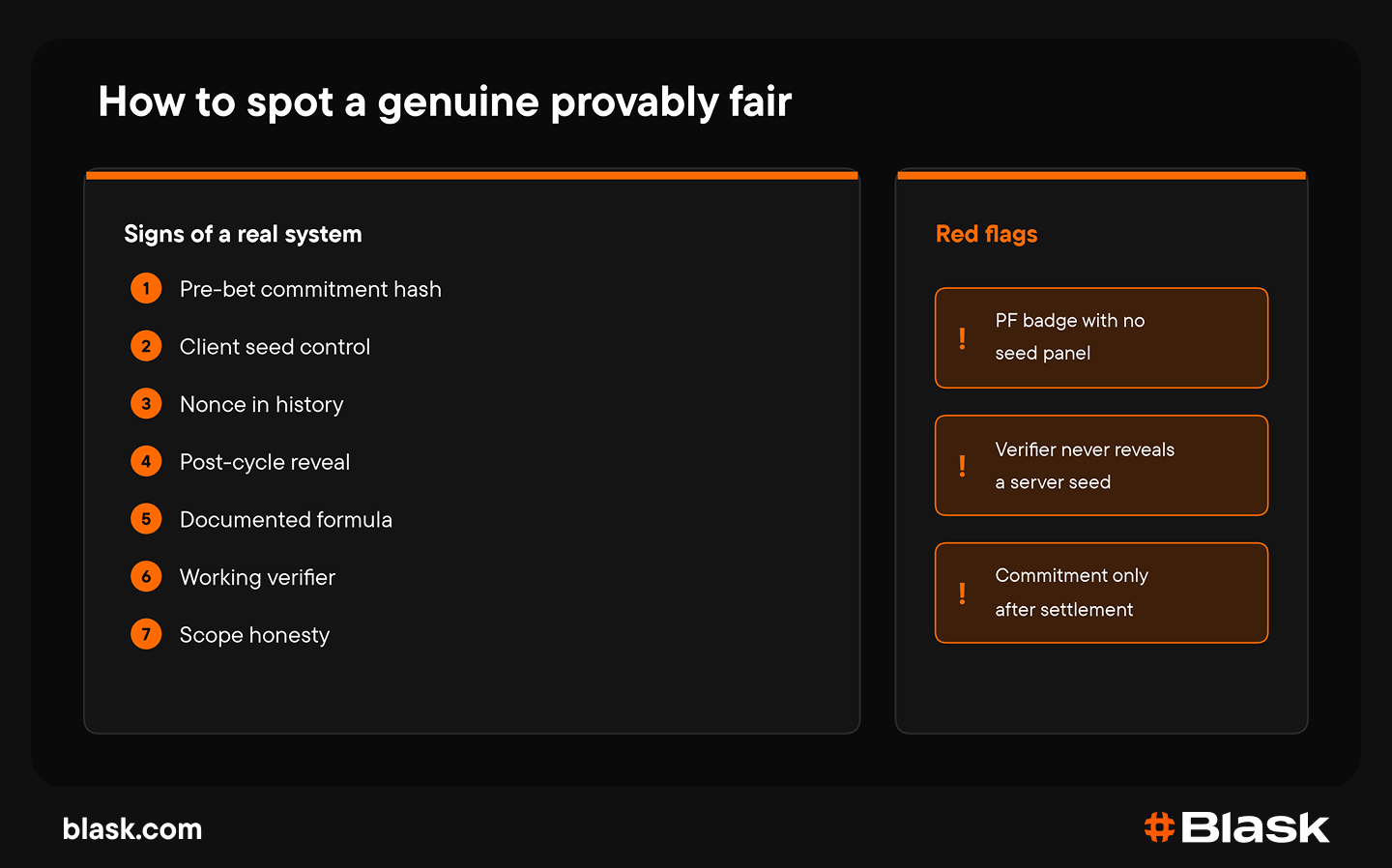
Signs of a real provably fair system:
- Pre-bet commitment — hashed server seed shown before wagering under that seed.
- Client seed control — players can set or rotate the client seed.
- Nonce in history — each bet stores the counter used.
- Post-cycle reveal — previous server seed becomes readable after rotation.
- Documented formula — HMAC/SHA details and outcome mapping published.
- Working verifier — built-in tool reproduces results; third-party recompute possible.
- Scope honesty — lobby states which titles are PF and which are studio RNG only.
Red flags: PF badges with no seed panel; verifiers that never reveal a server seed; commitments only after settlement; support that cannot produce seed triples.