Every slot machine has a risk profile built into it before a single player ever touches it. That risk profile is volatility. Understanding what does volatility mean in slots is the difference between choosing a game that fits your session goal and walking away frustrated from one that never could have delivered what you wanted.
— Max Tesla
CEO and co-founder Blask at Signal & Noise podcast
“Every gaming has a slot problem, not too many slots, too many bad ones. Studios spend millions copying yesterday’s top 10 without understanding why those games actually worked.”
Volatility determines how often a game pays and how large those payouts tend to be. The game provider fixes it in the math model before the title is certified and shipped to operators. Once live, neither the casino nor the player can adjust it. It is the architecture of the game’s payout logic.
What is slot volatility
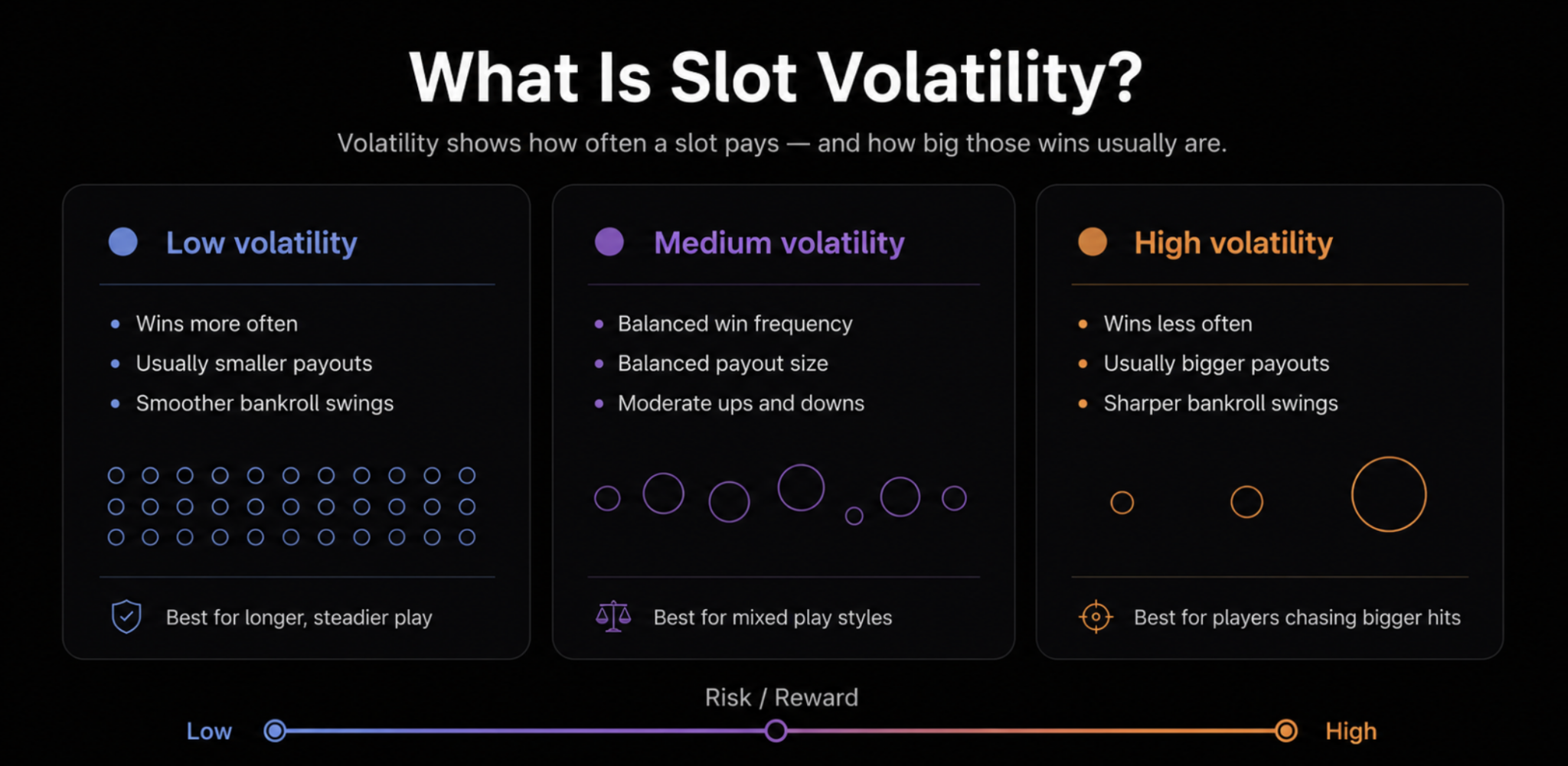
Slot volatility is the statistical distribution of outcomes across spins, the balance between win frequency and win size. A high-volatility game pays rarely but hits hard when it does. A low-volatility game pays often but keeps prizes small.
Two games can carry identical RTP values and produce completely different player experiences. Volatility is the mechanism that explains the difference.
Slot volatility in iGaming
Slot volatility determines:
How long a session lasts on a fixed budget
How often the bonus round triggers
What the realistic maximum win ceiling looks like
Whether the game suits casual entertainment or dedicated high-stakes sessions
How much bankroll you need before variance has room to work
Guy Hasson, a slot mathematician and game designer with 18 years of experience across Playtech, Playtika, Leap Gaming, and Tangelo, described the purpose behind all of this:
Guy Hasson
“Over the years, my concern was how to increase fun, retention, monetization, same thing, time on machine. All of the same thing, specifically to the audience to which you’re doing it.”
Volatility starts with audience. It is a design decision about which emotional experience a game is built to deliver, not a technical parameter chosen for convenience.
Volatility vs variance: are they the same?
Slot variance and slot volatility describe the same concept. Variance is the precise mathematical term: the average squared deviation of outcomes from the mean. Volatility became the industry shorthand that appears on paytables, lobby filters, and provider documentation.
Most game providers, operators, and review platforms use both words interchangeably. When a provider math sheet references a “low-variance” design, it means exactly the same thing as “low-volatility.”
The only distinction is context.
Math teams and developers tend to say variance. Marketing materials, player guides, and casino filters tend to say volatility. There is no practical difference in what either term means when selecting or evaluating a game.
How slot volatility works
Slot machine volatility is built from three primary design levers:
Hit rate: how often a winning combination lands per spin. Across hundreds of certified titles, low-volatility games cluster around 40–55% hit frequency. Medium-volatility games cluster around 25–33%. High-volatility games typically fall below 22%. Extreme-volatility titles often register below 15%.
Paytable shape: the ratio between low-symbol and high-symbol payouts. Flat paytables with many similar-value symbols produce low volatility. Steep paytables with rare, enormous top symbols produce high volatility.
Bonus feature design: how frequently bonus rounds trigger, how large their potential is, and whether multipliers are capped or accumulate. High-volatility games concentrate most of their mathematical expected value inside rare bonus events. In Gates of Olympus, the bonus triggers roughly once every 448 spins. In a typical low-volatility title, the equivalent trigger comes every 12–50 spins.
These levers interact. A game with a low hit rate and a moderate paytable produces a different experience than a game with a moderate hit rate and extreme multiplier accumulation during free spins. Both can be labeled “high volatility” while playing very differently in practice.
Hasson is direct about what this means for the craft:
“The math is the experience of the game, and you need to know what people enjoy.”
Guy Hasson
That is the job of a slot mathematician, not only to set correct statistical parameters, but to understand what those parameters feel like to the person spinning.
Slot volatility vs RTP: what’s the difference?
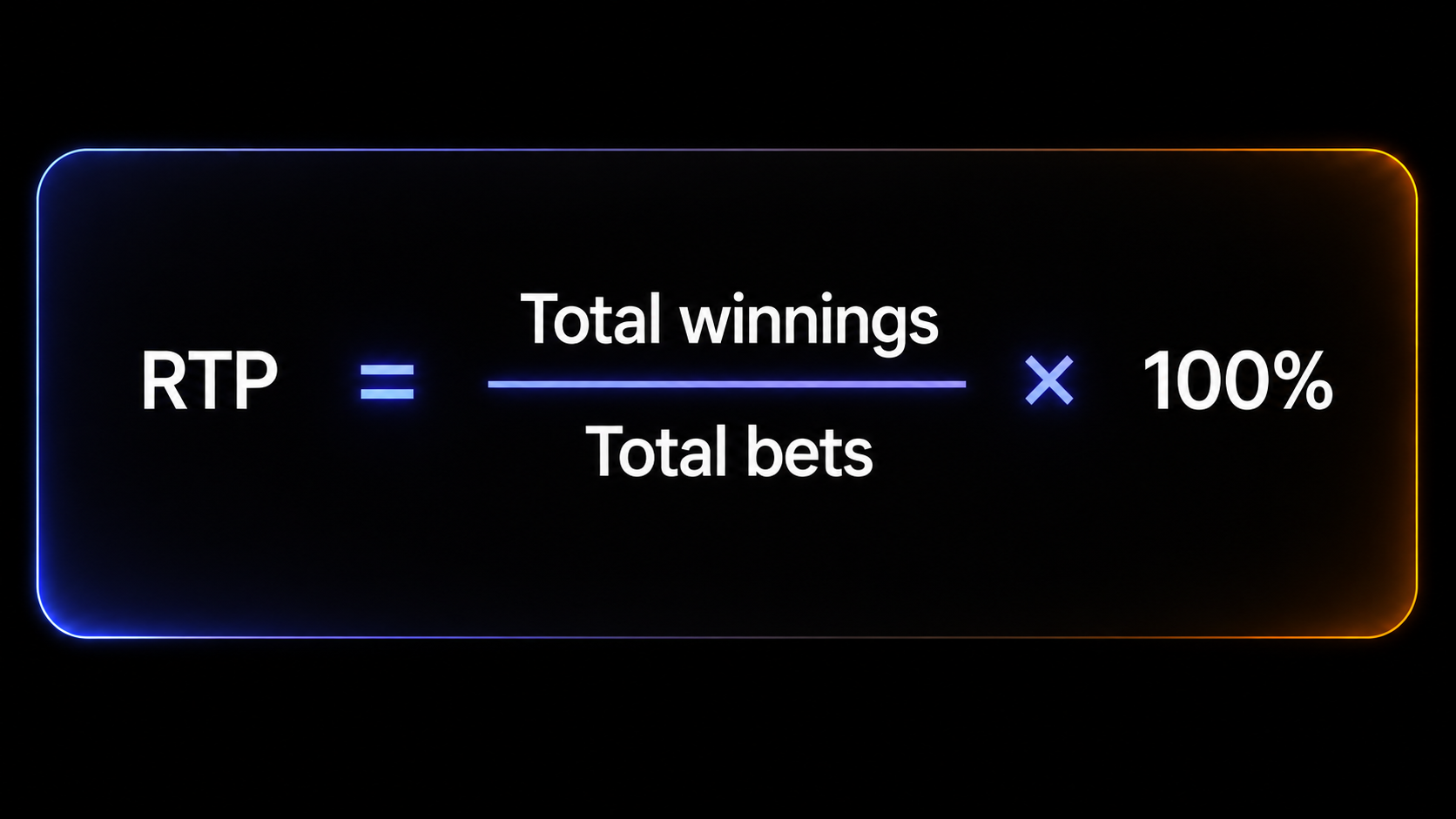
RTP measures what percentage of all wagered money the game returns to players over millions of spins. It is a long-run average that only materializes at scale. Slot volatility describes how outcomes are distributed around that average in the short term.
What is RTP in iGaming
Take two games, both with 96.5% RTP:
Game A: wins on 42% of spins, prizes range from 2–15x the bet, maximum win is 500x
Game B: wins on 11% of spins, long dry stretches in the base game, bonus round delivers up to 15,000x the bet
Both return 96.5% mathematically. Game A is low volatility. Game B is high volatility. Over one million spins, their RTP converges. Within any single session, they bear almost no resemblance to each other.
Pragmatic Play makes this concrete: Gates of Olympus carries 96.50% RTP and a 5/5 volatility rating. Sweet Bonanza carries 96.49% RTP and a 4/5 volatility rating. The 0.01% RTP gap is statistically irrelevant. Gates of Olympus concentrates its return into multipliers that accumulate permanently during free spins, up to 500x stacked, while Sweet Bonanza resets its multiplier bombs each tumble. Same provider. Nearly identical RTP. Completely different risk architecture.
Pragmatic Play also licenses Sweet Bonanza with three distinct RTP configurations. Standard markets receive 96.51%. Regulated markets like the UK and MGA jurisdictions receive 95.45%. Grey-market and Curaçao-licensed casinos sometimes carry 94.50%. The volatility profile stays constant. The house edge changes. A player moving from a grey-market casino to a UK-licensed operator is playing the same volatility with a meaningfully different long-run return; most players have no idea.
Types of slot volatility
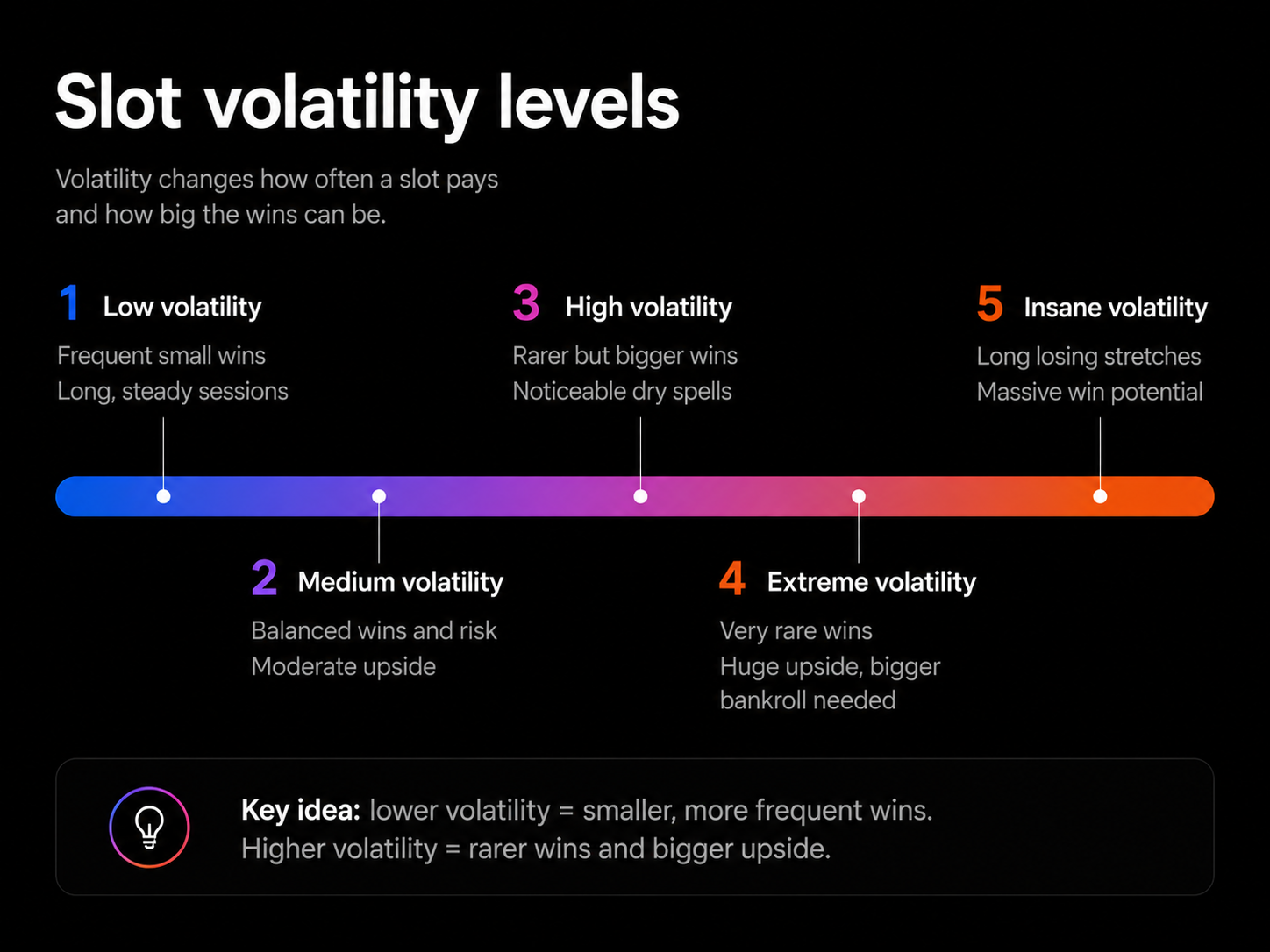
Most providers use a five-tier classification.
Slot volatility levels in iGaming
Low volatility slots
Low volatility slots pay on 40–55% of spins. Wins typically range from 2–20x the bet. Maximum win potential rarely exceeds 500–1,000x. Sessions feel steady: balance moves slowly, wins arrive often enough to sustain engagement, and the risk of a sudden complete bust is low.
What does low volatility mean in slots? The game keeps you in the session rather than chasing a life-changing payout. Entertainment comes from consistency, not peaks.
Best for: casual players, limited budgets, players prioritizing session length over jackpot potential, new players learning how slots work.
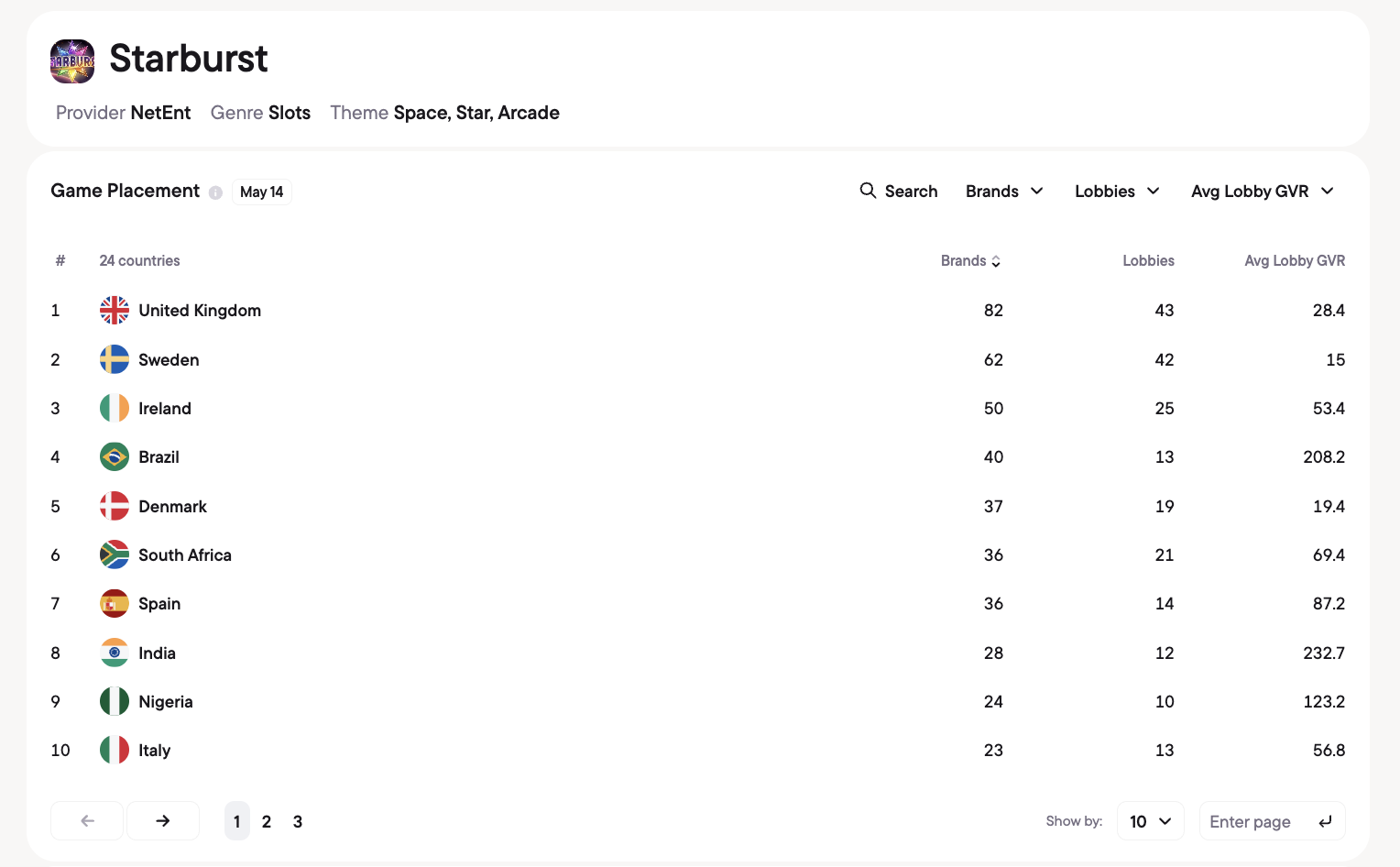
Example: Starburst (NetEnt): one of the most widely deployed low-volatility titles globally. Featured across 82 brands in the UK market with an average lobby rank inside the top 28 positions. Free spins feature with expanding wilds, predictable pay cycle, and a play loop short enough for a 20-minute session. Bankroll erosion is slow and controlled.
Starburst (NetEnt) positions across the countries in Blask
Starburst’s hit frequency exceeds 35% in the base game. Most sessions on a $50 budget at $0.20 per spin will last well beyond 200 spins.
Medium volatility slots
Medium volatility slots hit less often than low-volatility games but offer higher individual payout potential, typically up to 2,000–5,000x the bet. Hit frequency clusters around 25–33%. Dry spells between wins are more noticeable than in low-volatility titles, but sessions rarely feel completely dead.
The popularity of medium and high volatility is increasingly reflected in modern game portfolios. According to 1spin4win, this is not simply a response to operator demand but a deliberate product strategy based on player behavior.
Olga Hlukhovskaya
“We consistently see that players respond well to medium- and high-volatility titles because they create a more dynamic and engaging gameplay experience.”
Most players intuitively gravitate toward medium volatility because it balances engagement with reward potential. The session has variance but not enough to feel hostile to normal budgets.
Best for: players who want some upside without committing to long dry spells. Works across a wide range of budgets and play styles.
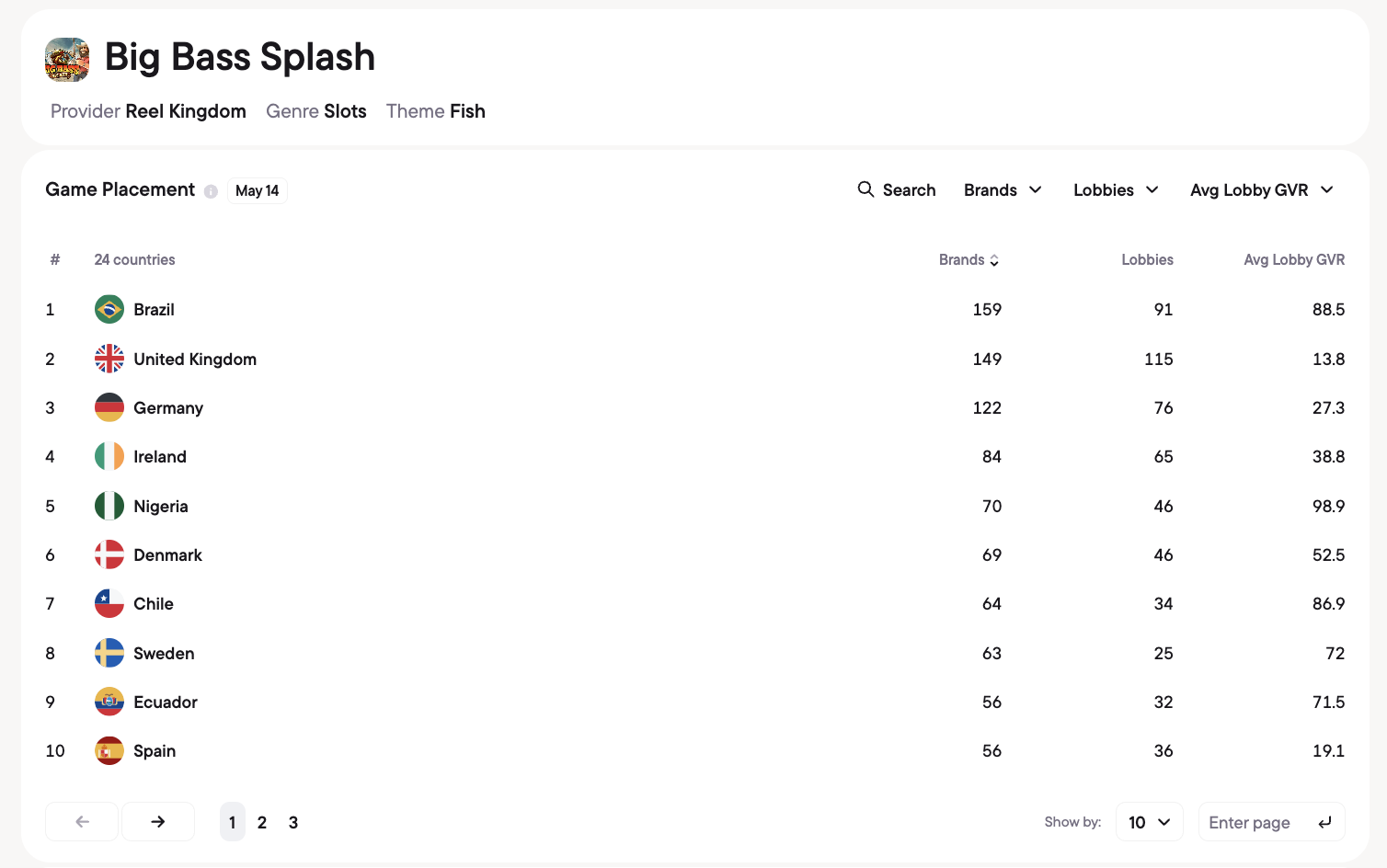
Example: Big Bass Splash (Reel Kingdom): the most widely distributed slot game in the UK, appearing in 149 brands with an average GVR of 13.8. In Brazil it reaches 159 brands. Medium volatility with a fishing theme, a straightforward bonus collector mechanic, and a moderate win ceiling.
Big Bass Splash (Reel Kingdom) positions across the countries in Blask
Guy Hasson explained why fishing games work so well at this volatility level, pointing to an alignment between theme and mechanics:
“It was done in such a way where the culture of fishing, you wait, and then suddenly you catch something, and you catch something big. But it’s a pastime of luck. You wait there and some of it is your expertise and some of it is luck. And the way that gamification worked is exactly that.
They put the gamification correctly with the experience that has to do with both luck and expertise. And that’s why it’s suddenly out of nowhere, there was a new theme that was super popular.”
The fishing game’s medium volatility: frequent enough small wins to sustain the session, rare enough big catches to justify the wait, mirrors the real-world experience it models. That coherence between math model and theme is a textbook example of what separates durable titles from fast-fading launches.
Hasson noted during the Signal & Noise podcast, reviewing Blask data live: “We’ve got more slots, Pragmatic Play dominating the games. These are games that are popular, Pragmatic Play games are popular in many, many, many countries and many markets. But… two Real Kingdoms, the fishing thing. I find that interesting.”
High volatility slots
High volatility slots win less frequently. Dry runs of 20–50 spins without a meaningful win are normal. When wins land, they tend to be substantial. Bonus rounds are infrequent but carry multiplied potential. Hit frequency typically falls between 15–22%. Bonus triggers come once every 150–450 spins depending on the title.
What does high volatility mean in slots? It means accepting longer losing stretches in exchange for larger potential rewards. The expected value is identical to a low-volatility game with the same RTP. The difference is distribution: fewer wins, each one larger.
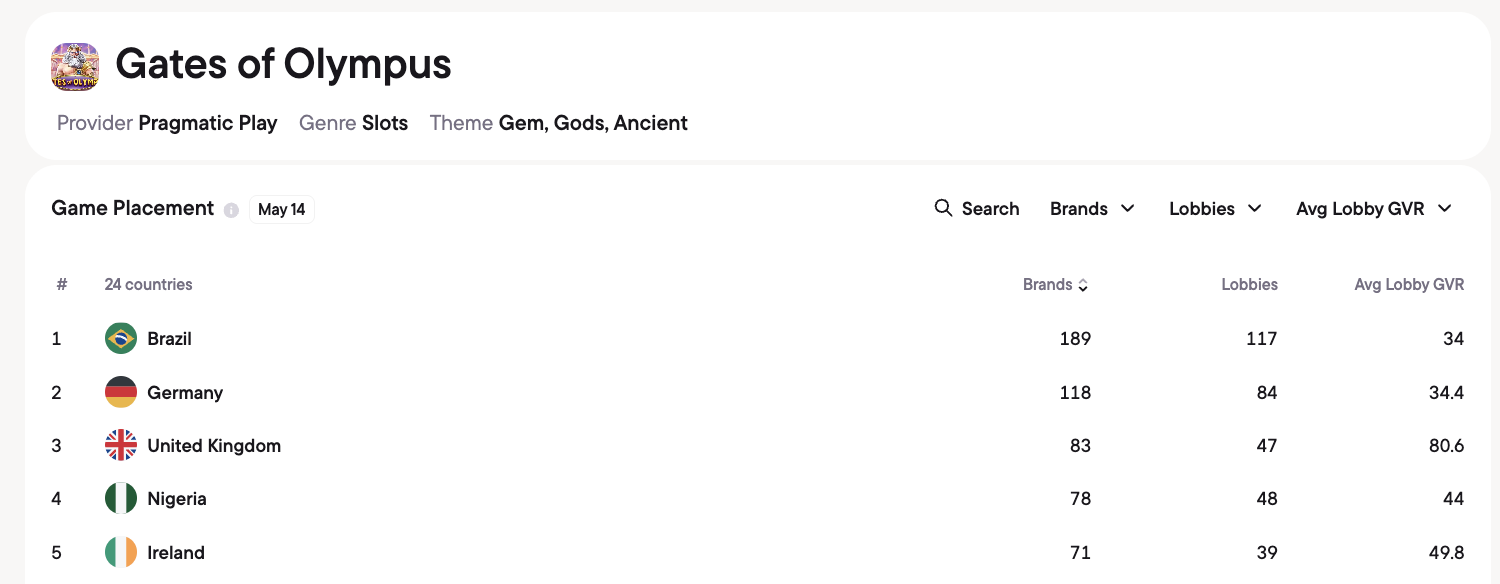
Example: Gates of Olympus (Pragmatic Play): the benchmark high-volatility title globally. Pragmatic Play rates it 5/5. Hit frequency: 28.82%. Bonus trigger: approximately 1 in 448 spins. Multiplier orbs accumulate permanently during free spins and can stack to 500x. Maximum win cap: 5,000x. Carried by 186 brands in Brazil and 83 brands in the UK, with lobby visibility consistently inside the top 34 positions.
Gates of Olympus (Pragmatic Play) positions across the countries in Blask
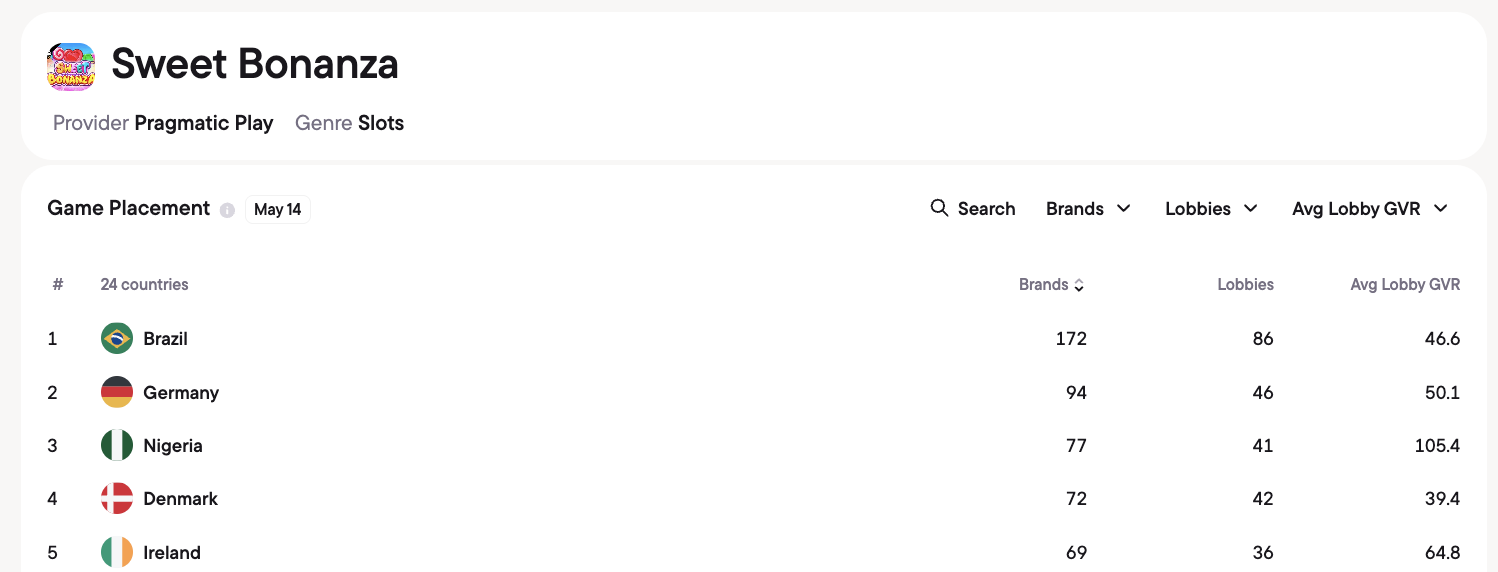
Example: Sweet Bonanza (Pragmatic Play): rated 4/5 by Pragmatic Play. Hit frequency: 22.27%. Bonus trigger: approximately 1 in 451 spins. Multiplier bombs up to 100x reset each tumble rather than accumulating. Maximum win: 21,175x, four times higher than Gates of Olympus despite slightly lower volatility. Present in 172 brands in Brazil, ranking among the top five slot titles globally by casino lobby distribution.
Sweet Bonanza (Pragmatic Play) positions across the countries in Blask
High volatility slots dominate streaming, bonus-hunting communities, and social sharing precisely because their math creates rare, extreme moments. Steady 10x wins on a low-volatility title generate no content. A 5,000x on Gates of Olympus does.
Extreme volatility slots
Extreme volatility pushes hit frequency below 15% and concentrates maximum win potential far above standard high-volatility titles. Wins of 25,000x–50,000x are possible, though statistically rare. Sessions require larger bankrolls and deliberate pacing. Extended base-game cold runs before a bonus trigger are expected, not exceptional.
The “1000 series” from Pragmatic Play represents the clearest market example of this tier. These are mechanical evolutions of proven high-volatility franchises: same core gameplay, raised multiplier ceilings, lower hit frequency, higher maximum win potential.
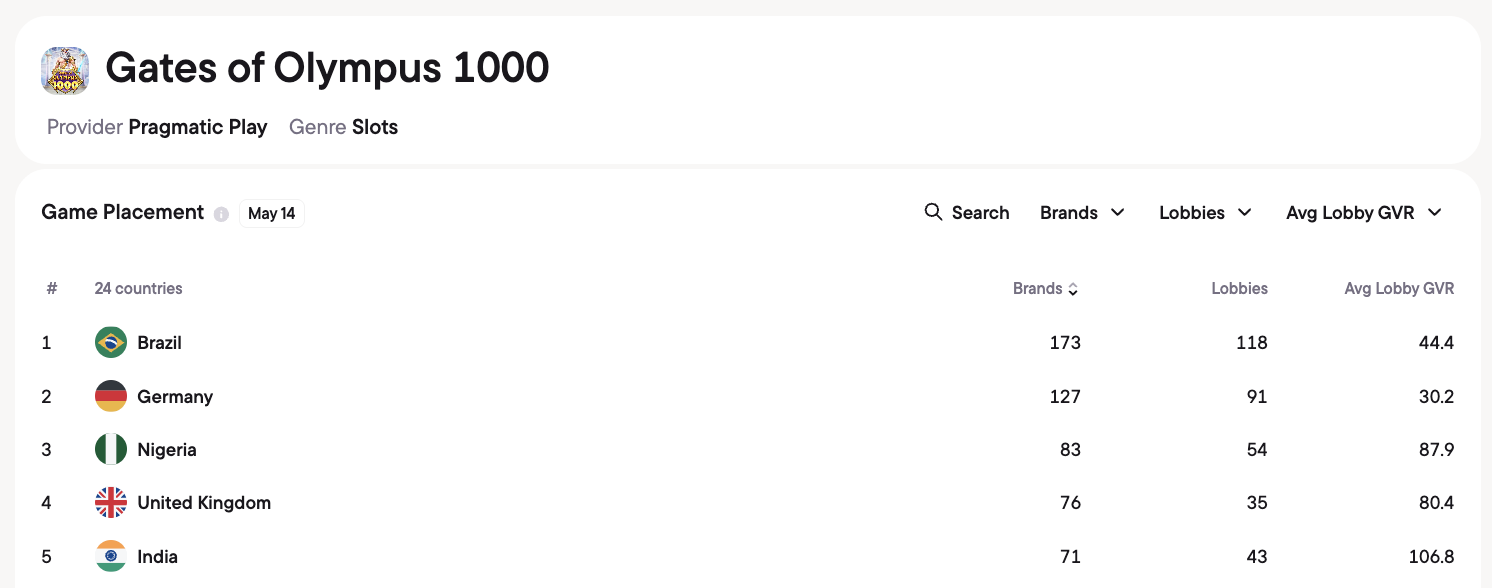
Example: Gates of Olympus 1000 (Pragmatic Play): the expanded-potential variant of the base title. Maximum win raised to 15,000x. Very High volatility (5/5). Present in 173 brands in Brazil, approaching the 186-brand distribution of the original title within roughly 12 months of launch. This speed of adoption signals strong player appetite for higher ceilings, not just familiarity with the base game.
Example: Sweet Bonanza 1000 (Pragmatic Play): maximum win raised to 25,000x. RTP: 96.53%. Very High volatility (5/5). Multiplier bombs up to 1,000x.
Some extreme-volatility titles offer bonus buy features at 50–100x the base bet for direct bonus access, allowing players to skip the extended base-game cold run and access the high-potential bonus directly.
Insane volatility slots
Insane volatility is the informal label for titles where maximum win potential exceeds 50,000x or 100,000x the bet, with hit frequencies so low that extended sessions can pass without any meaningful win. These are niche products targeting bonus hunters, high-rollers, and streamers seeking extreme moments.
The mathematical logic is the same as all volatility tiers: identical expected value, more extreme distribution. But the practical requirement is substantially different: these games need hundreds of spins of bankroll to give variance space to operate. At standard bankroll sizes, most players will deplete their budget before reaching the bonus event that makes the math work.
Bonus buy is common in this tier. At 50–100x the base bet per purchase, it eliminates the base-game waiting cost and provides direct access to the high-potential bonus round. For serious bonus hunters, this can be the more cost-effective path to meaningful results.
How volatility affects your gameplay
Bankroll strategy
Slot volatility directly determines the bankroll required to give variance room to operate. The standard framework:
Low volatility: 50–100 spins of bankroll is typically sufficient. Wins arrive often enough to keep balance stable across a normal session.
Medium volatility: 100–200 spins recommended. Some stretches will test patience before a meaningful win arrives.
High volatility: 200–500 spins minimum. The gap between bonus triggers can span many base-game spins. On Gates of Olympus, the average bonus arrives every 448 spins, meaning a player with fewer than 200 spins of bankroll is statistically likely to miss the bonus entirely.
Extreme/Insane volatility: 500+ spins minimum. Bonus hunting typically uses a dedicated session budget separate from regular play.
These figures are minimum thresholds, not guarantees. A player who hits the bonus on spin 30 beat the average. A player who hits it on spin 700 is within normal statistical variance. Both outcomes are expected from the same math model.
Hasson quantified how much math matters when budgets are tight:
“I changed the math with a new math model and they started getting, one of them got 600% improvement, one of them got 350% improvement.”
The volatility redesign, without touching graphics or theme, transformed game performance. Choosing the wrong volatility tier for your budget is the player-side equivalent of that math failure.
Bonus rounds and jackpots
In high-volatility slots, bonus rounds carry the bulk of the expected return. The base game in many extreme-volatility titles pays below 95 cents per dollar bet. The remaining RTP lives in free spins and bonus events that trigger rarely.
Research into observed spin data shows that high-volatility games maintain a pseudo-win rate (spins that land with a visual win animation but pay out less than the spin cost) of 7–12% across the base game. This is deliberate design. It prevents the base game from feeling completely dead between bonus triggers, sustaining engagement through the long stretches. The emotional experience is maintained even when the math is not paying out.
According to Glukhovska, individual mechanics such as Hold and Win features, jackpots, or large multipliers cannot be viewed separately from volatility—they are all balanced within the game’s overall mathematical model.
She notes that while 1spin4win titles can reach maximum multipliers of up to 5,000x, the studio deliberately keeps RTP above 97% and focuses on medium- and high-volatility gameplay to create more frequent rewarding moments instead of rare “all-or-nothing” outcomes.
“The probability of hitting x50,000 in a slot is extremely low—much lower than, for example, x2,000. That’s why we focus on making larger wins feel achievable rather than purely theoretical.”
Jackpots follow the same logic. Progressive jackpots reduce effective base-game RTP because a portion of every bet contributes to the jackpot pool. All meaningful progressive jackpot games are high-volatility by definition. The jackpot contribution comes from many small losses across the player base, concentrated into rare massive wins.
Knowing where a game’s RTP lives (base game vs. bonus) is the most useful diagnostic a player can run before choosing a slot.
Session length and pacing
Low-volatility slots sustain engagement across long sessions with consistent feedback. A player on a $50 budget at $0.20 minimum can realistically play for an hour or more. High-volatility titles can exhaust the same budget in 15 minutes if the base game runs cold.
Operators account for this when building lobbies. A well-constructed slot section offers titles across volatility tiers so players with different budgets and session goals find their fit. Blask data shows that high-volatility titles dominate hero lobby positions, while low-volatility titles often anchor the broader grid for casual traffic.
How to identify a slot’s volatility
Check the pay table
The paytable communicates volatility directly to anyone who knows what to look at:
Symbol value distribution: a steep gap between the top symbol and mid-range symbols signals high volatility. A flat distribution with many similarly-valued symbols signals low volatility.
Scatter and bonus trigger probability: if the bonus requires three specific symbols across five reels, the trigger is rare. Rare triggers mean higher volatility. If the bonus trigger probability is stated (some providers include it), divide 1 by the frequency to get average spins between triggers. A bonus every 12 spins is low volatility. A bonus every 450 spins is high volatility.
Maximum win cap: providers set a ceiling. Games capped at 500x are almost always low or medium volatility. Games capped at 5,000x are high. Games capped at 15,000x or above are extreme or insane.
Multiplier design: fixed multipliers and capped symbols indicate lower volatility. Accumulating or uncapped multipliers indicate high volatility.
Research slot reviews and provider info
Pragmatic Play publishes a 1–5 icon volatility scale on every title:
Title
RTP
Pragmatic Volatility Scale
Max Win
Sweet Bonanza
96.49%
4/5
21,175x
Gates of Olympus
96.50%
5/5
5,000x
Gates of Olympus 1000
96.50%
5/5
15,000x
Sweet Bonanza 1000
96.53%
5/5
25,000x
Big Bass Bonanza
96.71%
High
2,100x
Major game providers also publish math sheets through B2B licensing agreements, technical documents containing hit rates, bonus trigger frequency, standard deviation, and maximum exposure. Casino product managers use these when evaluating titles for lobby placement.
Players can access review platform summaries of this information. Look for empirically derived ratings based on observed spin data rather than self-declared labels from provider marketing.
Casino volatility ratings (1-5 Scale)
Many online casinos now surface volatility ratings in lobby filters and game cards. The most common scale:
Rating
Tier
1
Low
2
Low-Medium
3
Medium
4
High
5
Extreme / Insane
Volatility filtering is not just a player education feature; it is a segmentation signal operators can use to identify high-value traffic.
When these ratings are operator-assigned rather than provider-verified, accuracy varies. Cross-referencing with the provider’s own scale eliminates most ambiguity.
Slot volatility in online vs land-based casinos
Land-based slot machine volatility is shaped by physical constraints. Floor space, machine turnover rates, and player comfort requirements make medium volatility the dominant tier in physical casinos. Extreme and insane volatility titles are not viable on a physical floor; they require too much time per meaningful result to justify cabinet space. Most land-based slot cabinets target the 30–40% hit frequency range.
Online casinos operate without these limits. Their lobbies host hundreds of titles across the full volatility spectrum. Providers deliberately build extreme and insane volatility products for the online channel specifically, designed for streaming, social sharing, and communities that follow bonus hunts. These formats do not exist in any meaningful form in land-based environments.
Game volatility in iGaming is trending toward higher tiers. Providers release higher-ceiling variants of proven franchises, and the market absorbs them quickly.
Culture and market history also shape which volatility profiles take hold. Hasson described the mechanism: “Players play slots for many reasons. To escape, to escape to a fantasy world, to go into nostalgia.”
What triggers that escape varies by market, by generation, by prior gaming experience. In Germany, decades of physical gaming hall culture built appetite for specific volatility profiles around Book of Ra-style titles. In Brazil, where the licensed market is younger and mobile-native, the player base shows stronger appetite for high-volatility formats.
Hasson illustrated the cultural gap directly:
“Santa holds a cultural meaning. But in China, it doesn’t. So Santa didn’t really walk in China. And they couldn’t figure out why. They couldn’t figure out that the cultures are different. You need to find the Chinese equivalent of Santa to do that.”
The same logic applies to volatility. A volatility profile that feels like appropriate risk in one market can feel alien in another. The math does not change; what changes is the cultural context for what a big win means, and how long a player is willing to wait for one.
How to choose the right volatility for you
Goals: entertainment vs jackpot chasing
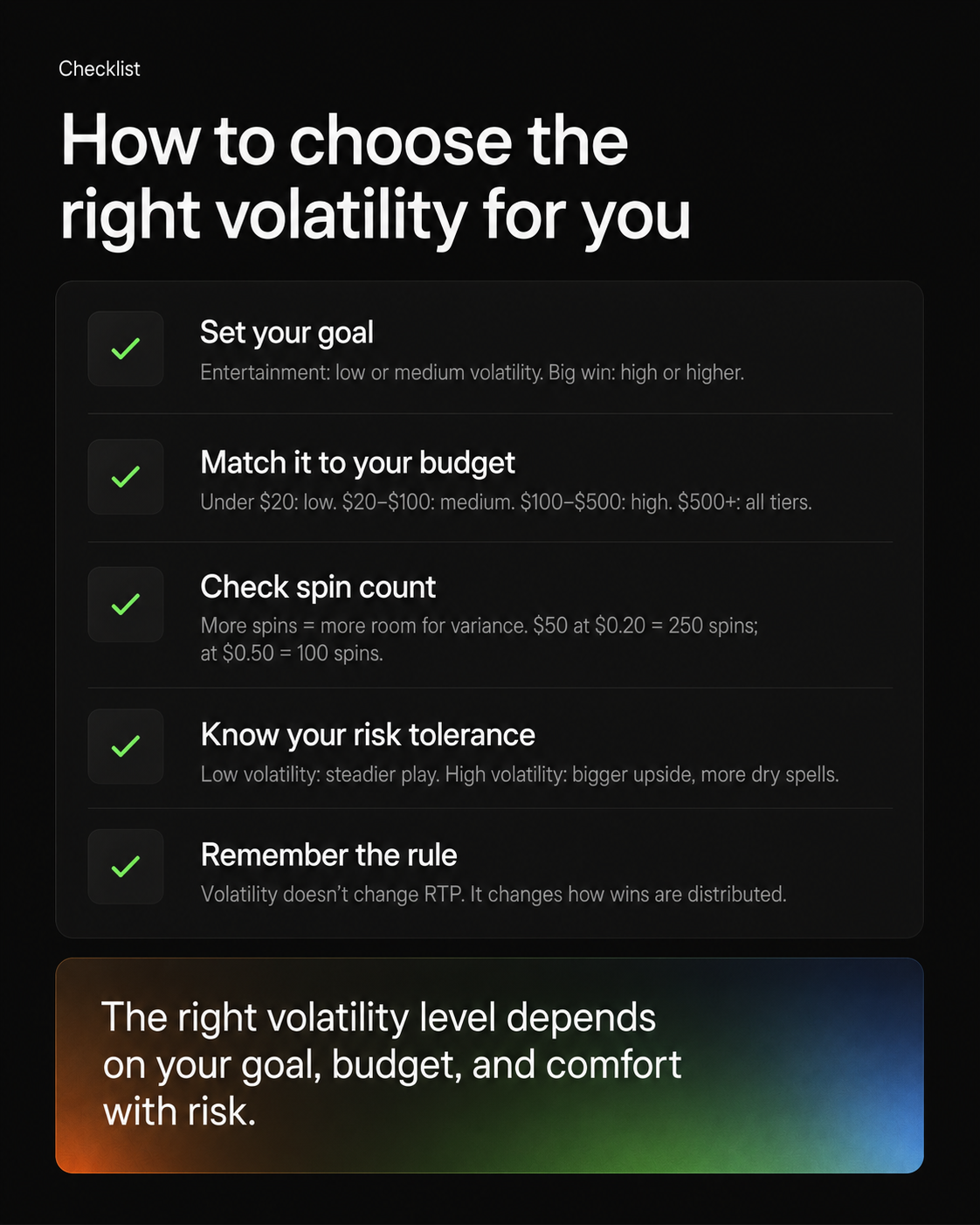
The goal of the session determines the volatility tier. This is the most important match to make before loading a game. If the goal is entertainment (sustained engagement, frequent feedback, visual reward), low or medium volatility delivers it reliably. These titles keep sessions alive longer on the same budget.
If the goal is a large, session-defining win, high volatility is the necessary condition. No low-volatility slot reaches 10,000x maximum win. That ceiling only exists in high, extreme, and insane titles. The tradeoff is accepting a high probability that the session ends with nothing meaningful before the potential is reached.
Setting an honest goal before selecting a game eliminates most post-session frustration.
Budget and bankroll size
Budget determines which volatility tier is accessible:
Under $20: Low volatility only. High-volatility games deplete this bankroll before variance has room to operate.
$20–$100: Medium volatility is the practical choice. Selective high-volatility play at minimum stake is possible on the upper end.
$100–$500: High volatility at normal stakes. Some extreme volatility at minimum bet.
$500+: Full access to all tiers, including extreme and insane at meaningful stakes.
The calculation is stake multiplied by target spin count. A $50 budget at $0.20 per spin is 250 spins, sufficient for medium-volatility sessions, marginal for high volatility. The same $50 at $0.50 per spin is only 100 spins, which is insufficient for any high-volatility title where the average bonus trigger may be 300–450 spins away.
Risk tolerance and personality
Slot volatility is a designed emotional experience. Asker Khubiev, CEO of 100hp, described the distinction between slot volatility as a fixed product feature and crash-game volatility as a player-managed experience:
Asker Khubiev
CEO of 100hp
Slots: volatility is hardwired by the provider. RTP and volatility are fixed in the math model — for example, Sweet Bonanza is high volatility, 96.5% RTP. The player only chooses the bet and the game. Risk profile equals title selection. The need it serves: passive entertainment, ‘switch it on and spin.’ The emotion comes from animations, bonus games, near-misses.
“Slots: volatility is hardwired by the provider. RTP and volatility are fixed in the math model — for example, Sweet Bonanza is high volatility, 96.5% RTP. The player only chooses the bet and the game. Risk profile equals title selection. The need it serves: passive entertainment, ‘switch it on and spin.’ The emotion comes from animations, bonus games, near-misses.
Crash: volatility is managed by the player in real time. The math model sets the multiplier distribution, but the exit point is the player’s decision. Want low volatility — cash out at x1.2. Want high — wait for x50. The need it serves: control, skill — illusory but tangible. The emotion comes from your own decision, not the animation.”
That contrast defines the psychological split between slot players and crash/instant game players. Khubiev continued:
“Slots are more about passively waiting for the result. The player hits spin and waits: will a combination, bonus, free spins, or a big win land? The psychology is closer to: ‘I trust the game and wait for a lucky moment.’
Crash games are more about making an active decision inside the round. The player decides when to cash out: at x1.3, x2, x5, or risk it further. The psychology is closer to: ‘I’m managing the risk myself.'”
Neither preference is wrong. They reflect different relationships with risk. Once you select a slot, volatility removes you from the decision loop; the game manages risk from that point forward. Players who find that passive trust comfortable get their maximum reward potential through high-volatility slots. Players who need active agency find that relationship in crash and instant game formats instead.
How to choose the right slot volatility in iGaming
How slot developers set volatility
The game’s certified math model locks in volatility before regulatory approval. Neither the operator nor the player can modify it after launch. Development is the only window for adjustment.
Olga Hlukhovskaya, Business Development Director at 1spin4win, says the process always begins with mathematics rather than visuals or theme.
Olga Hlukhovskaya
“At 1spin4win, volatility is always built on mathematics first, because this is what defines the rhythm of the game — how often wins appear, how rewards are distributed, and how dynamic the session feels. At the same time, math is only the foundation. The ultimate goal is the player experience. Even small adjustments to the mathematical model can completely change how a game is perceived.”
Designers configure volatility through four primary decisions:
Base-game hit rate: the frequency of any winning outcome per spin
Paytable structure: the value relationship between all symbol tiers
Bonus trigger probability: how often bonus rounds activate
Multiplier design: whether multipliers are fixed, progressive during free spins, or uncapped
After configuring these parameters, developers run Monte Carlo simulations across millions of spins to verify that the designed volatility matches the intended experience. They test average session length at target stakes, bankroll depletion probability, bonus frequency, and maximum win exposure. Developers submit the simulation output to regulators alongside the certified RTP for approval.
Hasson quantified how much math determines outcome: “If the math is good enough, people are blind to the thing they see, because they hated what they saw and it still got great KPIs.” He restructured the math models for two clients with poorly designed, badly looking games, touching no graphics, and saw improvements of 350% and 600% in key performance metrics. The volatility redesign drove the entire result.
Volatility is load-bearing, not decoration.
Hasson also identified a persistent gap in the industry between mathematical precision and human understanding. When he asked on LinkedIn whether mathematicians need emotional intelligence, nearly all the “no” votes came from mathematicians.
His position: “The math is the experience of the game, and you need to know what people enjoy.” A volatility profile that is mathematically correct but emotionally misaligned produces a game nobody plays.
In his analysis of level-5 and level-6 games, titles that grow instead of fade after launch, Hasson found a consistent pattern across companies:
“They probably accidentally found a way to appeal at the same time to both high volatility players and low volatility players simultaneously. And you know that low volatility players like the low volatility games, high volatility players like the high volatility games, and they don’t really mix. But they found a way for games, for the top-top games to appeal to both types of players.”
This is rare and structurally difficult. Volatility, by design, sacrifices one audience for the other. The titles that thread this needle, offering enough base-game engagement for low-volatility players while delivering enough ceiling for high-volatility players, are the ones that grow over time and generate successful sequels.
Sweet Bonanza and Gates of Olympus both achieve this in different ways: Sweet Bonanza through its higher hit frequency (22.27% base game) paired with extreme multiplier bombs; Gates of Olympus through its accumulating orb mechanic that makes every free spin feel like it’s building toward something.
Where volatility design is heading, according to Khubiev of 100hp: “Volatility will increasingly be designed not only through RTP and hit rate, but through UX, round pace, visual feedback, progress, and the sense of control.” How quickly a round resolves and how visible the danger feels is becoming as important as the underlying math.
Glukhovska believes the industry’s next step is not simply increasing volatility, but making high rewards feel more attainable.
“Very high multipliers such as x10,000 or x20,000 look impressive, but in reality they are often beyond a typical player’s lifecycle. Our focus is on more moderate maximum exposure (usually up to x5,000) where bigger wins remain exciting while still feeling realistically achievable.”
Common misconceptions about slot volatility
“A slot is due to pay after a long losing streak.” Each spin is independent. Volatility describes the long-run distribution of outcomes across millions of spins, not streak behavior within a session. A high-volatility game that has run 300 cold spins is not statistically more likely to pay on spin 301. The math resets with every spin.
Hasson addressed the underlying misunderstanding: “The slot players are not just gamblers. They are actually playing it for fun.” When players expect a payout “due” after a streak, they are applying a reward expectation that the math does not support. The fun is in the anticipation, the animation, the build-up, not in a predictable schedule of returns.
“High RTP means lower risk.” Not necessarily. A 97% RTP high-volatility title requires more bankroll and patience to access its value than a 95% RTP low-volatility game. Most of the 97% lives in rare events. The game can feel like it pays less than the lower-RTP title during any given session. RTP without volatility context is an incomplete picture.
“Low volatility is always the safer choice.” Depends on the goal. A player who deposits $10 to chase a large win is taking more effective risk on a low-volatility game, because that game will never produce the outcome they want, regardless of how many spins they play. Safety is relative to objective.
“Volatility changes over the course of a session.” The certified math model is fixed. The only exception is progressive jackpot games, where the jackpot pool grows until a hit resets it. Effective RTP shifts slightly as the jackpot accumulates. The base-game volatility does not change.
“Online casinos can tighten or loosen the slots.” In licensed, regulated markets, operators cannot modify provider math. The volatility is certified, monitored by regulators, and identical for every player at every stake. What operators can control is which games they promote and how prominently they are placed, not the math inside the game.
“High volatility slots and crash games compete for the same player.” Khubiev directly addressed this: “They are not full competitors, but different formats with partial audience overlap. They compete for time, deposit, and player attention, but they serve different needs.” Slot machine volatility is fixed and passively experienced. Crash game volatility is dynamic and actively managed by the player. The formats are psychologically distinct.
“New mechanics always work better.” Studios that chase novelty at the expense of proven volatility structures pay the price in launch failures. Hasson: “There’s a lot of knowledge. When new people come in, usually in their early 30s, they are so sure that everything they think of is new and has never been tried that they don’t want to listen to experience.” Comic book-style slots, for instance, have failed repeatedly across 18 years. The volatility profile that works fits the game’s theme, its intended audience, and what that audience already responds to.
Tips for playing slots based on volatility
Match volatility to bankroll before loading a game. A 100-spin budget works for low volatility. High-volatility games need 200–500 spins to give variance room. If the budget does not support the spin count, choose a lower tier.
Read the paytable before the first spin. Maximum win cap, bonus trigger probability, and symbol value distribution tell you more about a game’s actual behavior than its lobby description or name.
Know where the RTP lives. For high-volatility slots, most expected return is inside the bonus round. If the session ends before a bonus triggers, that is normal variance, not evidence the game is broken or unfair.
Use hit frequency as a diagnostic. Comparing your observed win rate to a game’s published base-game hit frequency tells you whether you are running within normal variance or experiencing a statistical outlier session. A game listing 28% hit frequency that has produced wins on fewer than 10% of your spins is running cold, still within the range of expected variance, but useful context.
Use bonus buy selectively on extreme-volatility titles. At 50–100x the base bet, buying into the bonus directly skips the base-game waiting cost. On extreme-volatility titles where the base game may run hundreds of cold spins, this is sometimes the most cost-effective way to access the game’s upside.
Set a session budget, not a loss-recovery target. Playing through losses to recover them on a high-volatility game doubles the bankroll exposure without changing the probability of any individual spin.
Understand instant win games as a separate volatility experience. Khubiev of 100hp described the shift: “In classic slots, volatility is the mathematics of distance: how often the game pays, how large it pays, and how long a player is willing to wait for a bonus or a big win. In instant games, volatility becomes a sensation of risk in the moment: the player sees the danger faster, makes a decision faster, and gets the result immediately. Slots: ‘I wait for the game to pay.’ Instant games: ‘I feel and manage the risk myself.'” If active, decision-driven risk feels more natural than passive waiting, instant games may be a better fit than high-volatility slots.
Track which volatility tier you consistently choose. Most players have a preference that aligns with their session behavior. Identifying it explicitly lets you search for it deliberately rather than discovering it after the fact.
Click-to-registration rate (Click-to-Reg) shows how many tracked clicks turn into player accounts. This guide covers the formula, worked examples, the difference from CTR and Reg-to-FTD, and how acquisition teams diagnose a falling rate.
Blind box gambling is a paid transaction in which chance decides which item of value the buyer receives, and the payment is made for that chance. A sealed retail box that always delivers a figurine from a published series remains a product sale; the hidden variant is a feature of the goods. A livestream spin, […]
Walk through any Japanese city and you will hear it before you see it: the metallic rain of steel balls, amplified jackpots, and LCD reels selling the latest anime tie-in. Neon facades say pachinko in katakana, foreigners call it pinball. Neither label captures the economics. This is Japan’s largest commercial gambling category, a vertical that […]