

- Updated:
- Published:
Ireland’s regulator rules are pushing operators off the market — Betfred pauses its Irish business
Ireland’s new gambling regulator is reshaping the market before licensing takes full effect — and Betfred is the latest operator to step back.
Betfred is temporarily pausing its Irish operations from 30 June 2026, citing the need to align with the incoming Gambling Regulatory Authority of Ireland (GRAI) licensing regime. From 1 July, Ireland replaced the old Revenue licensing system: operating without a GRAI licence became a criminal offence, with fines of up to €20M or 10% of annual turnover.
The operator has asked customers to withdraw balances before 30 June and not leave bets settling after 29 June. Sources suggest Betfred expects to resolve the formalities quickly and hopes to return to the Irish market soon.
Betfred remained a small player after twelve months in Ireland
Betfred launched in Ireland’s online market in autumn 2024 without the support of a retail network, betting on a digital-only model against entrenched local leaders. So far, that experiment has not paid off: the operator has failed to gain a firm foothold in the market and remains on the deep periphery.
Blask data highlights that barrier through the key demand metrics. Betfred’s BAP fluctuated near the bottom of the ranking throughout the period, never breaking out of the lower tier. Its average CEB over the same period stood at only around $8.9M, a low level for an Irish market shaped by strong local operators.
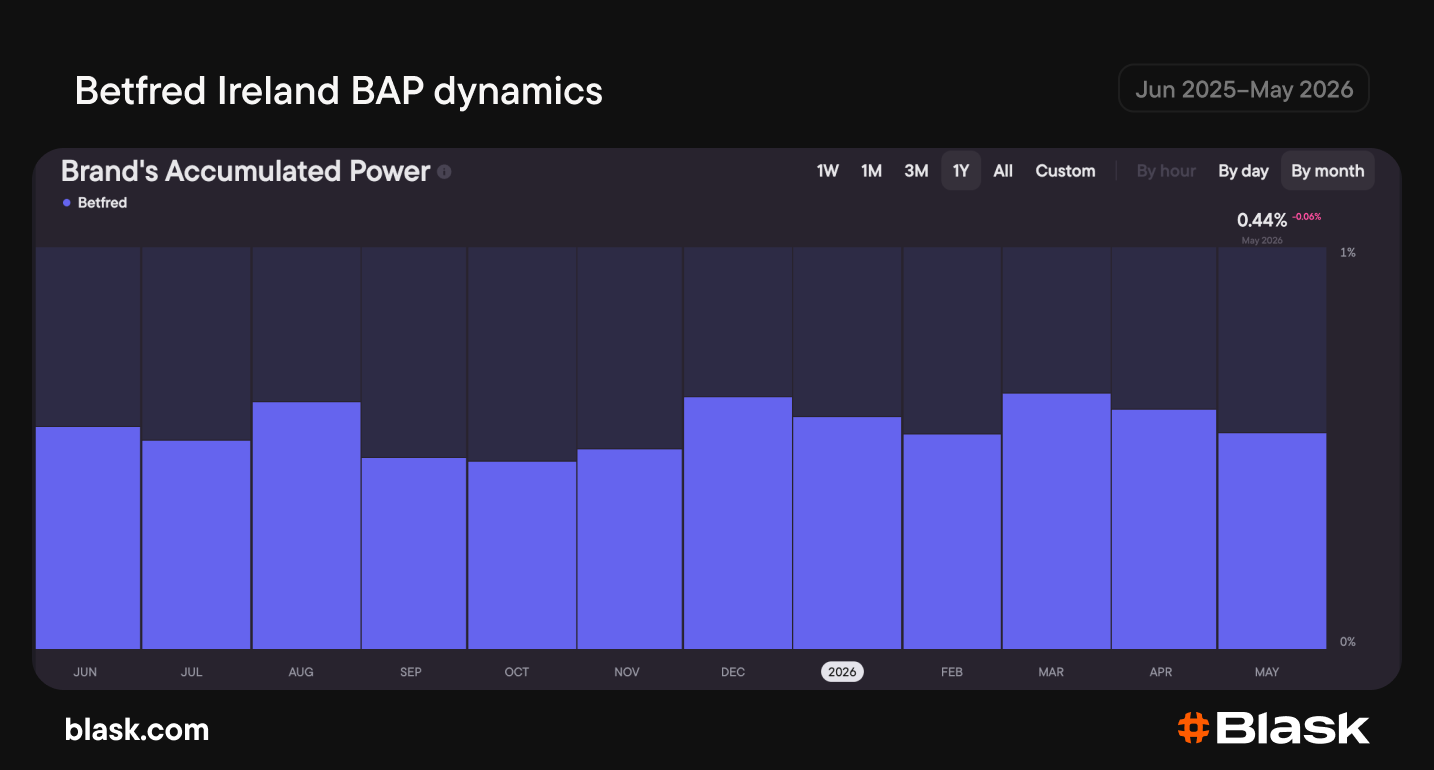
The scale of the gap becomes clearer when compared with Betfred’s home market. In the UK, Betfred’s BAP stands above 4.9%. That wide difference shows that the Irish launch gave the brand only a nominal presence on the market map, without securing a real competitive position.
A pause, not an exit — but the same model is unlikely to work
Betfred has described the move as temporary and confirmed that it will honour outstanding ante-post World Cup bets. A return once GRAI licensing is in place remains possible. However, coming back on the same terms would likely produce the same result: GRAI will add compliance costs to a market where the brand never built meaningful demand. For a second attempt, a shift in strategy looks more credible than simply obtaining a licence.