

Lithuania’s Gaming Control Authority confirmed that personalised player cards will become mandatory for all licensed gambling by January 1, 2029
The measure is part of amendments to the Gambling Law approved by the Ministry of Finance, with the rollout scheduled to take place in stages during 2027–2028.
Every customer of licensed land-based casinos, gaming halls, and online platforms will need a card linked to a verified profile and national ID documents. According to the Authority, the framework will cover 18 casino licences, 50 gaming halls, and 10 online licences. Players will register through the state identification system, while the card will track bets, deposits, and withdrawals across all operators. Transactions will be automatically blocked once preset spending limits are reached.
Officials say the system will help detect underage gambling, enforce self-exclusion, and identify signs of gambling addiction. From 2029, gambling venues will also have to process payments and payouts only through cashless methods linked to the card. The model is described as the EU’s first fully centralised gambling control system: in Poland and Norway, player cards apply to slots, but do not cover all channels.
In Lithuania, the player-card reform comes after a wider regulatory tightening: stricter advertising rules from July 2025, a higher minimum gambling age of 21 from November 2025, and a full advertising ban from January 1, 2028.
TOPSport leads a concentrated onshore market
Lithuania regulates both casino and sports betting, so the player-card reform reaches across the entire licensed market. According to Blask, total market CEB reached $241.8M for May 2025–April 2026, with licensed operators accounting for 96%.
TOPSport leads Lithuania by BAP with a 41.12% share, $106.63M in CEB, and +26.22% YoY in Blask Index.
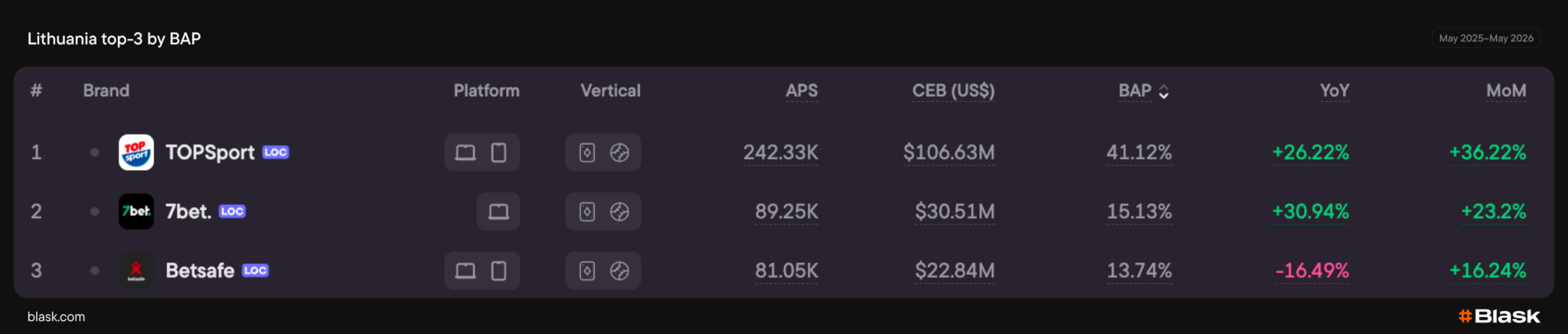
The data shows why the card reform matters most for incumbent operators rather than new entrants. Lithuania’s licensed market is already highly concentrated: licensed operators hold 96% of CEB, while TOPSport alone controls 41.12% of BAP. For these operators, the next three years are less about gaining legal access to the market and more about adapting to a heavier compliance layer before the 2029 deadline.