
The U.S. poker ecosystem remains one of the most stable structures in online gambling.
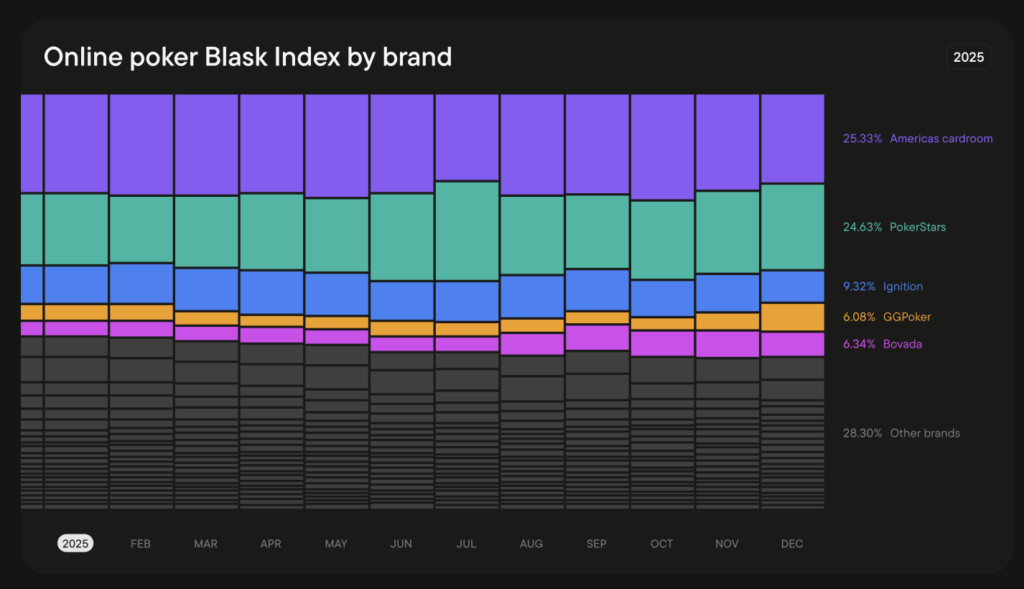
Americas Cardroom and PokerStars together accounted for approximately 50% of all U.S. online poker demand by December 2025, and market shares remained broadly stable throughout the year with no major new entrants breaking into the top tier — making online poker the most structurally unchanged segment in American online gambling.
The stability of the online poker market stands in sharp contrast to the rapid consolidation of prediction markets, the double-digit growth of major sports betting brands, and the volatile share shifts in unregulated casino markets.
Poker’s duopoly appears durable because of the product’s inherent network effects: players want to play against other players, and the two platforms with the most active player pools attract more new players, compounding their advantage.
A duopoly that has barely moved
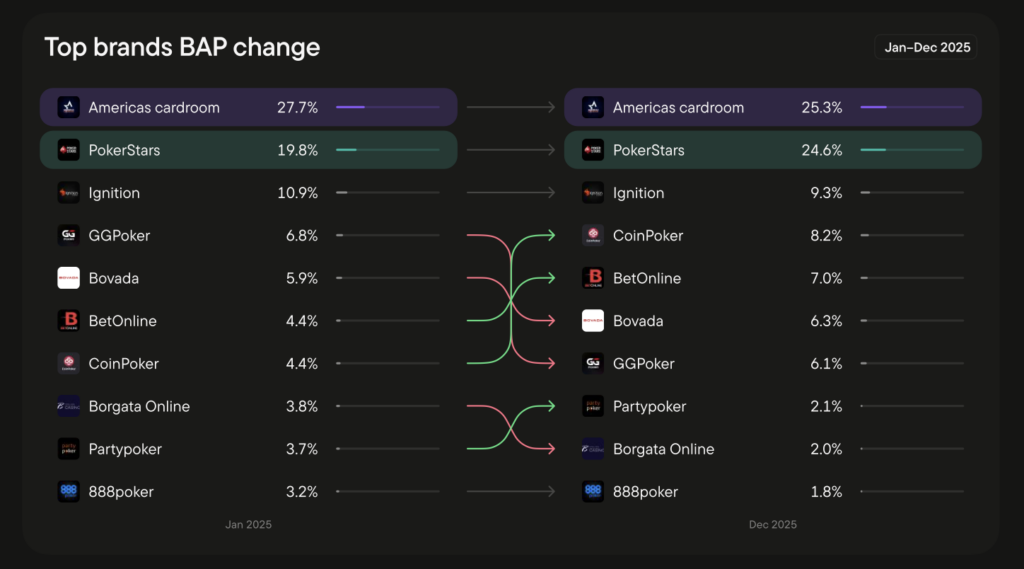
Americas Cardroom held 25.3% of Blask Index by December 2025. PokerStars held 24.6%. Together, the two platforms account for roughly half the market — a share that has been relatively stable for several years.
The remaining 50% is fragmented across Ignition Casino, GGPoker, Bovada’s poker room, BetOnline’s poker offering, and CoinPoker, with each holding 6–9%.
Small shifts around the edges
What changed within the broadly stable picture was directional share movement at the margins.
PokerStars, BetOnline, and CoinPoker each gained share versus their January 2025 positions, while GGPoker and Bovada’s poker room gave back some of the ground they had held at the start of the year.
No platform gained or lost more than 2–3 percentage points over the full year.
A market shaped by offshore activity
The regulatory structure of U.S. online poker is more complex than sports betting.
Legal, regulated online poker currently operates in only five states — New Jersey, Nevada, Michigan, Pennsylvania, and Delaware — through a shared liquidity agreement that allows players in those states to compete against each other.
The vast majority of U.S. online poker activity, as tracked by Blask, occurs on offshore platforms that serve players in all 50 states regardless of local law.
The two leaders follow different regulatory paths
Americas Cardroom, operated by the Winning Poker Network and based in Costa Rica, is not licensed in any U.S. state.
PokerStars, owned by Flutter Entertainment — also the parent company of FanDuel — operates a licensed U.S. real-money poker product in the five regulated states alongside its offshore platform.
The two operations appear to be tracked somewhat separately in Blask’s demand signals, though the company’s overall market presence reflects both.
Why poker markets tend to stabilize
The relative stability of online poker contrasts with the instability in other gambling segments for a fundamental reason: poker is a skill-based game in which players compete against each other rather than against the house.
The poker economy is driven by the rake — the percentage of each pot taken by the platform as a fee — and by tournament entry fees, not by the casino-style house edge that makes slots and blackjack perpetually profitable for operators.
Switching platforms is harder than it looks
This structure creates different competitive dynamics.
Players who have built up chip stacks, tournament histories, and social networks on a particular platform face meaningful switching costs that sports bettors or casino players do not.
The liquidity of the player pool — the number of active players available at any given table and stakes level — is itself a product feature that incumbents can defend more effectively than in markets where all products are equivalent.
Regulated states show the same pattern
For the regulated states, the online poker market is similarly concentrated.
New Jersey’s poker traffic flows primarily to PokerStars, DraftKings Poker, and BetMGM Poker — all licensed, all competing within a shared liquidity pool that provides the minimum player density needed to run viable cash games and tournaments.
A pattern shared with prediction markets
The prediction markets parallel is instructive. Both online poker and prediction markets are competition-against-others products rather than player-against-house products. Both show strong winner-take-most dynamics.
Online poker has had its winner-take-most resolution — the current duopoly — for years. Prediction markets are in the process of reaching theirs.