


iGaming demand moves when culture, regulation, and competition collide. Blask data shows which events create short spikes, which ones reset market structure, and where operators should react first.
Major events do not create iGaming demand from nothing. They concentrate attention that already exists.
A football final can pull casual bettors into the market for one night. A cricket tournament can lift acquisition across a full month. A new tax rule can change the economics of the market overnight. A licensing deadline can separate brands that are ready to operate from those that only looked ready.
The mistake is treating all of these moments as the same kind of opportunity. They are not. Some events are traffic spikes. Some are acquisition windows. Some are market-structure tests.
Blask tracks these shifts through country-level and brand-level demand data. In this article, we look at four event types that consistently reshape iGaming markets: sport, national pride, regulation, and competitive consolidation.
What Blask measures when iGaming demand moves
Blask Index measures iGaming demand from search activity and brand-level consumer interest. It is a leading indicator: it captures how much attention iGaming brands generate before that attention turns into deposits, bets, or revenue.
For commercial sizing, Blask also uses Acquisition Power Score (APS) and Competitive Earning Baseline (CEB). APS estimates how many new customers a brand or market should attract based on its current demand position. CEB estimates the revenue available under current competitive conditions.
Both APS and CEB are shown as min-avg-max ranges. Acquisition and revenue do not move in a straight line, especially around major events. Seasonality, campaign timing, bonus pressure, and competitor activity all change the realistic floor and ceiling.
Sport creates attention, but the sport has to matter locally
Sports events are the easiest events to overread. A global tournament can look important from the outside and still fail to move a local betting market.
Blask data from India and Bangladesh during the ICC Men’s T20 World Cup shows why local fit matters. In June, India recorded 55.7M in total Blask Index, 1.82M average APS (909.6K-4.55M range), and $426M average CEB ($213M-$1.07B range).
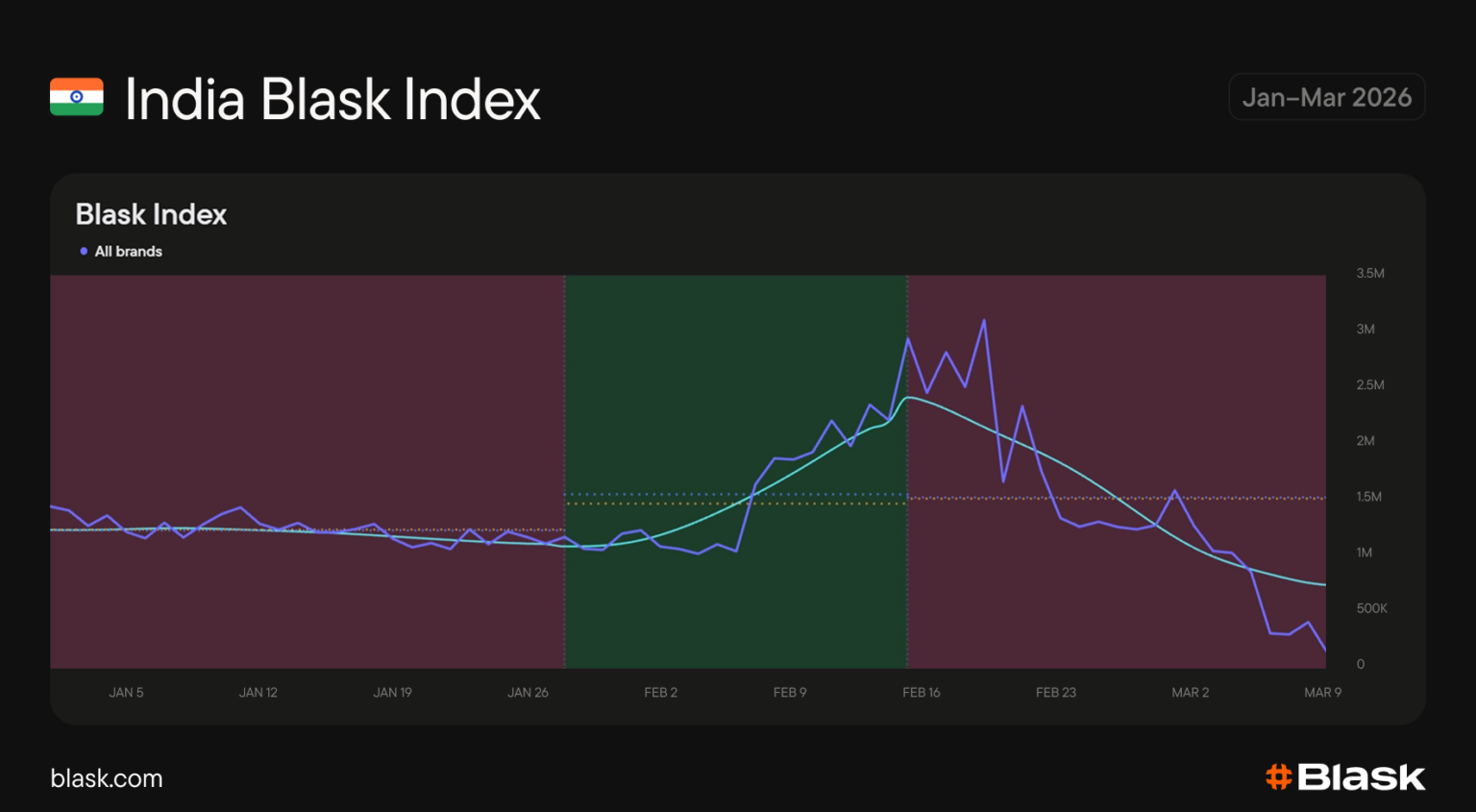
Bangladesh recorded a higher 61.2M total Blask Index over the same month, with 1.91M average APS (956.3K-4.78M range) and $93.6M average CEB ($46.8M-$233.9M range).
The two markets responded to the same tournament, but not in the same commercial shape. India produced a much larger revenue baseline, while Bangladesh showed intense demand relative to its market size. The India-Bangladesh Super Eight match on June 22 gave operators a direct rivalry moment to work with, and India won by 50 runs.
That is the useful lesson. The event was not “cricket.” It was cricket plus national rivalry, local viewing behavior, and enough operator competition to convert attention into acquisition.
Football turns national pride into concentrated demand
Football behaves differently. It often creates shorter, sharper demand moments, especially in countries where the national team carries cultural weight.
Argentina’s Copa America final is a clean example. In July, Blask tracked 12.8M total Blask Index in Argentina, with 477.3K average APS (324.9K-934.3K range) and $104M average CEB ($61.3M-$232.3M range). Betano led the market by demand growth, up 5,015% year-over-year in Blask Index during the month, while Betsson and bet365 also posted triple-digit year-over-year demand growth.
The sporting context matters. Argentina beat Colombia 1-0 in extra time to win a record 16th Copa America title. For operators, that kind of event is not just a betting fixture. It is a national attention event with a narrow window.
The operational response should match the shape of the demand. Football finals reward fast campaign timing, local creative, payment readiness, and retention offers for newly active players. They do not give brands weeks to adjust.
Regulation changes the rules of competition
Regulatory events move demand in a different way. They do not always create a visible consumer spike, but they change which brands can convert demand profitably.
Brazil shows this at scale. In 2025, Blask tracked 2.57B total Blask Index in Brazil across 528 active brands. The market generated 79.3M average APS (58.2M-142.7M range) and $6.35B average CEB ($4.36B-$12.32B range). Betano ranked first by Blask demand, with 16.3M average APS and $971M average CEB ($728.2M-$1.7B range).
Brazil’s regulated fixed-odds betting market began operating under a federal authorization model in 2025. Industry reporting on the Ministry of Finance framework shows that only authorized operators can operate nationally, while non-compliant platforms face enforcement and advertising limits.
That matters because regulation turns brand demand into an execution test. A brand can have awareness, but if it cannot meet licensing, payments, compliance, and responsible gambling requirements, demand becomes harder to monetize. In regulated markets, the winners are not only the loudest brands. They are the brands with enough operational depth to stay visible after the market tightens.
Tax shocks expose market fragility
Ecuador shows the other side of regulation: sudden tax changes can put pressure on margins before the market has time to mature.
From August through October, Blask tracked 20.5M total Blask Index in Ecuador, with 796.1K average APS (398K-1.99M range) and $72.3M average CEB ($36.1M-$180.7M range). Ecuabet dominated the market during the period, accounting for 608.3K average APS and $55.2M average CEB ($27.6M-$137.9M range).
The policy context explains the pressure. Ecuador introduced a 15% tax on sports betting operators, with the framework taking effect from July 1 and registration handled through the country’s tax authority. The rules also applied a 15% withholding tax to player winnings.
For operators, the strategic question changed. The market was no longer only about capturing demand. It was about whether each brand could absorb the tax, adjust bonuses, protect margins, and avoid pushing players toward less controlled alternatives.
This is where Blask data becomes useful beyond rankings. A tax change can reduce promotional flexibility while demand remains active. Operators need to know which brands still hold attention, which ones are losing share, and where acquisition remains economically viable.
The pattern: events do not move markets equally
The same headline can mean four different things in four different countries.
| Event type | What moves | What operators should watch |
|---|---|---|
| Cricket tournaments | Sustained monthly demand and acquisition | Blask Index, APS, rival brand movement |
| Football finals | Short, concentrated attention | Daily demand spikes, campaign timing, retention |
| Licensing changes | Market access and legal visibility | Active brand count, BAP shifts, compliant competitors |
| Tax changes | Margin pressure and consolidation risk | CEB range, bonus intensity, demand share |
This is why annual summaries go stale so quickly. The useful question is not “what happened this year?” It is “what kind of event is happening, and what kind of demand response should we expect?”
Blask helps answer that question in real time. Blask Index shows when attention moves. APS shows whether demand can become acquisition. CEB shows the commercial ceiling and floor under current competitive conditions. Together, they give operators a way to separate noise from market movement.
Conclusion: treat events as demand signals, not content hooks
Major events are not marketing decorations. They are demand signals.
The operators that benefit are not always the ones with the biggest campaign. They are the ones that understand the market mechanism behind the event: sport fit, national emotion, regulatory pressure, or competitive consolidation.
That is the shift. Do not wait for post-event reports to explain what happened. Track demand while it is still moving, then decide whether the market calls for acquisition, retention, compliance work, or restraint.

Here’s how Blask gives you the edge:
- Blask Index: A comprehensive metric to measure market interest, enabling you to monitor the overall popularity of iGaming entertainment and track growth across regions.
- Competitive Earning Baseline (CEB): Updated monthly, this metric provides insights into revenue trends, helping you strategize for maximum profitability.
- Acquisition Power Score (APS): Stay on top of player acquisition trends by tracking the number of new players entering the market.
- Real-time data updates: With hourly insights, you can respond instantly to events like sports finals or regulatory announcements.
- Customer Profile: Dive into player demographics and motivations to tailor your marketing efforts and product offerings.
2024 has proven that the iGaming industry is only getting more dynamic. With Blask, you’re not just playing catch-up — you’re leading the way. Don’t just watch the industry change. Shape it.
Game on, with Blask.