

- Updated:
- Published:
Quebec’s ad debate stalls market opening — Blask data shows offshore already winning
As Québec’s gambling ad debate slows the push to open the market, Blask data shows a deeper problem: Loto-Québec dominates brand awareness, but offshore operators capture most of CEB among the top brands.
In Canada, the debate over gambling advertising restrictions continues. The Québec Online Gaming Coalition argues that this dispute is blocking market opening: politicians point to public criticism of advertising pressure and are in no hurry to change the model. But Blask data on Québec shows that the real problem sits outside the advertising debate.
Monopoly with 67% of demand
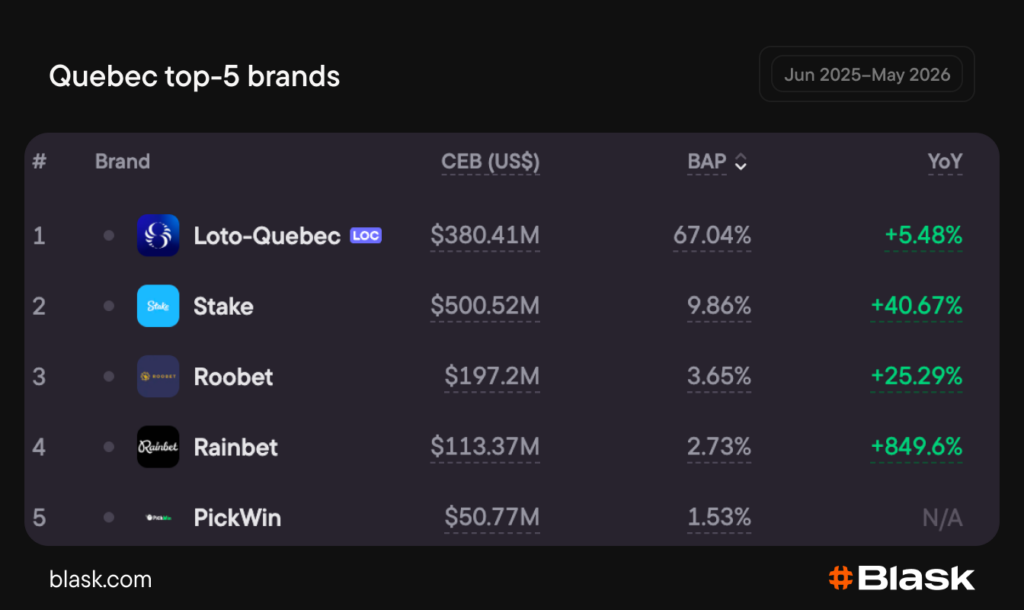
Over the last 12 months, Loto-Québec generated $380.41M in CEB, while Stake reached $500.5M with only 9.86% BAP, putting it about 32% ahead of Québec’s monopoly.
The advertising debate in Québec misses the wider market split. A Mainstreet Research survey cited by the Québec Online Gaming Coalition found that only 26.6% of Québec online players used Loto-Québec’s Espace Jeux for online casino or sports betting after lottery-only users were excluded, while 73% chose private platforms.
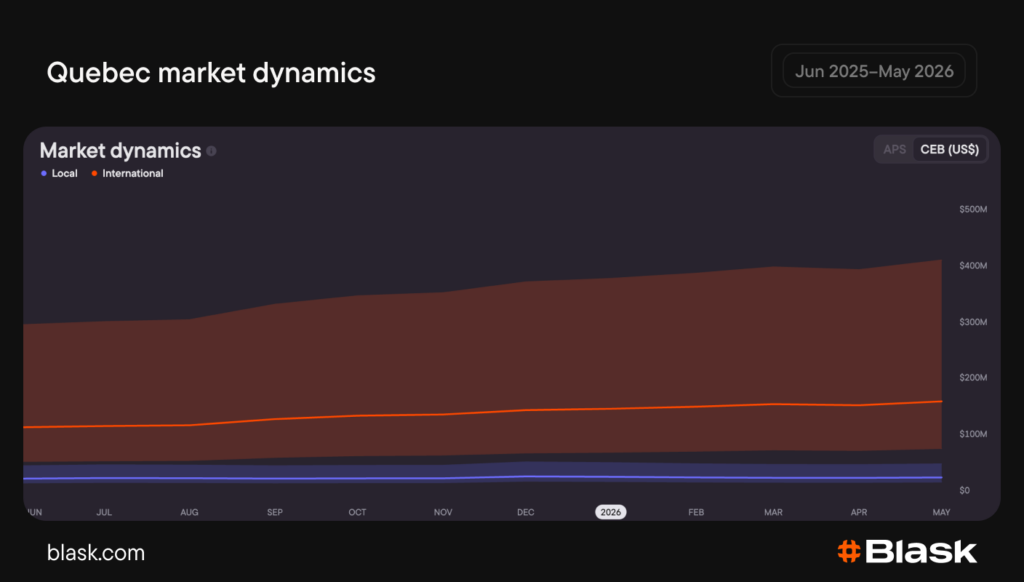
Blask shows a similar split through CEB: Loto-Québec accounts for 30.6%, while Stake, Roobet, Rainbet and PickWin together account for 69.4%. The monopoly owns attention, but high-LTV players appear to spend more offshore, where rules, limits and oversight are lighter.
Offshore grows faster
Loto-Québec remains the largest brand by demand with a Blask Index 5.48% YoY growth, but offshore brands are growing faster. Stake grew +40.67%, Roobet +25.29% and Rainbet +850%.
The data shows the core tension in Québec’s market: the licensed monopoly still owns most player demand, but the faster growth and higher revenue potential are visible offshore. Player spending is moving into channels the province does not control.
Not an advertising issue
The advertising debate gives Québec a simple argument for keeping the monopoly model in place.
Blask data shows why that argument is incomplete. Loto-Québec already holds 67% BAP in the province, so visibility is not the main issue. Players know the licensed option. A large part of the offshore demand is not coming from lack of awareness, but from players’ choice.
Stake shows the scale of that gap. The brand has only 9.86% BAP in Quebec, but its estimated revenue is higher than Loto-Québec’s.
Advertising restrictions may make offshore brands less visible. But visibility is not the issue — Loto-Québec already holds 67% BAP. Players are choosing offshore because the product is different: fewer restrictions, higher limits, and no mandatory self-exclusion tools. Blask data confirms that gap.