

- Updated:
- Published:
Germany could lose $463M in World Cup sports betting turnover to offshore operators
Germany risks missing out on nearly half a billion dollars in sports betting during the 2026 World Cup, with the offshore market poised to capture a significant share.
The German Sports Betting Association (DSWV) issued the warning on June 8: the 2026 FIFA World Cup is set to be the largest betting event in Germany since the Fourth Interstate Treaty on Gambling (GlüStV) took effect in July 2021.
DSWV forecasts total tournament betting turnover to exceed $1.16B. Licensed operators are expected to capture only 60–70% of that amount. The remaining 30–40% could flow to unlicensed bookmakers serving German customers, leaving up to $463M outside the regulated market.
Association president Mathias Dahms said the gap reflects flawed market channelization rather than tournament-specific dynamics. According to figures from the regulator GGL, about a third of users still turn to illegal services, while the black market is growing 17% faster than the legal market.
The association links this to the strict limitations of the state framework: a 5% tax on stakes, a monthly deposit cap of $1,160, and restrictions blocking popular live micro-markets.
Current market metrics: the balance of power between legal and offshore sectors
Blask currently tracks 365 active iGaming brands in Germany. Search demand typically spikes around major tournaments — and Germany’s offshore share still sits at 34% CEB.
Throughout 2025, Germany generated $3.03B in overall CEB. The licensed segment recovered some ground in the second half of the year following an offshore surge: offshore demand peaked at 61.9% of BAP in April but dropped to 29.4% by December. This recovery was driven by the return of the Bundesliga and Champions League, alongside scaled payment and domain enforcement by GGL.
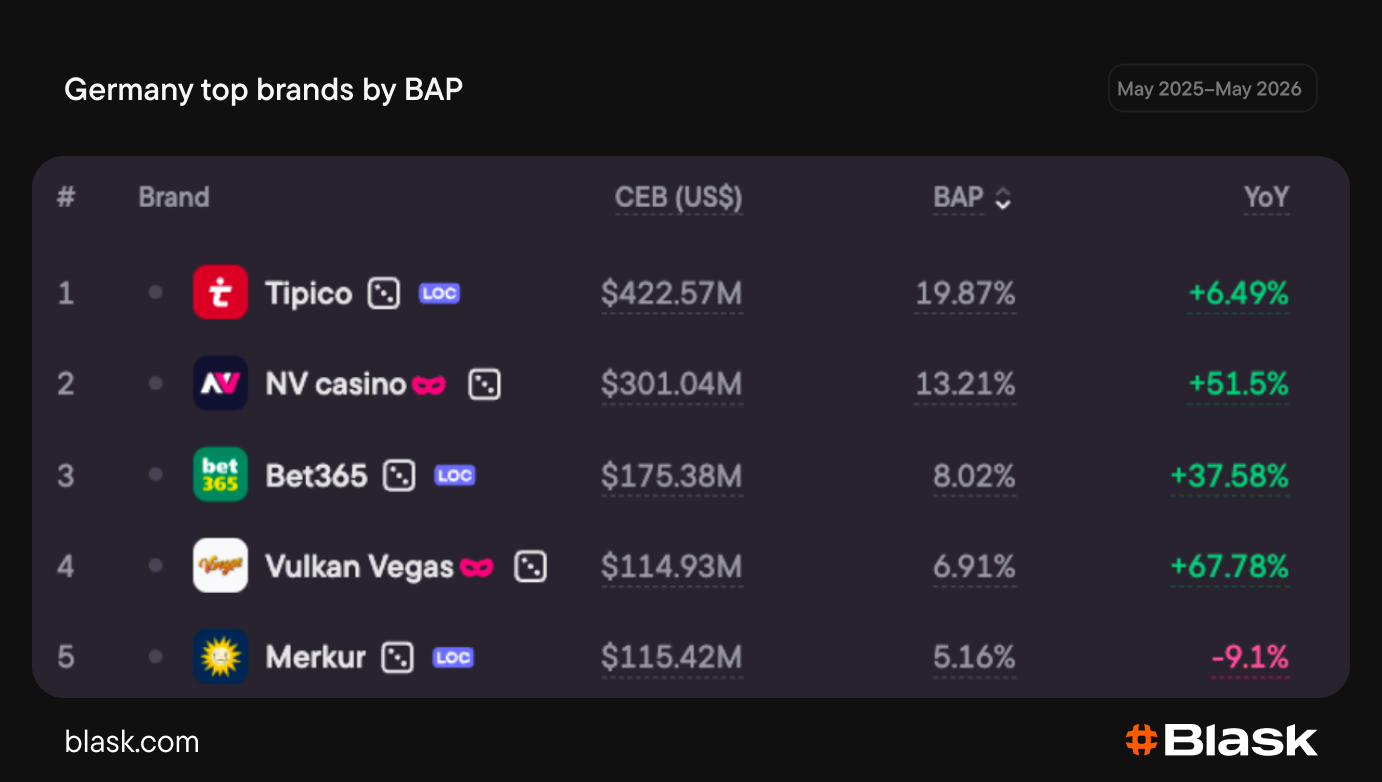
As of June 2026, Tipico leads the German market with 19.87% BAP. NV Casino and Vulkan Vegas also appear near the top of the ranking, but both carry Blask’s potential data manipulation flag, indicating possible external manipulation or unreliable brand metrics. With that caveat, Bet365 remains the strongest fully licensed global brand in the German ranking after Tipico.
Football remains the primary driver of the industry: Blask customer profile data shows that traditional sports betting accounts for 56% of product preferences among German players.
High stakes for offshore brands: the challenges of the World Cup
The World Cup is almost certain to boost volume across the German betting market. Licensed companies are expected to capture most traffic, but the structural limits of GlüStV still give offshore books a clear advantage: broader product offerings, looser advertising rules, and easier onboarding for players.
The evaluation of the Interstate Treaty framework scheduled for the end of 2026 may eventually rewrite the rules of the game. However, as the tournament kicks off, the market will still face the same structural imbalances that have consistently allowed offshore operators to maintain a major share of the German audience.