

- Updated:
- Published:
Traditional iGaming brands in the US lose consumer demand to sweepstakes casinos

Blask data reveals the scale of the grey area segment as sweepstakes operators come under regulatory scrutiny.
Blask recently introduced sweepstakes casino analytics for the US iGaming market, and the segment proved to be huge. According to the January–May 2026 data, nationwide demand for sweepstakes brands was higher than user interest for traditional iGaming operators. Sweepstakes lose out to online casinos and sportsbooks in 15 states — and only in 4 of them, licensed iGaming brands account for over 50% of combined Blask Index.
Sweepstakes dominate the demand
The legal iGaming sector in the US is losing the user demand battle not only to offshore operators and prediction markets, but also to sweepstakes casinos. A grey area segment is currently under attack by regulators, as a wave of explicit state-level bans started last year.
Sweepstakes casinos are online platforms that run casino-style games under US promotional law instead of gambling regulation. They rely on a dual-currency model: players buy Gold Coins purely for play and receive Sweeps Coins as a free bonus, and only the Sweeps Coins can be redeemed for cash prizes. Because the redeemable currency is always available at no cost — no purchase is ever strictly required — the model avoids the legal definition of a wager. Regulators have been challenging that, and in several states sweepstakes casinos are already explicitly banned.
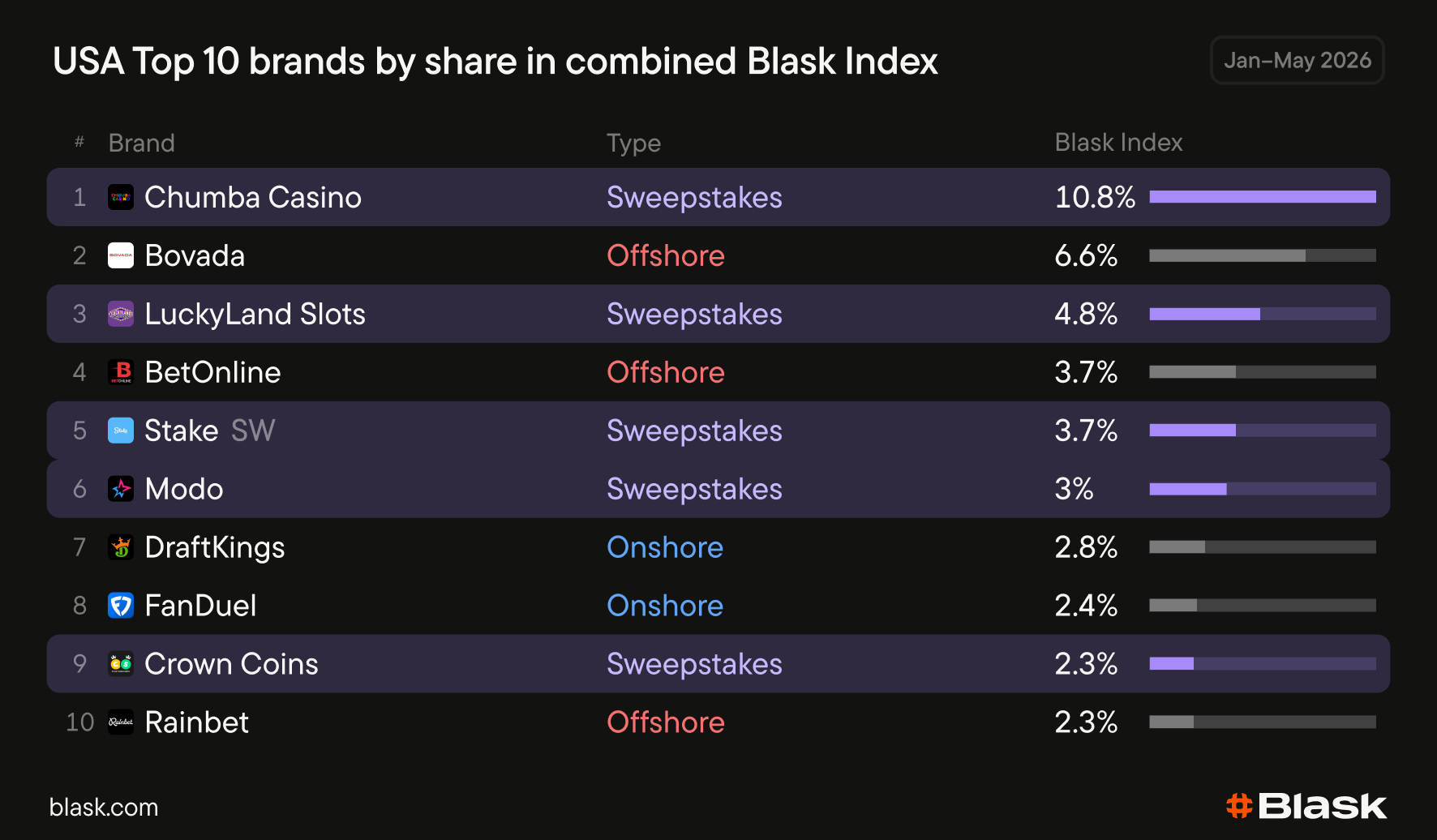
Blask Index shows sweepstakes brands outperforming traditional iGaming operators in January–May 2026. Their share of combined demand reached 57.9%.
Half of the top 10 operators by user demand nationwide, including the leader, were sweepstakes. The highest-ranked traditional brands are offshore, and the largest onshore operators — DraftKings and FanDuel — occupy only 7th and 8th places. Together they captured less than half the demand of Chumba Casino, the leading sweepstakes brand.
Where traditional operators lead
On a state-by-state level sweepstakes’ Blask Index exceeded that of the traditional brands in 35 jurisdictions. The remaining 15 states are evenly split across three iGaming regulation models.
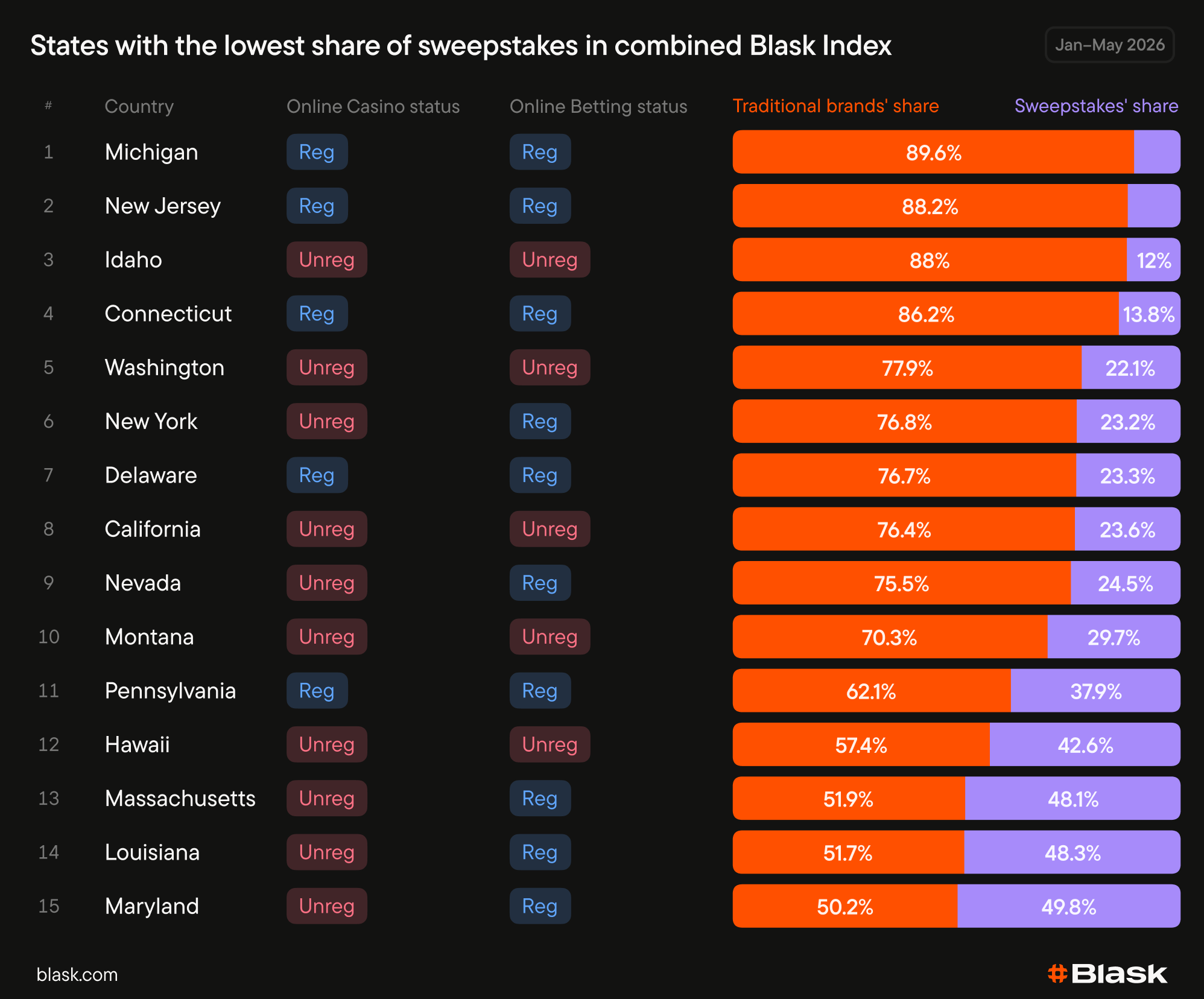
In 13 out of these states sweepstakes casinos are either banned or restricted. They are only legal in Pennsylvania and Hawaii. These jurisdictions differ completely as Hawaii prohibits traditional iGaming, while Pennsylvania has an open regulated market.
But without enforcement against sweepstakes, licensed brands cannot win the majority of user interest in Pennsylvania, as they do in Delaware, Connecticut, New Jersey and Michigan. These 4 are the only states where onshore operators outdraw offshore and sweepstakes rivals combined.
Bottom line
Blask’s new sweepstakes feature gives an additional layer to understanding the shape of the iGaming market in the US and how much user demand goes not only offshore, but to the grey area as well. Blask data shows that a competitive licensed market paired with strict enforcement can pull users into the regulated segment. But for now most markets just belong to sweepstakes casinos.