

- Updated:
- Published:
Hungary’s iGaming market: open on paper, closed in practice

Blask data shows how a formally liberalised market remains concentrated around the former monopoly.
Hungary recently changed government for the first time in sixteen years. The new administration has put the gambling sector under scrutiny, reviewing the arrangements that shaped today’s market. On paper, it looks mature and highly channelized. Blask data reveals the real structure.
A midsize market that looks stable
Hungary is not a very big market. For the 12 month period ending in May 2026, the country’s projected revenue, measured by CEB, was $651.85M. That ranks Hungary 49th of the 135 markets Blask tracks worldwide — between Singapore and Israel.
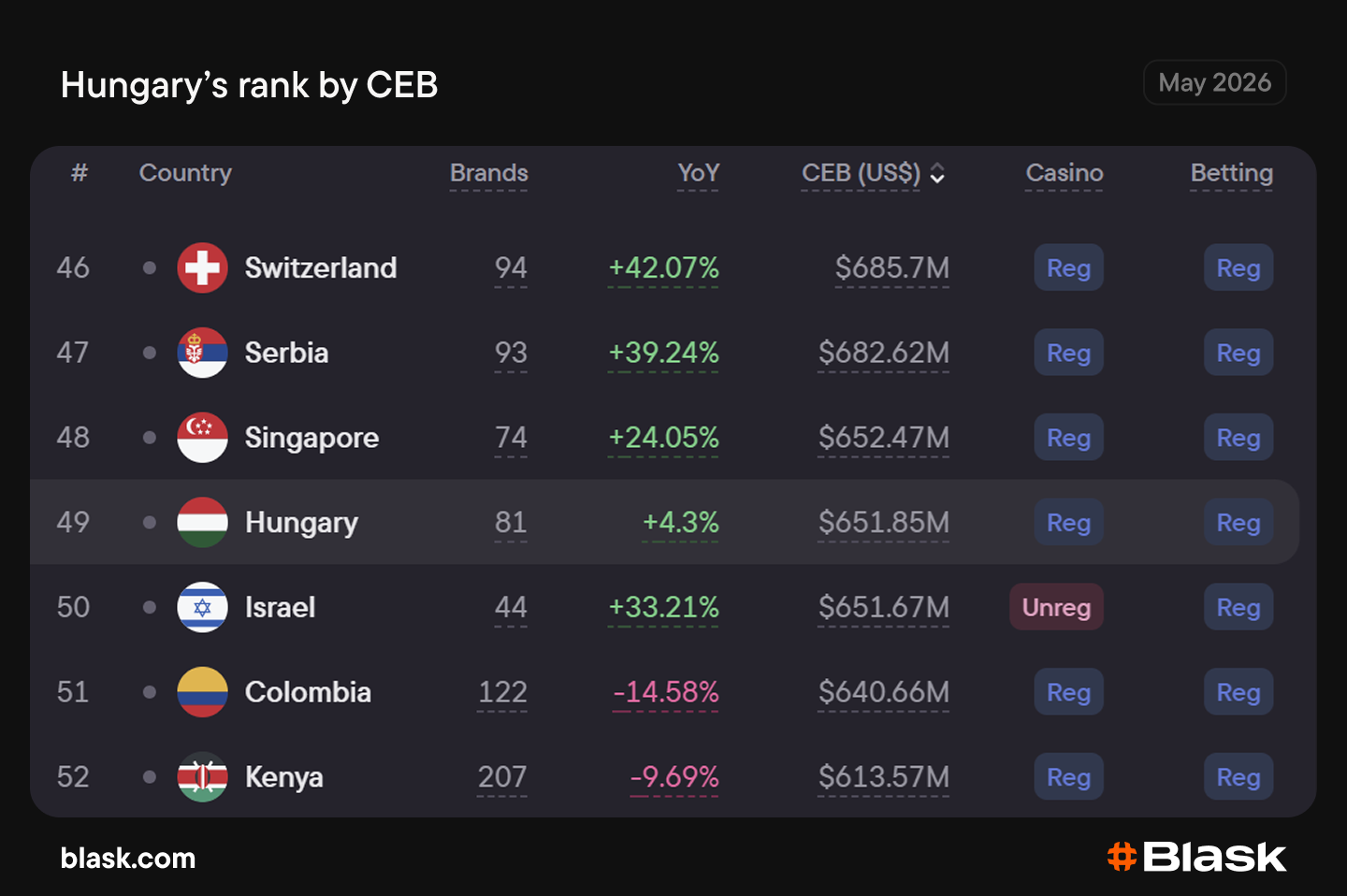
Year over year, Hungary’s CEB rose 5.7% and its Blask Index gained 4.3%. The onshore-offshore split looks just as settled: over the trailing 12 months, licensed brands held 76.4% of the country’s Blask Index and 79.5% of its CEB. Against the same period a year earlier, the onshore segment added about 2 percentage points of CEB share while giving back roughly half a point of Blask Index share.
A high level of channelization, combined with a regulatory framework, makes Hungary look like a well-established, competitive, open market. Despite that formal appearance, it is not.
How the market was built
Hungary formed its iGaming market around a state betting monopoly and a concession-based online casino model. Private online casinos were permitted from 2014, but only when tied to a land-based venue. Online betting stayed a state monopoly until 2023.
Those rules produced a duopoly. As of December 2022, state-owned TippmixPro was the only legal online betting brand, while the legal online casino vertical was controlled by a local group, LVC Diamond Kft, whose largest brand is Vegas.hu.
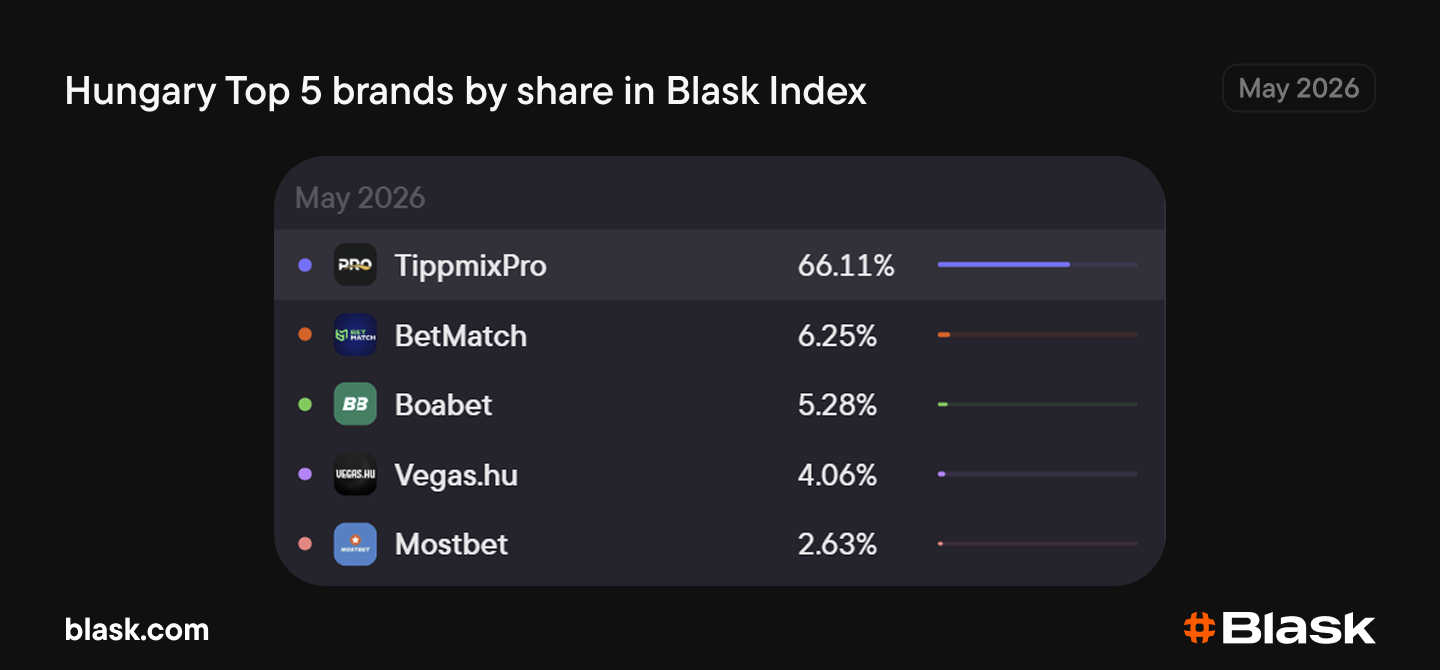
Formal liberalization of online betting in 2023 did not change much. The vertical is currently split between TippmixPro and Vegas.hu, and the state-owned brand’s share of Hungary’s total Blask Index rose — from 41.1% in December 2022 to 66.1% in May 2026.
Shifts in the offshore segment
In December 2022, several major international brands were active in Hungary. Among them, Bet365 held the highest share in the country’s Blask Index — 36.3%. Unibet accounted for 13.7%. Bet365 left the Hungarian market in November 2023, Unibet followed a year later.
Aside from LVC Diamond’s brands, no operator applied for a Hungarian license. Several international operators instead challenged the post-2023 regime in court, arguing that Hungary’s licensing and enforcement rules still shut out EU operators despite the market’s formal opening.
With no legal competition and the majors gone, new offshore brands filled the gap. Betmatch and Baobet both entered in 2024 and, by May 2026, had climbed to second and third by share of Blask Index.
Bottom line
From the outside, Hungary looks stable and channelized. The 2023 reform was meant to open online betting, but licensed demand only grew more concentrated. The new government puts that structure to the test — one that could finally open the market in practice, not just on paper.