
- Updated:
- Published:
What is an iGaming license
Behind every legally operating casino, sportsbook, and poker platform sits a valid iGaming license. Without it, operators face payment blocks, software rejections, and banking denials. With it, they gain access to players, partners, and processing infrastructure that makes sustainable growth possible.
What is an iGaming license
| An iGaming license is a formal authorization issued by a government-recognized regulatory body that permits a business to offer online gambling services — casino games, sports betting, poker, lotteries, and related products. The license confirms that the operator meets a defined set of legal, financial, technical, and ethical standards set by the issuing jurisdiction. |
What is a gambling license, at its core, is a regulatory contract. The operator agrees to:
- operate transparently;
- protect players;
- prevent money laundering;
- submit to ongoing oversight.
In return, the jurisdiction grants legal standing that unlocks access to banking, payment processors, software providers, and global player markets.
According to KodeDice, operating without a valid gaming license can result in fines, asset seizure, or forced shutdown. An online casino license also validates the technology layer. It requires:
- independent RNG testing;
- security audits;
- player data protection frameworks.
This AI image is a metaphor of an iGaming license.
Why iGaming operators need a license
There are several reasons why a license is mandatory for online casinos and online sportsbooks.
Legal operation in target markets
Every regulated market requires its own license before an operator can legally accept players. For example, the famous Curaçao license does not authorize UK player acquisition. If the online casino wants to operate in the United Kingdom, it must get a UKGC license.
If the brand doesn’t want to obtain a legal license, it gets Curaçao’s. But the online casino operates in a gray zone, being offshore in the particular jurisdiction.
Banking and payment access
Banks and PSPs treat unlicensed gambling companies as high-risk entities they cannot legally serve. FastOffshore notes that licensed businesses can enter banking partnerships and payment gateways that are inaccessible to unlicensed operators. Without a license, card processing, bank transfers, and most third-party payment integrations are unavailable.
Player trust and credibility
A visible license number from a recognized authority — MGA, UKGC, Isle of Man GSC — signals external regulatory oversight. Altenar’s research confirms that serious players understand licensed operators offer certain protections as standard:
- Fair play.
- Fund protection.
- Complaints mechanism.
This trust directly impacts conversion and retention, particularly in competitive markets.
Software provider eligibility
Major game studios, for example Evolution, Pragmatic Play, NetEnt, Playtech, only supply content to licensed operators. Without a recognized license, an operator is limited to smaller studios — a severe competitive disadvantage in any mature market.
Types of iGaming licenses
KodeDice’s 2026 licensing guide identifies four main classification frameworks:
- Activity-specific.
- Business-model-based.
- Fee-structure-based.
- Jurisdiction-based.
The most practically important distinction for operators is between activity-specific license types.
Casino license
A casino license permits operators to offer:
- slots;
- table games;
- live dealer content;
- virtual gaming products.
Regulators require certified RNG testing, fair gaming audits, player protection systems, and AML compliance. In most offshore jurisdictions, a single casino license covers all casino verticals under one approval.
Sportsbook license
A sportsbook license authorizes operators to accept wagers on real-world sporting events. Compliance requirements include:
- odds integrity systems;
- match-fixing prevention;
- in some markets, official data agreements with sports governing bodies.
In the US, sportsbook licenses are issued state-by-state. For example, operators in New Jersey, Pennsylvania, and Michigan each hold separate authorizations from their respective state regulators.
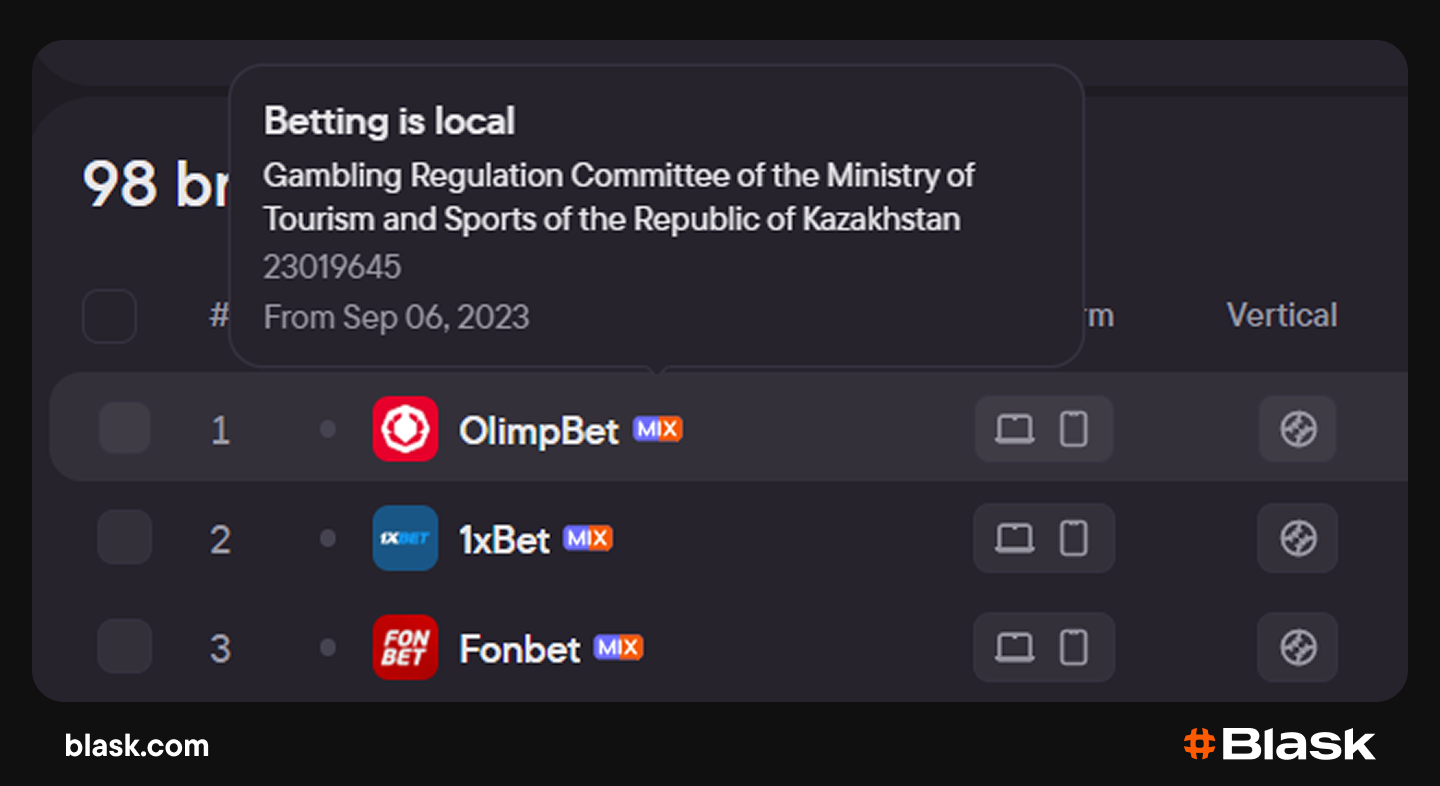
Some countries legalize only one iGaming vertical. For example, Kazakhstan legalized sports betting only, while casinos are prohibited.
Poker license
Poker room licenses are required to host online poker games and tournaments. Regulators focus on anti-collusion systems, chip-dumping detection, secure payment flows, and fairness certification. In the US, online poker operates across six states under shared liquidity agreements through the Multi-State Internet Gaming Agreement (MSIGA).
Bingo and lottery license
Bingo licenses cover platforms hosting online bingo games, with requirements for fair-play systems and responsible gambling frameworks. Lottery licenses authorize management of draws and sweepstakes, with rules governing prize distribution and draw transparency. In the US, online lottery (iLottery) is legal in ten states as of 2026:
- Virginia.
- New York.
- New Jersey.
- Pennsylvania.
- Georgia.
- Illinois.
- Michigan.
- Kentucky.
- North Carolina.
- New Hampshire.
B2B software supplier license
Game developers, platform infrastructure companies, and payment processors supplying services to B2C operators need a B2B supplier license. B2B licenses focus on software integrity, technical audits, internal controls, and AML compliance — rather than player-facing requirements.
The MGA issues separate B2B and B2C categories; the Isle of Man GSC covers providers through its eGaming Software Supplier license.
Operators must confirm their software suppliers hold valid B2B authorizations in each regulated market they serve.
Top iGaming licensing jurisdictions
The best iGaming jurisdictions in 2026 differ significantly in cost, speed, compliance burden, and market access.
| Jurisdiction | Regulator | Timeline | GGR Tax | Best for |
| Curaçao | Curaçao Gaming Authority | 4–8 weeks | 0% | Fast global entry |
| Malta (MGA) | Malta Gaming Authority | 200–360 days | 5% | EU-facing operators |
| UK (UKGC) | UK Gambling Commission | 3–6 months | 21% POC | UK market access |
| Gibraltar | Gibraltar Gambling Commission | 3–5 months | 0.15% (capped) | Established brands |
| Isle of Man | Gambling Supervision Commission | 3–6 months | 0% GGR | Tax-efficient global ops |
| Kahnawake | Kahnawake Gaming Commission | 2–4 months | Low fixed | Mid-sized operators |
| Anjouan | Anjouan Betting & Gaming Board | 4–8 weeks | Low fixed | Startups |
Curaçao — fast and affordable
| 🔥 The most popular option among iGaming operators. |
The Curaçao Gaming Authority (CGA) has been the most popular entry-level jurisdiction for offshore operators for two decades. A single license covers casino, sportsbook, lottery, and poker under one approval, completable in 4–8 weeks.
The absence of GGR taxes and low initial fees make it the default choice for startups. Core limitation: Curaçao does not authorize operation in the UK, US regulated states, Germany, Sweden, or most EU markets with mandatory local licensing.
Malta (MGA) — premium EU standard
The Malta Gaming Authority is the gold standard for EU-facing iGaming. An MGA license provides access to European payment rails, premium software providers, and player markets across the continent. MGA consolidated its framework into two types:
- B2B (software suppliers).
- B2C (player-facing operators).
Licensing demands rigorous AML compliance, player fund segregation, responsible gambling toolsets, and regular audits. Altenar identifies the MGA as most suitable for operators prioritizing market reach, credibility, and regulatory stability. Application fees start at approximately €5,000; the GGR tax is 5%.
United Kingdom (UKGC) — strictest tier-1
The UK Gambling Commission license is the benchmark for iGaming credibility. It grants access to a mature UK market but carries the most demanding compliance requirements in the industry:
- mandatory responsible gambling tools;
- strict advertising standards;
- affordability checks;
- player verification at registration;
- 21% Point of Consumption (POC) tax on UK-derived revenue.
No offshore license substitutes for UKGC authorization — UK players can only legally be accepted by UKGC-licensed operators.
Gibraltar — established hub
The Gibraltar Gambling Commission (GGC) operates one of the few jurisdictions with a framework built explicitly for remote gaming. Benefits include a 0.15% GGR tax (capped at approximately £425,000 annually), no VAT, and access to European markets.
The GGC is highly selective — it licenses only established operators with a proven track record.
Isle of Man — trusted crown dependency
The Isle of Man Gambling Supervision Commission (GSC) offers zero corporate tax on gambling profits, sophisticated digital infrastructure, acceptance of cryptocurrency payments, and coverage of all gambling activities — including skill games — under a single license.
Kahnawake (Canada) — long-standing
The Kahnawake Gaming Commission (KGC) is one of the longest-running gaming commissions globally, issuing operator and software supplier permits from the Mohawk Territory of Kahnawake, Quebec. A single license supports casino, poker, and sports betting at competitive fees.
Anjouan and Costa Rica — emerging options
Anjouan processes applications in 28–42 business days, with total costs starting under $15,000. The license covers all iGaming verticals and is recognized by a range of global payment service providers.
Costa Rica is categorically different. FastOffshore is explicit: no actual gambling license exists in Costa Rica — only company incorporation. Operators presenting “Costa Rica licensed” status operate without regulatory oversight. Payments are crypto-only; players have no regulatory recourse. Costa Rica is a sandbox, not a regulated jurisdiction.
US state-by-state licensing
The United States operates the most complex iGaming licensing environment globally because no federal online gambling license exists. According to the US iGaming Guide 2026, online casino real-money gaming is legal in seven states as of 2026. Sports betting is live in 38 states plus Washington DC.
| State | Online Casino | Sports Betting | Online Poker | 2025 GGR (Est.) |
| New Jersey | Yes | Yes | Yes | $2.1B |
| Pennsylvania | Yes | Yes | Yes | $2.4B |
| Michigan | Yes | Yes | Yes | $1.8B |
| Connecticut | Yes | Yes | No | $380M |
| West Virginia | Yes | Yes | Yes | $210M |
| Delaware | State-run | State-run | State-run | $95M |
| Rhode Island | State-run | State-run | No | $140M |
Each state has its own regulator. For example, New Jersey’s Division of Gaming Enforcement (NJDGE), Michigan’s Gaming Control Board (MGCB), Pennsylvania’s Gaming Control Board (PGCB).
iGaming license costs by jurisdiction
KodeDice reports that the minimum cost of an iGaming license starts at approximately €15,000 and scales significantly with jurisdiction, prestige and compliance burden. Altenar notes that Brazil’s SPA license requires BRL 30 million (approximately €5 million) upfront — one of the most expensive entry points globally.
Application fees
Application fees cover document verification, background checks, and preliminary regulatory review. They are non-refundable regardless of outcome.
| Jurisdiction | Application Fee (Est.) |
| Malta (MGA) | €5,000–€10,000 |
| UK (UKGC) | £5,725–£25,000+ |
| Curaçao (CGA) | $15,000–$25,000 total |
| Isle of Man (GSC) | £5,000–£20,000 |
| Anjouan | $10,000–$15,000 total |
| Kahnawake | CAD $20,000–$50,000 |
Annual renewal fees
Most regulators require annual renewal. MGA and UKGC annual fees are tiered by GGR volume — a small B2C UKGC operator pays approximately £25,000 per year. Large operators pay significantly more. Curaçao and Anjouan use fixed renewal structures that provide cost predictability for early-stage operators.
Gaming taxes
GGR taxes are the largest long-term cost variable in jurisdiction selection. Unlike one-time application fees, they scale with revenue indefinitely.
| Jurisdiction | GGR Tax Structure |
| Malta (MGA) | 5% GGR |
| UK (UKGC) | 21% point of consumption |
| Spain | 20% GGR |
| Gibraltar | 0.15% GGR (capped ~£425,000) |
| Isle of Man | 0% on GGR |
| Curaçao | 0% (fixed license fee model) |
| Anjouan | 0% GGR (fixed fee) |
Altenar’s casino license cost analysis shows that Spain’s 20% GGR tax makes it expensive for operators despite market size, while Malta’s 5% is significantly more favorable for profitability at scale.
Compliance and audit costs
Beyond direct license fees, operators carry ongoing costs:
- third-party technical audits;
- RNG certifications;
- AML system maintenance;
- responsible gambling tool implementation;
- legal counsel.
KodeDice estimates these operational compliance costs often exceed the licensing fees themselves depending on platform scale. Technical audits from certified labs (eCOGRA, BMM, GLI) typically cost €10,000–€30,000 per audit cycle.
How to apply for an iGaming license
Step 1: choose jurisdiction
Identify the jurisdiction that aligns with target players, budget, timeline, and product type. Key variables:
- which markets must be served;
- which model is chosen: offshore vs onshore;
- what GGR tax rate fits the financial model;
- how quickly live operation is needed.
Step 2: incorporate a local entity
Most jurisdictions require a local legal entity before or during the application. So it will take time to incorporate a presence in the country.
For example, local licenses could be obtained only with a company in the country. When the Brazilian legal market started to create, presence in this country was one of the key requirements.
Step 3: prepare documentation (business Plan, AML policy, KYC)
Applicants must compile a comprehensive package before submission. FastOffshore states that incomplete applications are the number one cause of delays.
Core requirements:
- company incorporation certificate;
- certified ownership and director identification;
- business plan;
- audited financial statements;
- proof of capital reserves;
- AML/CTF policy;
- KYC verification framework;
- responsible gambling policy;
- technical platform specifications.
Step 4: pass due diligence
Licensing authorities conduct thorough background checks on all key personnel — directors, shareholders, and beneficial owners. Criminal records and other reputational factors across all jurisdictions where principals have operated are all assessed.
Step 5: submit and wait for approval
Once all documentation is compiled and the application fee is paid, the package is submitted to the regulatory body. Anjouan and Curaçao can complete the review in 4–8 weeks. MGA takes 200–360 days. UKGC takes 3–6 months under optimal conditions. Operating before formal approval is granted constitutes unauthorized gambling and can disqualify the pending application.
License requirements: common documentation
While each jurisdiction maintains its own specific list, the following documents are required across virtually all major iGaming licensing applications. Altenar’s licensing framework and KodeDice’s document checklist both confirm these as universal requirements:
| Document | Purpose |
| Certificate of incorporation | Confirms legal existence of the entity |
| Shareholder & director IDs | Certified passports, proof of address |
| Beneficial ownership declaration | Full ownership chain to natural persons |
| Business plan | Revenue model, market strategy, operations |
| Audited financial statements | Proof of financial stability |
| Capital reserve proof | Bank statements or investor commitments |
| AML/CTF policy | Anti-money laundering procedures |
| KYC framework | Player identity verification procedures |
| Responsible gambling policy | Self-exclusion, deposit limits, tools |
| RNG certification | Third-party fairness testing certificate |
| Technical platform specifications | Software architecture and security protocols |
Compliance obligations after licensing
AML and KYC standards
Licensed operators must maintain active AML and KYC programs. UKGC and MGA operators are subject to regular AML audits; failures result in substantial fines. The UKGC has issued penalties exceeding £10 million to operators for AML and social responsibility failures.
Responsible gambling tools
All local-licensed operators must provide players with:
- deposit limits (daily, weekly, monthly);
- session time limits;
- reality checks;
- cooling-off periods;
- self-exclusion options (including national self-exclusion registries like GAMSTOP in the UK);
- links to gambling harm support organizations.
Player fund segregation
Many tier-1 jurisdictions require operators to keep player funds separate from operational funds in segregated accounts. MGA licensed operators must maintain player fund protection at either basic or higher levels. UKGC mandates segregated accounts and quarterly reporting on protection arrangements. Failure to segregate funds is treated as a serious breach capable of triggering license suspension.
Reporting and audits
Licensed operators submit periodic reports covering:
- financial performance;
- player activity volumes;
- AML suspicious activity;
- responsible gambling interventions;
- technical change logs;
- annual external audits of financial accounts;
- RNG systems;
- AML frameworks are standard.
How to choose the right iGaming license
Target markets and player geography
The first question is always: where are your players? If the target market is the UK, only a UKGC license works. For EU markets without mandatory local licensing, an MGA license provides broad coverage. For global reach at lowest cost, Curaçao or Anjouan serve as entry points. For the US, state-by-state licensing is non-negotiable.
Budget and time-to-market
Fast licenses (Anjouan, Curaçao) are cheap and quick but limit market access. Credible licenses (MGA, UKGC) take 6–12 months and cost significantly more. FastOffshore recommends a staged approach: start with a lean offshore license to validate the concept and generate revenue, then expand to a tier-1 jurisdiction when the business can absorb the cost. This is how to get a gambling license efficiently — start where you can move, then move where you want to be.
Game verticals covered
Verify that the chosen jurisdiction’s license explicitly covers every planned vertical. Most offshore licenses (Curaçao, Anjouan, Isle of Man) cover all gaming activities under one approval. Some European markets issue separate approvals per vertical. B2B suppliers must confirm their software is authorized in every jurisdiction where their operator clients hold licenses.
Banking and PSP access
An MGA or Isle of Man license opens doors with European acquirers, Visa, and Mastercard. A UKGC license is required for UK-resident card processing. Curaçao and Anjouan licenses are accepted by alternative PSPs and crypto processors, but rejected by most traditional European acquirers.
Common mistakes in iGaming licensing
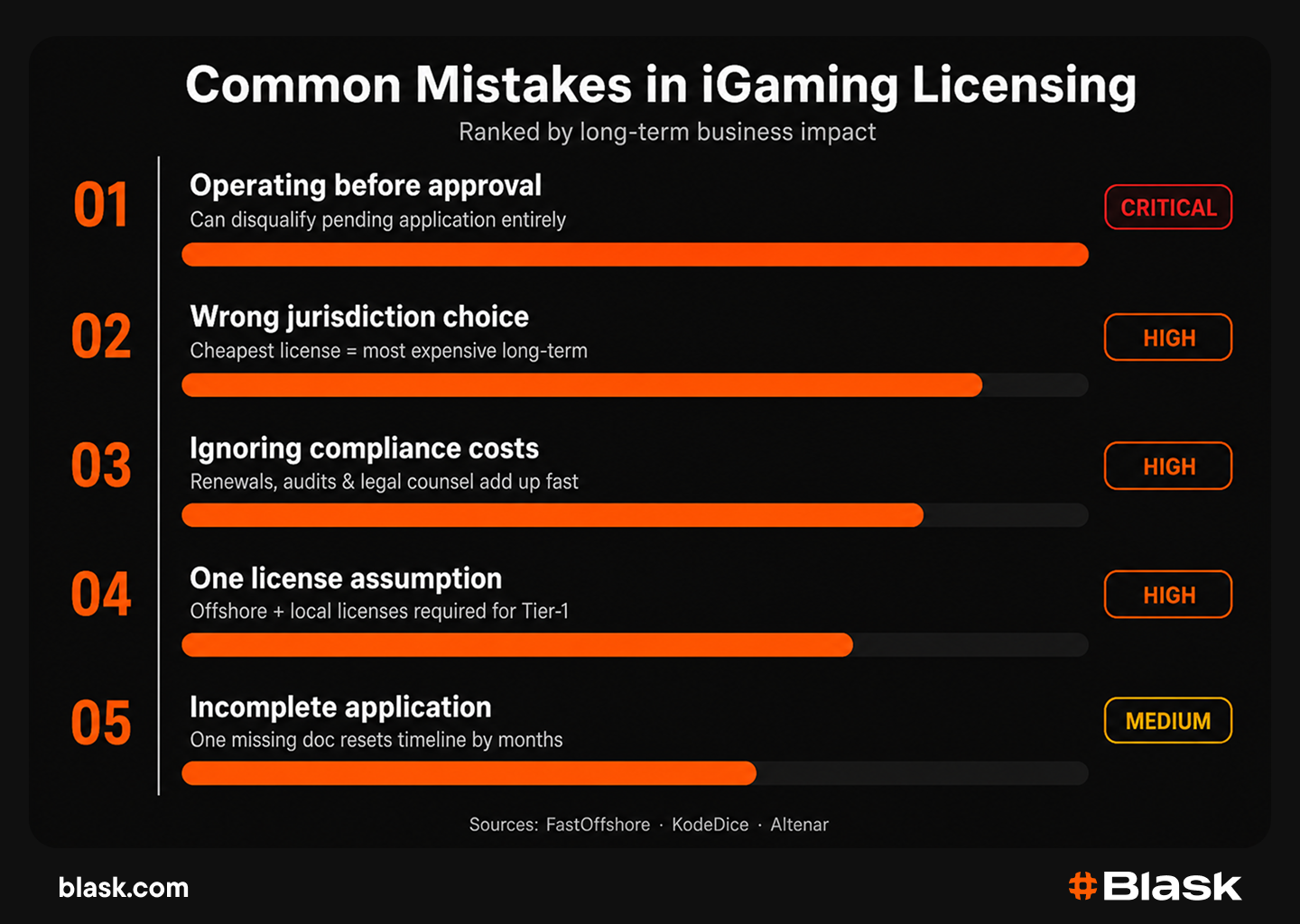
Mistakes in iGaming licensing can cost you reputation, money, and time.
Choosing jurisdiction by cost alone. The cheapest license is the one with the lowest total cost — including lost revenue from blocked markets and PSP rejections. A Curaçao license at $20,000 that locks out all Tier-1 markets costs more long-term than an MGA license for an EU-focused business.
Submitting incomplete applications. FastOffshore states that incomplete documentation is the number one cause of delays. A single missing document can reset the clock by months. Prepare the full package before submission.
Ignoring ongoing compliance costs. Operators budget for the application fee and forget annual renewal, AML systems, audit cycles, and legal counsel. Altenar flags hidden compliance costs — audits, certifications, local representation — as a consistent budget surprise. Total cost over three years is the correct metric, not the application fee.
Assuming one license covers all markets. KodeDice confirms that operators can only legally engage players where their license is valid. International operators typically hold multiple licenses — an offshore license for global reach plus local licenses for regulated markets.
Operating before formal approval. Launching before a license is issued — even in soft launch — constitutes unauthorized gambling and can disqualify the pending application entirely.
Future of iGaming licensing in 2026
Curaçao Modernization (LOK)
Curaçao is undergoing the most significant restructuring in its history. The new National Ordinance on Games of Chance (LOK) replaces the previous master-license sublicense model with individual operator licenses issued directly by the Curaçao Gaming Authority (CGA). Under LOK, each operator holds its own license — master license holders can no longer sublicense their authorization. New requirements include higher capital reserves, mandatory AML systems, player protection tools, and enhanced reporting. FastOffshore describes Curaçao as still viable but in transition — operators on legacy sublicenses must migrate to individual CGA licenses or cease operation.
Crypto casino licensing
Cryptocurrency gambling has moved from regulatory grey area to formal licensing consideration. The Isle of Man GSC explicitly permits cryptocurrency acceptance, as do Anjouan and Curaçao. KodeDice’s 2026 analysis identifies the Isle of Man as allowing crypto casino and Web3 sports betting under its existing framework. Anjouan and Nevis are positioning themselves as early movers for blockchain-based gambling operations. Malta’s MGA has engaged with the MiCA regulatory framework applicable to crypto asset service providers but has not yet issued dedicated crypto gambling licenses.
Emerging Latin American markets
Latin America is the fastest-growing regulated gambling region globally. Brazil’s Secretariat of Prizes and Bets (SPA) launched a full sports betting licensing framework in 2025, requiring a BRL 30 million license fee — viable only for well-capitalized operators. Colombia’s Coljuegos framework has been operational since 2016 and represents a mature regional model. Mexico, Argentina (provincial level), and Peru are at various stages of online gambling regulation. Operators planning for LatAm entry in 2026–2027 should monitor Brazil’s rollout closely — the market size justifies significant upfront investment despite the high entry cost.