
- Updated:
- Published:
What Is Gambling
Every wager begins with a single, universal moment: the tension of the unknown. Whether it is the spin of a roulette wheel, the turn of a card, or the final seconds of a live sports match, gambling thrives on uncertainty. Yet, behind this thrill lies a meticulously engineered machine. The modern gambling industry is a vast network of data scientists, risk managers, and legal experts working to quantify chance and manage exposure. This article answers the questions on what gambling is, how it works, why it exists, and how law, math, and risk shape the entire industry.
What Is Gambling
What is gambling can be answered without fluff. It is the commitment of value to an uncertain result for potential gains. Many legal jurisdictions are still based on the following three concepts: the stake, the risk, and the prize. The health sector also considers it a public matter when losses begin to disrupt day-to-day living.
How Gambling Works
At its core, a wager exchanges a small certain loss for a shot at a larger return. Operators frame that shot with rules, odds, and payout schedules. Players gamble because uncertainty creates tension, excitement, and the dream of a quick hit. The system works because randomness never stops moving.
The Three Elements: Consideration, Chance, Prize
The notion is simplified into three components by the lawyers. The consideration refers to money, credit, or any other valuable thing. The element of chance refers to uncertainty, despite skill affecting the margins. The prize means that there is something valuable at stake.
Core elements appear in every market:
- Consideration.
- Chance.
- Prize.
Skill vs Chance Games
Certain types of games rely heavily on luck, including slot machines and roulette. There are other games that have a bit of judgment involved, such as poker and certain sporting bets.
Some casino games are similar to skill-games, but they are not. For example, crash games such as Aviator by Spribe, Chicken Road by InOut Games, Doodle Crash by Barbara Gang don’t require a particular skill but their gameplay imitates skill-based games.
| Criteria | Skill-Based Games | Chance-Based Games |
| Outcome Determination | Driven by player knowledge, strategy, mathematics, and decision-making. | Driven entirely by Random Number Generators (RNG) or physical randomness. |
| Player Influence | High. Players can study, practice, and improve their long-term win rate over time. | None. Every round is independent; past results do not affect future outcomes. |
| Common iGaming Examples | Poker, Blackjack (using basic strategy), Sports Betting, Daily Fantasy Sports (DFS). | Slots, Roulette, Baccarat, Crash games, Plinko, Mines. |
| House Edge & Profitability | Operators earn via “rake” or entry fees. Highly skilled players can achieve positive Expected Value (+EV). | Operators use a built-in mathematical house edge (RTP < 100%). The house always wins in the long run. |
| Regulatory Treatment | Often regulated differently; some jurisdictions do not classify them as traditional gambling. | Strictly regulated as gambling/gaming worldwide, requiring specific licenses and compliance. |
House Edge and Probability
The concept of chance is the basic principle behind all gambling games. House advantage refers to the average amount that the game retains over time. This does not mean that the player will definitely lose in a particular spin.
Types of Gambling
The main types of gambling differ in pace, skill load, and payout style. Some are instant and repetitive. Some unfold over hours or days. All of them package uncertainty into a product.
Main categories dominate the sector:
- Casino play,
- Sports wagers,
- Lotteries,
- Fantasy Sport,
- Sweepstakes casinos,
- Racing pools.
Casino Gambling (Slots, Tables, Live Dealer)
Casino games revolve around repeat actions and quick processing. Slot machines use algorithms to generate numbers and mathematical models. Table games involve rules that have both luck and strategy components. The live dealer versions broadcast live games from casino studios.
Canada is an example where online gambling is much more popular than online betting (3,7k times).
There are several types of casino content:
- Slots. They heavily dominate the iGaming industry. For example, in European countries they account for 80% content share.
- Crash games. It’s a big trend of the last few years. It started from Aviator by Spribe and continued with lots of crash titles.
- Instant win. This category appeared when game providers started to create something different from crash titles. For example, Tower Rush (Galaxsys), Doodle Crash (Barbara Bang).
- Plinko. This genre is inspired by the classic TV game show, where a ball drops through a pyramid of pegs into multiplier zones.
- Mines. Based on the classic computer game Minesweeper, players uncover tiles with multipliers while avoiding hidden mines.
Sports Betting
Sports betting transforms beliefs into bets. Bets span from victors, totals, props to live action. Betting odds vary based on injuries, weather, volume trading, and risk management. In legalized states, this category now generates huge tax revenues.
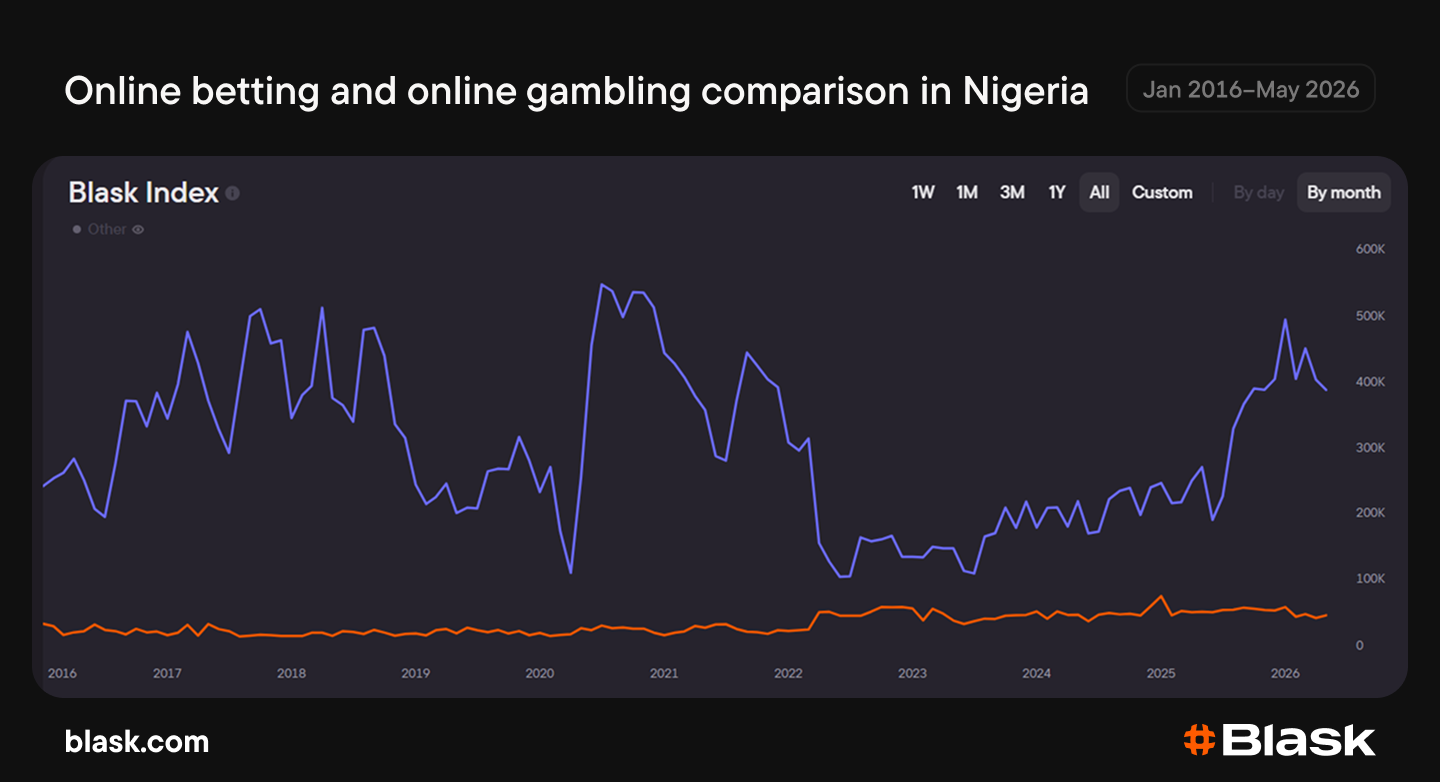
In some countries, sports betting is more popular than online gambling. Nigeria is a clear example. Blask Index of betting category is 9x higher than the gambling one.
Lottery and Scratch Cards
Lottery tickets offer cheap dreams with a neat package. The scratch-off lottery ticket compresses all that hope into mere seconds. The jackpot could be big, but the chances are merciless. That is why these games appear simple but are unforgiving mathematically.
Some jurisdictions stand out as players there like lotteries the most. For example, people in the United Kingdom are much more interested in lotteries than in placing bets or playing slots.
Poker
Poker is the odd one out. It rewards memory, position, bankroll discipline, and reading patterns. Still, short-term luck can flatten a sharp player. That mix keeps poker inside gambling law in many places.
Bingo and Keno
Bingo and keno thrive within relaxed guidelines. One picks the numbers or buys cards and waits for random draws. This process seems to be a slower-paced game compared to slots. The mathematics, however, is stacked against the player.
Horse Racing
Racing occupies an old meeting point between sport and gambling. Bettors analyze form, pace, training, and tracks. The odds from tote betting compared to fixed odds may vary dramatically. Racing appears timeless, yet odds making is brutal.
Social Gambling and Sweepstakes
Social games tend to strip out any money incentives and then introduce virtual chips or other rewards. In sweepstakes casinos, a system of prizes according to promotional regulations is established. This explains why it is difficult to draw a distinction between entertainment and legal gambling.
Online Gambling vs Land-Based Gambling
Online gambling runs faster, hides friction, and stays open all day. Land-based venues add travel, physical cues, and more visible limits. Gambling online also reduces the visual proof that players get at live tables. That gap matters when fairness depends on trust in software and regulation.
Legal Status of Gambling
Law is where the topic gets patchy. One country may permit broad licensing, while the next bans remote play almost completely. Legal gambling is never one global model. It is a mosaic of local statutes, regulators, taxes, and court decisions.
| Country | Is gambling legal? |
| United States | Depends on state |
| Australia | Yes |
| United Kingdom | Yes |
| Italy | Yes |
| Netherlands | Yes |
| Canada | Yes |
| Philippines | Yes |
| India | No |
| Brazil | Yes |
United States (Federal, State, Tribal)
In the United States, a multi-tiered approach is used. The federal government establishes general restrictions, but state laws provide more specific restrictions on the map. Tribal gambling is done under the Indian Gaming Regulatory Act and Tribal State Compacts for Class III casino gambling. This explains why one state might permit online betting while another does not.
In practice, U.S. gambling often falls into two broad models:
- Commercial gaming, run by private operators such as BetMGM, FanDuel, and DraftKings under state licensing systems.
- Tribal gaming, conducted by federally recognised tribes under IGRA and tribal-state compacts. These models do not always align. In some states, tribal interests have limited or delayed entry for commercial operators, with California being the clearest example.
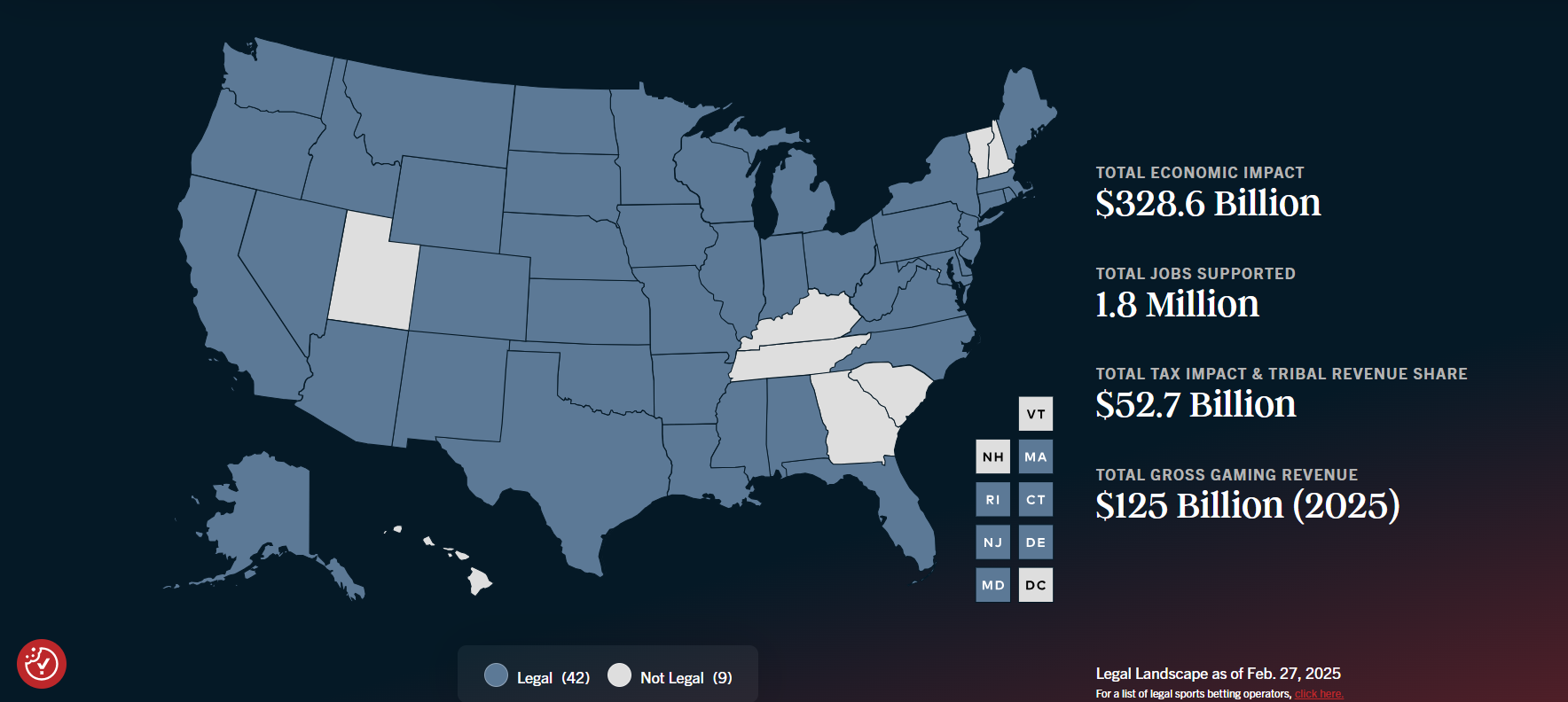
AGA provides an interactive map on its website about the gambling status in all states. Online gambling is legal in 7 states.
United Kingdom (UKGC)
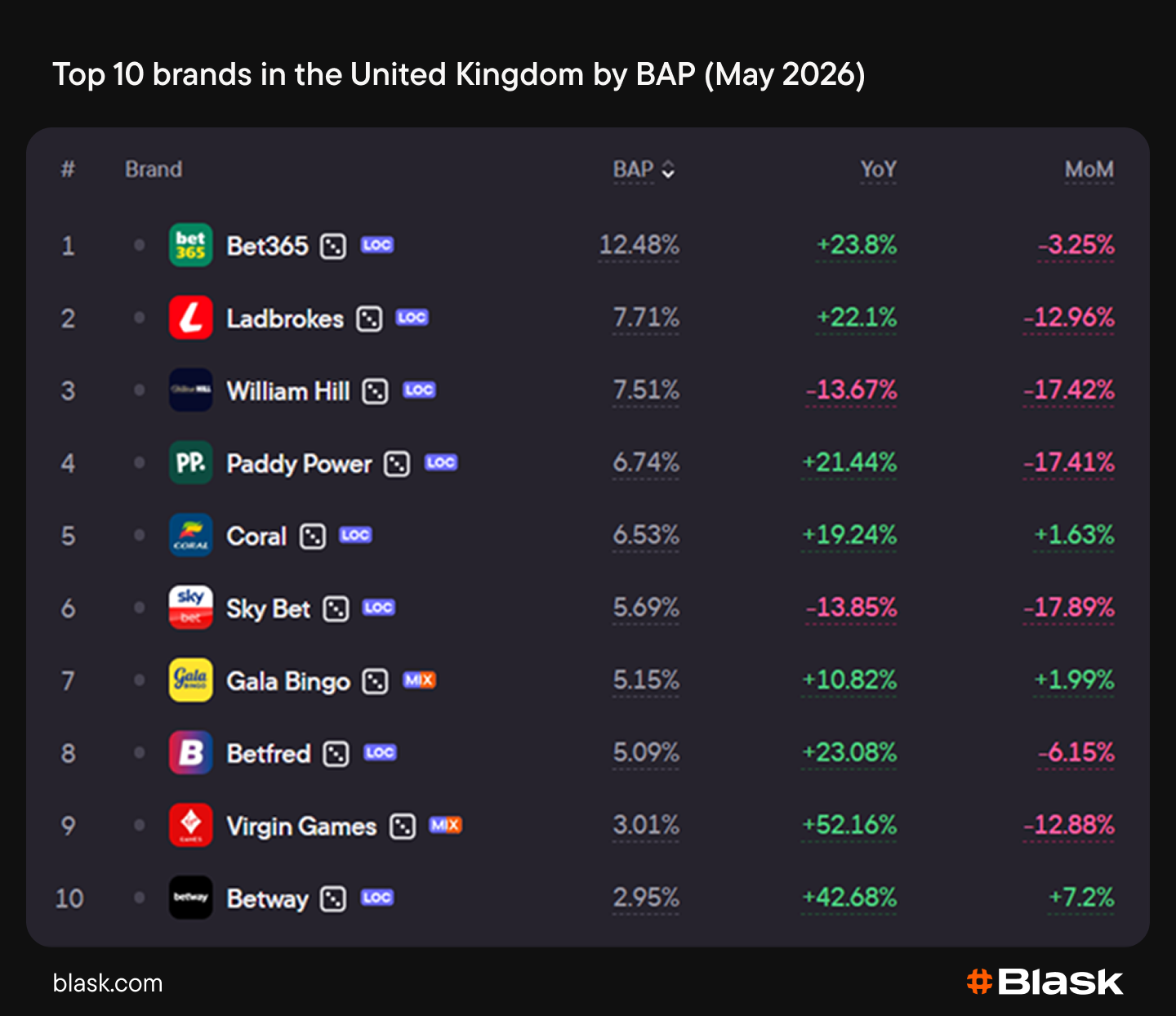
The gambling market in Great Britain relies on the existence of a national regulatory body that is highly licensing-oriented. The UK Gambling Commission is mandated to give operating licenses to most of the gambling establishments, while also licensing positions held by individuals. This creates a highly centralized system.
Europe (MGA, Curaçao, Country-Specific)
There is no one code applicable to all countries in Europe. In Malta, B2C licenses have been issued and multiple verticals can be conducted using one license following approval. The LOK license in Curaçao can now be issued through their authority’s website for remote gambling licensing.
Across Europe, operating offshore is a major legal risk rather than a clever shortcut. In tightly regulated markets such as Italy, Germany, and France, unlicensed gambling products can expose operators to criminal prosecution, regulatory enforcement, site blocking, payment disruption, and heavy financial penalties. In practice, that means an offshore model may quickly turn from a growth plan into a direct legal liability.
Licensing centres usually focus on four pillars:
- Suitability checks;
- Player protection;
- Technical controls;
- AML reporting.
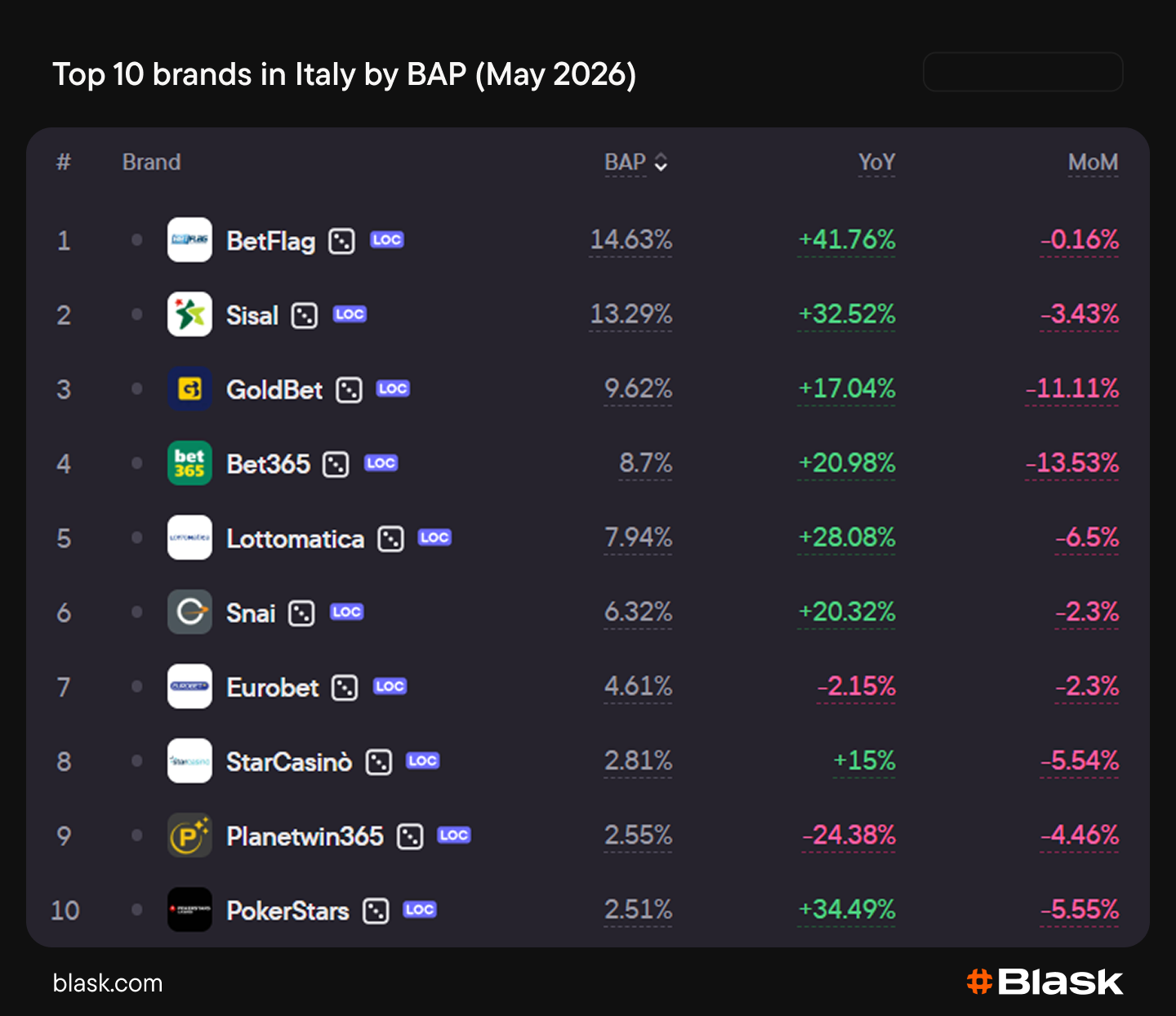
Italy is the largest European market after the United Kingdom. Italy is #6 in Blask with a $6.33B CEB.
| The iGaming market worldwide power ranking displays more than 100+ countries. It shows the current Blask Index, BI dynamics in the past 90 days, and the total number of active brands. |
Asia and Emerging Markets
Even Asia is not one big market. Singapore has allowed only a highly controlled remote operation system and prohibited the unregulated service. Only casinos business is allowed within an integrated resort in Japan under strict regulations. The Philippines has maintained the license-based operation of several digital games via PAGCOR.
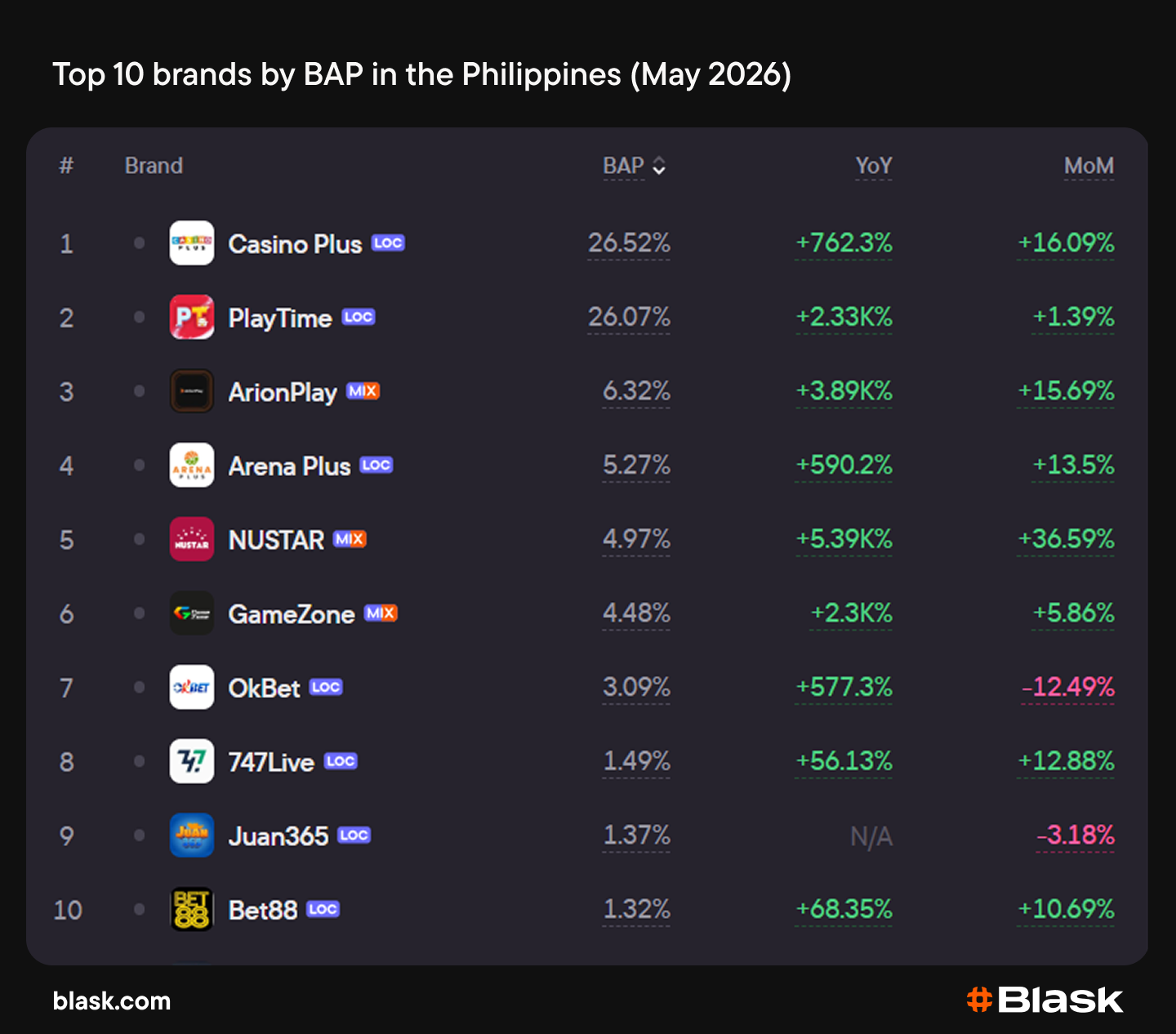
The Philippines remains the only country where online casinos and sportsbooks are legal.
How the Gambling Industry Operates
The business looks flashy from the front, but the machinery is layered. An operator rarely builds every game, payment rail, and compliance tool alone. The online gambling industry runs on contracts, software, risk models, and reporting pipelines. The customer sees a lobby, while the back end looks like a wiring diagram.
Operators and Platforms
Brands, player wallets and customer relations are owned by operators. Platforms take care of account management, payments, limits and session management logic. There may be companies that have a single product while others run books, casinos, poker and bingo out of one stack.
Regulators and Licensing
Regulators act as gatekeepers. They assess ownership, financing, controls, technical criteria, and safer play systems. The license does not operate merely as a symbol. It operates as a permission system with audit risk implications.
Game Providers and Aggregators
Gaming providers develop slots, table games, and specialty games. Game aggregators allow numerous gaming providers to be integrated together. This will save time for the operator in exploring the new market. Another effect is concentration, as a few pipes can reach several thousand destinations.
Affiliate Marketing in Gambling
Affiliate marketing works by pushing traffic through review sites, comparisons, and search funnels. The affiliate marketing model may involve commissions on first deposits, revenue sharing, or hybrids. Such a marketing strategy can work well due to the preexisting interest of consumers in search.
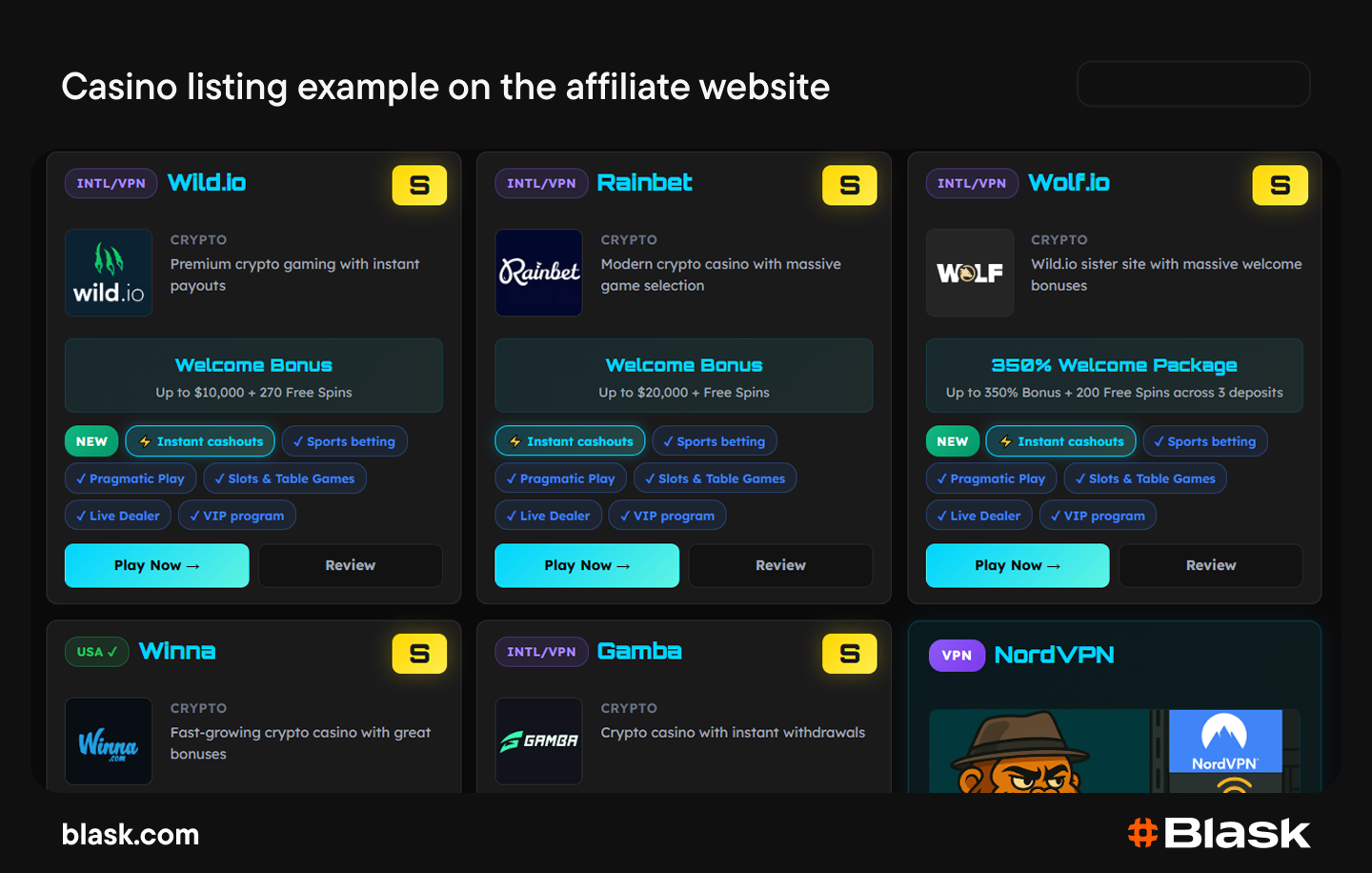
There’s the example of an affiliate website where top casinos are listed.
Mathematics of Gambling
It is math that fuels the engine of any colorful banner. It defines frequencies of wins, volatility, and long-term playability. If there’s no such element, the game cannot pass commercial testing. When there is one, any element may get its price.
House Edge
The house edge is the inherent average advantage. In roulette, blackjack, slots, and keno, the house edge varies according to the rules being played. The smaller the edge, the slower the grind, but it doesn’t eliminate the risks involved.
RTP (Return to Player)
The RTP refers to the return of the investment theoretically made during an extended period. This value is normally presented as a percentage. An online casino offering an RTP of 96% means that they still hold on to 4% of their investment.
Variance and Volatility
Variance explains the range of outcomes. The higher the variance, the longer periods of drought and larger spikes. The lower the variance, the more frequent payouts, but with smaller payouts too. This is what makes two slots with the same RTP so different from each other.
Expected Value (EV)
Expected Value refers to the average return on an investment made. In gambling products, the expected value is normally negative for the gambler. However, depending on the situation, be it an exchange or poker playing, it may vary. It is important because a good outcome is irrelevant.
Gambling Bonuses and Promotions
Bonuses are more of an acquisition tool than a gift. These include matched deposits, bonuses, cash back, loyalty boosters, and so forth. The big figure that people see may actually be hiding important details such as the rollover requirements, weighting of games, and expiration period.
| Bonus Type | How It Works | Typical Conditions & Restrictions |
| Welcome Bonus (Deposit Match) | The operator matches a percentage of the player’s first deposit (e.g., 100% up to $500). | High wagering requirements (30x-50x), strict max bet limits while clearing the bonus. |
| No Deposit Bonus | Free credits or spins awarded simply for registering a new account, requiring no initial deposit. | Very high wagering requirements, strict maximum cashout limits, and game restrictions. |
| Free Spins (FS) | A set number of spins on specific slot titles; winnings are usually credited as bonus cash. | Restricted to specific games, and winnings are subject to wagering requirements before withdrawal. |
| Cashback | Returns a percentage of net losses over a set period (daily/weekly) as bonus funds or real cash. | Often capped at a maximum amount; cash versions may require a low (1x) wagering turnover. |
| Reload Bonus | A deposit match offered to existing players on subsequent deposits to drive retention and engagement. | Usually offers a lower match percentage than the welcome bonus, with standard wagering requirements. |
| Sticky (Non-Cashable) Bonus | Bonus funds are added to the balance for gameplay, but the bonus amount itself is removed before withdrawal. | Players can only withdraw the real-money winnings generated from playing with the bonus funds. |
| VIP / Loyalty Program | Players earn points for every wager, which can be exchanged for cash, bonuses, or physical rewards. | Tiered systems require massive long-term volume to reach top tiers; points often have expiration dates. |
Responsible Gambling and Problem Gambling
Public health bodies draw a hard line between harmless recreation and visible harm. The World Health Organization says losses can damage mental health, family life, housing, and essential spending. A person may gamble for relief, boredom, or escape, then lose control slowly. Responsible gambling language exists, but WHO warns that optional tools alone are often weak.
Signs of Problem Gambling
Warning signs are usually practical before they become dramatic. Bills get skipped, time disappears, debt rises, and secrecy grows. Work, study, and relationships start taking hits. In severe cases, crime, homelessness, and suicidal thinking can enter the picture.
Common warning signs often cluster:
- Debt pressure;
- Hidden spending;
- Missed work;
- Relationship conflict;
- Chasing losses.
Self-Exclusion Tools
Self-exclusion blocks access for a chosen period. Pre-commitment tools cap time, spend, or losses before play starts. The World Health Organization argues universal systems work better than optional ones. Voluntary tools help, but only when they are broad and enforced.
Helplines and Support Resources
Formal treatment still has low uptake. Shame and denial often delay help for years. Health services, specialist clinics, and helplines remain the safest route once harm is obvious.
Gambling Taxes and Reporting
Tax rules depend on the jurisdiction, but reporting duties are common. In the United States, winnings are taxable and belong on the return. Certain payouts trigger Form W-2G, but all winnings must still be reported. Losses may be deducted only up to winnings when records exist.
History of Gambling
This tradition goes back farther than states, casinos, and paper tickets. There are indications that dice games started way before time, along with the existence of betting parlors in China and card games in medieval times in Asia. In 1638, the Ridotto in Venice became one of the first casinos ever recorded. Remote gambling emerged in 1994.
Future Trends in Gambling for 2026
The subsequent step is going to be far more calculated than anything else. Mobile first, compliance, and quicker payment processing will influence product roadmaps. Real growth is still happening, but regulation is creeping towards the middle ground. This might impact operator thinking on all screens and offerings.
Crypto Gambling
Cryptocurrency products are moving away from being novelties to becoming useful items. This can be seen from their speed and accessibility across borders. While this is happening, authorities are linking the usage of cryptocurrency with licensing and transparency responsibilities.
AI-Powered Personalization
Today, AI influences risk assessment, promotional decisions, support allocation, and even when to retain users. The most sophisticated technologies analyze user behavior instantly. This may help security, yet it will increase the power of persuasion. It will become the key topic for discussion.
Live Dealer Expansion
Live dealer content is an important connection between remote gambling and the experience in land-based casinos. It brings in human tempo, cards, and visible tables. This format is favored by operators because it increases time spent at gaming sessions and sales of other products.
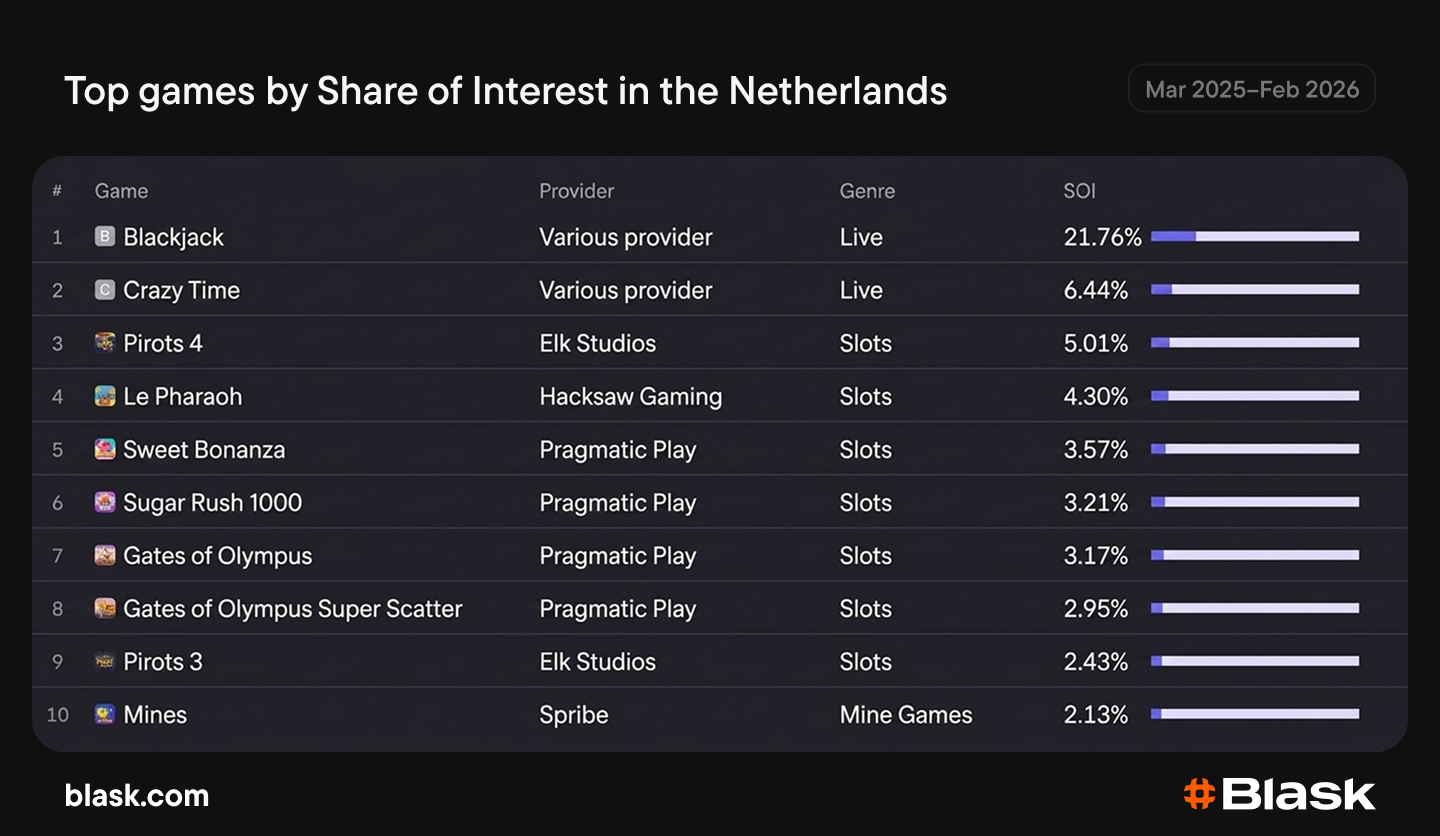
For example, according to a Blask report on the Netherlands, the Dutch players are searching for Blackjack.
Regulatory Convergence
Global law will not quickly converge. Nevertheless, the trend is unmistakable. There will be increased demand for more robust identity verification, more robust anti-money laundering requirements, bonus regulations, and tougher tools against exploitation. It will remain an easy question what gambling is but its regulation will only become thicker.