
Blask Index for betting brands in Argentina peaked three weeks before the final — even as World Cup Index in the tournament spiked 89% on match day.
Spain beat Argentina 1:0 in extra time in the World Cup final. Before Enzo Fernández’s red card, the team held a scoreless draw despite the opponent’s dominance. A second yellow card in the closing minutes of regulation left the team without its main midfielder, and substitute Ferran Torres scored the winning goal in the 106th minute. Extra time had worked in Argentina’s favor multiple times during the tournament, but in the final it worked against them for the first time.
After the match, 39-year-old Lionel Messi left the field in tears — presumably his last World Cup. Spain won its second title and became the first country to hold both the men’s and women’s world titles simultaneously.
The tournament set records off the pitch too. Analytics firm GCI estimated the global betting volume at around $593B, with roughly 69% of that amount flowing through offshore channels. Blask Index data for the country, however, showed an unexpected pattern.
Holidays drove bigger spikes than Argentina’s matches
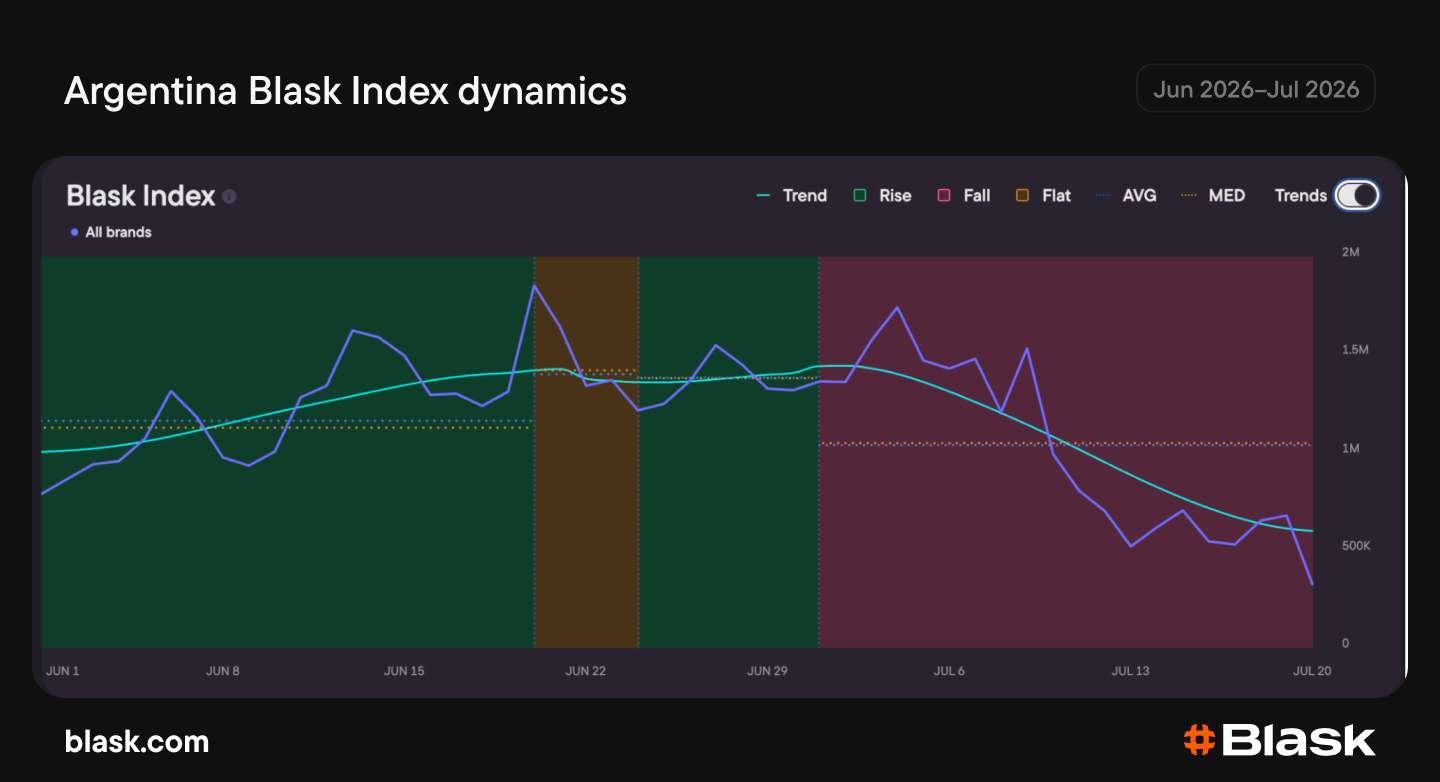
Argentina’s Blask Index rose at several points during the tournament, but not every peak was directly tied to national team matches. The highest level came on June 20, when the country marked a national holiday that coincided with the group stage. Another notable rise came on July 9, Independence Day, ahead of a long holiday weekend.
The most direct link to Argentina’s play came on July 4. After a dramatic extra-time win over Cape Verde, the index grew 10.75% and hit the tournament’s second-highest peak. An unexpected score, two comebacks from the opponent, and uncertainty until the final whistle likely sustained interest in betting brands.
After the win over Switzerland on July 11, Blask Index dropped sharply. By July 13, Blask Index had lost 72% from its tournament peak. The semifinal against England barely moved the needle, and on the day of the final the index remained 63% below its high. The tournament’s biggest match generated less search interest in betting brands than the early stages of the competition.
Demand faded as the final approached
During Copa América 2024, Betano’s Blask Index rose 48.6% MoM in June and another 30.3% in July, as Argentina advanced to the title. The 2026 World Cup followed the opposite pattern: demand peaked early and declined before the semifinal and final.
The 2026 World Cup played out differently. The most significant rise in search demand came in the tournament’s early stages, after which the index began to decline. Neither the semifinal nor the final brought demand back to its June and early-July levels.
The data doesn’t reveal registrations or betting volume directly, but they show that the main wave of attention to betting brands built up before the decisive matches. Betano, which operates in Argentina under a local license, holds around 30% BAP and remains the market’s largest brand.