

- Updated:
- Published:
US offshore gambling market 2026: Bovada and BetOnline alone generate $6.44B

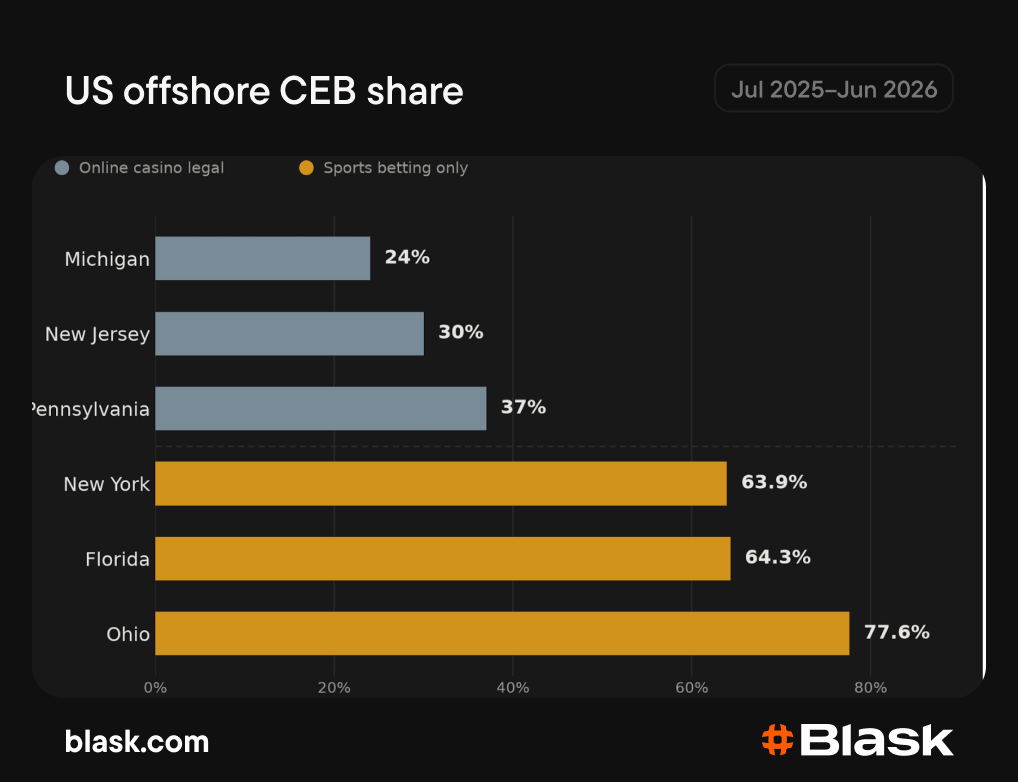
Bovada and BetOnline generated a combined $6.44B in offshore CEB during H1 2026, more than the licensed operators BetMGM trails. Offshore’s share of total US CEB reaches as high as 77.6% in sports-betting-only states like Ohio, compared with just 24% in fully regulated Michigan.
The legal US market breaks records every quarter: new states launch online casinos, operators report record GGR, and licensed brands go public. According to the American Gaming Association (AGA), Americans place $673.6B a year in bets with illegal and unregulated operators — almost a third (31.9%) of the entire US gambling market.
Blask reaches a similar conclusion through its own CEB and BAP metrics — though, as the estimates below show, pinning down one clean number for the offshore market is harder than it looks.
How big is the offshore market — and why estimates diverge
AGA estimates the illegal US sports betting market at $84B a year, equal to around 24% of the sports betting market as of 2025. By comparison, a comparable AGA estimate for 2022 put the share at 36%.
Circa Sportsbook CEO Derek Stevens offered a different figure at Missouri licensing hearings in August 2025, putting illegal operators’ share of US betting volume at 75%. Industry analysts criticized the number as unsubstantiated, and former FanDuel CEO Nigel Eccles also called similar estimates far-fetched.
These sources rely on different metrics and methodologies: AGA measures handle, Blask measures CEB and BAP, and Stevens’s methodology was never disclosed. The figures are therefore not directly comparable.
Offshore controls two-thirds of US CEB — and the gap is widening
Blask splits brands into locally licensed and offshore, and calculates CEB for each segment separately. Total US market CEB reached around $78.7B in 2025: $26B from licensed operators and $52.7B from offshore brands. Offshore thus accounted for roughly two-thirds of the market.
In H1 2026, that share grew from 65.8% to 67.5% YoY. Offshore CEB rose from $25.5B to $27.2B, compared to H1 2025 while licensed CEB fell from $13.3B to $13.1B. U.S. commercial gaming revenue hit $20B in Q1 2026, up 6.0% YoY — the biggest first quarter on record, according to the AGA’s Commercial Gaming Revenue Tracker. Yet that growth in regulated GGR didn’t translate into a bigger licensed-segment share of total CEB, which instead slipped as offshore demand grew faster.
The size of the gap depends on the regulatory model. In states with legal online casinos, the offshore share is markedly lower: 24% in Michigan, 30% in New Jersey and 37% in Pennsylvania. In states where only sports betting is legal, it reaches 63.9% in New York, 64.3% in Florida and 77.6% in Ohio.
H1 2026 · Online casino states vs. sports-betting-only states
California and Texas are both fully offshore online gambling markets. Based on H1 2026 CEB, they would still compete with some of the world’s largest national markets: if treated as standalone countries, California ($2.8B) would rank 8th globally, between Italy and the Philippines, while Texas ($2.19B) would place 12th, between Australia and Indonesia.
Why offshore keeps winning despite record growth in the regulated market
The US remains one of the largest regulated online gambling markets, but growth in the legal segment doesn’t mean offshore is shrinking. According to Yield Sec data for the Campaign for Fairer Gambling, illegal operators controlled 74% of the market by revenue in 2024, and their digital footprint far exceeded that of licensed brands. By mid-2025, audience exposure had fallen from 88% to 82%, but illegal operators still had roughly six times more affiliates.
One reason is the product gap. Offshore and crypto-native operators offer a wider game selection and higher betting limits. Derek Stevens built his argument around exactly this gap, proposing a low hold as a way to lure high-volume bettors back into the regulated sector.
Prediction markets are rapidly becoming a major part of US gambling demand. In H1 2026, the combined Blask Index for Kalshi and Polymarket reached 49.8M, nearly matching the traditional iGaming segment at 51.3M. Their share of the combined segment rose from 15.8% in H1 2025 to 49.25% in H1 2026, as prediction-market demand grew 385% YoY while traditional iGaming declined 6%. Prediction markets accounted for more than half of total demand from February through April, peaking at 52.4% in March, before easing to around 48% in May and June.
Bovada and BetOnline alone generate nearly $13B in offshore CEB
In Blask’s BAP ranking, offshore brand Bovada remains the US market leader. BetOnline ranks second, ahead of DraftKings and FanDuel. Seven of the ten biggest brands by demand belong to the offshore or unregulated segment overall.
The gap shows up in CEB too. During H1 2026, Bovada generated an estimated $3.94B in CEB and BetOnline $2.5B. Together, the two brands accounted for approximately $6.44B in offshore CEB during the first half of the year.
The US offshore market continues to grow alongside the regulated sector. Sports betting is legal in most states, but major markets such as California and Texas still have no regulated online betting, while online casinos are legal in only a few states. Offshore operators also offer higher limits, a broader product range and wider nationwide access.
Sweepstakes are another force reshaping US demand. Blask puts the vertical ahead of licensed and offshore operators combined in 35 of 50 states by mid-2026, with regulated brands holding their ground only where a mature legal offering was backed by active enforcement — a split Blask broke down in its earlier look at the segment. As with offshore play, that spend stays invisible to regulatory GGR.
FAQ
How much of the US gambling market is offshore in 2026?
Blask estimates offshore brands controlled 67.5% of total US iGaming CEB in H1 2026, up from 65.8% a year earlier. The American Gaming Association separately estimates $673.6B, or 31.9% of total US gambling handle, flows to illegal and unregulated operators annually.
Which offshore brand leads the US gambling market?
Bovada ranks first in Blask’s BAP ranking for the US market, ahead of licensed leaders FanDuel and DraftKings. Bovada generated an estimated $3.94B in CEB during H1 2026, with BetOnline second among offshore brands at $2.5B.
Does legalizing online casinos reduce offshore gambling?
Yes, substantially. In states with legal online casinos, offshore share drops to 24% in Michigan, 30% in New Jersey and 37% in Pennsylvania. In states with sports betting only, offshore share reaches 63.9% in New York, 64.3% in Florida and 77.6% in Ohio.
How big are prediction markets compared to traditional US iGaming?
In H1 2026, Kalshi and Polymarket’s combined Blask Index reached 49.8M, nearly matching the 51.3M generated by the entire traditional iGaming segment. Prediction market demand grew 385% year over year while traditional iGaming demand fell 6%.