

Blask Index data across the five largest markets shows the strongest demand spikes came at the tournament’s kickoff and when national teams were knocked out.
Held simultaneously across the US, Mexico and Canada, the tournament put the American betting market on track for $2.32B-$4.33B in wagers over the championship. It became the largest sporting event in the history of regulated US betting.
But total handle doesn’t reveal when the audience was most active. Player interest is spread unevenly: it climbs sharply, falls back, then peaks again. Blask tracks daily demand across five key markets throughout the tournament, from 11 June to 19 July, to pinpoint the day of maximum interest in each.
Five markets, three scenarios for peak demand
Blask data shows maximum demand formed not around the final but at the moments when market attention concentrated most sharply: on a national team’s first match, in a knockout game, or during a packed opening weekend. Each market had its own trigger, but in all five cases the high point landed on an event able to pull in the widest possible audience at once.
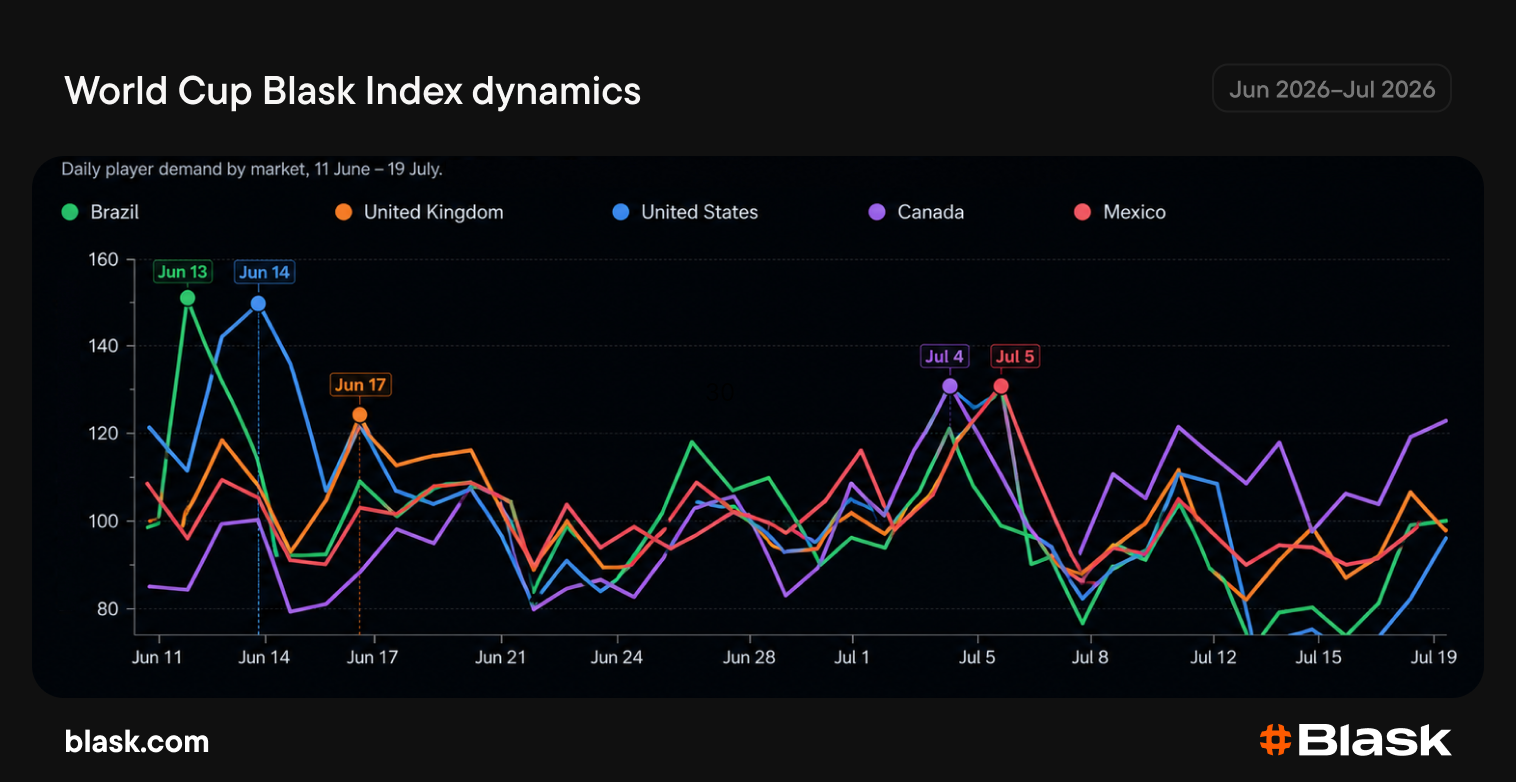
Brazil topped out on 13 June, the day of the team’s opening match against Morocco. Within a day Blask Index rose by more than 50%, and demand ran roughly 50% above the tournament average. In one of the world’s largest betting markets, the national team’s debut became a mass entry point into the championship, pulling in casual bettors alongside regulars — a one-off audience that thins out once group results start eliminating teams.
The United Kingdom followed a similar path, cresting on 17 June when England beat Croatia 4:2 and Blask Index rose about 15% on the day. That first match drew more attention than any later stage: early in the tournament expectations are still at their highest, and interest reaches well beyond the regular betting audience.
Canada and Mexico, by contrast, hit their highs in the knockout rounds. Canada reached its peak on 4 July during its Round of 16 loss to Morocco, while Mexico followed a day later, peaking in a 2-3 defeat to England as Blask Index rose nearly 8%. In both markets, demand peaked when the host nation faced elimination.
The US was the exception, peaking on 14 June. The driver was not one national-team game but a packed opening-weekend schedule — a heavy slate of matches, the kickoff effect, and a broad new audience for whom a home tournament was reason enough to bet.
The final was nobody’s peak — first matches and knockouts drove demand
Across five markets, a match’s place on the calendar did not by itself set demand. The final topped the charts in no country: audiences reacted most to events tied directly to their own tournament story.
In Brazil and the UK, the high fell on the team’s first match, when expectations were greatest. In Canada and Mexico, attention peaked in the decisive knockout game. In the US, the trigger was a packed opening weekend that stacked several matches on top of broad interest in a home tournament.