Blask analysis shows FIFA World Cup 2026 was not profitable for bookmakers, especially in the early stages.
A recently published Blask special World Cup report describes how the 2026 World Cup affected iGaming demand across different countries and various stages of the tournament. It also suggests that the extended format made the World Cup unprofitable for sports betting operators, as only 49 of 104 matches produced an overall positive profitability index.
Profitability is estimated with Blask’s own proprietary model that scores every match and betting market by how much it moved the bookmaker’s margin. A positive score means that the match was bookmaker-friendly; a negative score means that it favoured players.
Profitability by tournament stage
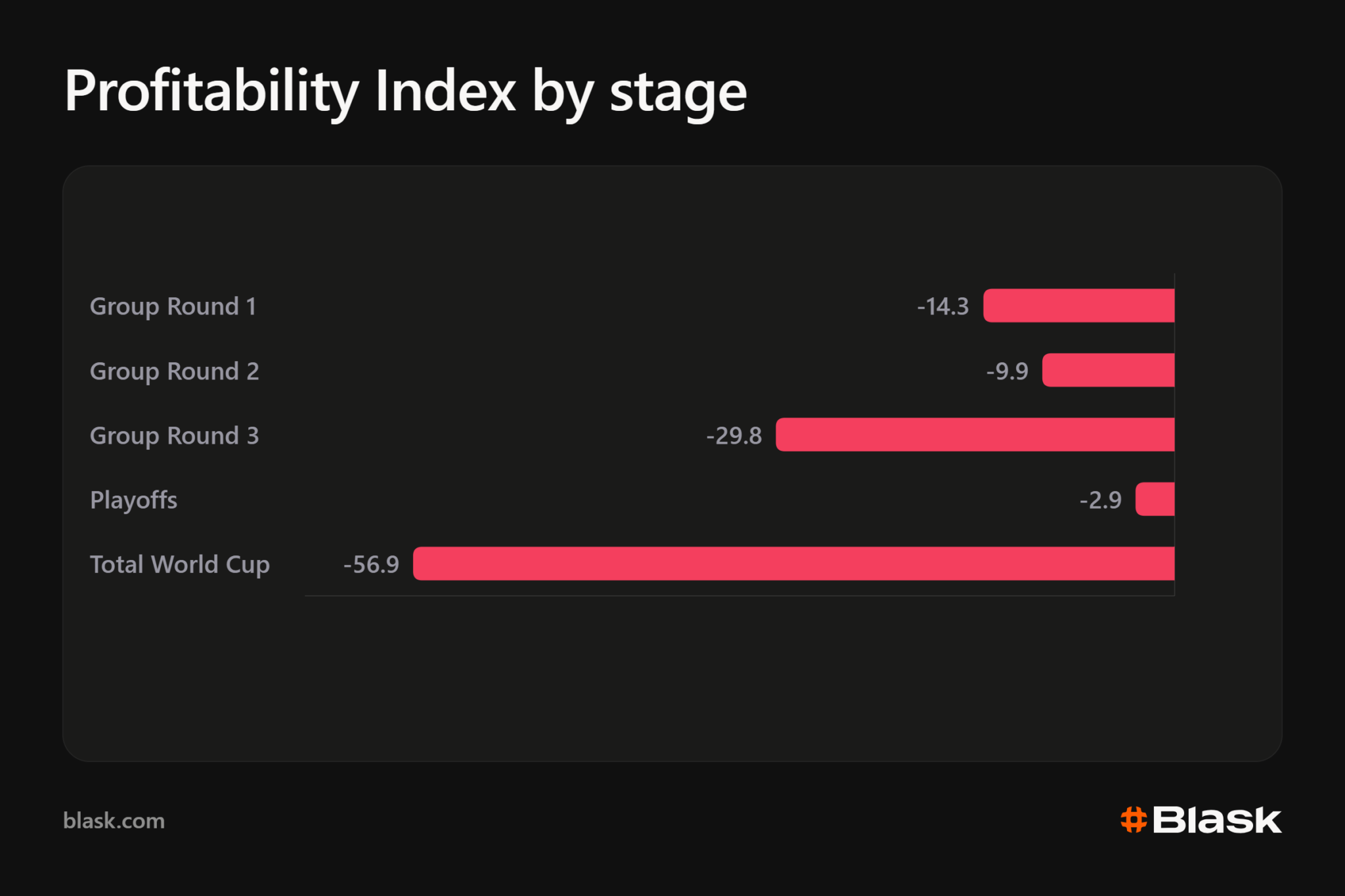
The 2026 edition of the FIFA World Cup was unprecedented — 48 participants and 104 matches. The very first round showed how badly it could affect betting operators’ margins.
Only 9 of 24 group Round 1 games were bookmaker-friendly. The round produced a highly negative profitability index, with most losses coming from live betting, as players bet during the matches on what they saw and could deduce from the flow of the game.
That knowledge of teams’ strengths and weaknesses carried over into Round 2 and Round 3 pre-match betting strategies. Half of those games were punter-friendly, especially for bets before the starting whistle. A similar pattern applied to knock-out Round of 32, but later, with only the 16 best teams left in the tournament, the tide turned in the bookmakers’ favour.
Yet, the overall score proved unfavourable for sports betting operators.
Which matches and countries moved the margin
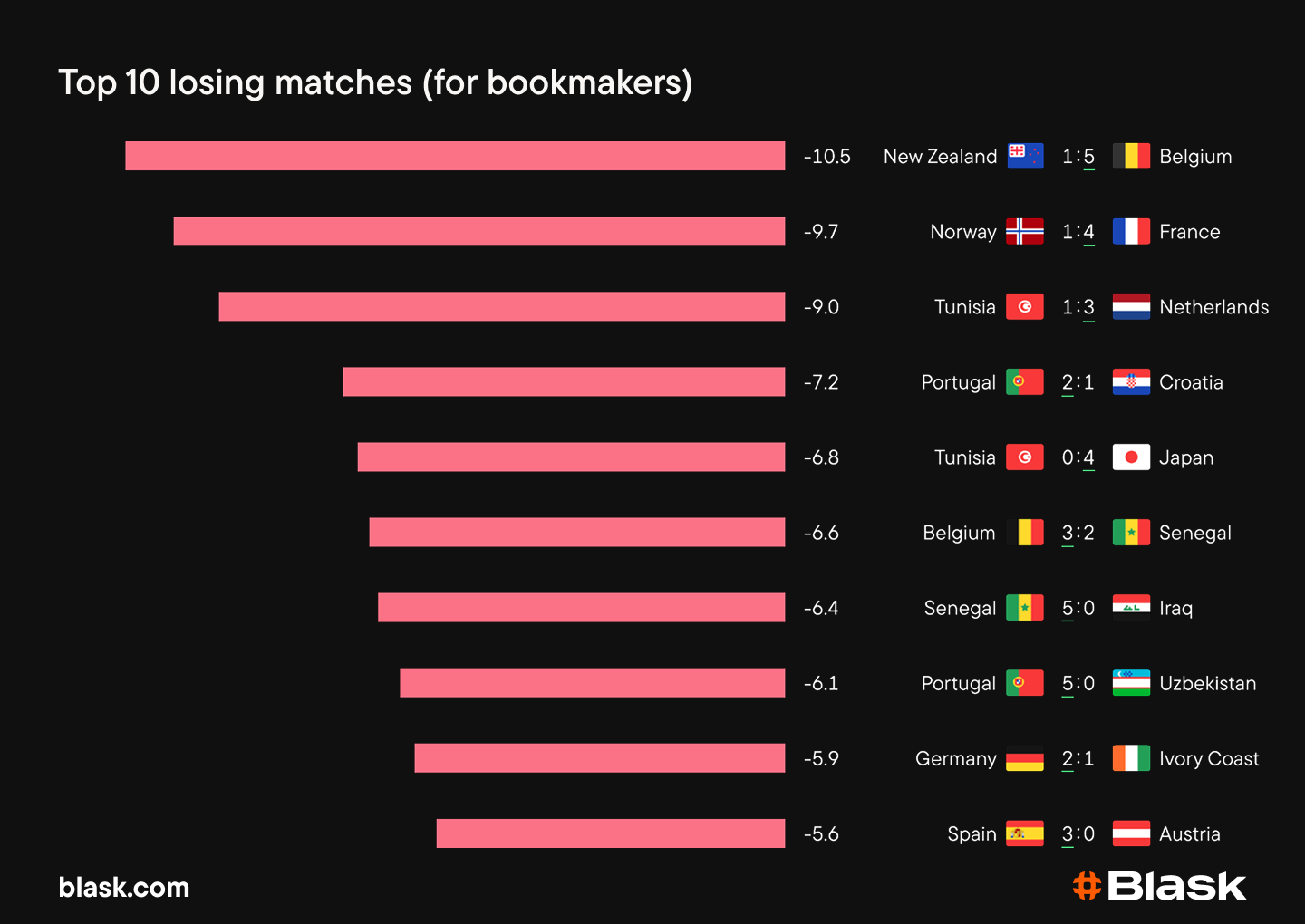
The worst match for bookmakers was New Zealand’s 1-5 defeat by Belgium in the final round of the group stage. That round produced 3 more of the 10 most punter-friendly matches. The rest came from group stage Round 2 and playoffs Round of 32, as they each delivered 3 such games.
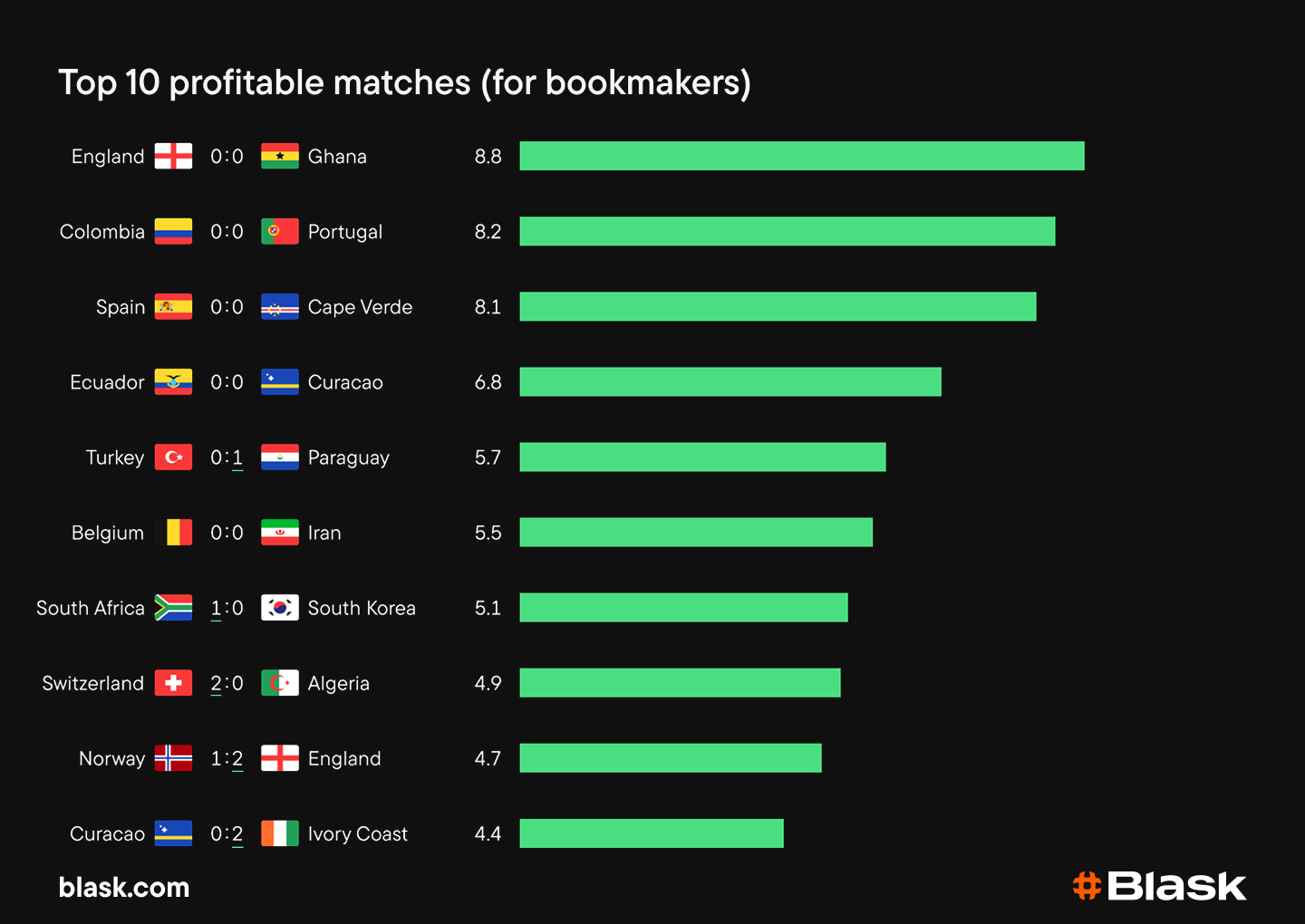
Surprisingly, 8 of the 10 most profitable matches also landed inside the group stage: 4 in Round 2, 3 in Round 3, and 1 in the opening round. The most bookmaker-friendly match in the whole tournament was England–Ghana in the second round of the groups, as it ended in a goalless draw.
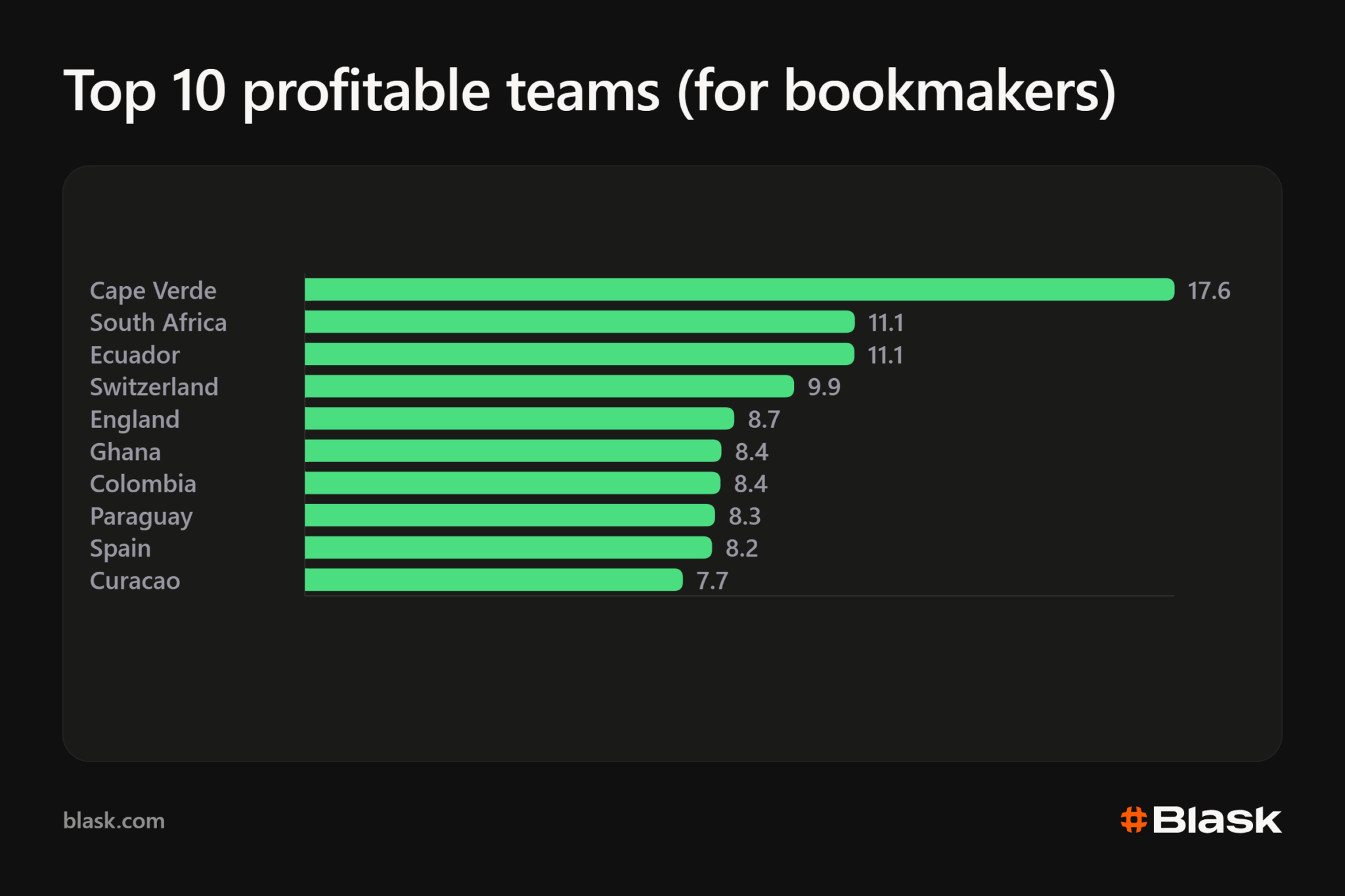
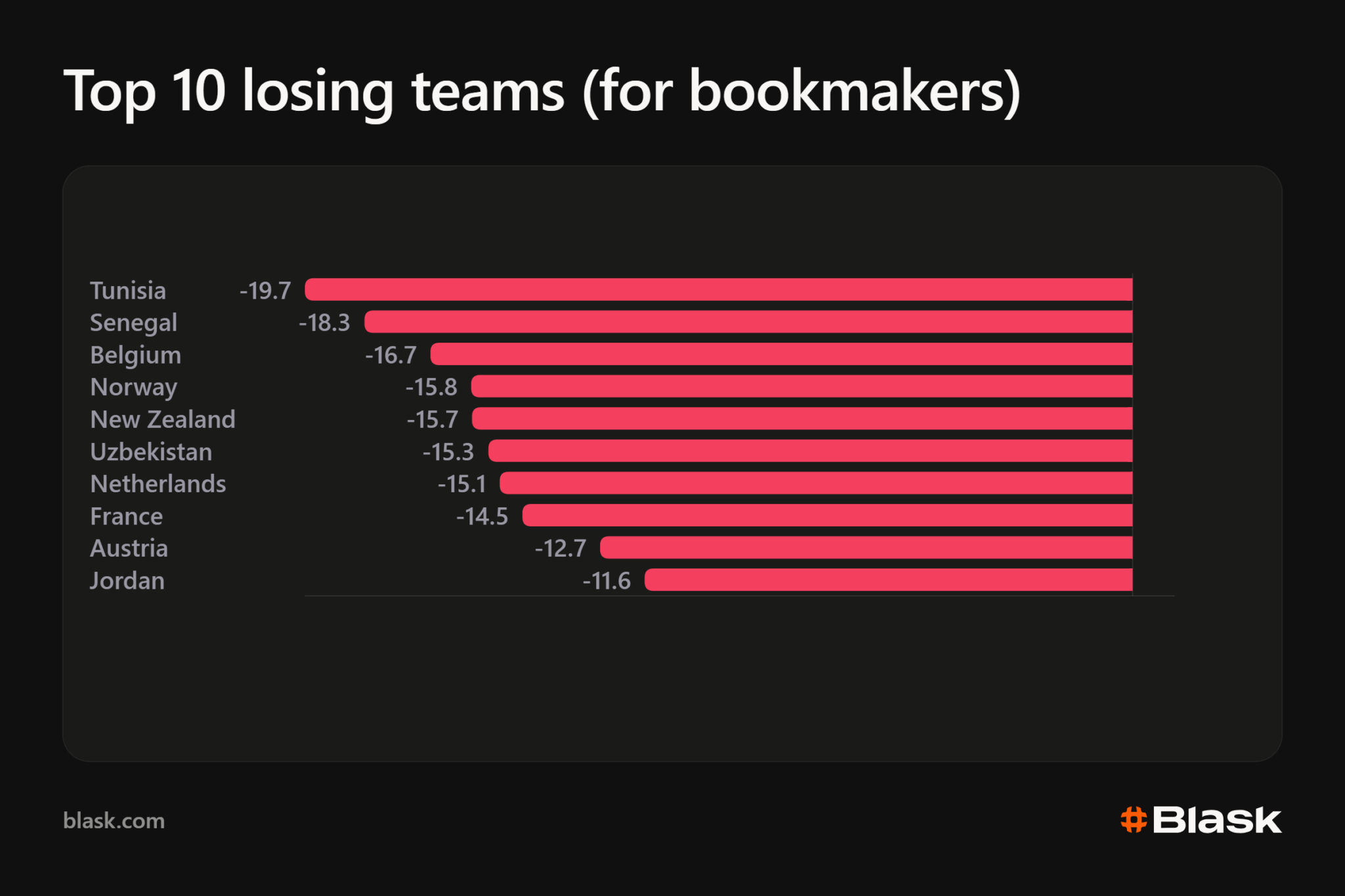
Both England and Ghana are among the only 20 countries whose teams produced profitable matches overall. They occupy 5th and 6th places respectively. England is also the most bookmaker-friendly team in terms of pre-match betting, considering that only 11 of 48 participants produced a positive score there.
The most unprofitable team in pre-match betting was Tunisia, which also produced the worst score overall.
The goals market behind the losses
Bets before the start of the matches were the most unprofitable for bookmakers, as they were responsible for −45 points of the overall profitability index of −56.9. The main losses for betting operators came from goals, as the Total over 2.5 pre-match market contributed −38.3 points to the overall index score.
That is the direct effect of the record-high goals-per-match ratio of 2.96 in the tournament. In total, there were 308 goals, with 8 of them scored in extra time. So, the goals-per-match ratio for regulation time was actually 2.88, with 52.88% of the matches delivering punters’ favourite Total over 2.5 goals result.
The ratio is still the highest among all World Cups in the 21st century, but the share of player-friendly total-goals matches is second highest after the 2014 tournament. Notably, all five other World Cups this century had fewer than half of their matches ending with 3 or more goals scored in regulation.
Among 55 matches ending with over 2.5 goals in regulation, only 6 were profitable for bookmakers overall. The highest overall score (+1.9) was delivered by the Switzerland–Canada group Round 3 match.
“Almost every big win for the bookmakers came with no late goal after the 75th minute and no comeback from a losing favourite. Both are in-play markets, so around three-quarters of the book’s best results came from live betting”.
Gennady Shevtsov
iGaming Market Analyst, Blask
Bottom line
For iGaming operators, a big international tournament like World Cup is above all a chance to bring in casual punters, and, where possible, to cross-sell them to a casino. Making money on the football itself is a bonus on top — and in 2026 they missed it, let down by the high scoring and the expanded format.
Halloween is still 10 days away, but the casino lobby is already in costume. And not all of the costumes are pumpkins. Blask analysts looked at Halloween slots and the darker titles gaining ground beside them: vampires, witches, demons. The snapshot is from October 12. 1. The season’s most visible title is vampire themed The […]
Two weeks of the decree gave back the gains made after 2022, and left the earlier boom in place. In Brazil, Blask Index rose about 30 times from January 2020 to the April 2026 peak. The licensed book under that climb is young: federal fixed-odds authorisations went live on 1 January 2025, under Law 14.790 […]
Brazil’s ban closed the same market for every licensed brand, but for most of them that market was the whole company. President Lula’s Provisional Measure 1,394 stopped new deposits and bets on 25 September, took licensed sites offline on 6 October and ends every federal licence on 25 October. Blask has estimated that the first […]