
- Updated:
- Published:
CAC by market: what operators actually pay to acquire a player in UK, Brazil, Germany and beyond

iGaming CAC by market is not one number. A single GEO cell that ignores channel mix, product mix, and brand position is how budget models fail — affiliate CPA is not blended CAC, and paid auction cost is not blended CAC either.
This piece separates those three layers for the UK, Brazil and Germany, then adds the Blask layer: at the same media budget, CAC falls where the brand already holds organic / leaderboard strength. Paid buys conversion on known demand; cold entry buys awareness from zero.
What CAC by market actually means
Three numbers get mixed in planning decks. Keep them apart.
| Metric | What it counts | What it does not count |
|---|---|---|
| Blended CAC | Total acquisition spend ÷ qualified FTDs (paid + affiliate CPA + brand + SEO amortised + bonuses attributed to acquisition) | A partner rate card |
| Paid / marginal CAC | Incremental cost of the next FTD from auctions and paid social | Organic or affiliate volume |
| Affiliate CPA (per qualified FTD) | Contract price paid to a partner for a qualified first-time depositor | Media, brand, CRM, and failed traffic cost |
Blended CAC formula:
| Blended CAC = (Paid media + Affiliate CPA payouts + Brand / sponsorship attributed to acquisition + SEO / content amortised + Acquisition bonuses) / Qualified FTDs |
|---|
Operators confuse partner CPA with their own CAC because the affiliate invoice is clean and the rest of the funnel is not. Auction waste, KYC drop-off, and brand spend push blended CAC above the partner rate card even when the CPA line looks cheap.
The table below is a structural pressure map from public regulatory and association facts, not a proprietary rate card. Use it to set planning assumptions, then stress-test against your own ledger.
Benchmark bands: UK, Brazil, Germany
| Market | Blended CAC pressure | Paid / auction pressure | Affiliate / partner channel | What drives it |
|---|---|---|---|---|
| UK | High Tier-1 | High: licensed media shrinking while unlicensed spend grows | Still a core channel; CPA is not full CAC | Brand density, high LTV, compliance load on licensed media |
| Germany | High Tier-1 | High on scarce inventory (daypart + creative limits) | Tighter than open markets; revenue-share partner deals constrained | GGL channel limits under GlüStV 2021 |
| Brazil | Lower in USD terms; rising in local competition | Rising with post-reg land grab | Affiliate-heavy acquisition; operators liable for partner ads | Lei 14.790/2023 regulates fixed-odds betting + SPA advertising chain |
Why the UK sits at the top of the board
UK acquisition is expensive because the market is mature, LTV supports higher bids, and licensed operators compete in a crowded brand set.
Regulated ad budgets are under pressure: BGC/WARC project licensed gambling advertising spend falling 9.2% to about £1.05B in 2025–26, while unlicensed spend rises about 32% to about £845M.
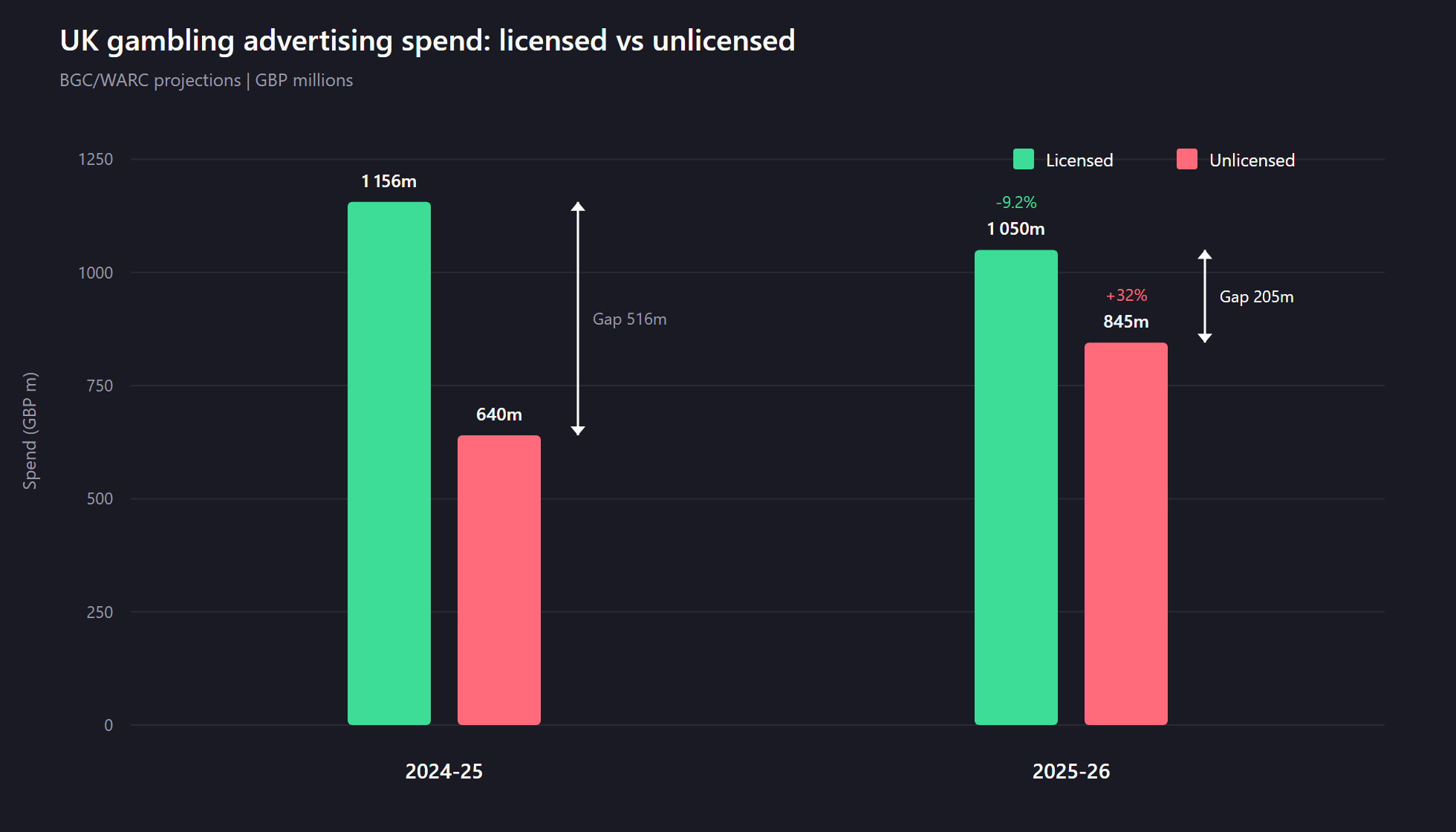
UK gambling advertising spend: licensed vs unlicensed
That squeeze does not lower auction CAC for licensed brands. It pushes spend into fewer measurable channels and raises the price of the remaining inventory.
Public operators still manage acquisition against LTV, not vanity volume. On Flutter’s Q1 2026 results call, management framed prediction-market and sportsbook investment around CAC-to-LTV returns and cited about $40M of Q1 Predicts test spend under that discipline.
Tax also resets the payback math. Rank Group’s trading update notes the Remote Gaming Duty rose to 40% from 1 April 2026 and the choice to protect performance marketing while cutting above-the-line spend.
Why Germany is expensive with less media room
German CAC is high even when media options look scarce. Under GlüStV 2021, the GGL blocks advertising for virtual slots, online poker and online casino on broadcast and the internet between 06:00 and 21:00, restricts sports-betting ads around live events, and bans sports-betting ads featuring active athletes.
Less open inventory means more competition for what remains. Affiliate economics are tighter than in open markets: under the Interstate Treaty framework, revenue-share style affiliate remuneration faces additional constraints.
Why Brazil’s nominal CAC looks cheaper (and still rises)
Brazil’s acquisition cost in USD terms sits below Tier-1 EU. That does not make Brazil cheap growth. Scale, sports-led demand, and a post-2025 licensing race pull partners and media into a land-grab. Lei 14.790/2023 put fixed-odds betting under federal rules. SPA authorization requires an outorga of R$30 million for up to three brands over five years.
By July 2026 the Ministry of Finance reported 85 authorized operators, and new portarias widened advertising duties across the whole promotion chain, with operators jointly responsible for affiliate publicity. Lower nominal CAC still has to clear tax, licensing, and rising qualified-FTD prices as the market consolidates.
Beyond the big three
The same logic travels.
- Netherlands. Untargeted mass-market gambling ads have been banned since 1 July 2023 under KSA rules. Acquisition weight shifts toward SEO, CRM, and audited affiliate/content paths.
- Ontario / US states. AGCO Standard 2.05 blocks public advertising of inducements, bonuses and credits (site and consented direct only). State markets add auction and sponsorship inflation on top. Brand and affiliate quality replace bonus-led CPA.
- Nordics. Mature regulated pools, strong local incumbents, and limited cold-entry headroom. Expect blended CAC pressure closer to Germany than to Brazil.
Organic strength changes the CAC you should expect
Competitive density and organic position set implied CAC pressure before the bid wallet opens. That is the Blask layer on top of public cost constraints.
In July 2026, BAP (Brand’s Accumulated Power) showed three different competitive shapes. The UK top five is fragmented. Brazil has one clear leader and a long chase pack. Germany concentrates demand in two offshore brands, with Tipico leading the licensed row.
CEB (Competitive Earning Baseline, or projected revenue) is the revenue a brand or market should capture given demand and competitive context. Lead with the average; the range is the scenario band.
| Market | Shape | Market CEB avg (min–max) |
|---|---|---|
| UK | Fragmented top five (Bet365 leads) | $989M ($707M–$1.83B) |
| Brazil | One clear leader (Betano), then Bet365 and a long chase pack | $1.08B ($798M–$1.91B) |
| Germany | Offshore-heavy demand; Tipico leads licensed search | $240M ($153M–$501M) |
Licence split explains Germany’s acquisition puzzle:
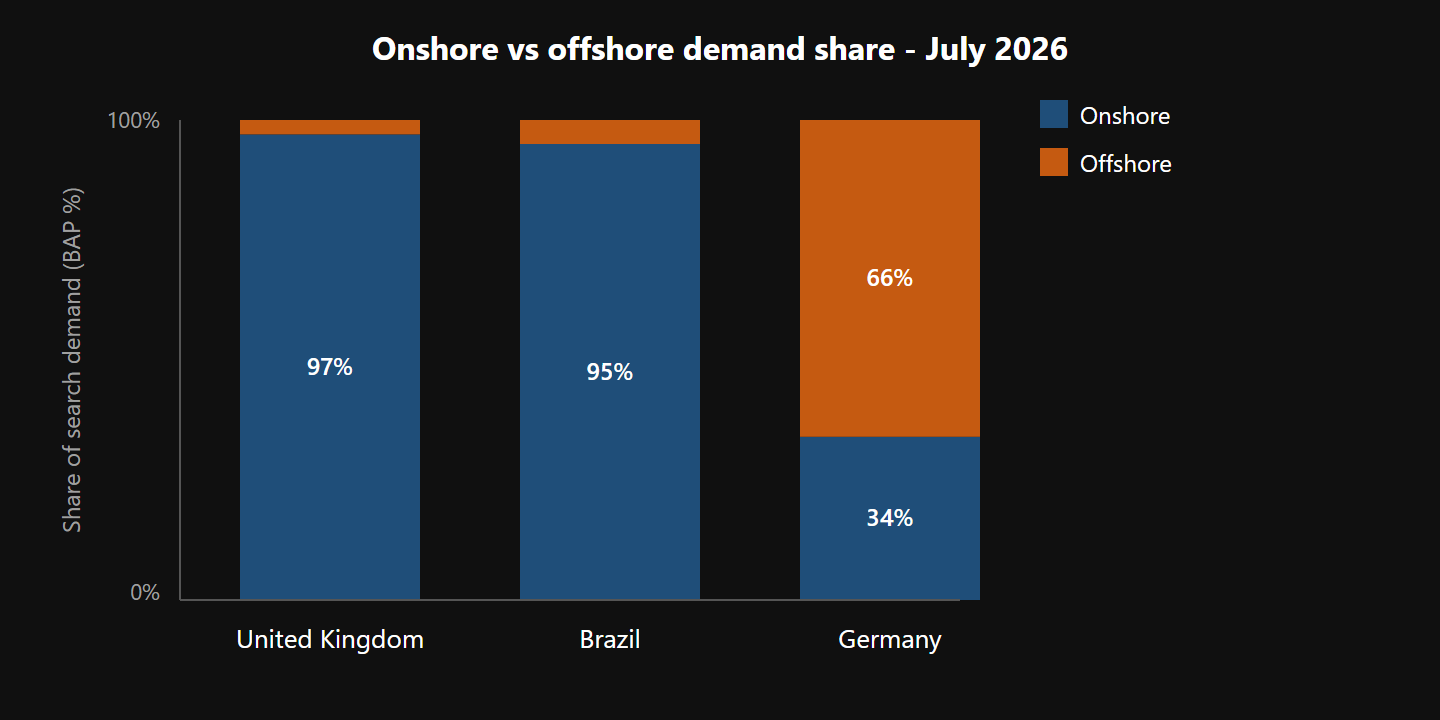
Onshore vs offshore demand share in UK, Brazil and Germany, July 2026
UK and Brazil search demand is almost entirely onshore. Germany is inverted.
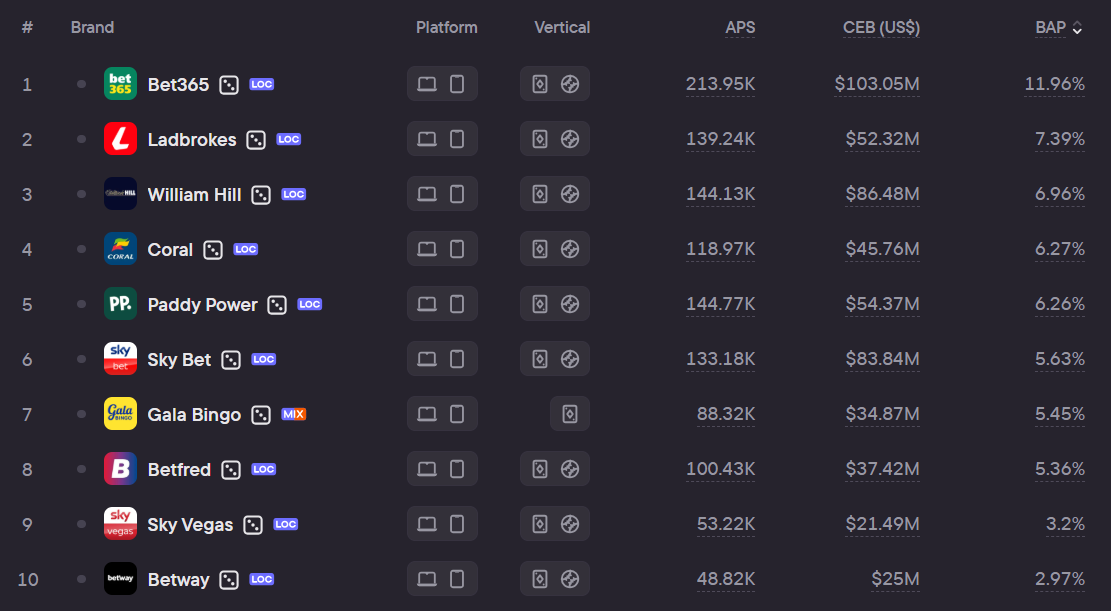
Top 10 brands in the UK by BAP, July 2026
The UK top 10 by BAP are all locally licensed.
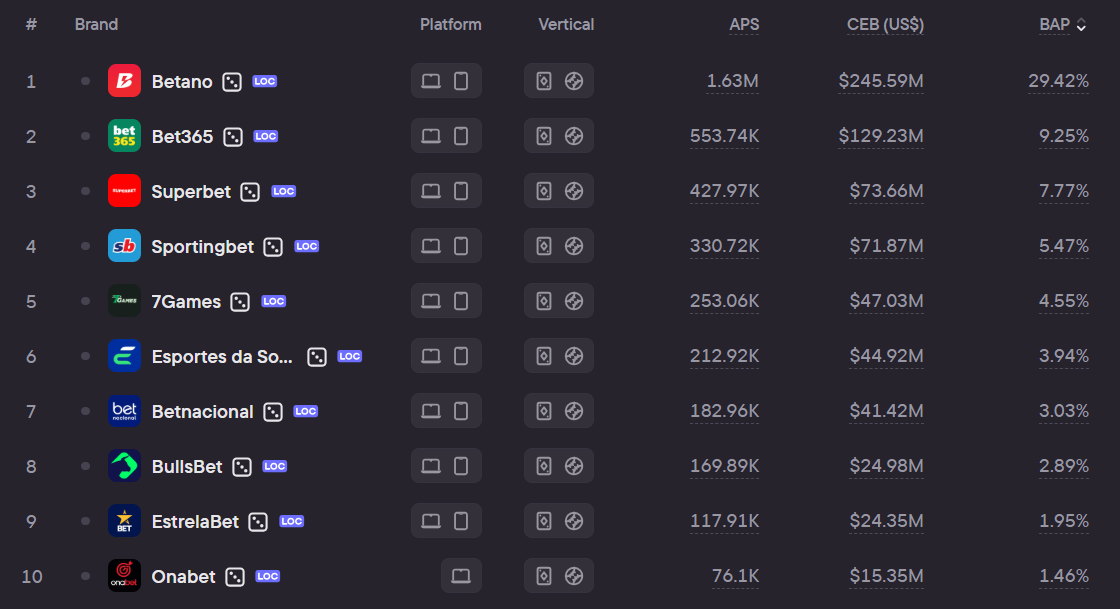
Top 10 brands in Brazil by BAP, July 2026
Brazil’s top tier is the same: every brand holds a local licence.
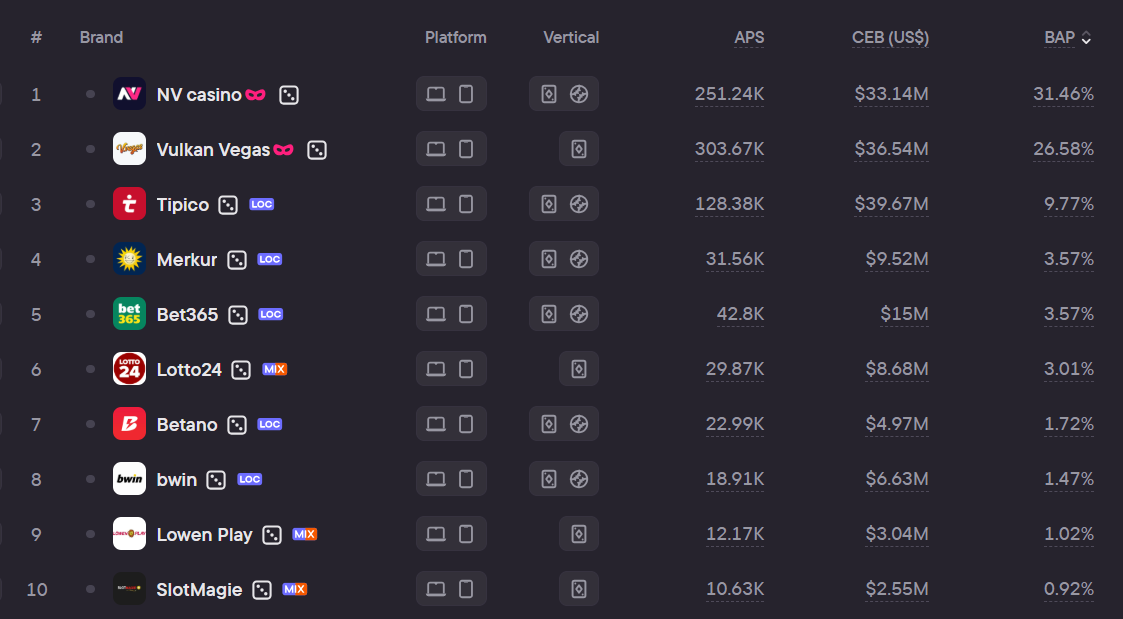
Top 10 brands in Germany by BAP, July 2026
First and second place in Germany are offshore brands.
A licensed German operator bidding into paid channels is not buying the same attention pool the Blask leaderboard shows. Cold licensed entry fights restricted media and an offshore demand overhang. That pushes paid CAC toward the top of the German pressure band even when “the market” looks concentrated.
Cases: leaderboard brands buy conversion, not awareness
Alberta / Bet365. Alberta’s regulated iGaming market launched on 13 July 2026. Blask data for that month already places Bet365 in the provincial top five, behind Stake, PlayAlberta and Sports Interaction. Paid there amplifies known demand. A brand with no local search footprint pays cold-entry rates for the same media.
Alberta top brands by BAP, July 2026
Sweden / NV Casino. NV Casino sits in Sweden’s top five behind ATG and Svenska Spel, and is the clear offshore name in that tier. Converting that demand into licensed marketing channels puts paid CAC nearer the floor of the Nordic band than a newcomer building recognition from zero.
Sweden top brands by BAP, July 2026
Brazil / Betano. Betano’s lead in Brazilian BAP is organic gravity. At a fixed media budget, its paid CAC sits toward the lower edge of the Brazil band; a cold entrant buying the same keywords sits toward the top. Same auction. Different conversion tax.
| Rule of thumb: cold-entry CAC tracks the upper edge of the market pressure band. Brand-in-leaderboard CAC tracks the lower edge. Media budget alone does not decide which edge you hit. |
|---|
Sports vs casino mix (why CPA differs on the same GEO)
Category demand shows why sportsbook and casino acquisition prices diverge inside one country:
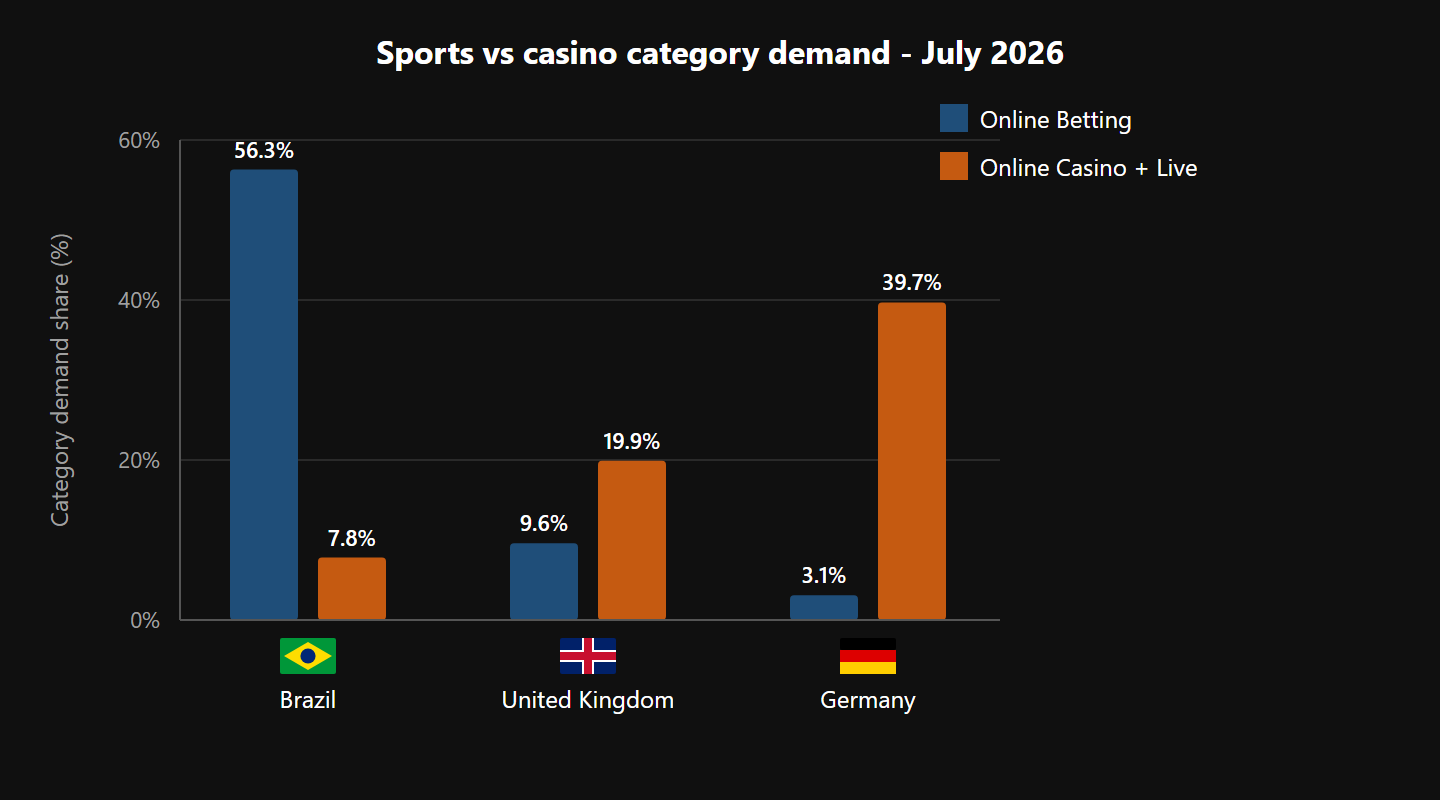
Sports vs casino category demand, July 2026
Casino LTV can justify higher CPA. Sports LTV is often thinner and more seasonal. Mixing those bands in one GEO CAC cell breaks the budget model.
How to use these bands in a budget model
The bands only work if the model keeps channels and products apart. The steps below are a GEO sheet build order — not a strategy brief.
1. Split channels and products on the sheet
A workable GEO row has three layers:
| Layer | What to model | Common mistake |
|---|---|---|
| Channel | Blended CAC, paid marginal CAC, affiliate CPA as separate lines | Pasting affiliate CPA into the blended cell |
| Product | Sportsbook and casino as separate bands on the same GEO | One GEO CAC cell for both products |
| Organic rank | Floor / mid / ceiling of the pressure band, set by BAP position | Same band for cold entry and leaderboard brands |
Start with blended CAC, then split sportsbook vs casino. Affiliate CPA does not belong in the blended cell.
2. Adjust the band for organic rank
Organic rank is the adjustment factor on top of the market band.
- Outside local top 10 by BAP: the paid pressure band sits near the top (cold-entry conversion tax).
- Top-5 demand holder: the floor of the band — the gap vs a cold entrant is retention capital.
3. Set an LTV:CAC floor before scaling
LTV:CAC still needs a floor before the plan clears finance.
Operators that disclose acquisition discipline stress-test payback rather than chase volume. A common planning stress test is about 3:1 lifetime contribution to blended CAC. Treat it as an internal hurdle, not a published industry statistic.
- Shorter-payback markets: can run tighter than 3:1.
- High-churn casino cohorts: need more headroom above the floor.
4. Check monetisation before adding FTDs
Monetisation comes before more FTDs.
When CEB shows under-earning at a normal APS level, the leak is conversion or value, not volume. More CAC into that funnel raises losses with better precision.
5. Rebuild the model on regulation shocks
Regulation shocks move the band faster than creative tests.
Ad bans, tax changes, and inducement rules are reasons to rebuild the model when the rulebook moves, not when the dashboard turns red. A regulatory event is a band reset, not a performance dip.
Checklist: before locking next quarter’s GEO budget
Use the list as a pre-flight on the sheet:
- Blended CAC, paid marginal CAC, and affiliate CPA are three separate lines.
- Sportsbook and casino have separate bands on the same GEO.
- Organic rank / BAP sets whether the plan uses floor, mid, or ceiling of the pressure band.
- LTV:CAC floor set (internal stress test).
- CEB vs actual earnings checked before scaling paid.
- Licence reality checked (Germany-style offshore demand overhang included).
Bottom line
iGaming CAC by market is a band shaped by channel mix, product mix, and organic rank, not a single CPA from an affiliate deck. Organic position and CEB on the target GEO show which side of the band a brand is funding. Cold entry and leaderboard entry do not share a CAC.
If you want to reduce your CAC, book a demo. Blask will help you.