- Updated:
- Published:
Brazil’s betting ban cost licensed operators about R$1.35 billion in 10 days
Brazil’s betting ban cost licensed operators about R$1.35 billion (roughly $270 million) in gross gaming revenue between September 25 and October 5, according to Blask’s estimate. On September 25, Provisional Measure 1.394 barred new deposits and bets.
At the pre-ban pace, every further week without licensed betting adds roughly R$0.8 billion, about $160 million, to that total.
How Blask estimated what Brazil’s betting ban cost
Blask started from the official gross gaming revenue (GGR) of licensed operators in the first half of 2026: R$20.07 billion, about 15% above the first half of 2025. It projected that pace forward from September 25, when new deposits and bets stopped.
Brazil has little seasonality compared with other markets, and the licensed market was growing every month before the decree. The projection includes an adjustment for that growth. Only licensed brands are counted.
💡 Key point: at the pre-ban pace, each week of a closed licensed market costs roughly R$0.8 billion, about $160 million.
The timeline that sets the final bill
Four dates determine how large the total becomes:
- September 25: new deposits and bets barred
- October 6: licensed sites go offline
- Around October 25: licences end
- Within 120 days: Congress must approve the measure or it lapses, and the vote can slip into February 2027
The market standing idle is not a small one
Brazil was the largest iGaming market in the world by demand in the first half of 2026. Blask Index is a real-time measure of market demand volume for iGaming brands in a given country, based on normalized search data, and Blask Index put Brazil at 1.41 billion, 15% of the global total across the countries Blask tracks. The Philippines followed well behind at 879.6 million.
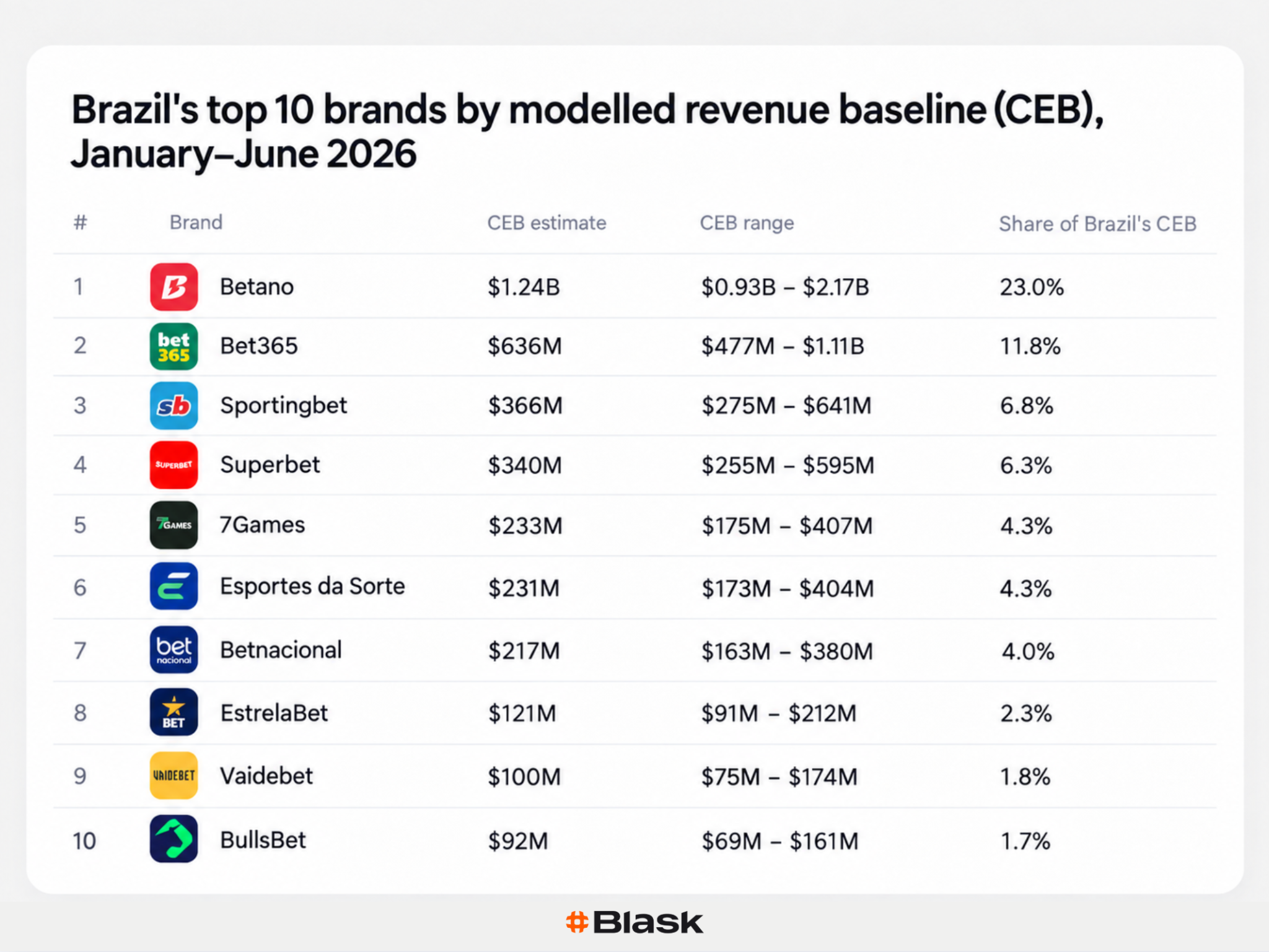
On revenue, Blask uses the Competitive Earning Baseline (CEB), a modelled revenue benchmark built from brand strength and competitive position. It is not operator-reported GGR. By CEB, Brazil ranked fourth in the world in the same period.
| Measure, first half of 2026 | Brazil |
|---|---|
| Blask Index | 1.41 billion, 15% of the global total |
| Philippines, for comparison | 879.6 million |
| CEB (min–avg–max) | $4.0B – $5.4B – $9.6B |
| Share of CEB held by ten licensed brands | 66% |
| Share of CEB held by Betano | 23% |
The money is not visibly moving to unlicensed sites
In Blask’s behavioral panel, reach to unlicensed sites stayed within 11% of normal on every day of the first week. Licensed reach fell 74% below normal by October 1.
Most legal bettors have stopped for now. The panel detail is in our piece on licensed betting sites in Brazil.
What it means for the state
The ban also removes a tax base. Federal betting tax was $1.8 billion in 2025. The 85 licences cost $456 million in total and are extinguished with no refund. The government’s own estimate of lost revenue to 2028 is $2.4 billion. These figures come from public sources, cited in the full report.
📚 Read more: Brazil’s betting ban: a lost market for some, a lost business for most
The loss accumulates each week the market stays closed. The detailed data, methodology and sources are in Blask’s report on Brazil’s betting ban.