
From the day Brazil banned licensed bets, 25 September, to 11 October, Blask Index (search demand for iGaming brands) for the country fell 81%.
💡 Key point: the 81% drop is total branded search demand in Brazil — not a single operator — in the first two weeks after Provisional Measure 1.394.
The drop sat on the onshore side. Search for brands with a Brazilian license went from 94.8% of the market on 25 September to 70.7% on 11 October. Offshore demand rose 6% over those same days.
Blask’s October 2026 report Brazil’s betting ban: what India’s 2025 ban shows is the closest measure of where players go next. The pages that still rank for licensed bets in Brazil describe last year’s roster.
What the measure closed
President Lula published Provisional Measure 1.394 on 25 September 2026. It bans the offer, intermediation and advertising of fixed-odds betting, including sports and online casino, from the day of publication. New deposits stopped the same day.
Licensed sites had to go dark on 6 October. Every federal authorization ends on 25 October, 30 days after publication, with no refund of the fee operators paid for the permit. Congress has 120 days to convert the measure into law or let it drop.
Stake showed how thin a legal exception was. On 8 October the 9th Federal Civil Court in São Paulo granted a preliminary injunction that let Stake operate until 25 October, with a ban on new promotions. The brand had asked to run until 2029 and lost that request.
On 9 October the president of the Regional Federal Court of the 3rd Region suspended the order on an AGU appeal: one licensee could not sit outside a national shutdown. The window lasted less than a day. The same 25 October date still ends every license, Stake’s included, unless Congress or the Supreme Court changes the measure.
Who held licensed demand
Before the decree, Brazil was a licensed book with a long tail. Blask data for January–September 2026 puts the country’s CEB (Competitive Earning Baseline, the projected revenue a market should support at current demand) at $7.83B ($5.81B–$13.88B range). Licensed brands held 96.8% of that baseline.
498 brands showed measurable demand from 1 January to 24 September 2026. A place on the official roster and a share of that interest were different things.
BAP (Brand’s Accumulated Power, a brand’s share of search interest in the geo) for 1 January–24 September shows how narrow the live market was. Betano held more than the next three licensed brands combined. The top four held 51.4% of that interest; the top ten, 69.3%.
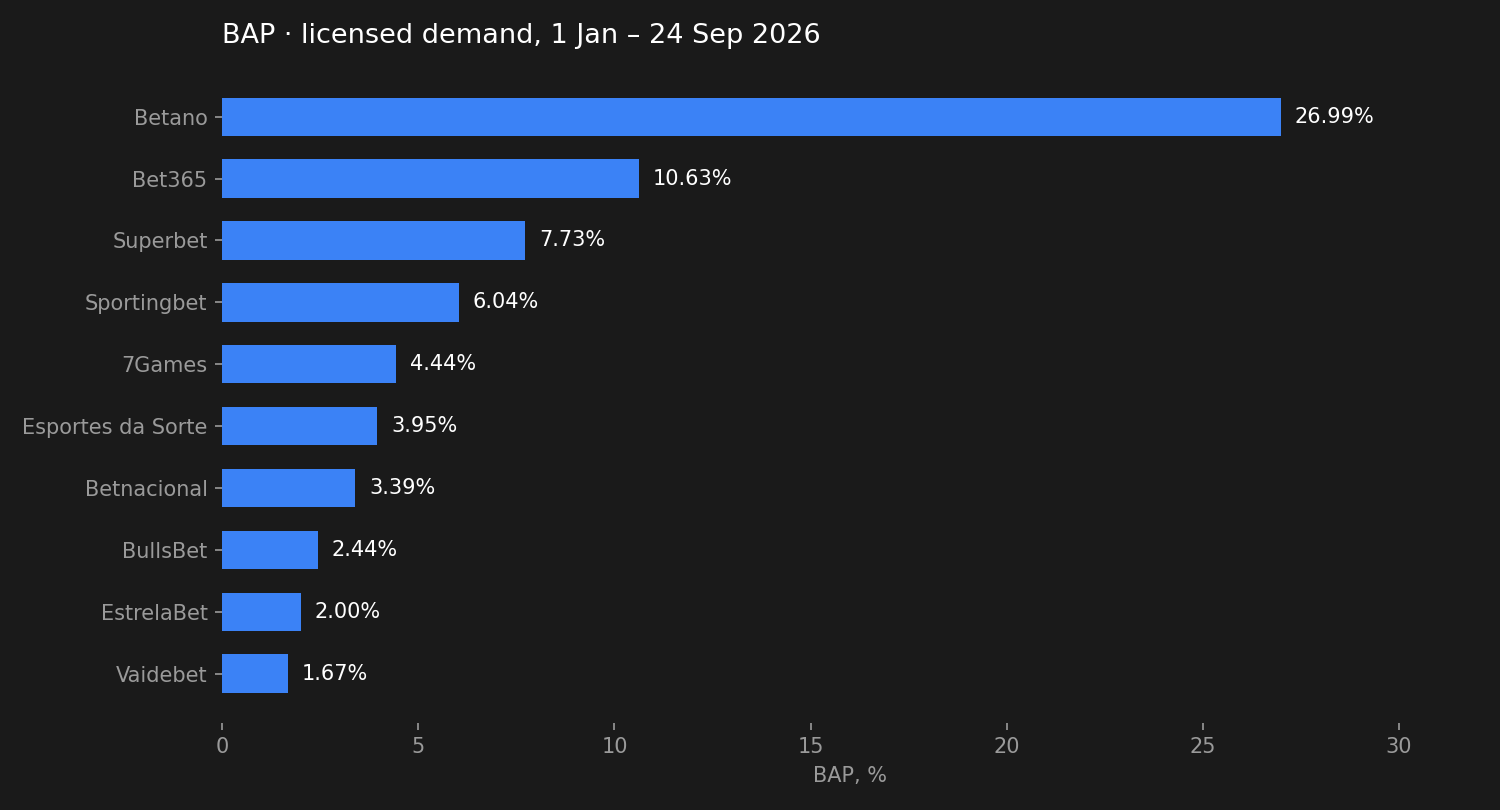
Most authorized names never held a point of that chart. The list that still circulates for licensed bets in Brazil recorded who was allowed to take a deposit. It did not record who players were looking for.
📚 Read more: Brazil iGaming market H1 2026: brands & trends
What search did after 25 September
From 1–24 September to 28 September–11 October, daily onshore Index in the Brazilian book fell 85%. Unlicensed Index rose 8% over the same days. Its share of search moved from 3.9% to 23% on a much smaller total.
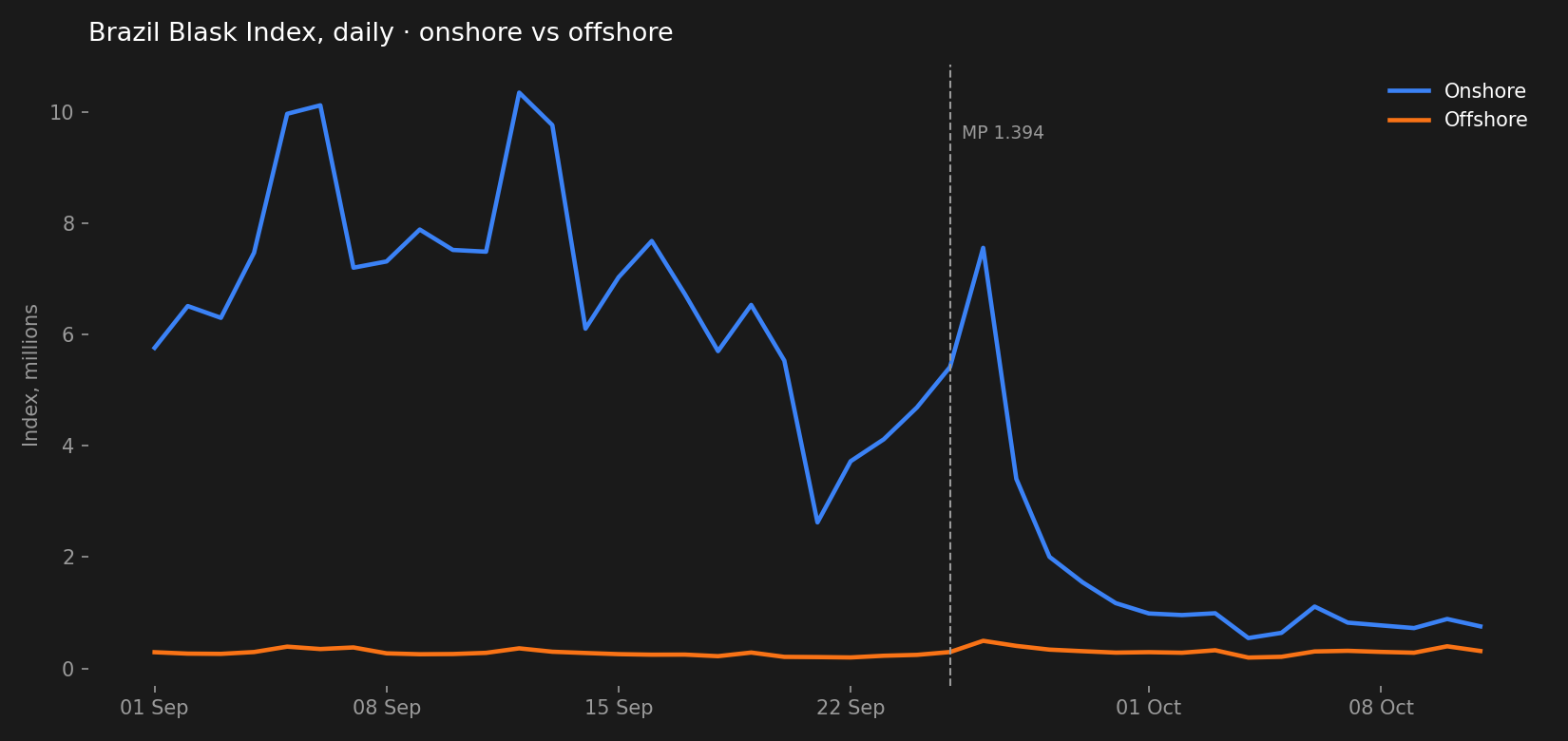
The same report recorded licensed-site visits 74% below normal by 1 October. Three months after India closed domestic real-money sites in August 2025, 63% of those players were still betting, almost all of them offshore — about 21.6 million of Brazil’s 25.2 million licensed bettors at that rate.
In India, branded queries understated the leftover market: domestic reach fell 73% within three months while offshore reach held level, as players moved to mirrors, pop-unders and saved links. 57% of Brazilian bettors in the panel had already visited an unlicensed site in the 90 days before 25 September.
📚 Read more: India’s betting ban: 63% kept betting offshore
Offshore brands that moved
Inside the almost-flat offshore line, a few brands moved.
- 1win more than quadrupled daily Index after 25 September and became the largest offshore name in the post-ban window. Panel traffic in that study reached it through numbered mirror domains that do not carry the brand.
- Melbet rose 324% from a smaller base.
- Bingo Em Casa more than tripled and is now the third-largest offshore book by post-ban search.
- Brabet, the largest offshore book in the first 24 days of September, fell 33%.
Licensed leaders dropped together
The licensed leaders did not shuffle: they dropped in a pack. Betano, Bet365, Superbet and Sportingbet each lost 87–90% of daily demand. Blaze lost 64%, the mildest fall among the large licensed brands.
📚 Read more: Blask Index Brazil: licensed betting demand fell from 5.4M to under 1M in a week
What publishers still rank
Blask Affiliates ranks brands by how many publisher sites in Brazil still carry them. That count is occupancy, so it does not measure who players search for. The two lists diverged after the shutdown.
Licensed names are coming off recommendation pages as operators go dark and publishers refresh. Betano and Sportingbet each lost about half their placements in sixteen days. 22bet, an offshore book, held its footprint on both dates. Parimatch added a site.
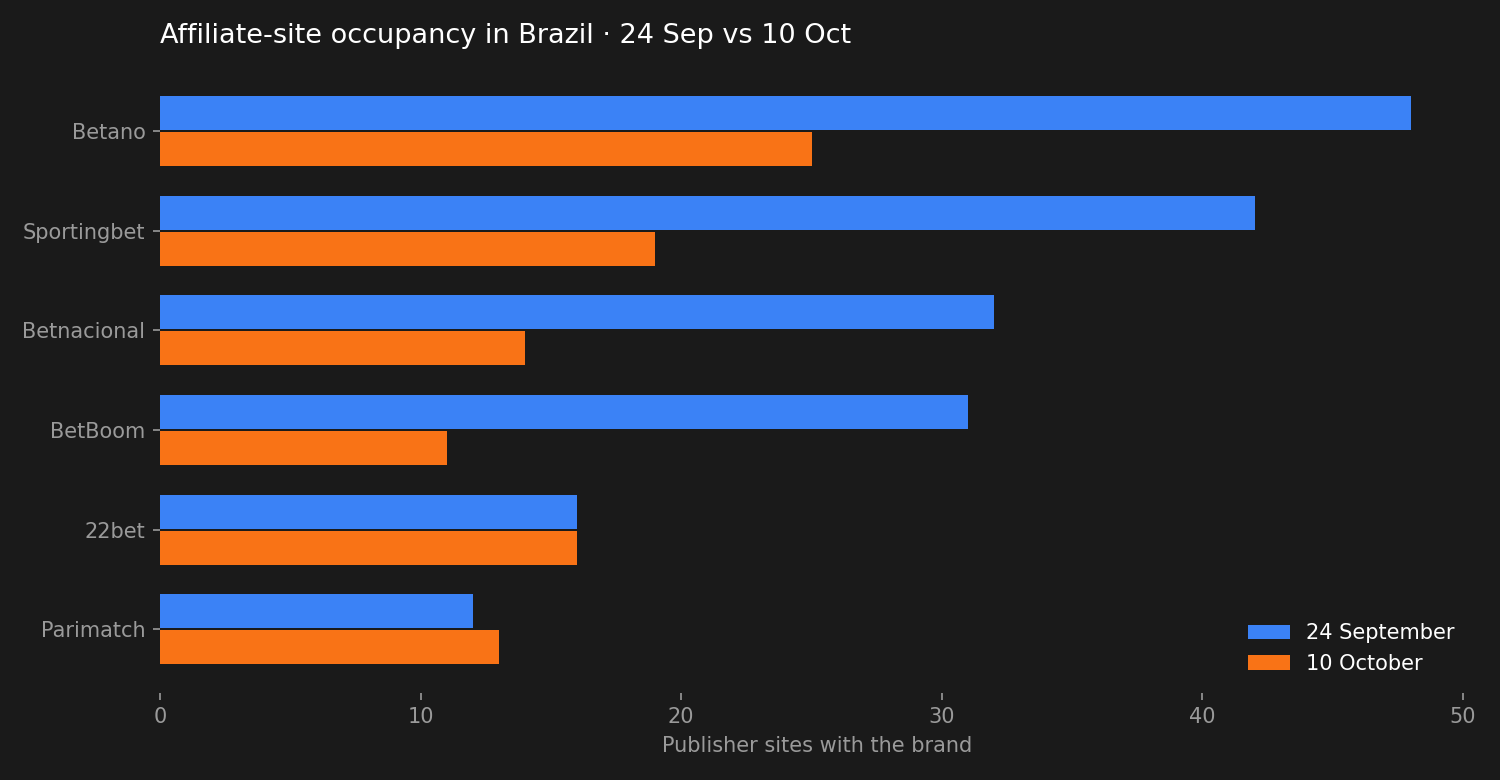
The publisher side of the same feed still looks like a pre-ban catalog. One slots directory dropped from 369 brands on page in September to 221 after the decree and still hosts a list. Occupancy moves slower than search.
That lag is why Google can keep ranking pages for licensed bets in Brazil whose names no longer take a deposit.
Bottom line
The official roster outlived the market that ten brands actually held: onshore search is gone, offshore search has not taken the volume, and 1win is the name that moved.
Whether 25 October ends the licenses or Congress rewrites the measure, the next reading is the same two lines — licensed Index, and whether offshore volume starts to follow it.