- Updated:
- Published:
Italy iGaming seasonality: the autumn engine, the summer hollow, and the weekend pulse

Italy’s iGaming demand follows the football calendar with mechanical precision — every peak, trough, and weekly rhythm maps to a recognizable fixture trigger.
Italy’s online wagering market follows a rhythm — one that can be traced back to the country’s sporting heartbeat. And in Italy, that heartbeat is football, by a wide margin the dominant driver of betting activity.
To turn that rhythm into a timing advantage, you need to know exactly when peaks build, when troughs repeat, and how demand behaves inside the week.
The year in review — a U-recovery into an autumn surge
From February to June 2025, Italian Blask Index softened by roughly 7%, forming a clear spring trough. From there, the market reversed course: a steady recovery through late summer accelerated into autumn, lifting the Trend line by more than 35% from the seasonal low to its winter peak before stabilizing into early 2026. The overall shape is a classic U-recovery that transitions into an autumn staircase.
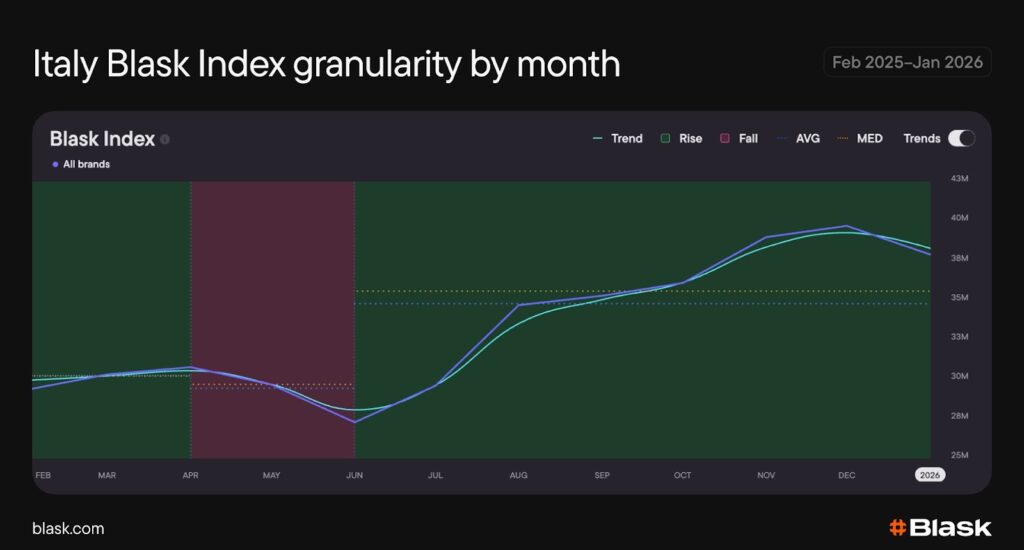
This pattern mirrors the restart of the football calendar: domestic leagues return in late August, European competitions layer in from September, and winter concentrates high-stakes fixtures that sustain elevated attention.
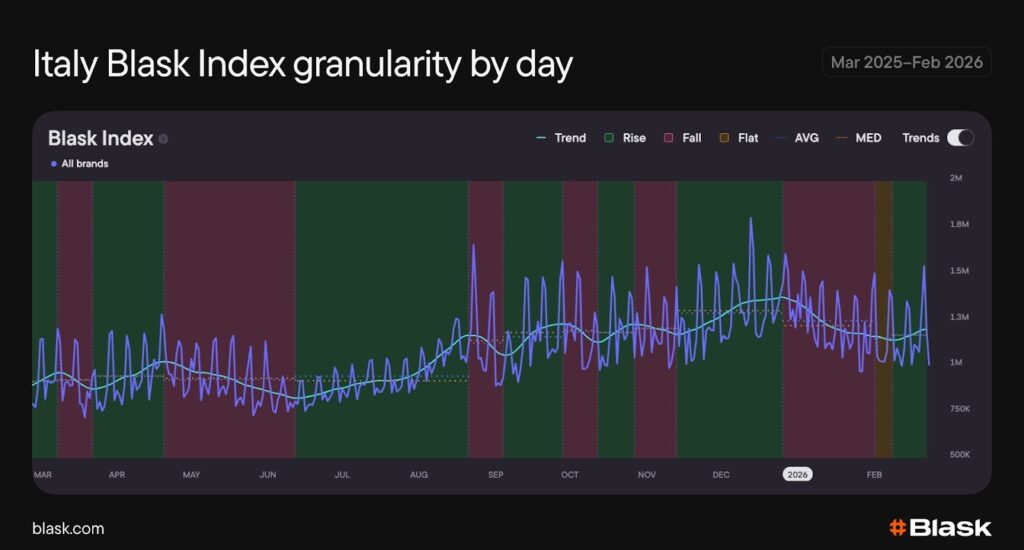
Across the year, the strongest spikes cluster in late summer and early winter with two dates standing out:
- August 23, 2025 — the opening round of Serie A. After the summer lull, postponed demand meets the return of domestic football. The result is a sharp reactivation spike driven by accumulated anticipation and heavy media coverage around the season restart.
- December 13, 2025 — Matchday 15 of Serie A, landing deep inside the high-intensity winter corridor. Mid-season positioning, title-race narratives and dense fixture cycles amplify attention. The date also coincides with Festa di Santa Lucia, a regional public celebration that extends leisure time in parts of the country, marginally reinforcing weekend activity.
On a daily basis, the strongest surges consistently fall on weekend matchdays, especially Saturdays. That pattern suggests liquidity is driven less by macro events alone and more by match density within each week.
Peaks and troughs — why autumn runs hottest
Italy’s peak demand sits firmly between September and December, and the structure behind it is mechanical rather than coincidental.
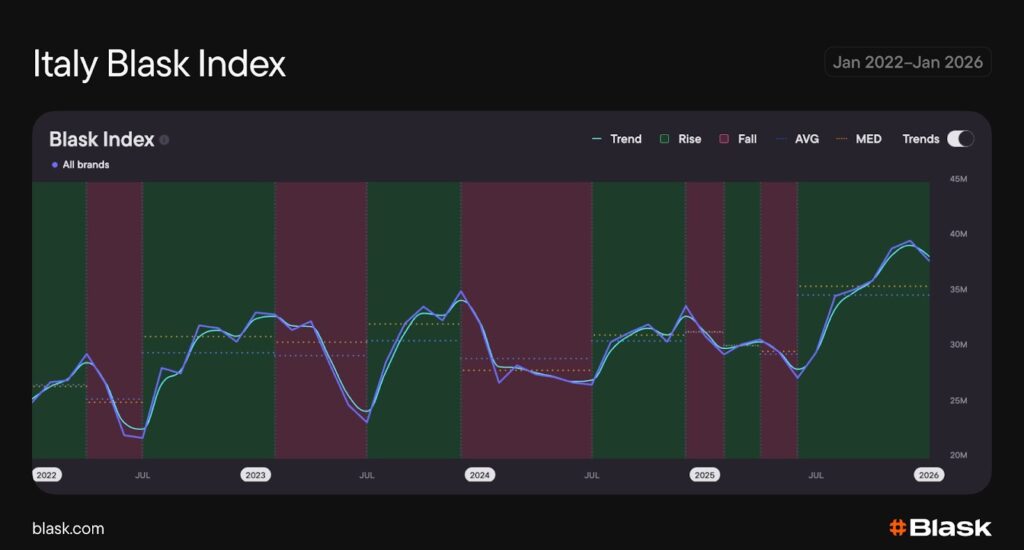
The core driver is club football density. The domestic championship runs from late summer through late spring, and by early autumn the match calendar reaches full cadence: weekly league rounds, Coppa Italia fixtures, and European competitions layered on top. While Serie A is still in its early narrative phase in September and October, continental tournaments intensify quickly — with Champions League, Europa League, and Conference League group stages building toward qualification for the knockout rounds. That “race for Europe” dynamic creates meaningful midweek volatility long before the domestic title race matures.
Add to this the autumn international windows — typically scheduled across September, October, and November — and the result is a sustained high-attention corridor. Domestic weekends, European midweeks, and national-team fixtures stack rather than substitute each other, producing a multi-layered demand cycle that reliably peaks before the winter break.
The Summer Dip — a structural lull, not a demand collapse
Italy’s most repeatable trough sits between June and early August.
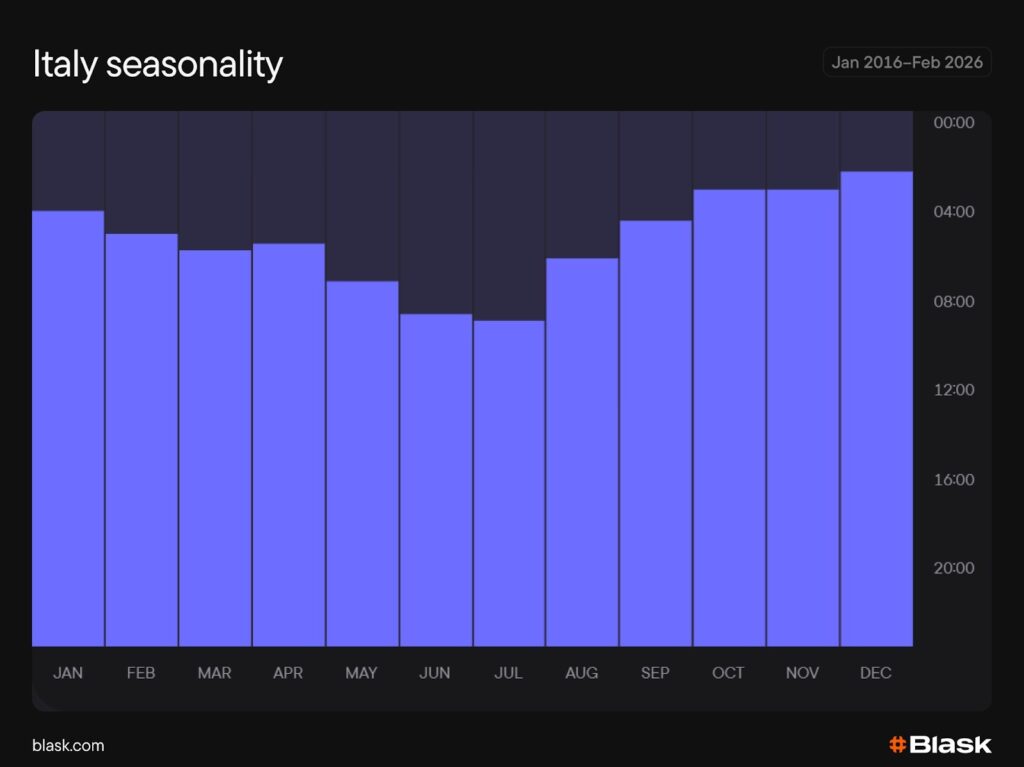
The cause for this is simple: Serie A is off-season, European competitions are finished, and only friendlies remain. With the core betting product absent, liquidity naturally softens.
Culturally, the timing amplifies the effect. Italy’s summer period is dominated by vacations and outdoor leisure patterns, shifting consumer attention away from digital entertainment and sports viewing.
Summer consistently functions as a lower-intensity phase in the annual cycle: engagement softens while the football calendar is paused, then rebuilds as competitive fixtures return.
Inside the week and the clock — where liquidity really lives
On a weekly basis, Italy shows a football-anchored structure — but the pattern is more nuanced than a simple “weekend spike” story.
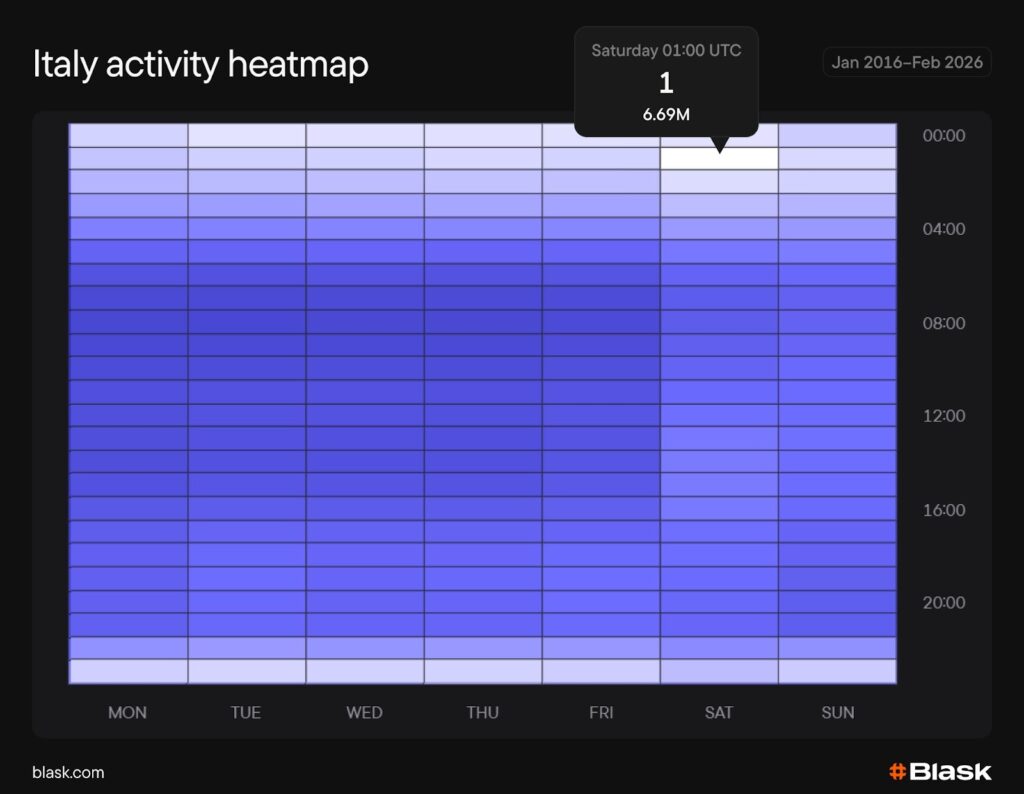
Saturday remains the most consistently elevated day, with activity building through Friday evening and carrying into Sunday. The strongest single slot of the week sits overnight from Friday into Saturday — a classic high-liquidity window when pre-weekend anticipation, live fixtures, and extended leisure time overlap.
What makes Italy structurally interesting, however, is the hourly symmetry. Across most days of the week activity clusters around the same evening time band. Rather than sharp isolated peaks, the heatmap shows repeated daily surges concentrated in late-evening local time. That repetition suggests a habit loop: users return at consistent hours regardless of weekday, with sports schedules amplifying — not solely creating — the demand.
This is also where interpretation requires nuance. While football clearly acts as the primary catalyst, the Blask Index measures total gambling attention — including both sports betting and casino activity. Midweek European fixtures (typically Tuesday and Wednesday evenings) lift engagement, but the persistence of evening peaks across non-match days indicates broader digital entertainment behavior layered on top of sports-driven cycles.
Bottom line
Italy’s iGaming demand is cyclical, but not random. Every peak and trough maps to a recognizable football trigger — a Serie A kickoff, a Champions League matchday cluster, or national football fixtures.
That predictability is the real takeaway. Blask data confirms the pattern holds year after year: a spring dip, a summer hollow, an autumn engine, and a winter plateau. The shape may flex slightly, but the structure doesn’t break.