
- Updated:
- Published:
T20 World Cup 2026 iGaming effect: the peak came early

You’d expect the biggest spike in betting activity to come at the climax of a major cricket tournament — the semi-finals, the final, the trophy moment. The ICC Men’s T20 World Cup 2026, held across India and Sri Lanka from February 7 to March 8, broke that pattern. Blask Index data shows that iGaming activity in key markets peaked during the group stage and faded toward the playoffs — even in the country that won the title.
The tournament brought together 20 teams over a full month of cricket, co-hosted by India and Sri Lanka — two markets where cricket drives massive betting volumes year-round. With heavyweights like Australia crashing out early and underdogs like Zimbabwe making noise, the tournament delivered no shortage of storylines. But for iGaming, the most interesting story was in the betting activity patterns.
Three markets, one pattern
We tracked Blask Index across every major cricket market for the duration of the tournament. The pattern that emerged was consistent: activity surged in the opening weeks, then declined through the knockout rounds, regardless of how far each country’s team progressed.
Here’s what happened in the three markets where the signal was clearest.
India
India’s Blask Index was flat through most of December and January. Once the tournament kicked off on February 7, demand began climbing sharply. The peak came around mid-February — right when the group stage delivered its biggest fixtures, including India’s 61-run demolition of Pakistan on February 15.
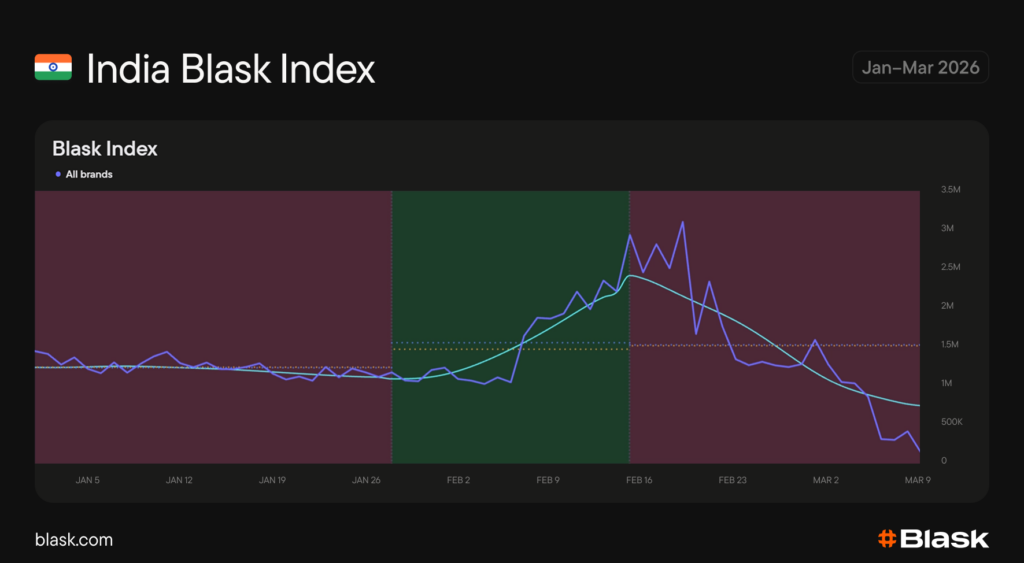
From there, the decline was steady and steep. By the time India reached the semi-finals in early March, the index had already fallen back to where it started. And on March 8, when India lifted the trophy after a dominant 96-run win over New Zealand in Ahmedabad, it was well below even that.
Sri Lanka
Sri Lanka, as co-host, followed a similar arc — just at a smaller scale. Blask Index was quiet through December and early January, then started climbing as the tournament approached. The peak came around mid-February, coinciding with the early rounds hosted on Sri Lankan venues.
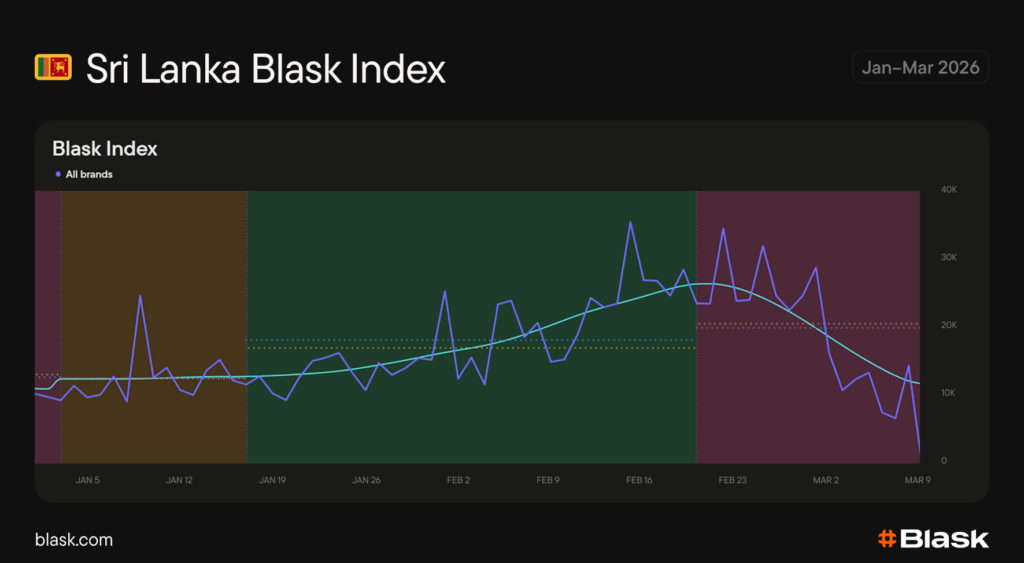
The decline set in as Sri Lanka’s own team faded from contention. By the Super 8 stage, Blask Index was already trending down. By early March, it remained above pre-tournament levels, but well off the peak. The co-host effect gave Sri Lanka a boost, but it didn’t sustain once the team’s run ended and marquee matches shifted to Indian venues.
Australia
Australia’s chart stands out from the other two. Blask Index was essentially flat through December and January. Then, in early-to-mid February, it spiked dramatically — a sharper jump than anything India or Sri Lanka showed in relative terms.
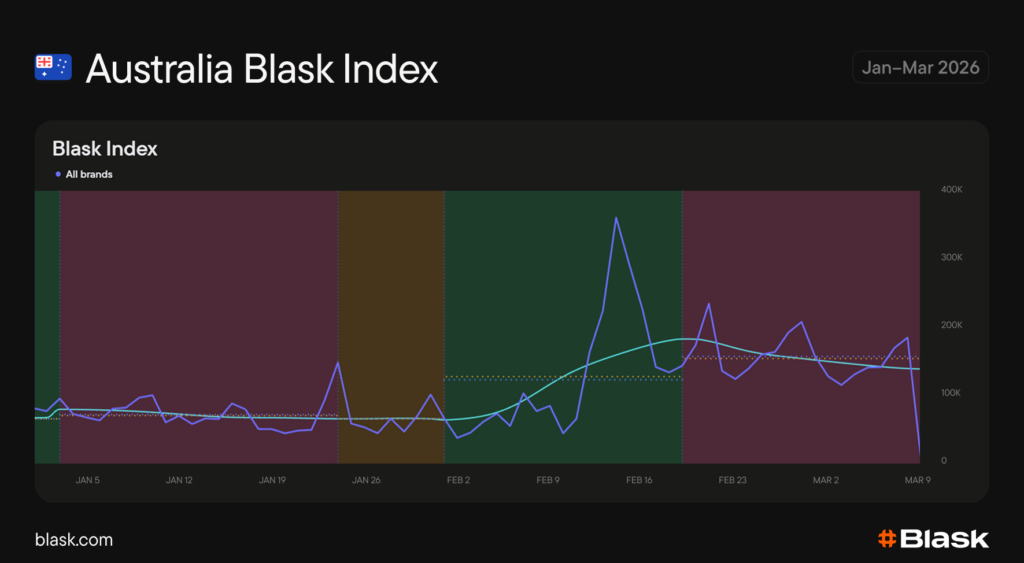
The timing lines up not with Australian victories, but with Australia’s collapse. Zimbabwe beat Australia by 23 runs on February 13, and Sri Lanka followed up with an 8-wicket win on February 16 — effectively knocking Australia out at the group stage. The surge in iGaming activity coincided with the shock and drama of the defending semi-finalists going home early.
After the spike, demand settled into a gradual decline but remained well above its pre-tournament baseline through late February. Australia’s case is the clearest example of a negative storyline — not a winning run — driving iGaming activity.
Cricket nations without iGaming spikes
Not every cricket-mad country reacted to the tournament in Blask Index terms. We looked at New Zealand, Pakistan, and South Africa — all nations with strong cricketing traditions and teams that were actively involved in the tournament — and found no meaningful spikes in iGaming activity.
New Zealand made it all the way to the final. Pakistan featured in the tournament’s most-watched group stage fixture against India. South Africa reached the semi-finals and delivered one of the tournament’s wildest moments — a double Super Over win against Afghanistan. Yet none of these storylines translated into visible movement in iGaming demand in those markets.
Bottom line: the attention window
The most striking pattern across all three markets is the same: iGaming activity peaked in the first two weeks of the tournament and declined from there. Not gradually — steadily and clearly, even as the stakes on the pitch got higher.
That’s counterintuitive. You’d assume the semi-finals and the final would be the peak — the biggest matches, the most eyeballs, the most money in play. But the data points to a different dynamic: the start of a major tournament brings a wave of casual attention and novelty that fades faster than the tournament itself runs.
And that’s probably the key issue. The T20 World Cup lasted 30 days. The iGaming attention cycle, based on what Blask Index showed, lasted roughly half of that. By the time the knockout rounds began, the broad-market surge was already over — what remained was the core audience that would have been there regardless.