
- Updated:
- Published:
What is gamification in iGaming
Acquisition buys the first deposit, and retention pays for it. With FTD costs often at $280–$1,400 and a common payback target of LTV ≈ 3x CAC, as cited by iGaming Business, and best-in-class gamified operators at 30–40% day-30 retention versus 15–25% average, as benchmarked by Xtremepush, gamification in iGaming — missions, seasons, status, and reward economies on real-money play — rebuilds return behaviour when catalogues look alike and larger matches stop working.
What is gamification in iGaming?
| Gamification in iGaming applies game-design systems — progression, goals, feedback, status, variable rewards — around wagering so play becomes a continuous journey, not isolated bets. It is a product and CRM layer that turns deposits, bets, and logins into structured loops. |
BidCanvas notes that ~55% of players leave within a year when engagement depends on delayed CRM, while unified real-time stacks push toward higher retention. Smartico guidance cited flags 60% first-24h dropout risk for weak onboarding and CAC often $800+.
| Layer | What it is | What it is not |
| Gamification | Meta-systems over days and seasons | A one-off free-spin drop |
| Core product | Slots, live, sportsbook, poker | The engagement shell |
| Outcome | Habit, status, measurable LTV | Vanity badges with no economy |
Three pillars separate serious programmes from cosmetic ones:
- Progression (XP, levels, seasons).
- Goals (missions, tournaments).
- Feedback (instant rewards, shop unlocks).
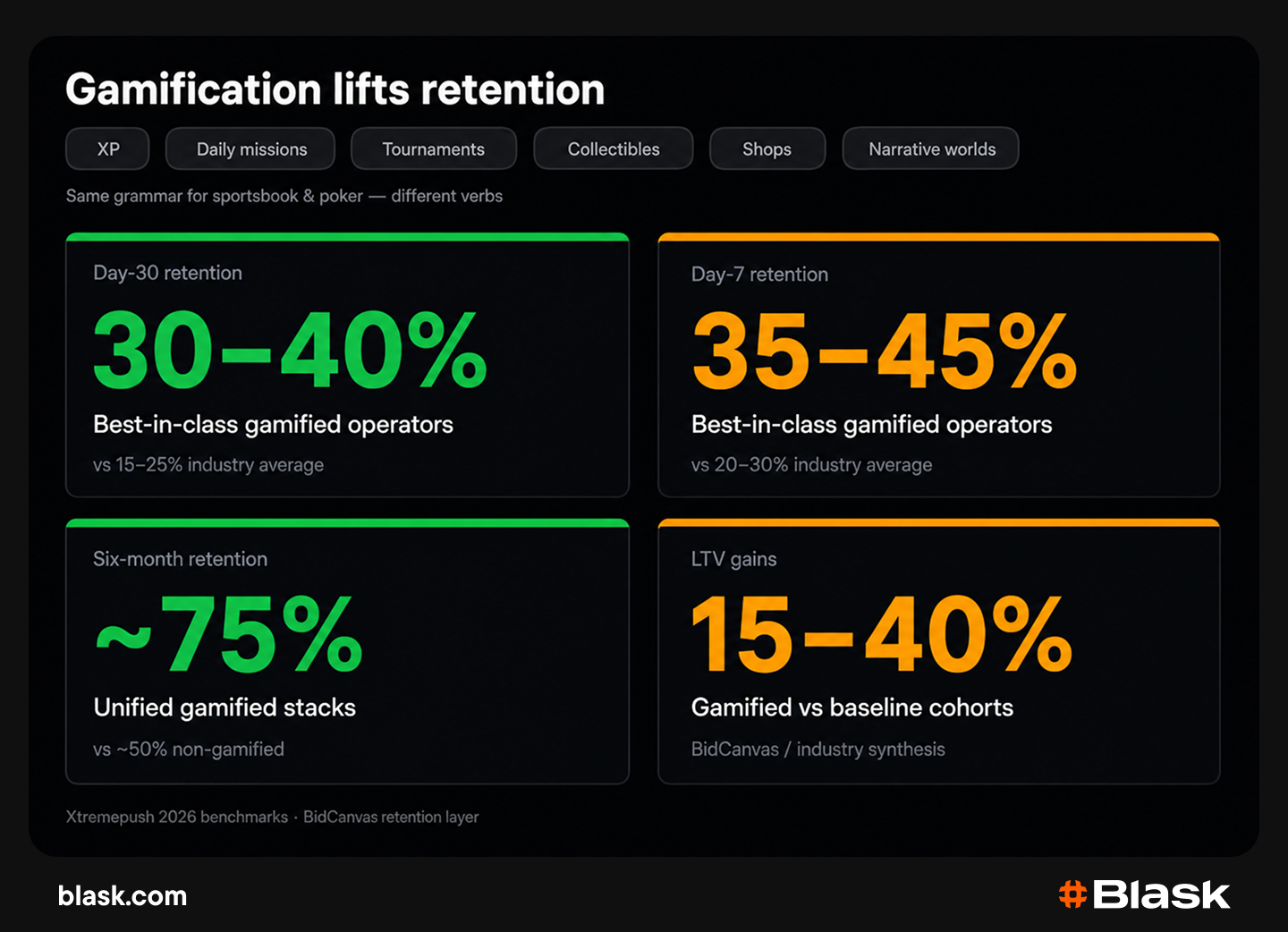
Online casino gamification covers XP, daily missions, tournaments, collectibles, shops, and narrative worlds. Sportsbook and poker use the same grammar with different verbs. Xtremepush puts best-in-class D30 at 30–40% vs 15–25% average and Day-7 at 35–45% vs 20–30%. BidCanvas cites ~75% vs ~50% six-month retention and 15–40% LTV gains.
Gamification vs standard casino features
Catalogue, bonus engine, and gamification layer must stay separate. Catalogue is supply; bonuses are price/conversion; gamification is habit and status.
| Dimension | Standard feature | Gamification |
| Primary job | Entertainment or promo incentive | Long-term engagement |
| Time horizon | Session or campaign | Weeks, seasons, lifetime |
| Feedback | Win/loss, odds | XP, missions, ranks, collections |
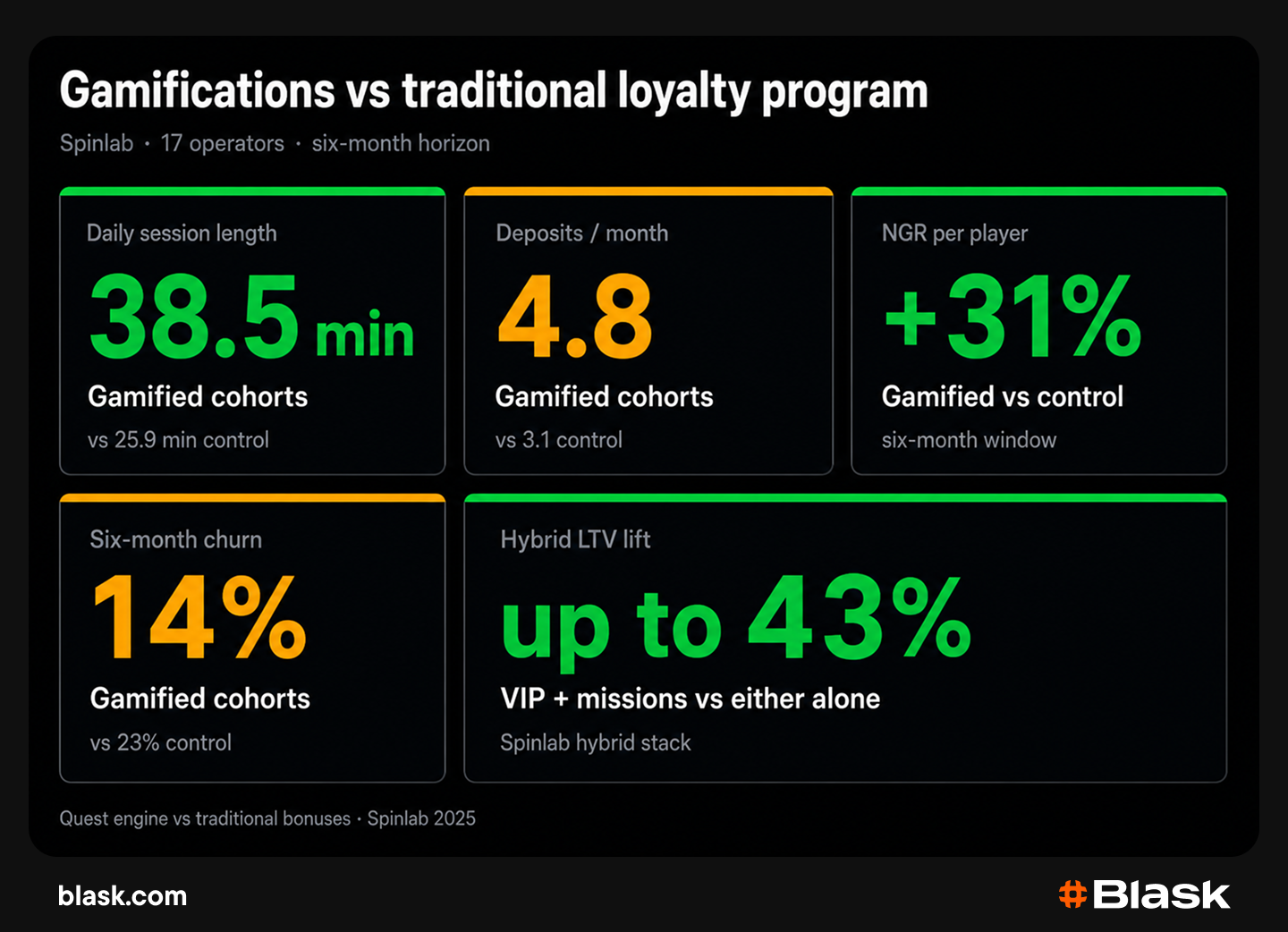
A free-spin drop is a reward. A mission that awards those spins after three deposit days is a system. Spinlab compared 17 operators over six months: gamified cohorts 38.5 vs 25.9 min daily session, 4.8 vs 3.1 deposits/month, +31% NGR/player, 14% vs 23% six-month churn; hybrids beat either model alone by up to 43% LTV.
H2 data in that piece still shows VIP working (1.4x deposit frequency at Silver, churn 32%→18% with weekly cashback) — but every competitor offers the same ladder. Durable stack: welcome certainty early, missions for mid-term, VIP for whales. Test: if removing the feature leaves only a discount, it is a bonus; if progress between sessions collapses, it is gamification.
Why gamification matters for operators
Four pressures:
- Retention economics.
- Brand sameness.
- First-party data.
- Regulatory limits on bonus intensity.
Online gambling sits near $120–143bn in 2026 depending on source, as Mordor estimates and TBRC projects. Broader gamification software reaches USD 36.46bn in 2026 on Mordor’s cut (25.24% CAGR to USD 112.32bn by 2031), while Fortune Business Insights puts 2026 at USD 46.69bn.
Player retention and lifetime value (LTV)
HBR restates Bain’s finding: a 5% retention lift can mean 25–95% more profit; new customers cost 5–25x more than retained ones.
| Metric | Average iGaming | Best-in-class gamified |
| Day-1 | 40–55% | 45–55% |
| Day-7 | 20–30% | 35–45% |
| Day-30 | 15–25% | 30–40% |
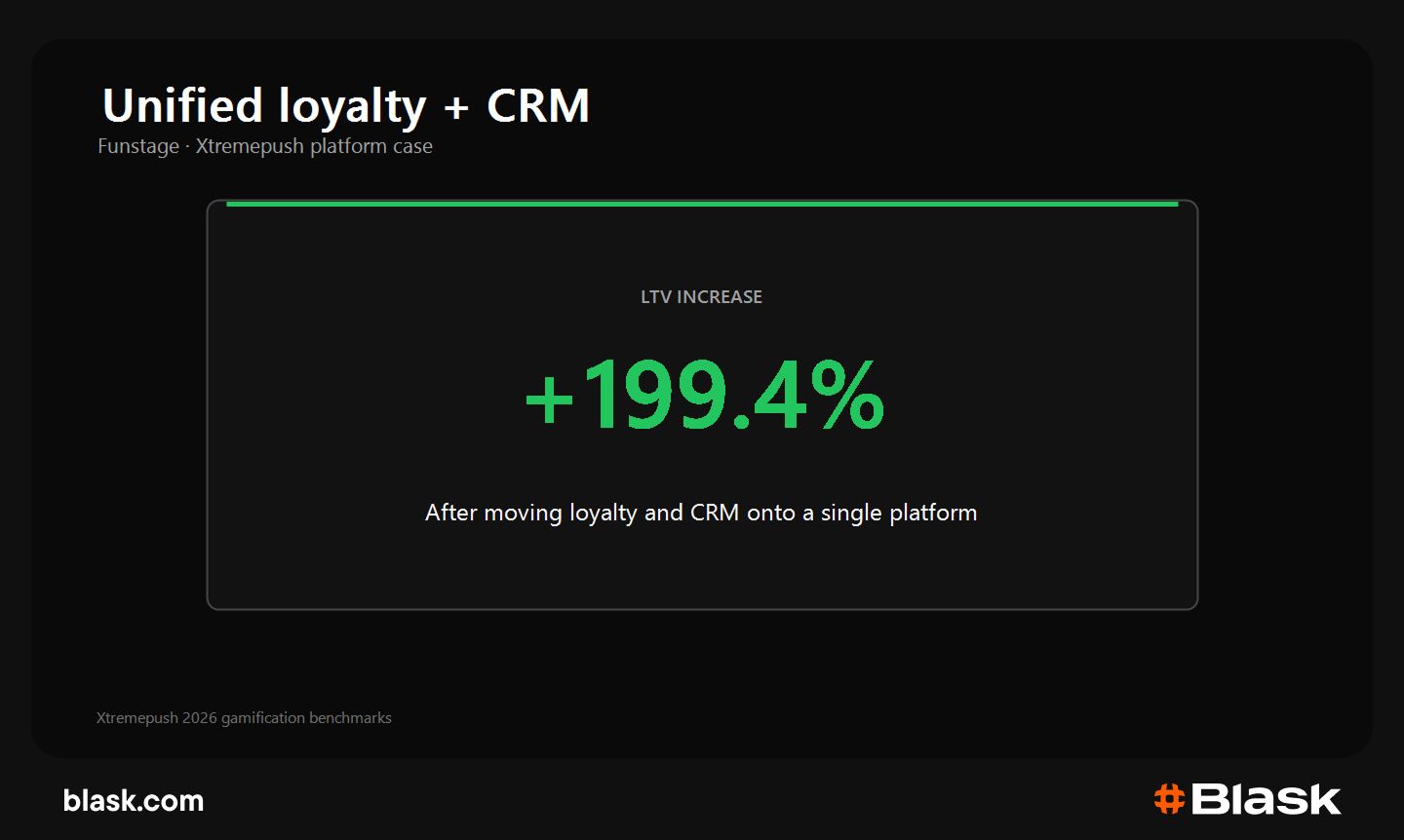
Xtremepush frames that ladder for 2026. Funstage’s 199.4% LTV after unifying loyalty+CRM is an upper bound. Soft2Bet plans around LTV ≈ 3x CAC. On 1,000 FTDs at $400 CAC, 20% D30 leaves 200 survivors; 35% D30 leaves 350 — same media check, 75% more retained base before ARPU moves.
Brand differentiation
Younger audiences expect progress-led apps, as Deloitte 2025 shows via Soft2Bet’s sportsbook coverage. Casino gamification becomes a brand when worlds, currency names, and shops feel owned — Soft2Bet MEGA Builder and ToonieBet’s “game within the game,” as iGaming Business describes. Spinlab Fullhouse moved LTV $310→$433, churn 26%→15%, ECB 18% vs ~24% cited average.
First-party player data and insights
Missions yield signals bonuses miss: completion rates, mechanic preference, abandonment, cross-vertical play. Smartico pairs and Optimove builds AI churn/LTV next to gamified engagement. Optimove×Stake lifted sport net revenue +66% and activation +64%. Unified real-time data separates average from best-in-class D30.
Regulatory-safe engagement
UKGC reforms tighten multi-product marketing, bonus wagering, game speed, and pre-deposit limit prompts, as the Commission announced with the GSGB. Soft progress (XP, status, shop entry) can reduce cash-match arms races while staying inside gambling law. EGBA 2024 reported that 65% of customers used safer-gambling tools (~21m, +14% YoY); deposit limits most common among voluntary users, as GamblingNews covers. Opaque random rewards invite the same scrutiny as loot boxes, as GOV.UK outlines.
Core casino gamification mechanics
Ship a small core loop, then seasonal content. Earn too fast and status dies; too slow and the bar feels broken.
Points, levels, and XP
Convert activity into visible progress. Dual-track works: XP for engagement breadth, VIP for economic value. Spinlab templates a hybrid: onboarding match — season quests — cashback 5–15% by tier. Fast early levels, then slowdown. Silent XP without UI feedback is behaviourally dead.
Missions, quests, and challenges
Workhorse of modern gamification. Best-in-class: 6–10 missions/active/month; average 2–4, as Xtremepush benchmarks. Completion sweet spot 55–65%, as Spinlab calibrates; mid-rollers ($200–$1,000) showed strongest lift.
| Mission type | Example | Use |
| Onboarding | KYC, first deposit, three game types | Day 0–7 |
| Habit | Three-day login; one bet daily | D7–D30 |
| Discovery | New providers / new sport market | Cross-sell |
Segment-aware targeting: sports-first players ignore slot grinders. Block deposit-escalation missions for high-risk accounts.
Tournaments and leaderboards
Create appointment play when rank is perishable. Prefer capped scoring and mid-field prizes over pure turnover races. Nearby rivals beat unreachable whale boards. Real-time scoring matters for churn reduction.
Badges, achievements, and collectibles
Work when scarce and meaningful; fail when every login fires fireworks. Random collectibles need disclosed odds and RG gates — variable rewards elevate dopamine prediction error, as Yu-kai Chou explains and Zack & Clark review. Achievements feed gamification marketing only when product truth matches ad copy.
Loyalty programs and reward shops
Loyalty is the backbone; shops are the sink. Without sinks, points inflate. Stake claims $14bn+ VIP payouts since 2019. Keep ECB under ~25% (Fullhouse 18%), as Spinlab advises. Shop self-serve cuts VIP-desk load.
Storylines, avatars, and worlds
MEGA Chance, Clawee, Builder, MEGA11 turn retention into entertainment, as iGaming Business covers and Soft2Bet details. Seasons need start / mid-point / end value — all reward at the finale invites chase. Lean teams should ship missions+shop before half-built maps. Hosts need one ledger with automated rewards to avoid double-dipping.
Gamification across verticals (casino, sportsbook, poker)
| Vertical | Best fit | Weak if copied blindly |
| Casino | XP, missions, races, collectibles, builders | Sport-only seasons with no daily loop |
| Sportsbook | Between-fixture meta-games, ticket missions | Slot wagering quests for football fans |
| Poker | Tournament ladders, freerolls, format badges | Deposit-streak missions that ignore skill |
MEGA11 exists for the sportsbook valley between fixtures, as iGaming Business explains. Cross-vertical bridge missions raise LTV without raising match %. Measure with vertical-aware diagnostics under shared D30/LTV/ECB rollups.
The psychology behind gamification
Variable rewards and dopamine loops
Variable-ratio schedules produce persistent behaviour; dopamine tracks prediction error and uncertainty, as Yu-kai Chou synthesises and Zack & Clark analyse. Mystery chests engage for the same reason EGMs can harm. Prefer transparent odds, predictable XP plus occasional surprise, and hard RG eligibility on random surfaces. No fake near-miss chrome on meta UI.
Progress, status, and social proof
Competence (filling bar), autonomy (chosen missions/shop), relatedness (leaderboards, seasons). Battle-pass resets broaden mid-tier access, as Power Up Gaming notes. Stake VIP shows status economics at scale. Gamification marketing should report real progression, not invented urgency. Soft-land seasons to avoid post-expiry churn cliffs, as Spinlab warns.
How to implement gamification in your casino
A gamification strategy is a decision document first: cohort, north-star, reward budget, licence rules, holdout.
Step 1: define strategic goals and kpis
One primary job per season.
| Goal | North-star | Support |
| Activate FTDs | D7 / second deposit | Week-1 mission completion |
| Lift mid-tier LTV | 90-day LTV / deposit frequency | ECB, day 60–90 churn |
| Cross-sell | Casino↔sports conversion | Bridge mission completion |
Baseline 90 days of D1/D7/D30, deposit frequency, NGR/active, bonus cost, RG alerts — by segment. Cap ECB ~25%; lock 10–20% FTD holdout. Name owners: Product, CRM, Finance, Compliance, Creative.
Step 2: select gamification software
Require unified CRM data, real-time rewards, geo/RG rules, holdout analytics, content tooling. Confirm wager-to-XP latency, exclusion/limit propagation, and who writes missions after go-live. Vague answers → expect average, not best-in-class, D30, as Xtremepush benchmarks and BidCanvas argues. Case studies (MEGA +65% NGR, Funstage 199.4% LTV, Spinlab +31% NGR/player) are not SLAs. Model ECB under vendor templates; separate platform, creative, and success fees. Optimove’s Smartico deal signals category consolidation, as citybiz reports.
Step 3: segment and personalise
Segment by lifecycle, product preference, value band, risk flags. Sports accounts get ticket missions; casino accounts get discovery; cooling accounts get low-friction reactivation; VIP hosts stay human — no Bronze chests for Platinum. RFM and predicted LTV, as Smartico positions and Optimove compares, prioritise recoverable value. Optimove×Stake shows orchestration ceilings: +66% sport NGR, +64% activation. Begin gamification marketing only after the product loop works.
Step 4: launch, measure, and optimise
Thin slice: onboarding quests + one weekly tournament + small shop of five to ten items. Do not ship a half-built world in month one. Instrument show/start/complete/redeem. Hold out 10–20% of FTDs. Optimise difficulty first (55–65% completion), then reward mix, then prize size. Watch D1/D7/D30, repeat deposits, ECB, RG alerts, as Soft2Bet recommends. Refresh content if completion drops >15% WoW, as Spinlab signals. If LTV moves toward 3x CAC, fund writers for the next season; if not, fix the economy before adding avatars.
Top casino gamification software and providers
| Type | Examples | Focus |
| CRM + gamification | Smartico; Optimove Gamify | Orchestration, AI, uplift |
| Immersive engines | Soft2Bet MEGA / MEGA11 | Worlds, sports meta-games |
| Platform-native quests | Spinlab Quest Engine | Fast launch in full stack |
Soft2Bet MEGA publishes the +65% NGR / +45% ARPU / 4x screen-time pack. Spinlab published the multi-operator quest study and Fullhouse hybrid. Insist on holdouts, RG hooks, and content ops in the contract — casino gamification software executes a gamification strategy; it does not invent one. Pilot on one brand before a multi-brand group rollout.
Real-world gamification examples
Published gamification examples:
- Soft2Bet MEGA / Betinia / ToonieBet (worlds + earn–redeem);
- MEGA11 (sportsbook between fixtures);
- Spinlab Fullhouse ($310–$433 LTV, 26%–15% churn, ECB 18%);
- Stake VIP ($14bn+ stated VIP spend); Sun Bingo wheel (+30% active in two weeks — light promo, not a seasonal architecture); Optimove×Stake CRM lifts.
| Example | Emphasis | Outcome class |
| Soft2Bet MEGA | Worlds + progression | NGR / ARPU / screen time |
| Spinlab Fullhouse | Quests + VIP hybrid | LTV + churn |
| Funstage / Xtremepush | Unified loyalty + CRM | High LTV outlier |
Mid-tier sketch: 18% D30 baseline, CAC $350, $200–$1,000 players, “Provider Tour” missions, 10–20% holdout; if deposits move toward 4.0/month and churn toward 18% at $8–12 reward cost, ECB can stay under 25% — otherwise redesign before scale.
Measuring gamification success: kpis and metrics
Public benchmarks only help when definitions match. Define once: Day-N retention (fixed cohort event — FTD or registration, never mixed), six-month active (state what “active” means), LTV after incentives over a chosen horizon, fully loaded CAC, ECB (reward cost ÷ incremental NGR vs holdout), quest completion (completions ÷ starts or shows), missions per active per month.
| Metric | Misuse | Cleaner use |
| Screen time | Success alone | Pair with NGR + RG alerts |
| Actives | Login missions inflate | Require bet or deposit |
| LTV uplift % | No baseline | Horizon + holdout |
Track retention ladder, monetisation, engagement quality, ECB, calibration (55–65% completion). Weekly scorecard: incremental NGR vs holdout, ECB, D30/90-day retention. Same-week cohorts only — or a football final looks like a product win.
Gamification and responsible gambling
The same loops that raise LTV can raise harm. Hard-block excluded/cooled-off/limit-hit accounts from missions and races. Prefer progress that does not require stake escalation; disable loss-chase copy on failed missions for flagged segments.
Surface deposit limits as prominently as season timers. EGBA shows 65% tool use (~21m, +14% YoY), 67.6m RG messages (+49%), 70% of voluntary users on deposit limits. Feed gamification events into the same risk engine as payments. UK product-intensity rules (autoplay bans, limit prompts, multi-product marketing limits) are design inputs, not footnotes, as UKGC announced.
Challenges and common mistakes
Overbuilding on day one; copying casino missions onto sportsbook/poker; reward inflation; overnight batch rewards (real-time feedback separates average from best-in-class D30); no holdout; CRM and loyalty on separate data; ignoring mid-tiers ($200–$1,000); RG as afterthought; content drought after launch; fraud blindness on tournaments; treating seasons as campaigns with no permanent economy owner.
Success theatre — celebrating opens and screen time without incremental NGR vs holdout — and blended reporting that hides segment damage are quieter killers. Vendor demos with MEGA- or Funstage-like upside are hypotheses until local holdouts reproduce them.
| Mistake | Symptom | Fix |
| Overbuild | Low completion, tickets | Thin slice + iterate |
| Inflation | ECB up, status dead | Rebalance earn/sink |
| Fragmented data | Average D30 despite “having gamification” | Unify events with CRM |
Future trends: AI, personalisation, and Web3 gamification
AI will size missions under ECB and RG constraints, as Smartico positions and Mordor notes Kindred’s 13% retention edge via churn models — explainability and audit logs become product features in stricter licences. The next-best mission in the lobby beats batch email. Web3 ownership mechanics will stay hybrid in licensed geos (off-chain progression, limited on-chain cosmetics). Sports-casino meta-layers (MEGA11-class) fill between-bet attention on mobile, where ~80% of play already sits.
Tooling gets cheaper as the gamification market scales toward USD 112bn by 2031; differentiation moves to economic discipline and trust. Durable question set: holdout beat? ECB inside cap? RG flat? Mid-tiers returning after the welcome package dies? That is how casino gamification becomes infrastructure, not a skin.