
- Updated:
- Published:
What is tilt in poker
Tilt poker is the gap between what a hand calls for and what emotion delivers. A player who is on tilt stops selecting lines by expected value and starts selecting them by frustration, fear, or the urge to get even. The phrase is casual; the damage is not. Peer-reviewed work on online poker links tilt frequency to problem-gambling scores, cognitive distortion, and anxiety — and the same pattern appears wherever money, uncertainty, and ego share a table.
This article defines the concept, traces where the term came from, maps how it warps decisions, and lays out practical controls — in-session and long-term — plus how the same mechanism shows up in casino play, sports betting, and esports.
What is tilt in poker?
| What does tilt mean in poker? In plain terms: a temporary loss of rational control in which emotional state overrides strategy. |
Academic definitions converge on the same idea. Moreau and colleagues (2020) describe tilt as an episode in which a player can no longer control the game through rational decisions. Palomäki, Laakasuo, and Salmela frame tilting as detrimental, out-of-control decision-making driven by negative emotion after losses. Browne’s 1989 paper — still the foundational reference — treated “going on tilt” as a breakdown of control among frequent players.
The on tilt meaning is therefore behavioural, not mystical. Cards did not change. Ranges did not change. The decision filter did. Common markers include:
- Overly aggressive lines after a loss (steam);
- Calling stations that “have to see a showdown”;
- Sudden stake increases after a downswing;
- Obsession with one villain who “got lucky”;
- Dissociation — clicking faster, feeling unreal, playing on autopilot.
In a French–Canadian sample of 291 online poker players, Moreau et al. found that tilt frequency was the strongest direct predictor of problem-gambling severity (structural path ≈ 0.49), ahead of gambling-related cognitive distortions (≈ 0.20). Tilt and irrational beliefs were strongly correlated (r ≈ 0.60). Operationally, poker tilt is not a personality type but a measurable state that predicts harm when it becomes frequent.
| Concept | Core meaning | Typical outcome |
| Emotional tilt | Emotion overrides strategy | Suboptimal lines, bankroll damage |
| Variance | Short-run results diverge from EV | Temporary swings, no skill change |
| Steam | Anger-driven aggression | Overbetting, bluff-heavy leaks |
Where does the term “tilt” come from?
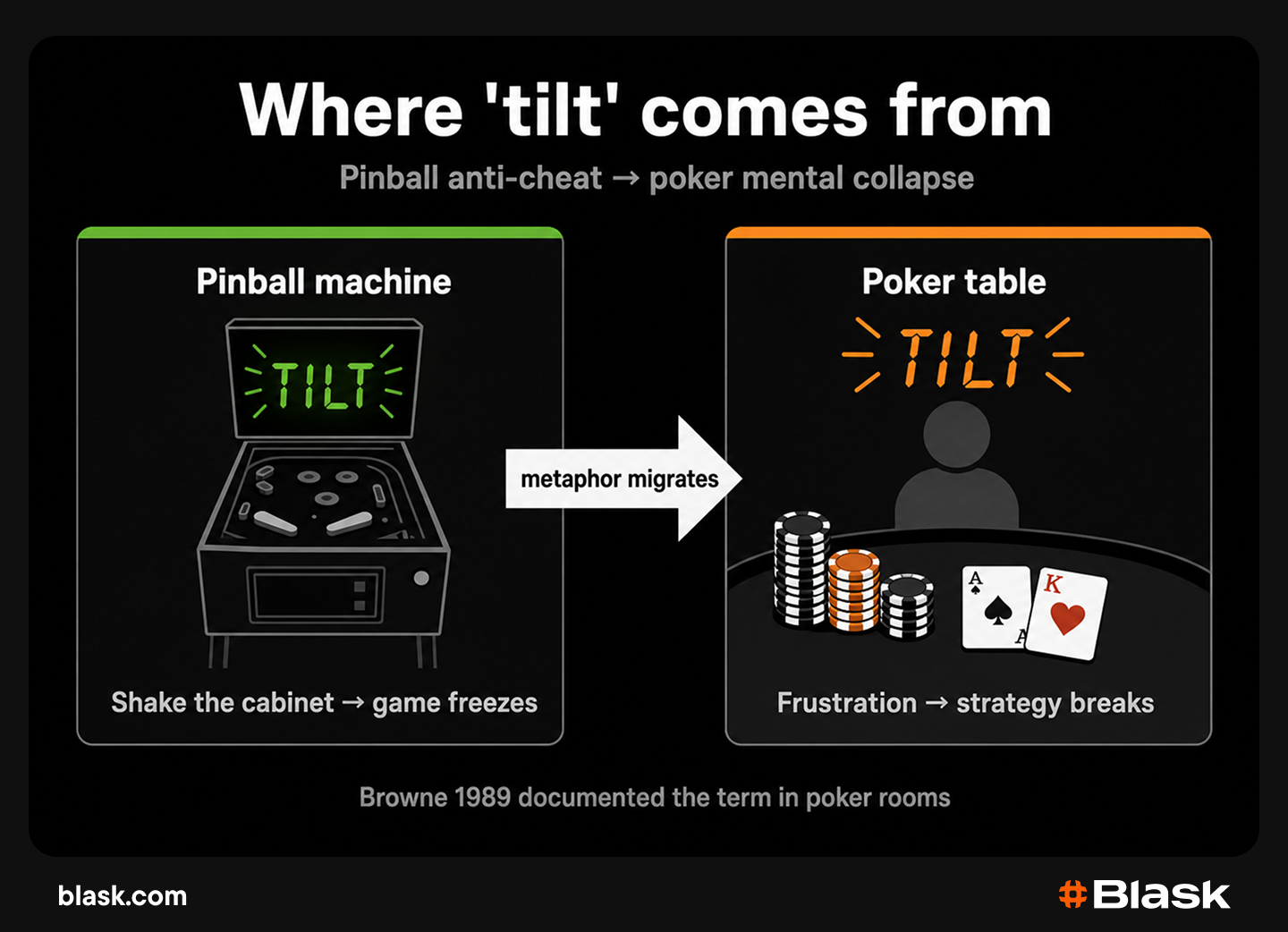
The word predates Hold’em forums. Pinball machines used a “tilt” mechanism — historically linked to inventor Harry Williams’s anti-cheat devices — that shut down scoring when a player shook or angled the cabinet. The display flashed TILT; the ball was over. The metaphor migrated into poker: force the machine (or the game) out of fair play through frustration, and the system punishes the attempt.
By the late 1980s, Browne (1989) had documented the term inside poker rooms as a loss of mental equilibrium. Later work in HCI and psychology — for example Wu et al. on detecting tilting — kept the same definition: negative emotion — erratic strategy — avoidable loss. Esports later borrowed the vocabulary wholesale; the mechanism is identical even when the currency is ranking instead of chips.
How tilt affects a player’s decisions
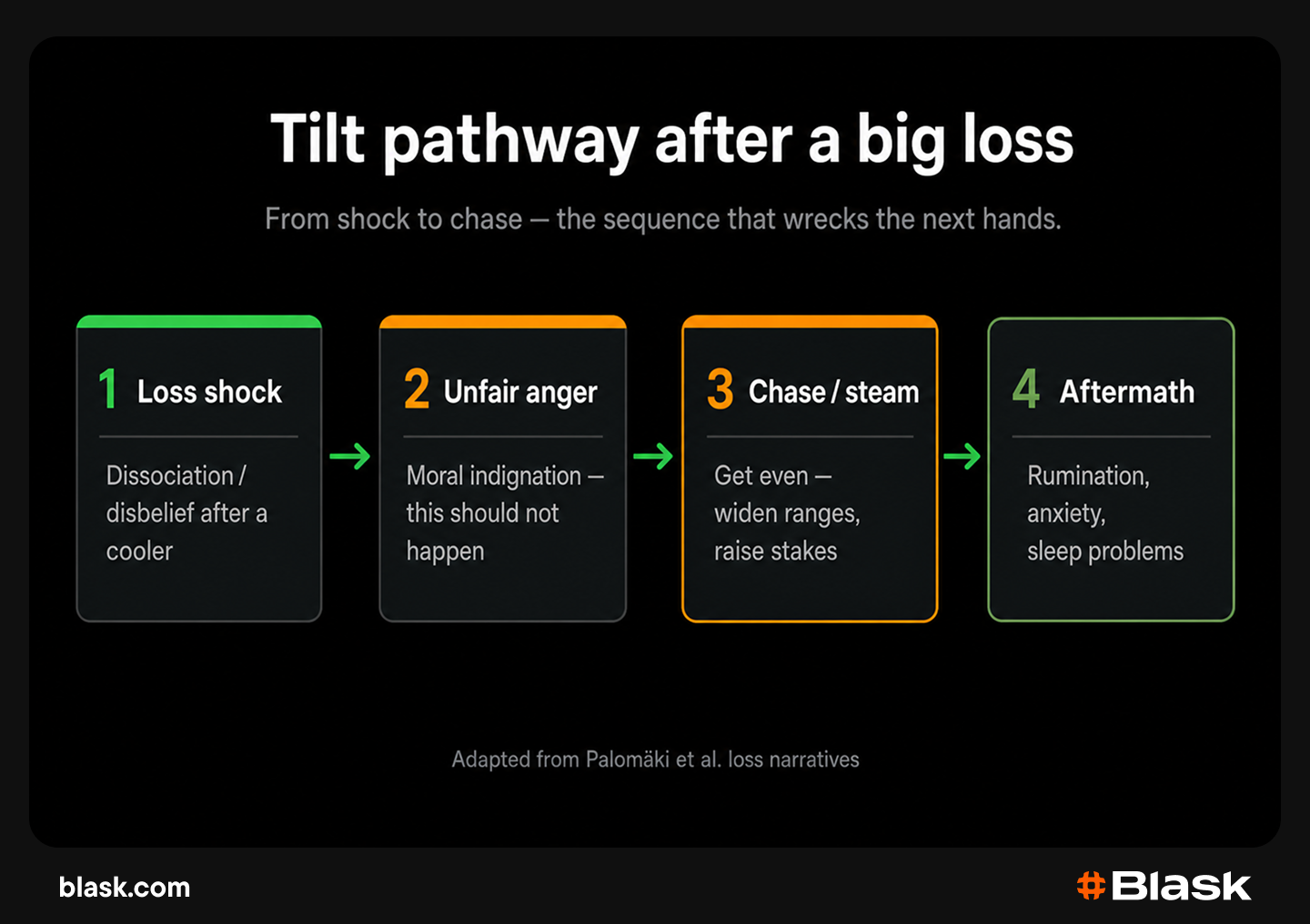
Good poker is Bayesian under uncertainty. Tilt replaces that with moral accounting: “this should not have happened,” “the deck owes a win,” “that player must pay.” Palomäki et al.’s qualitative analysis of 60 Finnish online players’ loss narratives found a repeating sequence: dissociative shock after a big loss — moral indignation (“this is unfair”) — chasing to restore a “fair balance” — aftermath of rumination, anxiety, and sleep problems.
That sequence maps cleanly onto decision science. Prospect theory shows that losses weigh more heavily than equivalent gains; Tversky and Kahneman’s classic estimate put the loss-aversion coefficient near λ ≈ 2.25 (later meta-analyses often find a smaller but still positive asymmetry — e.g. around 1.3 in risky-choice meta-analysis). At the table, that asymmetry fuels desperate get-even bets and scared folds from a damaged stack.
Moreau et al. also report moderate links between tilt frequency and anxiety (r ≈ 0.40) and urgency facets of impulsivity (r ≈ 0.27). Decisions under tilt therefore tend to:
- Widen ranges without a strategic reason
- Ignore stack-to-pot ratios and ICM in tournaments
- Overweight recent outcomes (recency bias) instead of long-run frequencies
- Personalise random runouts as insults rather than variance
| Decision domain | Balanced play | Tilted play |
| Aggression | Selected by range and blocker effects | Forced, revenge-driven |
| Calling | Pot odds + equity + implied odds | “Need to see it” |
| Session management | Stop-loss / stop-win rules | Chase until even or broke |
Common causes of tilt
Most tilt episodes start from a small set of repeatable triggers — inside the cards, across the table, or outside the room entirely. The four below account for the majority of sessions that go off-script.
Bad beats and variance
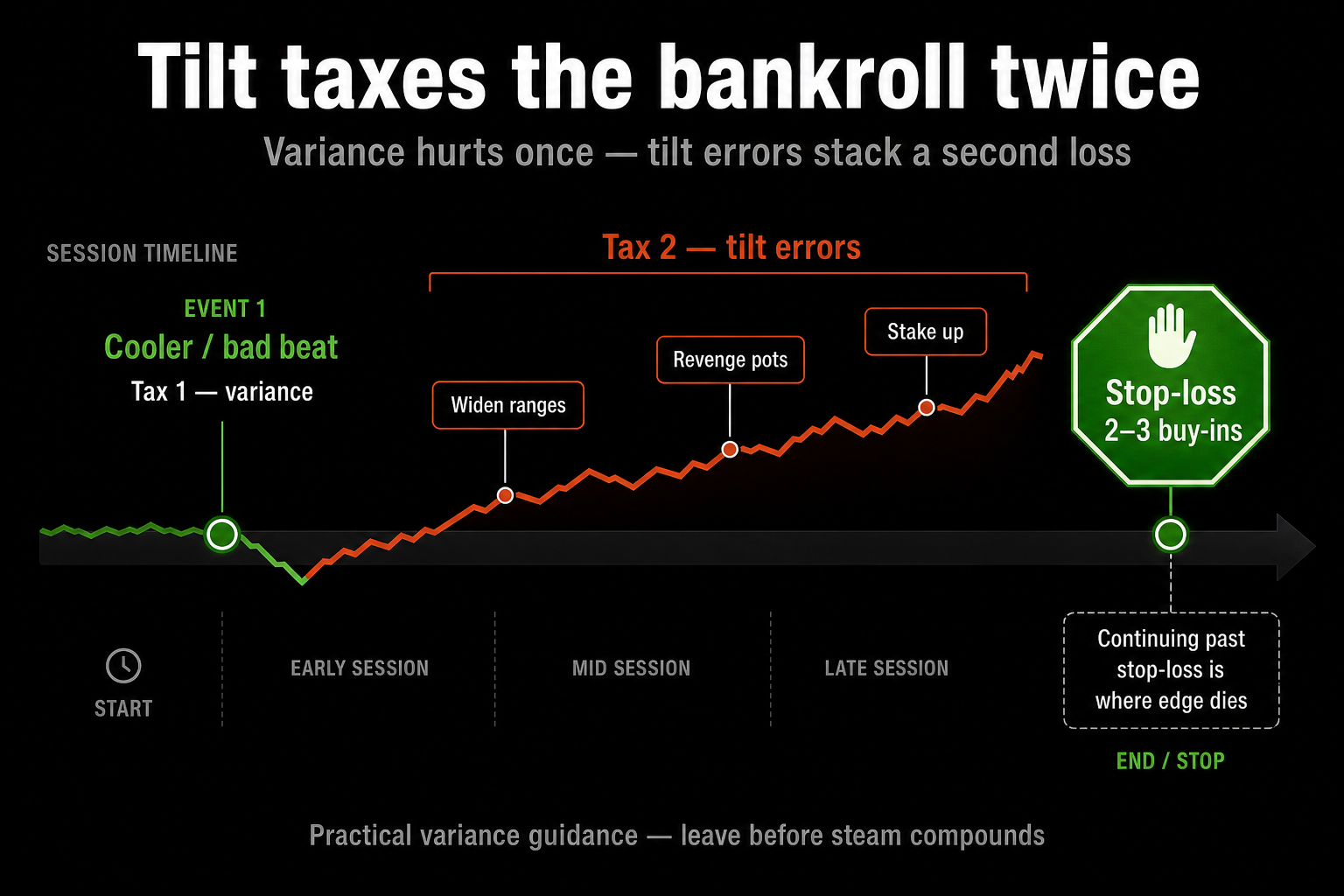
A bad beat is a low-probability loss with money already committed. It is also the most cited tilt trigger in poker culture — and for good reason: the brain treats a 90% favourite that loses as injustice, not as the 10% that was always priced in. Cash-game standard deviation commonly sits in a wide band (often cited around 70–160 bb/100 depending on format and style; see GTO Wizard’s variance framing and practical variance guides). A winning regular can still print multi-buy-in downswings that feel personal.
Variance is not tilt. Tilt is the second tax: strategic error stacked on statistical noise. GTO Wizard notes the feedback loop explicitly — tilt lowers win rate, which lengthens and deepens downswings.
Aggressive or lucky opponents
Villains who run hotter than average, needling opponents, or playing an unfamiliar hyper-aggressive style create ego threat. The tilt response is often “teach a lesson” — thin value bets become bluffs, and pot control disappears. Qualitative work on tilting repeatedly surfaces unfairness narratives directed at specific opponents rather than at the distribution of outcomes.
Card dead, boredom, and fatigue
Long stretches without playable hands produce understimulation. Fatigue and boredom are listed among internal tilt triggers in the Moreau et al. review of the literature. In the same sample, more than a quarter of players reported average sessions longer than four hours — a duration where attention and emotional regulation degrade. Forced action (“any two,” spewy bluffs) is boredom tilt wearing a strategy costume.
External life stress
Money stress, relationship conflict, sleep debt, and work pressure shrink the buffer available for table emotion. Anxiety and depression scores rise with problem-gambling severity in poker samples. Those states also covary with tilt. A session started as escapism often ends as mood regulation through wagering — using the game to manage feelings rather than to execute a plan.
| Trigger | Mechanism | Typical leak |
| Bad beat / cooler | Perceived unfairness | Steam, revenge pots |
| Downswing | Loss aversion + ego | Stake jump, longer sessions |
| Fatigue / boredom | Reduced inhibition | Spew, autopilot clicks |
| Life stress | Lower emotional bandwidth | Chasing, scared money |
Warning signs you’re on tilt
Self-detection beats post-session regret. Research instruments such as the OPTS tilting inventory for online players group signs into dissociation, loss of control, frustration, irritability, risk-taking, and aggressive acting-out. Practical early warnings:
- Heart rate up, jaw tight, or breathing shallow after one hand
- Replaying the last cooler while the next hand is dealt
- Changing table selection or stake level mid-session without a plan
- “Just one more orbit” after the stop-loss was hit
- Faster click speed online; slamming chips or muttering live
- Moral language (“robbed,” “owed,” “disrespect”) replacing EV language
In Palomäki’s narratives, dissociation and disbelief often appear before the chase. That window — seconds to minutes — is where pause routines still work.
Types of tilt
Tilt is not one mood with one leak. The emotional driver changes the surface behaviour — aggression, passivity, or chase — even though the underlying failure is the same: strategy no longer runs the decision.
| Tilt type | Emotional driver | Common behaviour |
| Anger / rage | Frustration, insult | Overaggression, steam |
| Loss-chasing | Urgency to break even | Longer sessions, stake up |
| Fearful | Anxiety over money | Passive, overfolding |
| Winner’s | Euphoria, invulnerability | Looser standards, stake up |
| Revenge | Personalisation | Target hunting |
| Entitlement | “Deserved” outcomes | Forcing action, blaming luck |
Anger / rage tilt
Classic steam. After a bad beat or a needling comment, aggression spikes. Hand selection widens; bluff frequency exceeds what ranges support. Live tells include raised voice and abrupt chip motion; online tells include instant all-ins and chat escalation.
Loss-chasing (desperation) tilt
The drive to get even. Loss-chasing is a clinical hallmark of gambling disorder — DSM-5 includes returning another day to get even — and reviews distinguish within-session vs between-session chasing (continuing / intensifying now vs coming back later). Zhang and Clark (2020) summarise chasing as a bridge from recreational to disordered play. In poker, it looks like moving up stakes after a downswing or refusing to quit until the session is green.
Fearful (scared-soney) tilt
The opposite surface behaviour with the same root: emotional control loss. Stacks that “matter too much” produce underbluffing, overfolding, and avoidance of +EV variance. Prospect theory’s loss weighting explains why a damaged bankroll feels louder than a healthy one.
Overconfidence / winner’s tilt
Positive urgency — acting rashly under extreme positive emotion — correlated with tilt scores in Moreau et al.. Winner’s tilt is sticky because it is rewarded short-term: loose hero calls that happen to hold, spewy bluffs that happen to land. The sample size is tiny; the confidence update is huge.
Revenge tilt
Target fixation. One opponent becomes the session. Thin value turns into bluffs; multiway pots are taken personally. The EV of “making them pay” is almost never calculated.
Entitlement tilt
The belief that solid play is owed a win tonight. Entitlement tilt shows up after long card-dead stretches or after “doing everything right” and still losing. It pairs tightly with interpretive bias on gambling cognition scales — the same distortions that Moreau et al. found elevated among higher-risk players.
Why tilt is so costly to your bankroll
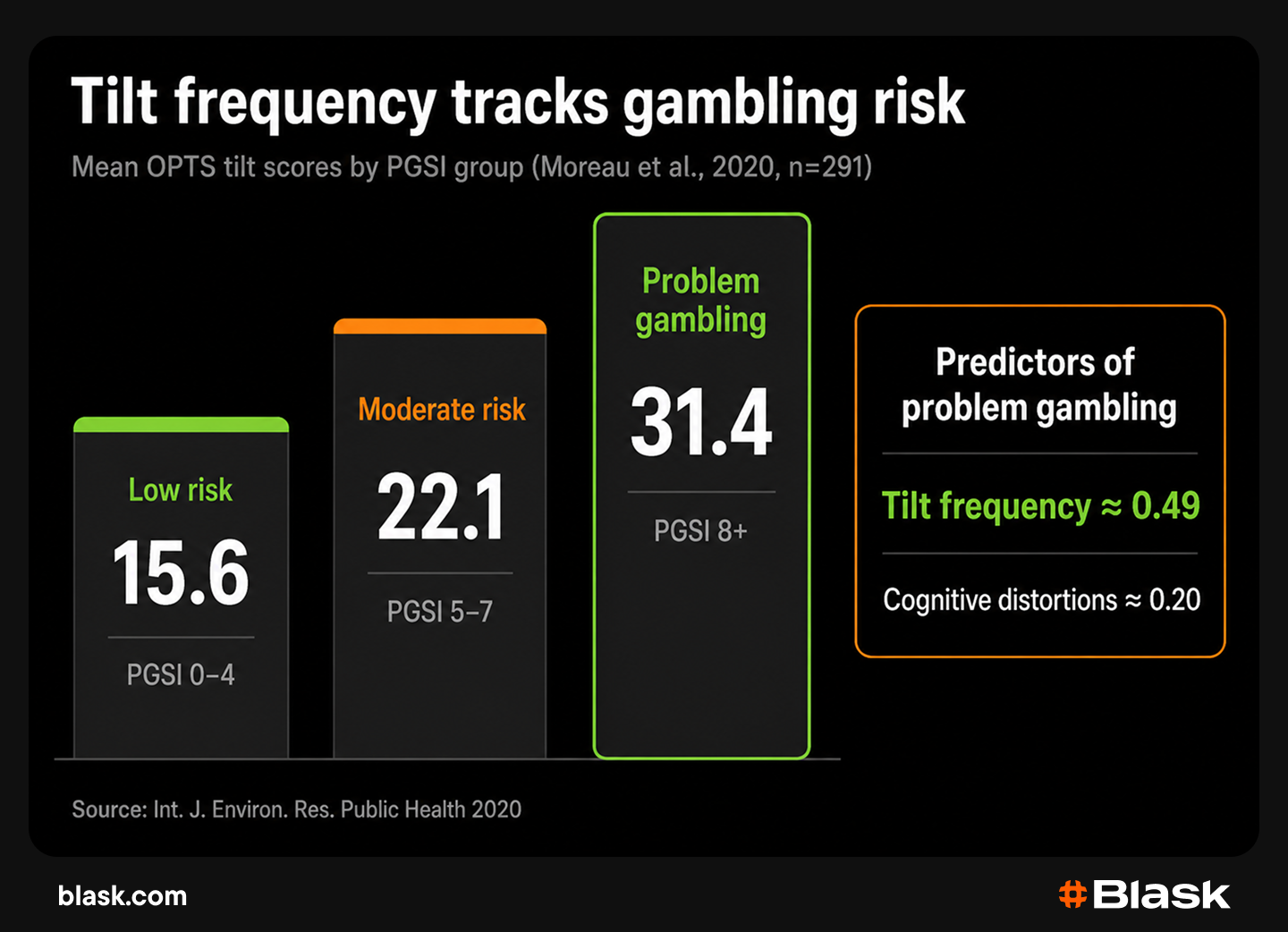
Tilt taxes a bankroll twice: once through the variance event itself, and again through every error that follows. In Moreau et al.’s grouping, mean OPTS scores rose from 15.6 (low-risk PGSI) to 22.1 (moderate-risk) to 31.4 (problem gambling) — a large effect (ANOVA F with effect size ≈ 0.27). Problem players also scored higher on inability-to-stop cognitions. Frequency of tilt was not a soft lifestyle quirk; it tracked harm.
Population context matters for operators and players alike. Among adults in England, the 2024 Health Survey for England found 5% with PGSI ≥ 1 (at-risk or problem gambling) and under 1% at PGSI 8+. The Adult Psychiatric Morbidity Survey 2023/24 estimated 1.6% at moderate risk or above (PGSI 3+) and 0.4% at problem level (PGSI 8+).
Poker-specific samples run hotter: Moreau et al. cite literature ranges of 8–30% problem gambling among online poker players, and French Observatoire des Jeux figures of about 14% of poker gamblers meeting problematic-use criteria, with probable pathological gambling higher in poker (7.9%) than across other gambling types combined (2.7%) in the sources they review.
Bankroll math makes the cost concrete. Simulations and coaching literature routinely show that even winning players can endure 20–40+ buy-in downswings over large samples. Add tilt — lower win rate, higher variance — and risk of ruin climbs. A session stop-loss of roughly 2–3 buy-ins is widely recommended in practical variance writing precisely because continuing past that point is where emotional play usually outruns edge.
In-game techniques to control tilt
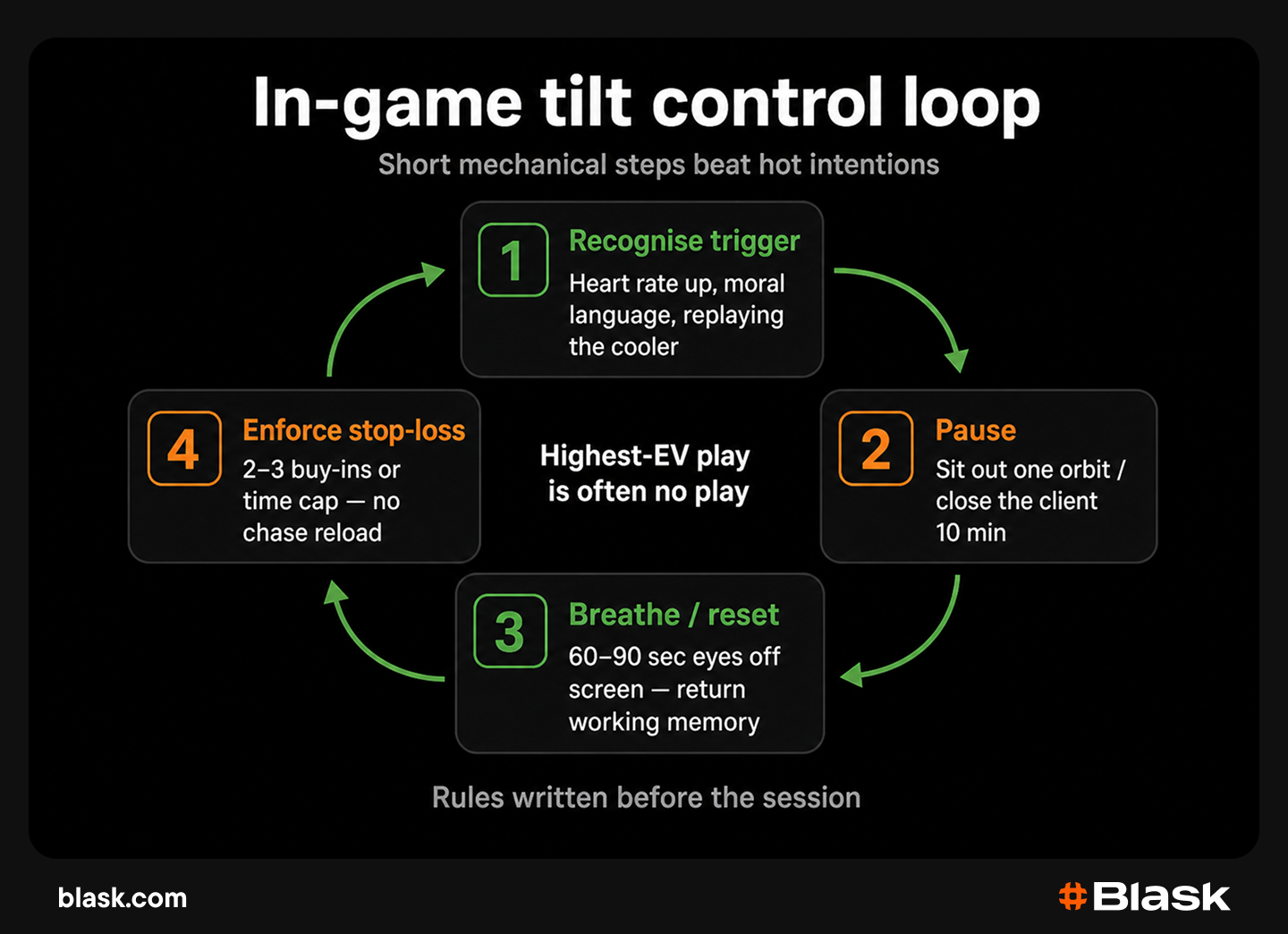
Once arousal is already high, the useful tools are short and mechanical: notice the spike, reset the body, then enforce rules written before the session started.
Recognise the trigger and pause
The highest-EV play after a cooler is often no play: sit out one orbit, stand up, close the client for ten minutes. Experienced players in qualitative studies repeatedly name stopping the session as the only reliable defence once tilt has started. Labeling the state — “this is unfairness anger, not a strategy change” — reduces fusion with the emotion.
Breathing and reset routines
Physiological arousal and tilt travel together. Experimental work on heart-rate sonification biofeedback during computer poker found that biofeedback can reduce emotional arousal (electrodermal activity) during play. A simpler field version: box breathing or a fixed 60–90 second eyes-off-screen reset after any hand that spikes heart rate. The goal is not zen; it is returning working memory to stack sizes and ranges.
Stop-loss and quitting rules
Rules written before the session beat intentions written during it.
- Session stop-loss, e.g. 2–3 cash buy-ins or a set tournament bullet count
- Time cap. Hard end time, especially for sessions planned over 2–3 hours
- Emotional stop. Two noted tilt signs → mandatory break
- Cool-down on reloads. No immediate deposit after a bust-out
These rules show how to avoid tilt compounding into a second and third buy-in lost at negative EV.
| Control | When to use | Failure mode if skipped |
| Pause / orbit sit-out | Right after trigger | Instant revenge hand |
| Breath / biofeedback reset | Arousal spike | Autopilot spew |
| Pre-set stop-loss | Before session | Chase spiral |
Long-term strategies to prevent tilt
In-session fixes stop the bleeding; longer habits shrink how often bleeding starts. Mental routine, bankroll structure, and honest review work as a single system rather than as separate hobbies.
Building a mental game routine
Palomäki, Laakasuo, and Salmela (2014) studied 417 players and found emotional sensitivity to losses was the strongest predictor of tilting severity — stronger than raw experience. Experience helped players believe they tilted less, yet was associated with higher reported severity overall, likely because volume creates more high-stakes tilt opportunities. The practical implication: mental training is not optional endgame content. Useful routine elements:
- Pre-session checklist (sleep, mood, bankroll, stop-loss);
- Post-session journal focused on decisions, not results;
- Scheduled study separate from scratched-ego sessions;
- Clear identity rule: results do not rewrite strategy mid-week.
Bankroll management as a tilt buffer
Scared money and desperation both shrink when the unit size is small relative to total roll. Common cash guidelines cluster around 25–50+ buy-ins for hold’em (higher for PLO and MTTs); see SplitSuit and GTO Wizard. Move-down triggers (e.g. roll below a stake threshold) should be mechanical. Bankroll management does not remove tilt; it removes the financial panic that turns one tilted session into an account wipe.
Reviewing hands objectively
Result-oriented review trains entitlement tilt. Process-oriented review trains stability: Was the line +EV with the information available? Solver and database study belong to calm hours. Hands that produce the loudest emotion deserve the calmest review — often they are coolers or thin spots, not proof of conspiracy.
Tilt beyond poker: casino, sports betting & eSports
The same emotional collapse is not poker-exclusive. Slots and table games compress feedback loops; near-misses and rapid re-spins amplify chasing. Sports betting adds narrative identity — a club, a tipster, a “lock” — so a bad beat feels like a personal insult. Esports adopted the word directly: performance research on the “tilt continuum” treats tilt as emotion-driven performance collapse across competitive games.
Loss-chasing literature outside poker shows the same behavioural family: longer sessions, higher stakes, faster play, returning another day to get even. The product surface changes; the psychology does not.
| Vertical | Common tilt spark | Typical chase behaviour |
| Poker | Bad beat, cooler | Steam, stake-up |
| Casino | Near-miss, long cold streak | Faster spins, higher bets |
| Sports betting | Late swing, voided edge | Live bet laddering |
| Esports | Throw, teammate error | Forced fights, tilted drafts |
Tools and responsible gambling resources
When tilt frequency rises, tools matter more than willpower slogans. Licensed-market baselines include deposit limits, session timers / reality checks, and self-exclusion — required information under UKGC LCCP 3.3.1. Industry safer-gambling campaigns note that hundreds of thousands of deposit limits are set monthly on licensed sites (Safer Gambling UK).
Useful starting points:
- GAMSTOP — multi-operator online self-exclusion for Great Britain–licensed sites (UKGC overview);
- GambleAware tools and support and the National Gambling Helpline (GB);
- GamCare — advice, chat, counselling pathways;
- National Council on Problem Gambling / 1-800-GAMBLER (US);
- Device-level blockers (e.g. Gamban) where appropriate.
Population surveys differ by method, but the signal is stable: a minority experience elevated harm, and chasing/tilt dynamics sit near the centre of that risk (HSE 2024; APMS 2023/24).
How operators address tilt and player protection (B2B angle)
For operators, platforms, and B2B suppliers, tilt is both a duty-of-care issue and a product-design issue. Regulators increasingly treat financial limits and interaction design as core controls, not brochure extras. The UK Commission’s Remote Technical Standards track — including clarified gross deposit limit rules with implementation toward 30 September 2026 — pushes consistent, prominent limit-setting.
Practical operator levers that intersect with emotional-loss risk and broader chasing behaviour:
- Friction after loss spikes — cool-downs after rapid reloads or stake jumps
- Reality checks — session clocks that interrupt dissociative grind
- Net deposit / loss visualisations — counter the “almost even” illusion
- Table-time and multi-table caps in poker clients
- RG messaging that uses players’ own vocabulary (“tilt,” “chase”) rather than only clinical labels — aligned with Moreau et al.’s clinical implication that tilt language is a workable entry point for prevention
- Staff and bot training to spot steam patterns (stake escalation, chat aggression, session length outliers)
Moreau et al. argue that monitoring tilt frequency could help identify higher-risk poker customers. For B2B analytics and CRM, that implies features beyond PGSI-style questionnaires: session telemetry, chase detection (faster betting, larger stakes after losses), and humane intervention design that does not simply push bonus re-entry.
Tips from the pros
Patterns from high-volume players and from the research base line up:
- Pre-commit, then obey. Stop-losses written cold beat promises made hot.
- Treat unfairness as a known bug in human firmware. Loss narratives show moral indignation as the bridge to chasing — name it early.
- Volume without mental skills raises exposure. Experience alone does not erase tilt severity; it can increase encounters with tilt-provoking spots.
- Quit is a skill line. Multiple studies and player reports converge on leaving the session as the primary emergency brake.
- Study emotions with the same seriousness as bet-sizing. Sensitivity to losses predicts tilting severity more than bravado does.
- Separate results days from strategy days. Reviewing while steaming encodes the wrong lesson.
- Shrink the unit when life stress rises. External load lowers the threshold for on-tilt poker decisions.
- Use product tools without stigma. Limits and self-exclusion are infrastructure, not surrender.
Bottom line
The pattern is predictable psychology under financial uncertainty. The on tilt meaning is simple: strategy left the session before the chips did. Reducing tilt poker damage is less about never feeling anger and more about shortening the window between trigger and reset — with bankroll structure, session rules, honest review, and, when needed, the same responsible-gambling tools that apply across every form of tilt gambling. Where poker tilt is left unnamed, bankroll damage compounds.