
- Updated:
- Published:
Macquarie cuts US World Cup 2026 handle to 5% of global total — Blask Index shows the opposite in demand
Macquarie’s $50B World Cup forecast leaves the US with a 5% slice, while Blask puts American demand at the top.
According to Macquarie, the 2026 World Cup will become the largest event in the history of global betting: total legal handle will reach $50B. Yet despite hosting the tournament, a maturing local market, and the popularity of same-game parlays, live betting, and player-prop wagering, the US will account for only around 5% of that volume.
Chad Beynon, senior gaming and leisure analyst at Macquarie, puts average global handle per match at roughly $500M — so even a 40% uplift in the US market looks marginal. The expanded format, with 48 teams and 104 matches, will also spread wagering across the calendar and dilute handle per fixture.
Divergence factors: Why audience interest does not convert into revenue
This mismatch comes down to scope: Macquarie looks only at legal betting, while the Blask World Cup Index tracks daily betting interest around the 2026 tournament, including how actively users search for odds, match markets and World Cup-related betting content. That interest does not always turn into legal wagers.
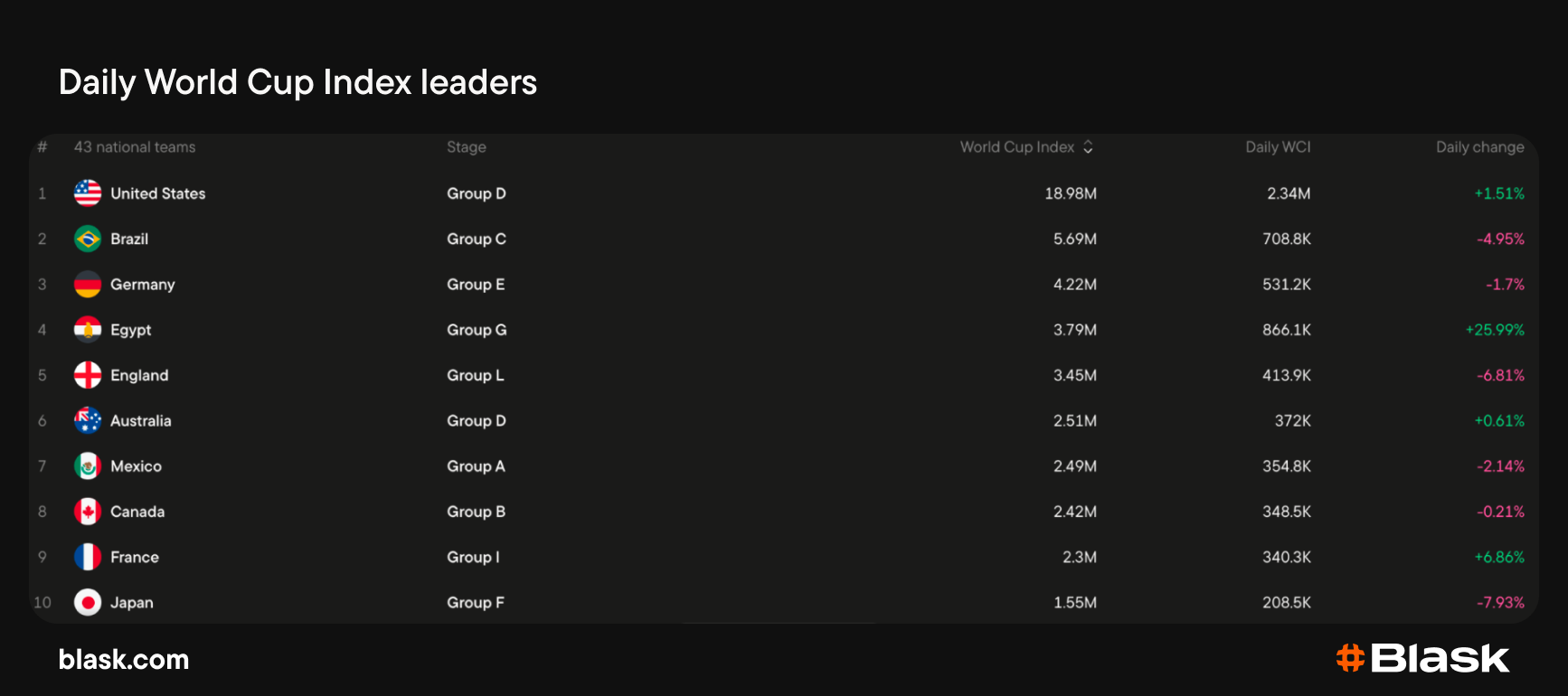
The US leaderboard shows why this distinction matters: a large share of demand goes to prediction markets, sweepstakes and offshore sites, which sit outside traditional legal revenue forecasts. With nearly 40% of Americans still living in states where online sports betting is banned, part of this demand is pushed into alternative channels.
Blask data puts total US market capacity at almost $80B over the past 12 months, with FanDuel alone capturing more than $7B, yet Macquarie expects the US to generate only around $2.5B in legal World Cup bets — a meaningful local uplift, but still a limited contribution against a global average of about $500M in handle per match.
US sportsbooks gain locally while global handle stays offshore
Blask World Cup Index already puts US tournament interest at a record high, and Macquarie still expects the event to add 2–5% to operator EBITDA in 2027 — with Flutter Entertainment, Super Group, and Rush Street Interactive among the beneficiaries. FanDuel and DraftKings stand to capture much of that uplift at home.
The largest handle pools, however, will sit outside the US — primarily in Europe, Latin America, and other mature wagering markets where punter culture has been building for decades. US operators may draw attention; the bulk of World Cup betting revenue will land elsewhere.