- Updated:
- Published:
What PIX is in iGaming
Pix is Brazil’s instant payment scheme, created and operated by the Banco Central do Brasil. It moves Brazilian reais between transactional accounts every day of the year, including nights and holidays, using Pix keys or QR codes. It is not a card network, not a cryptocurrency and not a closed wallet brand.
The Central Bank opened the scheme to the public on 16 November 2020. Adoption was a consumer-payments story first: keys, QR codes at the grocer, person-to-person transfers that settled in seconds.
Licensed betting inherited that habit. Players did not learn a new rail for gambling. Operators had to attach a gambling cashier to a rail that already cleared the rest of daily life.
In SPA-regulated betting it is the cashier players already know from the rest of the economy. After Portaria SPA/MF nº 615/2024, licensed deposits, withdrawals and prize payments have to travel as electronic transfers between the bettor’s registered account and the operator’s transactional account, both at institutions authorised by the Central Bank. Credit cards, crypto, cash, boletos and third-party payments are outside that list.
💡 Key point: licensed money has to move between two registered accounts at BCB-authorised institutions. A Pix from any other account is out of the Portaria 615 loop.
📚 Read more: What is SPA? Brazil’s betting regulator explained
How a Pix payment is addressed
A Pix key maps to an account in the Central Bank’s directory. Checkout is usually a dynamic QR code or a copia-e-cola payload. Settlement runs on the Central Bank’s Instant Payment System.
Keys can be:
- a CPF
- a CNPJ
- an email
- a mobile number
- a random identifier
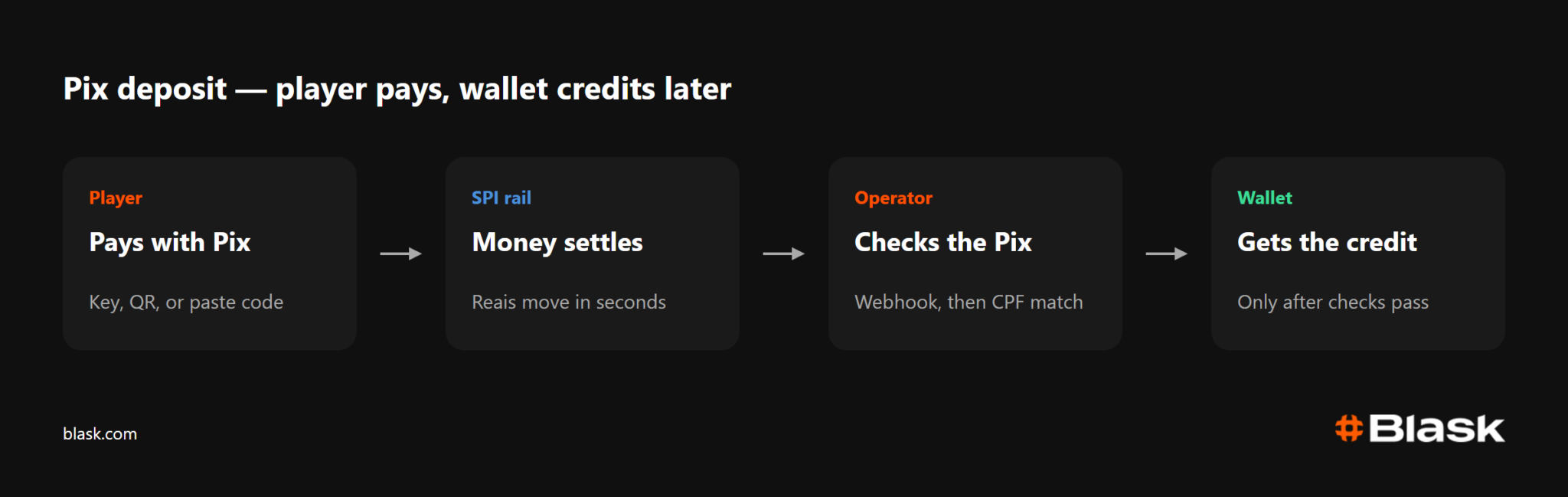
The player confirms in a bank or payment app; the operator credits the betting wallet only after the webhook and the compliance checks pass.
Withdrawals reverse the same rail, to an account the player has already registered.
Pix transfers are not a card-scheme chargeback product. Disputes exist through banks and the Central Bank. They are not a substitute for a reject-or-refund path when a payment fails a compliance test.
Speed is the other product fact. SPI is designed to settle in seconds. A betting wallet that credits on a delay the player does not see in grocery Pix will look broken even when the licence file is in order. Timeout, duplicate QR and CPF mismatch are therefore cashier states, not rare exceptions.
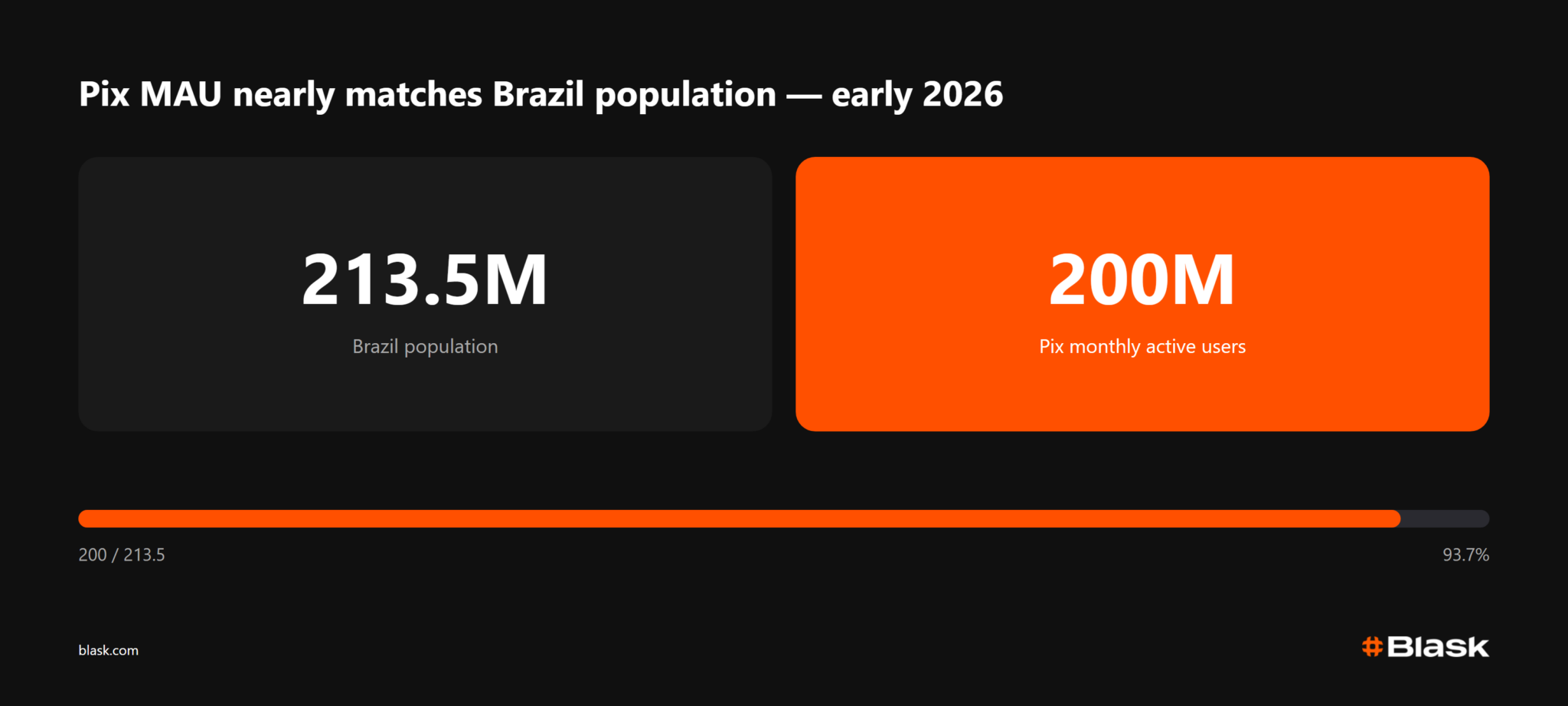
Adoption was fast. Wikipedia notes that within a year more than 62% of Brazil’s population used Pix; by later snapshots it had overtaken cards on volume and become the country’s main retail payment habit. By early 2026, industry summaries cite monthly Pix value near R$3.4 trillion and on the order of 200 million monthly active users — a scale that matters because betting cashiers compete with the same muscle memory players use for groceries and P2P.
What SPA allows and what it shuts out
Portaria 615, read with Laws 13.756/2018 and 14.790/2023, treats electronic transfer as Pix, TED, debit or prepaid card, and book transfer inside the same institution. The banned list includes cash, cheques, boletos, virtual assets, credit or other post-paid instruments, and any transfer that is not between the two registered accounts.
| In the Portaria 615 loop | Outside the list |
|---|---|
| Pix | Cash |
| TED | Cheques |
| Debit or prepaid card | Boletos |
| Book transfer inside the same institution | Virtual assets |
| Credit or other post-paid instruments | |
| Any transfer not between the two registered accounts |
CPF matching closes the loop. The sender CPF on a Pix payload has to match the KYC’d CPF on the betting account. A payment from a spouse’s key is a third-party deposit under that rule, even if the household thinks of it as one pot.
Mule accounts (contas laranja) are the AML pattern the same control is built to interrupt: a rented or stolen account deposits, a thin betting pattern follows, then a withdrawal leaves toward a cleaner destination.
Why this is a market fact, not a cashier preference
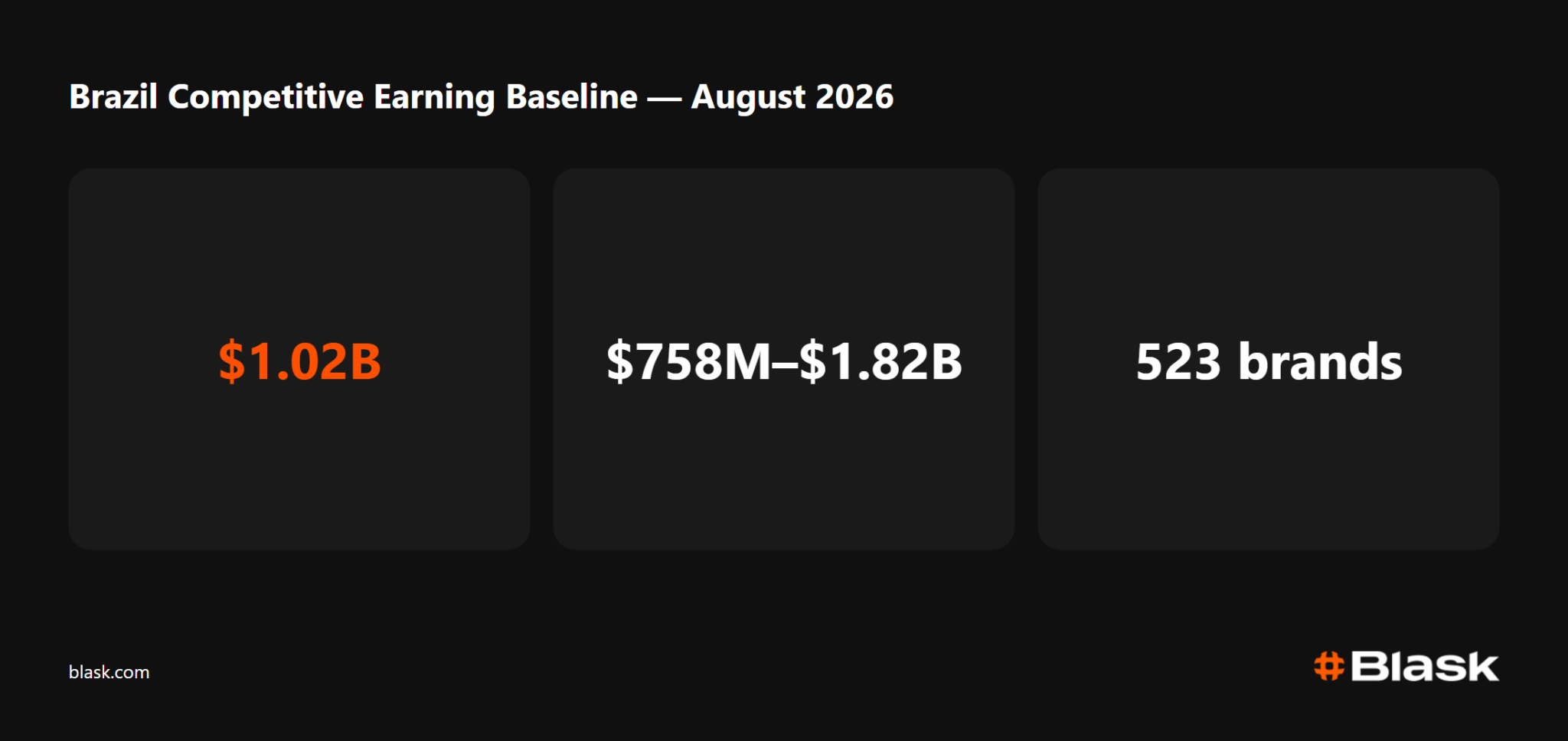
Brazil’s licensed fixed-odds market is large enough that the payment rail is part of the product. In August 2026 Blask’s Competitive Earning Baseline for Brazil was $1.02B ($758M–$1.82B range) across 523 tracked brands. That CEB figure is a revenue baseline for the market, not a Pix volume statistic. It is the scale sitting behind the cashier rule.
📚 Read more: Brazil iGaming market H1 2026: brands, demand, and what changed
Under SPA rules, Brazil’s licensed cashier concentrates on electronic transfers through BCB-authorised institutions. Pix sits at the centre because it is the only rail that combines universal consumer adoption, instant settlement, and regulator-friendly traceability.
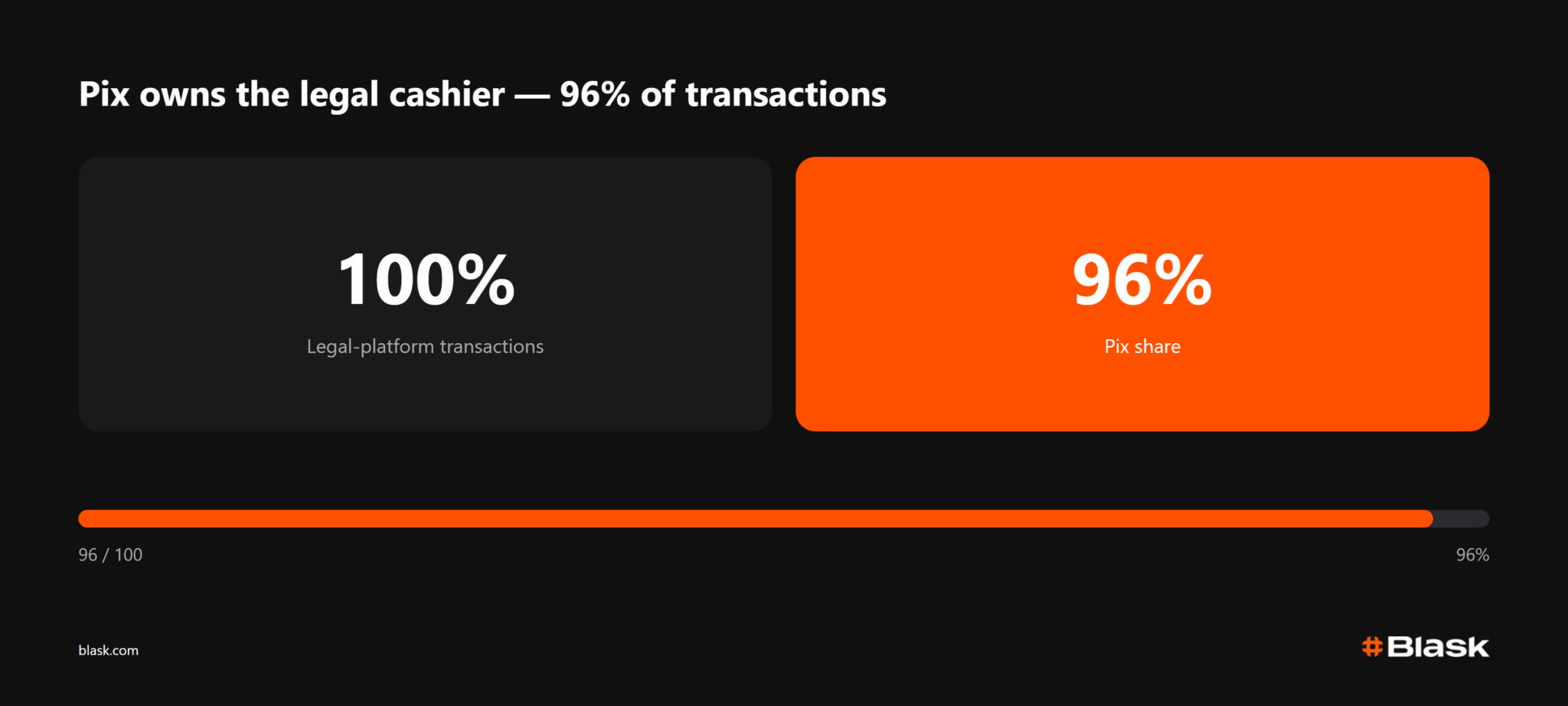
Industry estimates of Pix’s deposit share vary by source and should be labelled as such, not as Blask fact. GetBanked estimates that by the end of 2025 Pix carried roughly 78–82% of regulated iGaming deposit volume, with withdrawals almost entirely on Pix and TED/card residual. KYCAID puts Pix at upwards of 90% of deposit traffic in the post-credit/crypto vacuum. iGaming Business states a higher 96% share for Pix among legal-platform transactions — treat that as a trade estimate, not an audited SPA statistic.
Enforcement adds another reason Pix dominates. Because the rail is BCB-operated and bank-mediated, authorities can pressure institutions to restrict Pix flows to unlicensed operators. iGB describes that lever as part of the illegal-market fight; for licensed brands it means banking and PSP relationships are both commercial and compliance infrastructure.
TED, debit/prepaid, and same-institution book transfer remain formally allowed. In live cashiers they are secondary. Players expect Pix first.
FAQ
Is Pix a card?
No. It is the Central Bank’s instant transfer scheme.
Can licensed betting sites in Brazil take credit cards?
Not under Portaria 615’s allowed list for deposits, withdrawals and prizes.
Why do operators talk about CPF matching?
Because the Pix sender identity has to equal the verified player identity on the betting account.