

- Updated:
- Published:
56% of Australia’s online betting revenue goes to offshore operators. The regulator letting it happen has no full-time staff
A reform bill introduced on April 7 could reshape how Australia’s online betting industry is overseen or leave the structure largely unchanged.
Australia has the world’s highest per-capita gambling losses, at around AU$1,272 per person annually. The market behind that record generates $390.6M in estimated revenue every month. The body overseeing it has zero full-time employees.
That may be about to change — or not. The question is in parliament.
The scale of what’s at stake
As of March 2026, Blask tracks 321 registered online betting brands in Australia, 317 of them active.
Total market Competitive Earning Baseline (CEB) reached $390.6M for the month ($238.3M–$847.4M range). CEB is Blask’s market-based revenue benchmark derived from brand strength and competitive positioning, not operator-reported financials. The range reflects different competitive scenarios: $238.3M under conservative assumptions, $847.4M under favorable ones.
Player acquisition benchmarks align with the revenue picture. Acquisition Power Score (APS), Blask’s estimate of new customer inflow based on market presence, stood at 247.7K for March (164.4K–497.6K range).
But the most telling number is structural: 197 of 321 brands operating in Australia carry no local Australian license. They register in the Northern Territory, pay NT taxes, and fall under NT oversight — wherever their customers actually live.
Demand vs revenue: the offshore paradox
This licensing split creates a striking imbalance in the data.
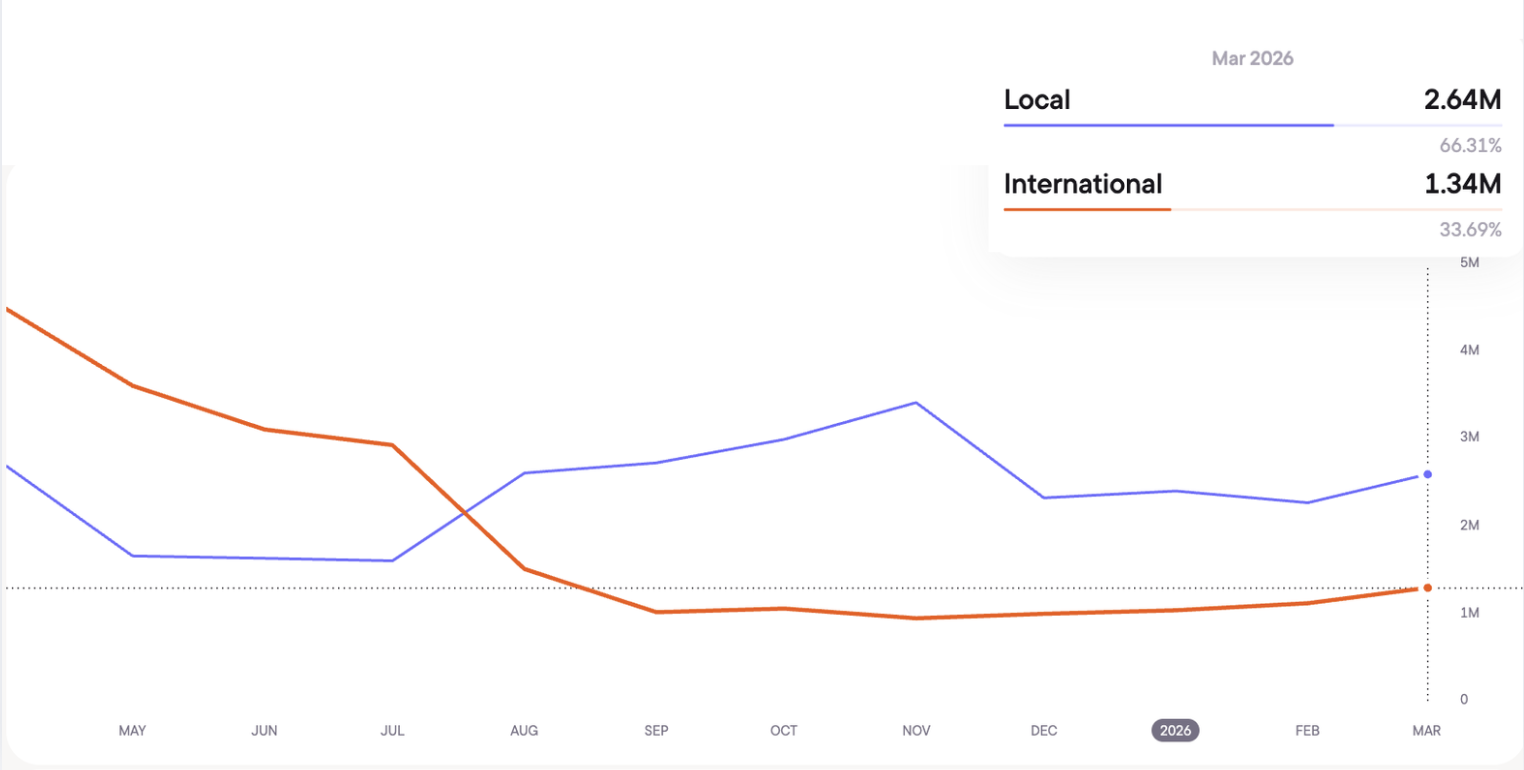
Blask Index — an AI-enhanced demand signal built from search activity — shows locally licensed brands generating 66% of total market demand in March 2026 (2.64M vs. 1.34M for international operators). By search attention, domestic brands dominate.
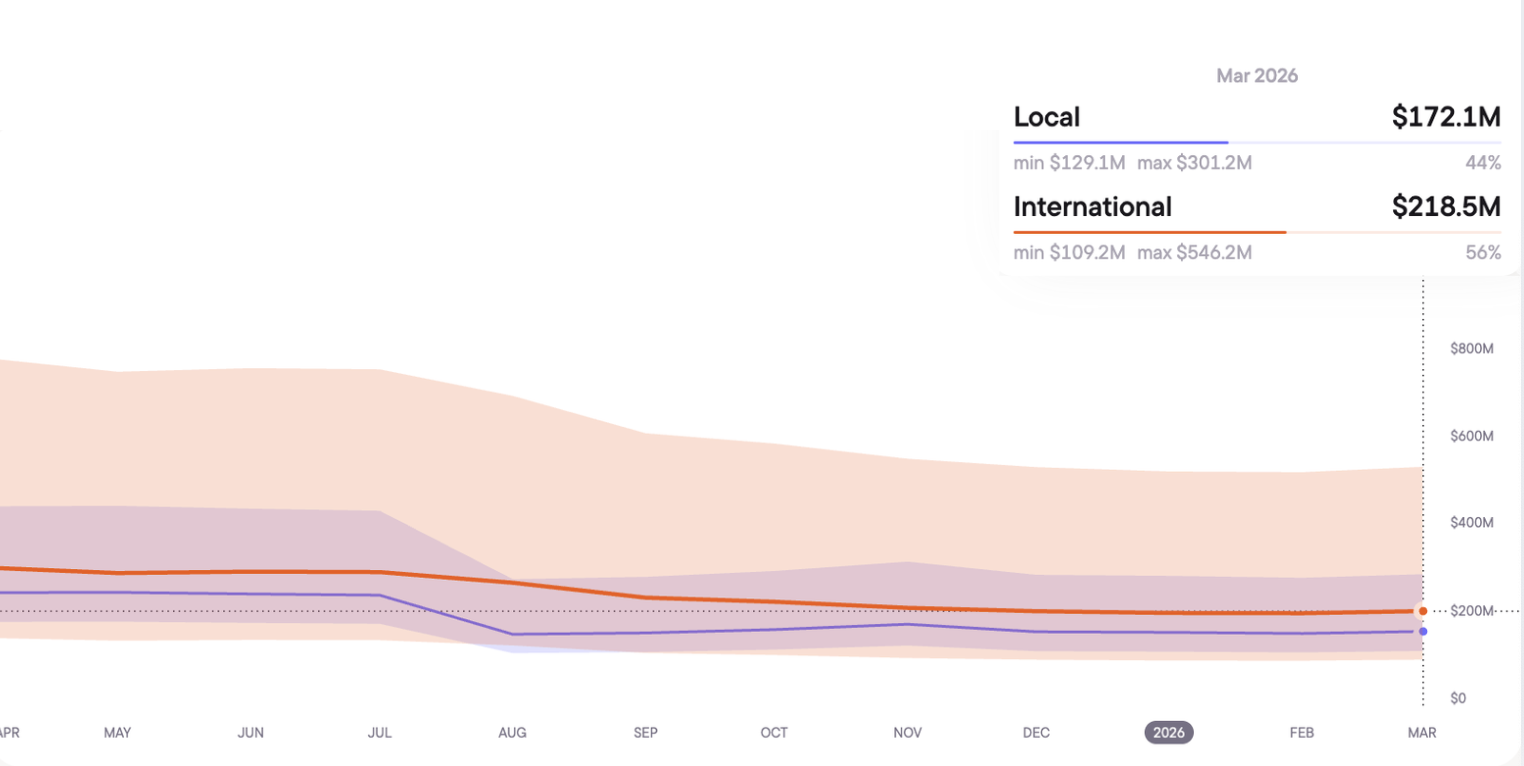
Revenue tells the opposite story. International operators — the 197 brands without a local AU license — account for 56% of total CEB ($218.5M vs. $172.1M for local brands). They attract less search interest but extract more money per player.
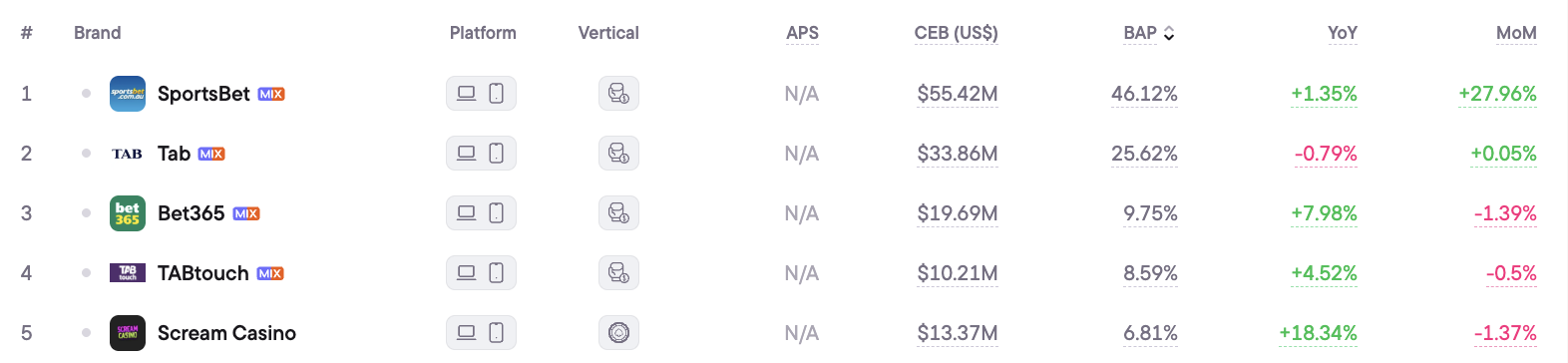
SportsBet leads the market in March 2026 with a monthly CEB of $55.4M ($41.6M–$97M). Tab sits second at $33.9M CEB. All three of the country’s biggest wagering brands — SportsBet, Bet365, Ladbrokes — are registered in the Northern Territory.
That registration arrangement is precisely why the Northern Territory Racing and Wagering Commission (NTRWC) became Australia’s de facto national online betting regulator in the first place.
A regulator in name only
The NTRWC oversees 52 of Australia’s largest online bookmakers. It does this with zero full-time employees.
Investigations by ABC and Four Corners published in October 2025 documented the details: six of the ten most recent commissioners personally owned racehorses; the commission chair accepted gifts and event invitations from operators his body was supposed to audit. The NT’s low tax rates attracted the biggest names in the industry — and the oversight structure that came with those registrations was, in practice, minimal.
The story gained national attention, and pressure for reform has been building since. In April 2025, the NT’s regulatory framework was described in parliament as a “complete farce.”
What the reform proposes
On April 7, 2026, NT Attorney-General Marie-Claire Bowtell introduced a bill to restructure the commission. The proposed changes:
- Strip NTRWC of local racing oversight, focusing it entirely on online wagering
- Ban commissioners from holding personal betting accounts
- Ban commissioners from owning racehorses
The bill does not create a federal regulator. Prime Minister Anthony Albanese declined recommendations from a parliamentary committee to move national oversight to a federal body. The NTRWC retains jurisdiction. A vote on the bill is expected in May 2026.
Separately, Albanese announced gambling advertising restrictions on April 2, including a ban on sports programming ads. Government analysis estimates the ad restrictions will reduce wagering by 0.8%.
What operators should watch
The structural question for the industry is not whether NTRWC commissioners can own horses — it’s whether Australia’s 219 active online brands will face tighter compliance requirements, higher licensing costs, or eventually a federal framework with standardized rules across states.
The current bill is a partial fix. It cleans up optics without fundamentally changing jurisdiction. That said, the political dynamic has shifted. The NT Parliament will vote in May under sustained media and public scrutiny. If the bill passes, it creates a narrower, wagering-only regulator with cleaner governance. If it fails or is watered down, the pressure for federal intervention increases.