

- Updated:
- Published:
Chile iGaming market Q1 2026: brands, demand, and what changed

Chile’s online gambling demand reached its highest point in at least three years in Q1 2026, up 42% year-over-year, as a Supreme Court blocking order failed to curb player interest and JugaBet emerged as a genuine rival to dominant Betano.
In November 2025, Chile’s Supreme Court ordered internet service providers to block all unauthorized online betting sites within five days — a sweeping ruling that declared only three state entities legally allowed to operate online. The outcome was the opposite of the intended effect: by Q1 2026, total market demand was up 42% from a year prior, and the platforms targeted by the court were capturing more players than before.
The story of Q1 2026 in Chile is partly about that paradox, and partly about something happening at the brand level: JugaBet, a local-focused operator that launched in 2023, nearly tripled its demand share in 12 months and now holds 11% of total market attention. Betano remains dominant at 43%, but the gap to the rest of the field has narrowed faster in the past quarter than at any point in the previous two years.
Meanwhile, Chile’s regulatory bill — approved by the Senate in August 2025 with 27 votes in favor — has been stalled in committee since September 2025, leaving the market in a legal gray zone that operators are, by the data, exploiting effectively.
About the data: Blask Index measures consumer search demand for iGaming brands, derived from Google Keyword Planner and Google Trends data. BAP (Brand Accumulated Power) shows each brand’s share of total market demand. All figures for Chile, Q1 2026 (January–March).
Track Chile in real time → blask.com/market/chile
Market demand in Q1 2026
Chile’s total Blask Index for Q1 2026 reached 21.8M, up 42% from 15.4M in Q1 2025. That is the sharpest year-over-year jump in at least three quarters and well above the regional average for Latin American markets in the same period.
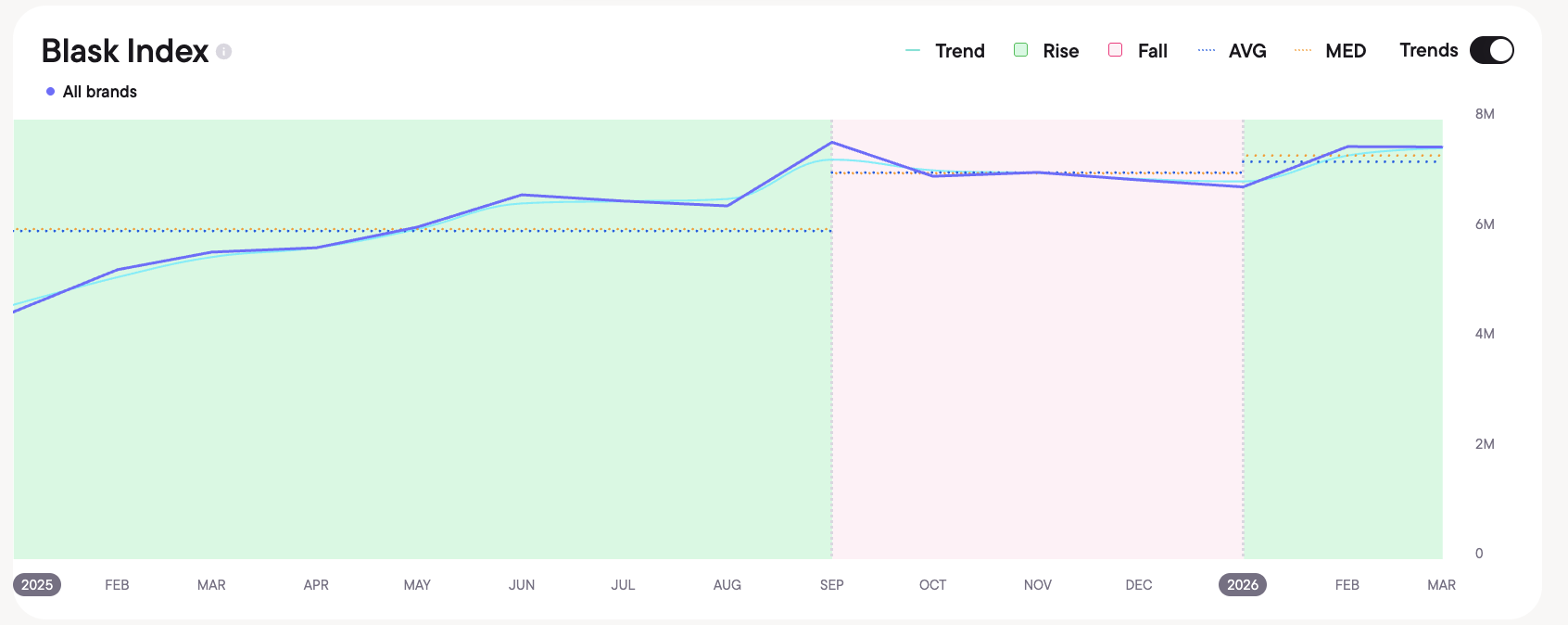
Quarter-over-quarter, demand grew a more modest 4.2% from Q4 2025 (20.9M). Q1 is typically softer than Q4 in markets with a strong sports betting component, since Q4 carries major football competitions. The fact that Q1 2026 still grew sequentially suggests structural demand expansion, not just seasonal carryover.
The market now has 145 active brands — up from 138 a year ago. The field is growing, but the top three operators still hold over 61% of all demand.
Top brands in Q1 2026
| Brand | BAP % | YoY change |
|---|---|---|
| Betano | 43.1% | ↑ +0.6 pp |
| JugaBet | 11.2% | ↑ +4.6 pp |
| Coolbet | 6.9% | ↓ –1.3 pp |
| Betsson | 3.8% | ↓ –0.3 pp |
| Novibet | 3.2% | ↓ –0.4 pp |
| 1win | 3.0% | ↑ +0.2 pp |
| WinChile | 2.8% | ↓ –1.4 pp |
| Rojabet | 2.1% | ↓ –1.0 pp |
| Micasino | 1.9% | ↓ –1.5 pp |
| Stake | 1.7% | ↑ +0.2 pp |
BAP — Brand Accumulated Power — measures each brand’s share of total market search demand. A brand can grow in absolute terms while losing BAP if the market expands faster than the brand does.
The ranking tells two stories at once.
First, Betano is not just the market leader — it is pulling away. Its Blask Index grew +32.5% YoY on a base that was already the largest in the country. Its Acquisition Power Score (APS) — Blask’s benchmark for new customer acquisition based on brand presence — reached an average of 385K per quarter (193K–962K range) in Q1 2026, up from 291K in Q1 2025. APS is a range because player acquisition depends on competitive intensity, seasonal variance, and campaign timing.
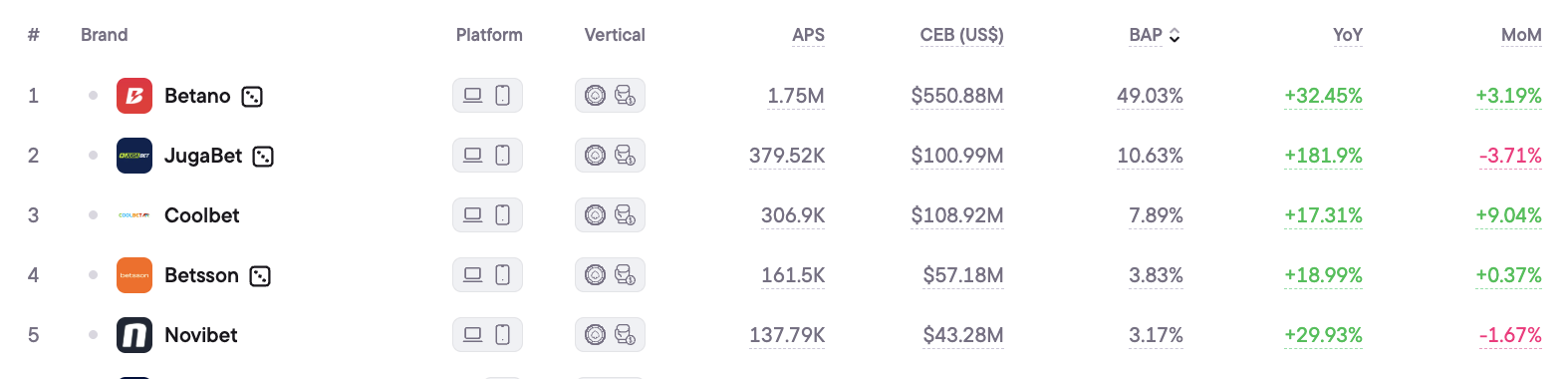
Second, the middle of the ranking is contracting. Coolbet, Betsson, WinChile, Rojabet, and Micasino all lost BAP points year-over-year. Collectively, these five held 23% of market demand in Q1 2025. In Q1 2026, they hold 17%. That 6 percentage point gap went almost entirely to JugaBet.
What drove the quarter
The Supreme Court blocking order accelerated consolidation. In November 2025, Chile’s Supreme Court ordered ISPs to block all unauthorized gambling platforms — effectively every operator except Polla Chilena de Beneficencia, Lotería de Concepción, and Teletrak. Yogonet reported in February 2026 that consumption on international operators grew following the blocking. Players seeking blocked sites migrated to alternatives — and the biggest brands with the highest recognition captured that flow. Betano and JugaBet, both with Android apps and strong brand recall, absorbed most of it.
JugaBet’s local positioning paid off. iGamingToday noted in August 2025 that local ties are a primary driver of success in Chile’s online betting market. JugaBet launched in July 2023 and built its brand around Chilean football clubs and local payment methods. Its demand grew +182% YoY in Q1 2026 — from a BAP of 6.6% to 11.2%. That is not an overnight spike; it reflects compounding brand investment that crossed an inflection point when blocking removed some smaller competitors from the field.
Regulation remains stuck, keeping the market open. Chile’s Senate approved an online gambling regulation bill in August 2025 with 27 votes in favor. As of Q1 2026, the bill has stalled in Joint Economy and Finance Committees, with no vote scheduled. In February 2026, deputies Roberto Arroyo and Patricio Briones publiclycalled for urgent action, citing the fact that all 16 Primera División football clubs now carry betting company sponsorships. The legal vacuum functions as a de facto open market for operators willing to absorb the regulatory risk.
Q1 2026 vs Q1 2025: year-over-year shift
| Metric | Q1 2025 | Q1 2026 | Change |
|---|---|---|---|
| Total Blask Index | 15.4M | 21.8M | +41.9% |
| Market leader | Betano (42.5%) | Betano (43.1%) | — |
| #2 brand | JugaBet (6.6%) | JugaBet (11.2%) | +4.6 pp |
| APS avg (quarterly) | 686K (343K–1.71M) | 893K (447K–2.23M) | +30.2% |
| CEB avg (quarterly) | $222M ($111M–$556M) | $293M ($147M–$733M) | +31.7% |
| Active brands | 138 | 145 | +7 |
Competitive Earning Baseline (CEB) is Blask’s market-based revenue benchmark — it estimates what a brand should be earning given its competitive position and demand signals, not from operator-reported financials.
The range reflects different competitive scenarios: $147M under conservative assumptions, $733M under favorable ones. Chile’s market-wide CEB average crossed $293M per quarter in Q1 2026, up 31.7% from $222M a year prior.
The gap between Blask Index growth (+42%) and CEB growth (+32%) suggests the market is attracting more demand than it is monetizing, which is typical of an unregulated market where conversion friction is higher than in licensed environments.
What this means for operators
Chile is growing faster than almost any other major Latin American market right now, and the regulatory paralysis is not slowing it down. JugaBet’s rise shows that local brand-building works here — operators with Chilean football partnerships, local payment integrations, and Spanish-language UX built for Chilean players outperform global brands that apply a regional template.
Betano understood this early and built a commanding lead. JugaBet is proving the playbook works for a second operator. The brands losing ground — Micasino (–36% YoY), Rojabet (–15%), WinChile (–6%) — are doing so without a clear differentiation story in a market that increasingly rewards it.
For Q2 2026, the regulatory bill remains the key variable. If the Senate advances the legislation, the market structure will shift sharply: offshore operators without Chilean licenses will face formal exclusion, and the operators currently investing in local positioning will gain a structural advantage they will not easily lose.
Conclusion
Chile’s Q1 2026 result is unusual: demand grew 42% year-over-year in a market where the Supreme Court was actively trying to shut down operators. What it reveals is that player appetite in Chile is strong enough to route around obstacles, and that brand recognition determines where that appetite goes. Betano is the clear winner. JugaBet is the clear challenger. The rest of the top 10 is shrinking in relative terms.
If regulation passes in Q2 or Q3 2026, the operators who built local brand equity without a license will be first in line for one. The operators who didn’t will find the window closed.